


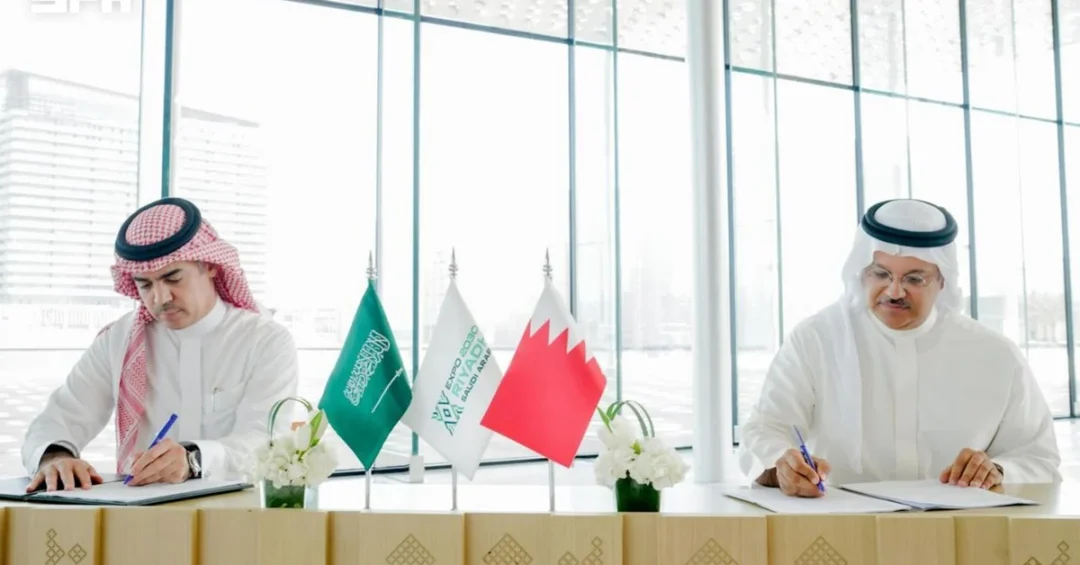
Bahrain has signed its official Participation Contract for Expo 2030 Riyadh, formalizing the Kingdom’s role in the six-month World Expo and advancing preparations for its pavilion, programs, and visitor experiences. The agreement was signed in Manama by Talal Al-Marri, Chief Executive Officer of Expo 2030 Riyadh, and Sheikh Khalifa bin Ahmed Al Khalifa, President of the Bahrain Authority for Culture and Antiquities, according to the Saudi Press Agency. The contract provides the formal framework for Bahrain’s participation and marks a new phase in the run-up to the event, which will be hosted by the Saudi capital from October 1, 2030, to March 31, 2031, under the theme “Foresight for Tomorrow.”
The signing reflects the deepening coordination between two neighboring Gulf states whose ties span culture, commerce, and regional diplomacy. For Expo 2030 Riyadh, the agreement is the latest in a series of formal commitments from participating nations, signaling that the event is moving from the confirmation stage into detailed planning and delivery. For Bahrain, it opens the way for a national presence designed to showcase its identity, achievements, and future aspirations on a global stage. The milestone also underscores the scale of international confidence in Saudi Arabia’s ability to convene the world in 2030, with more than 145 countries already confirmed to take part.
Context and Background
How did Bahrain’s participation reach this point, and why does the timing matter? The Participation Contract represents the formal instrument through which a country moves from expressing intent to participate in a World Expo to organizing the operational, logistical, and programmatic dimensions of its presence. For Bahrain, that transition is now underway. The agreement enables preparations to advance across key organizational and operational aspects, including the development of its pavilion, its programming calendar, and the experiences it will offer visitors throughout the six-month event.
Expo 2030 Riyadh follows the selection of Saudi Arabia as host by the Bureau International des Expositions, the Paris-based intergovernmental organization that governs World Expos. The event’s theme, “Foresight for Tomorrow,” invites participating countries to explore how societies can anticipate and shape the future. Bahrain’s decision to sign its contract early places it among the first nations to formalize participation, following France, which signed its own Participation Contract last month in Paris on the sidelines of the visit of His Royal Highness Prince Mohammed bin Salman bin Abdulaziz Al Saud, Crown Prince and Prime Minister, to France. That sequence illustrates the accelerating diplomatic and organizational momentum behind the Riyadh Expo.
The broader legal and administrative architecture for the event is also taking shape. The recent signing of the SEE Agreement between the Kingdom of Saudi Arabia and the Bureau International des Expositions establishes the framework governing the participation of countries and international organizations. With that foundation in place, bilateral contracts such as Bahrain’s can proceed, converting broad international interest into concrete commitments. More than 145 countries have confirmed their participation, and formal contracts are beginning to follow as preparations advance.
Key Details
What exactly does the agreement cover, and who is responsible for delivering it? The contract was signed in Manama by Talal Al-Marri, Chief Executive Officer of Expo 2030 Riyadh, and Sheikh Khalifa bin Ahmed Al Khalifa, President of the Bahrain Authority for Culture and Antiquities. The agreement provides the formal framework for Bahrain’s participation and covers the organizational and operational aspects of its presence across the full six-month event, including the development of its pavilion, its programs, and its visitor experiences.
Sheikh Khalifa bin Ahmed Al Khalifa described the signing as a reflection of the deep-rooted fraternal and historic ties between the Kingdom of Bahrain and the Kingdom of Saudi Arabia, as well as the growing cooperation between the two countries across a wide range of fields. He added that the signing marks an important milestone in Bahrain’s preparations and reflects the Kingdom’s commitment to playing an active role in the global event. Bahrain, he said, looks forward to presenting a participation that showcases its identity, achievements, and future aspirations while further strengthening its presence on the international stage, delivering a comprehensive national presence that reflects the significance of the event and the global platform it provides for cultural and knowledge exchange and building partnerships.
Al-Marri said the signing marks an important step in the preparations for Expo 2030 Riyadh and reflects the growing momentum as participating countries move from confirming their participation to delivering what they will bring to Riyadh in 2030. He noted that as Participation Contracts are signed, Expo 2030 Riyadh is increasingly taking shape through the pavilions, programs, and experiences that participating countries will bring to visitors. He added that the Expo organization looks forward to working closely with the Bahrain team in the next phase and to seeing a distinctive participation come to life, one that reflects Bahrain’s vision, culture, and ambitions while enriching the overall Expo 2030 Riyadh experience.
Bahrain is also expected to develop a sustainable pavilion designed to remain beyond the six-month event and become part of the Global Village, a key component of Expo 2030 Riyadh’s enduring legacy. That approach mirrors the Expo’s wider ambition to leave a lasting physical and institutional footprint in Riyadh rather than a temporary showcase that is dismantled after closing day.
International and Regional Impact
What does Bahrain’s early commitment signal to the wider international community? The signing adds to a growing list of countries formalizing their participation in Expo 2030 Riyadh, reinforcing the event’s standing as a genuinely global gathering. With more than 145 countries confirmed and contracts now being signed, the Expo is shifting from a diplomatic aspiration into an operational program with pavilions, schedules, and visitor journeys taking shape. Bahrain’s move, coming shortly after France’s contract signing, suggests that momentum is building across different regions and partners.
For the Gulf region, the agreement highlights the close coordination between Saudi Arabia and Bahrain and the broader integration of Gulf economies and cultural institutions. The two kingdoms share deep historical, familial, and economic links, and Expo 2030 Riyadh offers a platform to project that partnership to a global audience. Regional participation also strengthens the Expo’s ability to present a coherent narrative about the Gulf’s role in trade, culture, and innovation. For international audiences, Bahrain’s pavilion will offer a window into a Gulf identity that is both distinctive and closely connected to the region’s wider transformation.
Economic and Strategic Significance
Why does a Participation Contract matter beyond protocol? For host countries and organizers, each signed contract converts interest into deliverable commitments, allowing master planning, space allocation, construction timelines, and programming to proceed with greater certainty. For participating countries, the contract unlocks the practical work of designing a pavilion, budgeting for operations, and preparing cultural and business programming. Bahrain’s early signing gives its teams a longer runway to develop a presence that can serve tourism, trade, and cultural diplomacy objectives.
The strategic significance extends to the Expo’s legacy planning. A sustainable Bahraini pavilion intended to remain after the event and join the Global Village reflects a model in which national participation contributes to a lasting district in Riyadh. That aligns with Saudi Arabia’s broader approach to major events as catalysts for urban development, economic diversification, and international engagement. For Bahrain, a permanent presence in the Global Village offers a long-term platform for cultural and commercial exchange, extending the value of its participation well beyond the six months of the Expo itself.
Vision 2030 Alignment
How does Expo 2030 Riyadh connect to Saudi Arabia’s long-term national strategy? The Expo is a flagship element of the Kingdom’s efforts under Vision 2030 to diversify the economy, expand international partnerships, and position Riyadh as a global hub for business, culture, and innovation. Hosting more than 200 official participants and welcoming an expected 42 million visitors over six months, the event will showcase Saudi capabilities in infrastructure, events, and hospitality while creating opportunities for trade, investment, and knowledge exchange.
The steady progress of preparations, from the SEE Agreement with the Bureau International des Expositions to the signing of national contracts such as Bahrain’s, demonstrates the organizational discipline behind the event. Each new contract brings the Expo closer to its opening on October 1, 2030, and reinforces the Kingdom’s role as a convenor of global dialogue. For Saudi Arabia and its partners, including Bahrain, the coming years of planning will transform the shared ambition of “Foresight for Tomorrow” into pavilions, programs, and experiences that leave a lasting legacy in Riyadh and across the region.
20 Questions
Q1. What did Bahrain sign for Expo 2030 Riyadh?
A1. Bahrain signed its Participation Contract for Expo 2030 Riyadh, the formal agreement that provides the framework for its participation and allows preparations for its pavilion, programs, and visitor experiences to advance.
Q2. Who signed the agreement on behalf of Expo 2030 Riyadh?
A2. Talal Al-Marri, Chief Executive Officer of Expo 2030 Riyadh, signed the agreement on behalf of the Expo organization during a ceremony held in Manama, the capital of Bahrain.
Q3. Who signed on behalf of Bahrain?
A3. Sheikh Khalifa bin Ahmed Al Khalifa, President of the Bahrain Authority for Culture and Antiquities, signed the Participation Contract on behalf of the Kingdom of Bahrain.
Q4. Where was the Participation Contract signed?
A4. The agreement was signed in Manama, Bahrain, according to the Saudi Press Agency, which reported the milestone as part of the growing international momentum behind Expo 2030 Riyadh.
Q5. What does the Participation Contract enable Bahrain to do?
A5. It enables Bahrain to advance preparations across key organizational and operational aspects of its presence, including developing its national pavilion, planning its programs, and designing visitor experiences for the six-month event.
Q6. When will Expo 2030 Riyadh take place?
A6. Expo 2030 Riyadh will run from October 1, 2030, to March 31, 2031, a six-month period during which participating countries will present their pavilions, cultural programming, and innovations to a global audience.
Q7. What is the theme of Expo 2030 Riyadh?
A7. The theme is “Foresight for Tomorrow,” inviting participating nations and visitors to explore how societies can anticipate future challenges and opportunities through innovation, culture, and international collaboration.
Q8. How many countries have confirmed participation in Expo 2030 Riyadh?
A8. More than 145 countries have confirmed their participation in Expo 2030 Riyadh, with formal Participation Contracts beginning to follow as preparations for the event continue to advance across multiple areas.
Q9. What did Sheikh Khalifa bin Ahmed Al Khalifa say about the signing?
A9. He said Bahrain’s participation reflects the deep-rooted fraternal and historic ties between Bahrain and Saudi Arabia, and marks an important milestone in Bahrain’s preparations for the global event.
Q10. What did Talal Al-Marri say about the agreement?
A10. Al-Marri said the signing marks an important step and reflects growing momentum as countries move from confirming participation to delivering what they will bring to Riyadh in 2030.
Q11. Which country signed its Participation Contract before Bahrain?
A11. France signed its Participation Contract last month in Paris, on the sidelines of the visit of His Royal Highness Prince Mohammed bin Salman bin Abdulaziz Al Saud, Crown Prince and Prime Minister, to France.
Q12. What is the SEE Agreement and why is it relevant?
A12. The SEE Agreement between Saudi Arabia and the Bureau International des Expositions establishes the legal and administrative framework governing the participation of countries and international organizations in Expo 2030 Riyadh.
Q13. What kind of pavilion is Bahrain expected to develop?
A13. Bahrain is expected to develop a sustainable pavilion designed to remain beyond the six-month event and become part of the Global Village, a key component of Expo 2030 Riyadh’s enduring legacy.
Q14. What is the Global Village at Expo 2030 Riyadh?
A14. The Global Village is a planned component of Expo 2030 Riyadh’s legacy, where sustainable national pavilions are expected to remain after the event and continue serving as platforms for cultural and commercial exchange.
Q15. How many official participants is Expo 2030 Riyadh expected to bring together?
A15. Expo 2030 Riyadh is expected to bring together more than 200 official participants, including countries and international organizations, reflecting the broad international interest in the event.
Q16. How many visitors is Expo 2030 Riyadh expected to welcome?
A16. The six-month event is expected to welcome 42 million visitors, who will experience national pavilions, cultural programming, innovation displays, and immersive experiences across the Expo site in Riyadh.
Q17. What stage does Bahrain’s participation move into after signing?
A17. The signing moves Bahrain’s participation from the confirmation and preparation stage into planning and implementation, allowing detailed work on its pavilion, programs, and visitor experiences to proceed.
Q18. Why is Bahrain’s early signing significant for Expo preparations?
A18. It adds to the growing list of formal commitments, helping organizers finalize master planning, space allocation, construction timelines, and programming with greater certainty as the event approaches its 2030 opening.
Q19. How does Expo 2030 Riyadh support Saudi Vision 2030?
A19. The Expo supports Vision 2030 by diversifying the economy, expanding international partnerships, and positioning Riyadh as a global hub for business, culture, innovation, and knowledge exchange.
Q20. What legacy is Expo 2030 Riyadh expected to leave?
A20. The Expo is expected to leave a lasting legacy through sustainable pavilions such as Bahrain’s, which will remain in the Global Village, along with new infrastructure, partnerships, and global recognition for Riyadh.
Reader Feedback
We value your thoughts. Please share your feedback on this article.
Your feedback helps us improve our coverage.
Related articles
 Saudi FM Meets Seychelles VP to Boost Ties
 Saudi Crown Prince Congratulates Estonia’s New President
 King Salman Congratulates Estonia’s President-elect Madise
 Saudi Arabia Leads Gulf Food Security at GCC Meeting
 Crown Prince, Egypt President Discuss Regional Security
 CST Grants CSP License to NWC at LEAP 2026, Unlocking SAR455M