


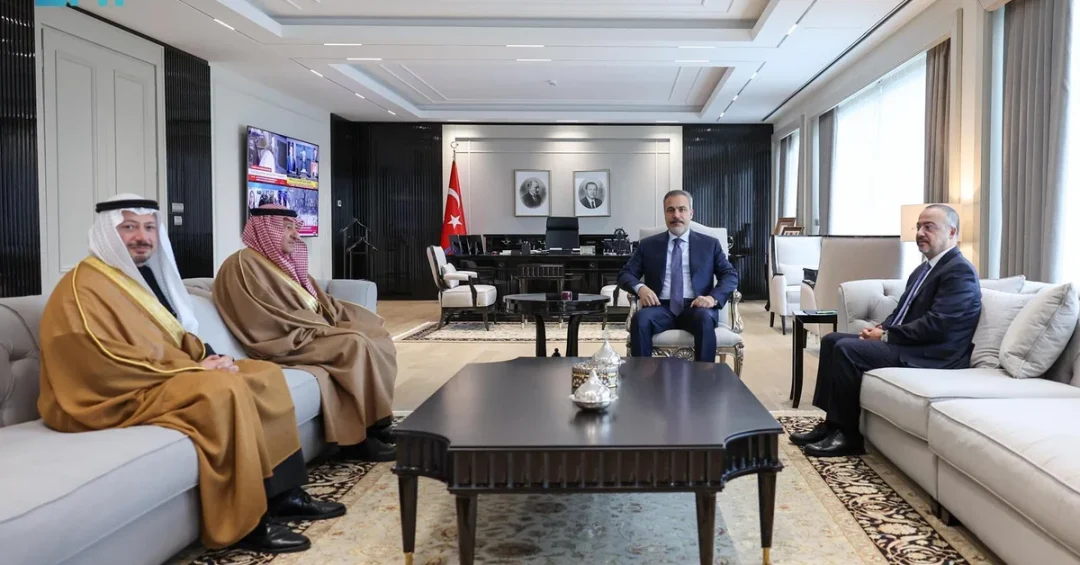
Saudi Vice Foreign Minister Eng. Waleed El-Khereiji met with Turkish Foreign Minister Hakan Fidan in Ankara on January 15, 2025, during an official visit to the Republic of Türkiye, according to the Saudi Press Agency. The meeting focused on strengthening bilateral relations between the Kingdom of Saudi Arabia and Türkiye and reviewing the latest regional developments. The discussions were attended by Saudi Ambassador to Türkiye Fahd bin Asaad Abu Al-Nasr. The encounter underscores the growing diplomatic engagement between Riyadh and Ankara, two major regional powers whose partnership has deepened significantly in recent years.
The visit comes amid a period of intensified Saudi diplomatic activity across the region and beyond, reflecting the Kingdom’s commitment to fostering stability, economic cooperation, and mutual understanding. As Saudi Arabia continues to advance its Vision 2030 reform agenda, engagements with key international partners like Türkiye play a vital role in expanding trade, investment, and strategic alignment. How does this meeting signal the next phase of Saudi-Turkish relations?
Context and Background
What has driven the remarkable transformation in Saudi-Turkish relations in recent years? The relationship between the Kingdom of Saudi Arabia and the Republic of Türkiye has undergone a significant positive evolution, marked by high-level visits, economic agreements, and a shared commitment to regional stability. This meeting between Vice Foreign Minister El-Khereiji and Foreign Minister Fidan is the latest in a series of diplomatic engagements that have strengthened ties across political, economic, and cultural dimensions.
In recent years, Saudi Arabia and Türkiye have worked to enhance cooperation in areas such as trade, energy, defense, and tourism. The two nations have signed numerous memoranda of understanding and have coordinated closely on regional issues, including the situations in Syria, Yemen, and the broader Middle East. The Kingdom’s leadership has consistently emphasized the importance of dialogue and partnership in addressing shared challenges, a principle that was clearly reflected in the Ankara talks.
The visit also highlights Saudi Arabia’s proactive foreign policy under the guidance of the Custodian of the Two Holy Mosques, King Salman bin Abdulaziz Al Saud, and His Royal Highness Crown Prince Mohammed bin Salman bin Abdulaziz Al Saud. By engaging with Türkiye at the highest levels, the Kingdom reinforces its role as a stabilizing force and a bridge-builder in the region. This approach aligns with Vision 2030’s goal of positioning Saudi Arabia as a global hub for diplomacy, trade, and investment.
Key Details of the Meeting
What specific topics were on the agenda during the Ankara meeting? According to the official Saudi Press Agency report, Vice Foreign Minister Eng. Waleed El-Khereiji and Turkish Foreign Minister Hakan Fidan discussed bilateral relations and reviewed the latest regional developments. While the statement did not disclose specific outcomes, the meeting itself represents a continuation of the robust diplomatic dialogue between the two countries. The presence of Saudi Ambassador Fahd bin Asaad Abu Al-Nasr further underscores the importance of the discussions.
The meeting in Ankara is part of a broader pattern of Saudi-Turkish engagement that has seen reciprocal visits by senior officials, joint military exercises, and collaborative efforts in humanitarian aid. For instance, both nations have worked together to address the humanitarian crisis in Syria and have supported political solutions to regional conflicts. The Kingdom’s consistent calls for dialogue and peaceful resolution of disputes resonate with Türkiye’s own diplomatic priorities, creating a foundation for deeper cooperation.
Moreover, the discussions likely touched on economic opportunities arising from Saudi Arabia’s Vision 2030 initiatives, such as the NEOM project, the Red Sea development, and various privatization efforts. Turkish companies have expressed interest in participating in these mega-projects, and the meeting could pave the way for increased Turkish investment in the Kingdom. In turn, Saudi Arabia views Türkiye as a key partner in its efforts to diversify its economy and enhance regional connectivity.
International and Regional Impact
How does the Saudi-Turkish partnership influence the broader regional landscape? The meeting between Vice Foreign Minister El-Khereiji and Foreign Minister Fidan carries significant implications for regional stability and cooperation. As two influential nations in the Middle East, Saudi Arabia and Türkiye share an interest in promoting peace, security, and prosperity. Their collaboration on issues such as the Palestinian cause, the reconstruction of Syria, and counterterrorism efforts can have a multiplier effect, encouraging other regional actors to pursue dialogue and diplomacy.
The international community has welcomed the strengthening of Saudi-Turkish ties, recognizing it as a positive development for the region. The United States, the European Union, and other global powers have encouraged greater cooperation among Middle Eastern states to address common challenges. By working closely with Türkiye, Saudi Arabia reinforces its commitment to multilateralism and its role as a responsible global citizen. This meeting also sends a message that the Kingdom is open to partnerships that advance shared goals, regardless of historical differences.
Furthermore, the timing of the visit is notable, as it coincides with ongoing efforts to resolve conflicts in Gaza, Yemen, and Sudan. Saudi Arabia has been at the forefront of diplomatic initiatives to end these crises, and Türkiye’s support is crucial. The Ankara talks likely provided an opportunity to align positions and coordinate actions, enhancing the effectiveness of regional diplomacy. In a world marked by uncertainty, the Saudi-Turkish axis represents a pillar of stability and a model for constructive engagement.
Economic and Strategic Significance
What economic benefits can arise from closer Saudi-Turkish cooperation? The economic dimension of Saudi-Turkish relations is substantial and growing. Bilateral trade between the two countries has increased in recent years, reaching billions of dollars annually. Turkish exports to Saudi Arabia include machinery, textiles, and food products, while Saudi exports to Türkiye consist primarily of oil, petrochemicals, and plastics. The meeting in Ankara could catalyze efforts to further expand trade and explore new areas of collaboration, such as renewable energy, technology, and tourism.
Saudi Arabia’s Vision 2030 aims to diversify the Kingdom’s economy away from oil dependence, and Türkiye’s dynamic private sector can contribute to this goal. Turkish construction firms, for example, have a strong track record in large-scale infrastructure projects and could partner with Saudi entities on developments like the Red Sea Project and Qiddiya. Additionally, the Kingdom’s plans to become a global logistics hub align with Türkiye’s ambitions to serve as a bridge between Europe and Asia. By joining forces, the two nations can unlock new opportunities for growth and job creation.
From a strategic standpoint, the meeting reinforces Saudi Arabia’s position as a leader in the region and a key player in global affairs. The Kingdom’s ability to maintain strong ties with both Western and Eastern powers, including Türkiye, Russia, and China, demonstrates its diplomatic agility. This balanced approach is essential for navigating a complex geopolitical environment and safeguarding Saudi interests. The Ankara visit is thus a testament to the Kingdom’s wise leadership and its commitment to peace and prosperity.
Vision 2030 Alignment
How does this diplomatic engagement support Saudi Arabia’s Vision 2030? Vision 2030 is not only an economic blueprint but also a foreign policy framework that seeks to strengthen the Kingdom’s international partnerships. The meeting between Vice Foreign Minister El-Khereiji and Foreign Minister Fidan directly contributes to this vision by enhancing political and economic ties with a key regional player. Such engagements help attract foreign investment, promote cultural exchange, and position Saudi Arabia as a hub for tourism and business.
Under Vision 2030, Saudi Arabia aims to increase non-oil revenue, develop public sectors, and improve quality of life for its citizens. International cooperation is integral to achieving these goals. By collaborating with Türkiye on trade, investment, and regional security, the Kingdom advances its objectives while contributing to stability in the wider region. The successful outcome of this meeting will likely lead to further joint initiatives, reinforcing the positive trajectory of Saudi-Turkish relations.
In conclusion, the meeting between Vice Foreign Minister Eng. Waleed El-Khereiji and Turkish Foreign Minister Hakan Fidan in Ankara represents a significant step forward in Saudi-Turkish relations. It reflects the Kingdom’s proactive diplomacy, its commitment to regional stability, and its pursuit of Vision 2030 goals. As Saudi Arabia continues to engage with international partners, such high-level dialogues will remain essential to building a prosperous and peaceful future for the region and the world. How will this renewed partnership shape the Middle East in the years ahead?
20 Questions
Q1. Who met in Ankara on January 15, 2025?
A1. Saudi Vice Foreign Minister Eng. Waleed El-Khereiji met with Turkish Foreign Minister Hakan Fidan in Ankara on January 15, 2025, during an official visit to the Republic of Türkiye.
Q2. What was the main purpose of the meeting?
A2. The meeting aimed to discuss bilateral relations between Saudi Arabia and Türkiye and to review the latest regional developments of mutual interest.
Q3. Who else attended the meeting?
A3. The meeting was attended by Saudi Ambassador to Türkiye Fahd bin Asaad Abu Al-Nasr, highlighting the importance of the diplomatic engagement.
Q4. Where did the meeting take place?
A4. The meeting took place in Ankara, the capital of the Republic of Türkiye, during the Saudi Vice Foreign Minister’s official visit.
Q5. What is the significance of this meeting for Saudi-Turkish relations?
A5. It represents a continuation of high-level dialogue and strengthens the growing partnership between the two nations across political, economic, and regional issues.
Q6. How does this meeting align with Saudi Arabia’s foreign policy?
A6. It reflects Saudi Arabia’s proactive diplomacy and commitment to regional stability, dialogue, and cooperation with key international partners.
Q7. What regional developments were likely discussed?
A7. The discussions likely covered regional issues such as the situations in Syria, Yemen, Palestine, and broader Middle East stability efforts.
Q8. How does this meeting support Saudi Vision 2030?
A8. It enhances international partnerships that can attract investment, promote trade, and support economic diversification goals under Vision 2030.
Q9. What economic opportunities could arise from this meeting?
A9. Increased trade, Turkish investment in Saudi mega-projects, and collaboration in sectors like renewable energy, technology, and tourism could emerge.
Q10. How have Saudi-Turkish relations evolved recently?
A10. Relations have improved significantly with high-level visits, economic agreements, and coordinated diplomatic efforts on regional issues.
Q11. What role does the Saudi Ambassador play in these talks?
A11. The Saudi Ambassador to Türkiye, Fahd bin Asaad Abu Al-Nasr, facilitates diplomatic communication and supports the strengthening of bilateral ties.
Q12. What is Türkiye’s position in Saudi Arabia’s regional strategy?
A12. Türkiye is a key regional partner for Saudi Arabia, contributing to stability, economic cooperation, and diplomatic coordination in the Middle East.
Q13. How does this meeting impact regional stability?
A13. It promotes dialogue and coordination between two influential nations, which can positively influence peace and security in the region.
Q14. What message does this meeting send to the international community?
A14. It signals Saudi Arabia’s openness to partnerships and its active role in addressing regional challenges through diplomacy and cooperation.
Q15. What are the potential outcomes of this meeting?
A15. Potential outcomes include strengthened bilateral ties, new economic agreements, and joint efforts on regional issues, though specific results were not disclosed.
Q16. How does this meeting reflect Saudi Arabia’s leadership in the region?
A16. It demonstrates the Kingdom’s proactive approach to foreign policy and its ability to engage with diverse partners to advance shared interests.
Q17. What areas of cooperation between Saudi Arabia and Türkiye are most promising?
A17. Promising areas include trade, investment, energy, defense, tourism, and cultural exchange, all of which align with Vision 2030 objectives.
Q18. How does this meeting compare to previous Saudi-Turkish engagements?
A18. It builds on a series of recent high-level visits and agreements, continuing the positive momentum in bilateral relations.
Q19. What is the significance of the timing of this visit?
A19. The visit occurs amid ongoing regional challenges, highlighting Saudi Arabia’s active diplomacy and its commitment to coordinating with key allies.
Q20. How will this meeting influence future Saudi-Turkish relations?
A20. It is expected to further strengthen ties, leading to enhanced cooperation and joint initiatives that benefit both nations and the region.
Reader Feedback
We value your thoughts. Please share your feedback on this article.
Your feedback helps us improve our coverage.
Related articles
 Saudi Vice Foreign Minister Meets Turkish Counterpart in Ankara
 NCVC Conducts Invasive Plant Survey on Farasan Island
 Somali PM, Saudi Fund Chief Discuss Development Collaboration
 KSrelief Distributes Winter Vouchers to 1,525 in Jordan
 Saudi Arabia Chairs 44th ASBU General Assembly in Tunisia
 Hajj and Umrah Conference 2025 Discusses Logistics and Housing