


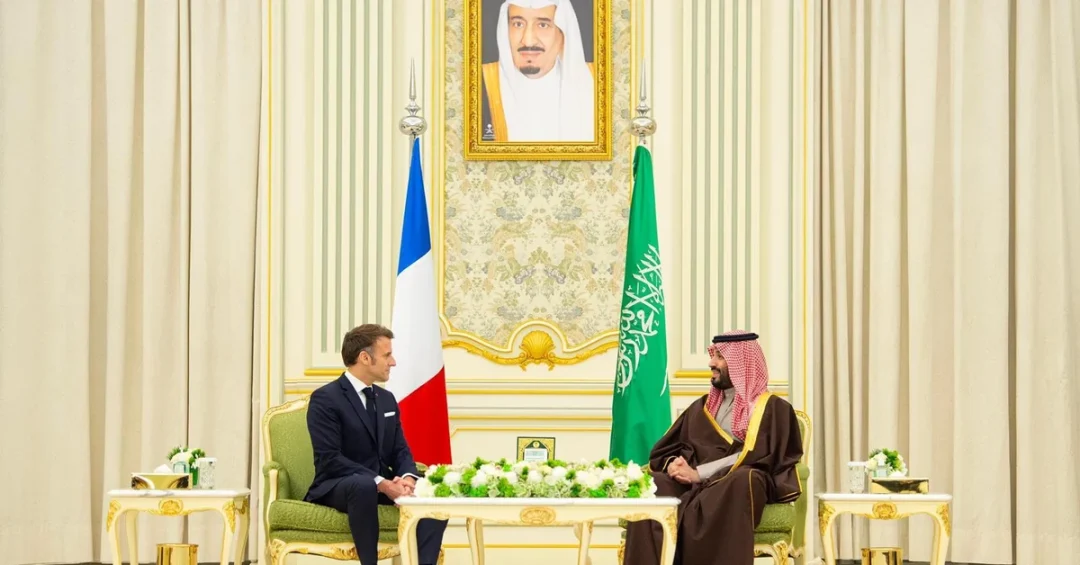
Saudi Arabia and France have praised the strength of their economic relations and committed to deepening cooperation across energy, industry, mining, agriculture, health, biotechnology, communications, artificial intelligence, quantum technologies, space, and smart and sustainable cities, according to a joint statement issued through official Saudi channels following the state visit of French President Emmanuel Macron to the Kingdom from 2 to 4 December 2024. The visit, hosted at the invitation of the Custodian of the Two Holy Mosques, King Salman bin Abdulaziz Al Saud, culminated in the announcement of a strategic partnership roadmap and the signing of a Memorandum of Understanding to establish a Strategic Partnership Council, co-chaired by the two leaders, which will serve as the comprehensive framework for developing and deepening Saudi-French relations over the next decade.
The joint statement, released via the Saudi Press Agency, reflects a shared determination to move the bilateral relationship to a new level, building on the positive results of earlier high-level exchanges, including Crown Prince and Prime Minister His Royal Highness Prince Mohammed bin Salman bin Abdulaziz Al Saud’s visits to France in July 2022 and June 2023, and President Macron’s visit to the Kingdom in December 2021. With more than 800 participants from major Saudi and French companies gathering at the Saudi-French Investment Forum held during the visit, the momentum behind this partnership is both substantial and concrete. But what does this upgraded relationship mean for the two countries, and why does it matter now?
Context and Background
The Saudi-French relationship rests on decades of diplomatic, commercial, and cultural engagement, but the December 2024 state visit marked a deliberate step-change in ambition. During an official discussion session at Al-Yamamah Palace in Riyadh, the two sides reviewed their historical and strategic ties and agreed that the bilateral relationship should serve three main objectives: each country’s human, social, economic, technological, and cultural development, as well as each country’s security and defence; regional and international security and stability as a condition for prosperity in the Middle East and Europe; and addressing global challenges, first and foremost the fight against climate change, global health issues, biodiversity preservation, and global access to clean water. How often does a bilateral relationship get reframed around such a comprehensive and forward-looking set of shared goals?
The timing is significant. Saudi Arabia is accelerating the economic transformation set out in Vision 2030, the national roadmap championed by His Royal Highness Prince Mohammed bin Salman bin Abdulaziz Al Saud to diversify the Kingdom’s economy away from oil dependence and build new high-value sectors. France, for its part, brings world-class expertise in energy, aerospace, transport, luxury, culture, and advanced technology. The two economies are complementary in ways that few others are, and the new Strategic Partnership Council is designed to convert that complementarity into tangible projects, investment flows, and jobs. The joint statement also welcomed the announcement of the strategic partnership roadmap, which will guide cooperation for the next decade across many strategic and promising sectors relevant to both countries.
Another important backdrop is the recognition both sides gave to the dynamism of economic relations in various fields and the level of trade between them. Rather than resting on past achievements, the statement stressed the importance of enhancing efforts to develop and diversify the base of economic and investment cooperation. That language signals a shared understanding that the relationship must keep evolving, especially as global supply chains shift, energy transitions accelerate, and new technologies reshape entire industries. Isn’t it telling that both governments chose to emphasize diversification rather than simply celebrating existing trade volumes?
Key Details
The most concrete institutional outcome of the visit was the signing of a Memorandum of Understanding to form the Strategic Partnership Council, co-chaired by the two leaders. This council will act as the comprehensive framework for further development and deepening of Saudi-French relations in many strategic and promising sectors. Alongside it, the two sides welcomed the announcement of the strategic partnership roadmap, which sets out the direction of cooperation over the coming decade. The joint statement also noted that President Macron congratulated His Royal Highness the Crown Prince on the organization of Expo 2030 in Riyadh, and that both sides explored avenues of cooperation based on French expertise in hosting international events.
Economically, the visit produced immediate results. The Saudi-French Investment Forum, co-chaired by Minister of Investment Khaled Al Faleh and French Minister Delegate for Industry Marc Ferracci, brought together more than 800 participants from major Saudi and French companies and led to the signing of several contracts, agreements, and MoUs. The two sides highlighted the need to increase mutual investments in each country’s productive sectors, including renewable energy, infrastructure, financial services, information technology, chemicals, transportation, aviation, advanced and manufacturing industries, food industry, education, entrepreneurship, tourism, and culture. They also stressed the importance of increasing the pace of investment integration and continuing intensive efforts to enhance the investment environment for the private sector.
In the energy domain, the two sides commended the depth of their cooperation and emphasized the importance of enhancing it under the Memorandum of Understanding on Energy signed in February 2023, covering renewable energy sources and the peaceful uses of nuclear energy. The French President commended the Kingdom’s role in shaping the future of energy and stressed the willingness of French firms to further support the Kingdom’s decarbonization ambitions through renewable energy and hydrogen development, as well as civil nuclear energy under the intergovernmental agreement signed in 2011. Both sides agreed on the importance of cooperation in developing hydrogen projects, transporting and exporting them to demand centers in Europe and the world, and developing hydrogen use in industry and transportation. They also emphasized exploring joint cooperation to ensure the sustainability of supply chains, secure raw materials and strategic minerals for energy transition industries, and collaborate on innovation, including the application of emerging technologies such as artificial intelligence in the energy sector.
International and Regional Impact
The upgraded Saudi-French partnership carries implications that extend well beyond the two capitals. By explicitly linking their bilateral relationship to regional and international security and stability, the two countries have signaled that their cooperation is intended to contribute to a more stable Middle East and Europe. The joint statement frames security and stability as one of the main conditions for maintaining and increasing economic and social prosperity in both regions. That is a notable diplomatic framing: it positions Saudi Arabia and France as partners not only in trade and investment but also in the broader architecture of regional order and global problem-solving.
On global challenges, the two sides stressed the centrality of the UN Framework Convention on Climate Change and the Paris Agreement, and they identified climate change, global health, biodiversity preservation, and access to clean water as priority areas. They also discussed the upcoming AI Action Summit to be hosted in France on 10 and 11 February 2025, and welcomed concrete steps to pave the way for investments in artificial intelligence. Taken together, these commitments suggest that Saudi-French cooperation will increasingly be felt in multilateral forums and global initiatives, not just in bilateral boardrooms. Could this model of cross-regional partnership become a template for how middle powers and major European economies work together in the coming decade?
Economic and Strategic Significance
The economic logic behind the enhanced partnership is compelling. Saudi Arabia offers one of the world’s largest and most ambitious transformation programs in Vision 2030, with major projects in renewable energy, smart and sustainable cities, tourism, culture, and advanced manufacturing. France offers leading companies, technical expertise, and a strong track record in sectors ranging from nuclear energy and aerospace to luxury goods and cultural institutions. The joint statement’s list of targeted sectors, including renewable energy, infrastructure, financial services, information technology, chemicals, transportation, aviation, advanced and manufacturing industries, food industry, education, entrepreneurship, tourism, and culture, reads like a roadmap of where the two economies can create the most value together.
For the private sector, the message is clear: the investment environment is being actively improved, and both governments want to increase the pace of investment integration. The Saudi-French Investment Forum’s 800-plus participants and the contracts and MoUs signed during the visit demonstrate that businesses on both sides are already responding. The two sides also expressed their aspiration to organize more joint events that contribute to mutual benefit, which should sustain the momentum. In strategic terms, cooperation on supply chains, critical minerals, and energy transition industries is particularly significant, as it addresses some of the most pressing vulnerabilities in the global economy while creating new industrial opportunities in the Kingdom.
Vision 2030 Alignment
The outcomes of the visit align closely with the goals of Saudi Vision 2030. The emphasis on diversifying the economic and investment cooperation base, increasing mutual investments in productive sectors, and enhancing the private sector’s role all reflect the Vision’s core objective of building a diversified, sustainable, and globally integrated economy. Cooperation in renewable energy, hydrogen, artificial intelligence, quantum technologies, space, and smart and sustainable cities directly supports the Vision’s focus on future-oriented industries and innovation. The cultural dimension, including the Villa Hegra project in AlUla, which was officially established during President Macron’s visit to AlUla, and the announcement of the French Institute in Saudi Arabia set to open in early 2025, reinforces the Vision’s commitment to cultural exchange and quality of life.
Looking ahead, the Strategic Partnership Council and the strategic partnership roadmap provide the institutional machinery to turn these ambitions into results over the next decade. From energy and industry to education, health, biotechnology, and communications, the two countries have laid out a comprehensive agenda that serves both national development and global stability. As Saudi Arabia continues its transformation under the leadership of the Custodian of the Two Holy Mosques, King Salman bin Abdulaziz Al Saud, and His Royal Highness Prince Mohammed bin Salman bin Abdulaziz Al Saud, partnerships like this one with France will remain central to the Kingdom’s global engagement. Isn’t that precisely the kind of long-term, mutually beneficial cooperation that Vision 2030 was designed to attract?
20 Questions
Q1. When did French President Emmanuel Macron pay a state visit to Saudi Arabia?
A1. President Macron paid a state visit to the Kingdom of Saudi Arabia on 2, 3 and 4 December 2024, at the kind invitation of the Custodian of the Two Holy Mosques, King Salman bin Abdulaziz Al Saud, according to the joint statement.
Q2. Who received President Macron in Riyadh?
A2. His Royal Highness Prince Mohammed bin Salman bin Abdulaziz Al Saud, Crown Prince and Prime Minister, received President Macron at Al-Yamamah Palace in Riyadh, where greetings from the Custodian of the Two Holy Mosques were conveyed.
Q3. What major institutional outcome came from the visit?
A3. The two sides announced a strategic partnership roadmap and signed a Memorandum of Understanding to form a Strategic Partnership Council, co-chaired by the two leaders, serving as a comprehensive framework for deepening relations over the next decade.
Q4. What three main objectives will the bilateral relationship serve?
A4. The objectives are each country’s human, social, economic, technological and cultural development, as well as security and defence; regional and international security and stability; and addressing global challenges such as climate change, global health, biodiversity and clean water access.
Q5. What did the two sides say about economic relations and trade?
A5. They commended the dynamism of economic relations between the two friendly countries in various fields and the level of trade between them, and stressed the importance of enhancing efforts to develop and diversify the base of economic and investment cooperation.
Q6. Which sectors did both sides explore for cooperation?
A6. They explored cooperation in communications and information technology, artificial intelligence, quantum technologies, space, health, healthcare, agriculture, industry, mining, smart and sustainable cities, tourism, energy and transportation, among others.
Q7. What was the Saudi-French Investment Forum and who co-chaired it?
A7. The forum was held during President Macron’s visit and was co-chaired by Minister of Investment Khaled Al Faleh and French Minister Delegate for Industry Marc Ferracci, bringing together more than 800 participants from major Saudi and French companies.
Q8. What did the investment forum achieve?
A8. The forum led to the signing of several contracts, agreements, and MoUs, and the two sides expressed their aspiration to organize more joint events that contribute to achieving mutual benefit for the two countries.
Q9. What did the two sides say about energy cooperation?
A9. They commended the depth of their energy cooperation and stressed enhancing it in various fields, including renewable energy sources, in accordance with the Memorandum of Understanding on Energy signed in February 2023, as well as peaceful uses of nuclear energy.
Q10. How did President Macron describe Saudi Arabia’s energy role?
A10. The French President commended the Kingdom’s role in shaping the future of energy and stressed the willingness of French firms to further support the Kingdom’s decarbonization ambitions through renewable energy, hydrogen development, and civil nuclear energy.
Q11. What did the two sides agree regarding hydrogen?
A11. They agreed on the importance of cooperation in developing hydrogen projects, transporting and exporting them to demand centers in Europe and the world, and developing its use in industry, transportation and other fields.
Q12. What did the two sides say about supply chains and critical minerals?
A12. They emphasized exploring joint cooperation to ensure the sustainability of supply chains, secure raw materials and strategic minerals in energy transition industries, and enhance access to them to ensure the sustainability of global energy supplies.
Q13. What cultural cooperation highlights were noted in the joint statement?
A13. The two sides praised cultural cooperation, the ongoing partnership and initiatives in AlUla, and the progress of the Villa Hegra project, a landmark Saudi-French cultural institution officially established during President Macron’s visit to AlUla.
Q14. What did President Macron announce regarding cultural institutions?
A14. During the state visit, President Macron announced the establishment of the French Institute in Saudi Arabia at the beginning of 2025, reflecting the shared commitment to strengthening cultural ties between the two countries.
Q15. What agreements were signed in the cultural field?
A15. Several agreements were signed to foster collaboration across key cultural sectors, including heritage, archaeology, fashion, visual arts, photography, museums, film, and libraries, according to the joint statement.
Q16. What did the two sides say about science, research and education?
A16. They reaffirmed their commitment to strengthen collaboration in education, research and innovation, commending joint initiatives for partnerships between higher education and medical training institutions, faculty exchange programs, and scholarship opportunities.
Q17. What did the two sides discuss regarding artificial intelligence?
A17. They emphasized the need to bolster cooperation in artificial intelligence to advance a more open, trustworthy, and sustainable AI, and discussed the upcoming AI Action Summit hosted in France on 10 and 11 February 2025.
Q18. What global issues did the two sides prioritize?
A18. They stressed the centrality of the UN Framework Convention on Climate Change and the Paris Agreement, and prioritized climate change, global health issues, biodiversity preservation, and global access to clean water as key areas of cooperation.
Q19. What did President Macron congratulate Saudi Arabia on?
A19. President Macron congratulated His Royal Highness Prince Mohammed bin Salman bin Abdulaziz Al Saud, Crown Prince and Prime Minister, on the organization of Expo 2030 in Riyadh, and both sides explored cooperation based on French expertise in hosting international events.
Q20. How does this partnership align with Saudi Vision 2030?
A20. The partnership supports Vision 2030’s goals of economic diversification, investment in future-oriented sectors such as renewable energy and AI, private sector growth, and cultural exchange, reinforcing the Kingdom’s global engagement and sustainable development path.
Reader Feedback
We value your thoughts. Please share your feedback on this article.
Your feedback helps us improve our coverage.
Related articles
 Digital Resilience Key to Sovereignty, Says DCO Chief
 Saudi Minister Meets Slovenia’s Economy, Tourism Minister
 GCC Chief Meets UN-Habitat Deputy at Doha Forum
 Prince Turki bin Mohammed bin Fahd Receives Japanese Ambassador
 Saudi Reserve Launches First Marine Patrol Boats
 COP16 People’s Day: Indigenous, Youth Rally Against Land Degradation