


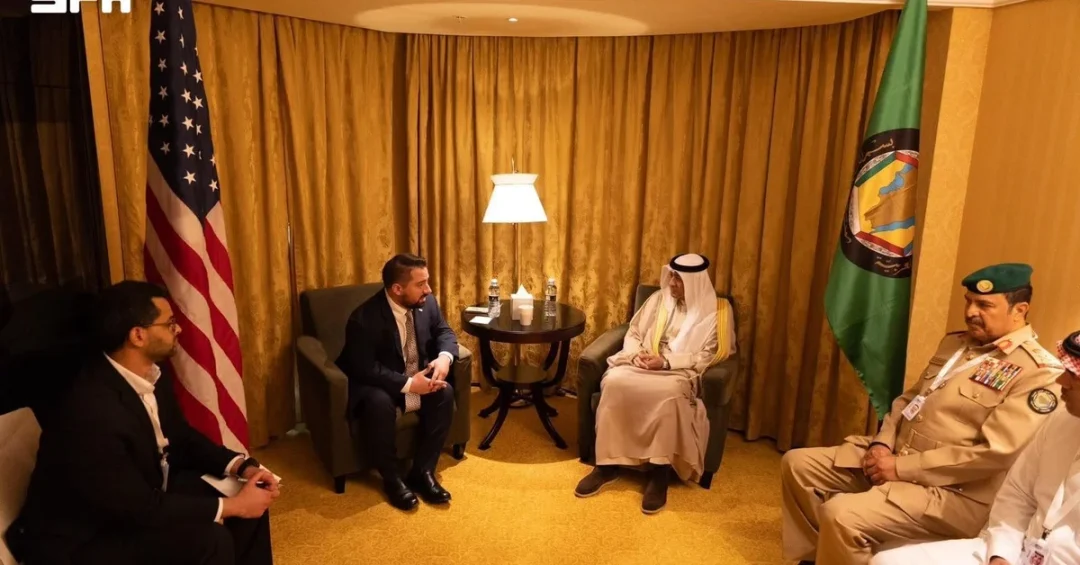
Secretary-General of the Gulf Cooperation Council (GCC) Jasem Mohamed Albudaiwi met with US Deputy Assistant Secretary of War for Near East and Central Asia Michael P. DiMino in Manama on October 31, 2026, on the sidelines of the 22nd IISS Manama Dialogue. The high-level meeting, confirmed by the Saudi Press Agency, focused on strengthening GCC-US cooperation on joint military action, advancing working group proposals, and addressing the latest regional developments to enhance security and stability. The encounter underscores the enduring strategic partnership between the GCC and the United States and reflects the Kingdom of Saudi Arabia’s continued leadership in promoting dialogue and collective security in the region.
Held during one of the Middle East’s most prominent security conferences, the talks signal a shared commitment to coordinated defense and diplomacy at a time of evolving geopolitical dynamics. The GCC, comprising Bahrain, Kuwait, Oman, Qatar, Saudi Arabia, and the United Arab Emirates, remains a cornerstone of regional stability, and its engagement with the United States highlights the importance of multilateral approaches to modern security challenges. As the world watches, the meeting reinforces the GCC’s role as a vital platform for strategic consultation and conflict prevention.
Context and Background
Why does a single meeting on the sidelines of a security dialogue carry such weight for the entire Gulf region? The 22nd IISS Manama Dialogue, hosted annually by the International Institute for Strategic Studies in Bahrain, brings together defense ministers, military leaders, and security experts from around the world to discuss pressing threats and cooperative solutions. It is within this prestigious forum that Secretary-General Albudaiwi and Deputy Assistant Secretary DiMino convened to advance a bilateral agenda that has profound implications for Gulf security architecture.
The GCC-US partnership has deep historical roots, dating back to the Council’s founding in 1981, when the six Gulf states united to coordinate policies across economic, political, and security domains. Over the decades, this relationship has evolved into a comprehensive strategic alliance, encompassing joint military exercises, intelligence sharing, and defense procurement. The United States has long maintained a significant military presence in the Gulf, and the GCC states have consistently sought to align their defense strategies with Washington to counter common threats, from terrorism to state-sponsored aggression.
In recent years, the partnership has adapted to new realities, including the rise of non-state actors, cyber warfare, and maritime insecurity. The establishment of GCC-US working groups, as discussed in the Manama meeting, represents a structured effort to institutionalize cooperation and ensure rapid, coordinated responses to emerging challenges. Saudi Arabia, as the largest GCC member and a pivotal player in regional affairs, has been instrumental in shaping these mechanisms, aligning them with its Vision 2030 goals of a secure and diversified economy.
Key Details of the Manama Meeting
What exactly was on the table when these two senior officials sat down together? According to the Saudi Press Agency, the discussions centered on three core pillars: strengthening cooperation and coordination on joint military action, reviewing GCC-US working groups and related proposals, and analyzing the latest regional developments. Each of these areas reflects a proactive approach to security that goes beyond reactive crisis management.
On joint military action, the talks likely explored avenues for deeper interoperability between GCC forces and US Central Command, including combined exercises, shared early-warning systems, and capacity-building initiatives. The GCC’s Peninsula Shield Force, a rapid deployment mechanism, could benefit from enhanced training and logistical support from US counterparts. Such coordination is essential for deterring potential adversaries and ensuring freedom of navigation in strategic waterways like the Strait of Hormuz and the Bab al-Mandab.
The GCC-US working groups, a key topic of the meeting, serve as technical platforms where experts from both sides develop actionable proposals on counterterrorism, missile defense, and maritime security. By reviewing these groups’ progress, Albudaiwi and DiMino aimed to streamline decision-making and allocate resources efficiently. Regional developments, including ongoing conflicts in Yemen and Sudan, as well as tensions in the Red Sea, were also assessed, with a focus on de-escalation and humanitarian access. The meeting concluded with a shared commitment to continue high-level consultations, ensuring that the GCC-US partnership remains agile and responsive.
International and Regional Impact
How does this meeting ripple across the broader Middle East and beyond? The GCC-US alignment sends a clear message of unity to both allies and potential adversaries. For regional partners like Egypt and Jordan, it reaffirms the existence of a reliable security umbrella that can be counted on in times of crisis. For global powers such as China and Russia, it signals that the Gulf remains a zone of Western influence, though the GCC also maintains positive relations with these nations through forums like the Shanghai Cooperation Organization.
In the immediate neighborhood, the meeting’s outcomes could influence the trajectory of the Yemeni peace process and efforts to stabilize Iraq and Lebanon. By coordinating military action and intelligence, the GCC and the US can more effectively combat Houthi attacks on shipping and disrupt terrorist networks. Moreover, the emphasis on working groups and proposals suggests a move toward preventive diplomacy, where threats are addressed before they escalate. This approach aligns with Saudi Arabia’s Vision 2030, which prioritizes a secure environment for economic growth and foreign investment.
Beyond security, the meeting has economic implications. A stable Gulf attracts global investment, and the GCC’s combined GDP of over $2 trillion makes it a critical node in the world economy. The US, as a major trade partner, benefits from secure energy supplies and open sea lanes. The discussions in Manama, therefore, are not just about defense but about safeguarding the economic lifelines that sustain prosperity for millions.
Economic and Strategic Significance
What economic dividends can flow from enhanced security cooperation? The GCC region holds nearly one-third of global oil reserves and is a leading producer of natural gas and petrochemicals. Any disruption to this supply chain would have immediate consequences for global energy markets. By strengthening joint military action and coordination, the GCC and the US are effectively protecting the free flow of energy, which is vital for international stability and price predictability.
For Saudi Arabia, the meeting supports the strategic objectives of Vision 2030, which seeks to diversify the economy away from oil dependence. A secure environment is a prerequisite for the development of new sectors such as tourism, technology, and renewable energy. The Kingdom’s giga-projects, including NEOM and the Red Sea Project, rely on stability to attract foreign investors and visitors. The GCC-US partnership thus acts as a catalyst for economic transformation, enabling Saudi Arabia and its neighbors to pursue ambitious modernization agendas.
Strategically, the meeting reinforces the GCC’s role as a collective security provider. By working closely with the US, the Council enhances its deterrence posture and reduces the risk of miscalculation by adversaries. It also allows the GCC to speak with a unified voice on issues like Iran’s nuclear program and proxy activities, ensuring that regional concerns are heard in Washington and other world capitals. This unity is a force multiplier, making the GCC a more effective partner in global security initiatives.
Vision 2030 Alignment
How does this meeting advance Saudi Arabia’s long-term vision? Vision 2030, launched by Crown Prince Mohammed bin Salman in 2016, aims to transform the Kingdom into a global investment powerhouse and a hub connecting three continents. A cornerstone of this vision is a secure and stable region, which is essential for attracting the $3 trillion in investments projected over the coming decade. The GCC-US discussions in Manama directly support this goal by enhancing defense cooperation and reducing threats that could undermine economic progress.
Furthermore, the meeting exemplifies Saudi Arabia’s proactive diplomacy and its commitment to multilateral solutions. Under the leadership of King Salman and Crown Prince Mohammed bin Salman, the Kingdom has consistently advocated for dialogue and partnership as tools for peace. The GCC, with Saudi Arabia as a leading member, serves as a platform for such engagement. By participating in forums like the Manama Dialogue and fostering ties with the United States, Saudi Arabia demonstrates its role as a responsible global actor and a catalyst for regional stability.
In conclusion, the meeting between Secretary-General Albudaiwi and Deputy Assistant Secretary DiMino is a testament to the enduring strength of GCC-US relations and the shared vision of a peaceful, prosperous Gulf. As the region navigates complex challenges, such high-level consultations ensure that the partnership remains dynamic and forward-looking. For Saudi Arabia, this alignment is not just about security; it is about creating the conditions for Vision 2030 to succeed, benefiting not only the Kingdom but the entire world.
20 Questions
Q1. Who met in Manama on October 31, 2026?
A1. GCC Secretary-General Jasem Mohamed Albudaiwi met with US Deputy Assistant Secretary of War for Near East and Central Asia Michael P. DiMino on the sidelines of the 22nd IISS Manama Dialogue.
Q2. What was the primary purpose of the meeting?
A2. The meeting aimed to strengthen GCC-US cooperation on joint military action, review working group proposals, and discuss regional developments to enhance security and stability.
Q3. Where did the meeting take place?
A3. The meeting took place in Manama, Bahrain, during the 22nd IISS Manama Dialogue, a prominent security conference in the Middle East.
Q4. Which organization does Jasem Mohamed Albudaiwi lead?
A4. Jasem Mohamed Albudaiwi is the Secretary-General of the Gulf Cooperation Council, which comprises Bahrain, Kuwait, Oman, Qatar, Saudi Arabia, and the United Arab Emirates.
Q5. What is Michael P. DiMino’s role?
A5. Michael P. DiMino serves as the US Deputy Assistant Secretary of War for Near East and Central Asia, focusing on defense and security matters in the region.
Q6. What are the GCC-US working groups?
A6. These are technical platforms where experts from both sides develop proposals on counterterrorism, missile defense, and maritime security to ensure coordinated responses.
Q7. Why is the Manama Dialogue significant?
A7. The Manama Dialogue brings together global defense leaders to discuss security challenges, making it a key forum for shaping regional strategies and partnerships.
Q8. How does this meeting benefit Saudi Arabia?
A8. It supports Saudi Arabia’s Vision 2030 by enhancing regional security, which is essential for economic diversification and attracting foreign investment.
Q9. What regional developments were discussed?
A9. Discussions likely covered conflicts in Yemen and Sudan, tensions in the Red Sea, and efforts to combat terrorism and ensure maritime security.
Q10. What is the Peninsula Shield Force?
A10. The Peninsula Shield Force is the GCC’s rapid deployment military mechanism, designed to respond to security threats and protect member states.
Q11. How does this meeting impact global energy security?
A11. By enhancing security in the Gulf, the meeting helps protect oil and gas supplies, ensuring stable global energy markets and price predictability.
Q12. What economic benefits arise from GCC-US cooperation?
A12. Cooperation attracts investment, secures trade routes, and supports economic diversification, benefiting both the Gulf region and the United States.
Q13. What is Vision 2030?
A13. Vision 2030 is Saudi Arabia’s strategic plan to diversify its economy, reduce oil dependence, and become a global investment hub by 2030.
Q14. How does the GCC promote regional stability?
A14. The GCC fosters stability through collective security, economic integration, and diplomatic engagement, with Saudi Arabia playing a leading role.
Q15. What threats does the GCC face?
A15. Threats include terrorism, cyberattacks, maritime insecurity, and state-sponsored aggression, which the GCC addresses through coordinated defense strategies.
Q16. What role does the US play in Gulf security?
A16. The US provides military support, intelligence sharing, and training, and maintains a significant presence to deter threats and ensure stability.
Q17. How does this meeting reflect Saudi leadership?
A17. It showcases Saudi Arabia’s proactive diplomacy and commitment to multilateral solutions, reinforcing its role as a regional leader and global partner.
Q18. What are the next steps after the meeting?
A18. Both sides agreed to continue high-level consultations and implement proposals from working groups to strengthen joint military action and coordination.
Q19. Why is the GCC important to the US?
A19. The GCC is a key ally for ensuring energy security, combating terrorism, and maintaining a balance of power in the Middle East.
Q20. How does this meeting align with global security goals?
A20. It promotes peace and stability, aligning with international efforts to prevent conflict, protect trade routes, and foster economic prosperity.
Reader Feedback
We value your thoughts. Please share your feedback on this article.
Your feedback helps us improve our coverage.
Related articles
 Al-Baha Advances Sustainable Urban Development on World Cities Day
 Madinah Advances Toward a Sustainable Urban Future
 Najran Highlights Architectural Identity on World Cities Day
 GCC Chief Affirms Indivisible Security, Bolsters Regional Architecture
 GCC Chief Meets Armenian FM in Manama
 NCVC Completes Native Seed Sowing Across Five Sites in Hail