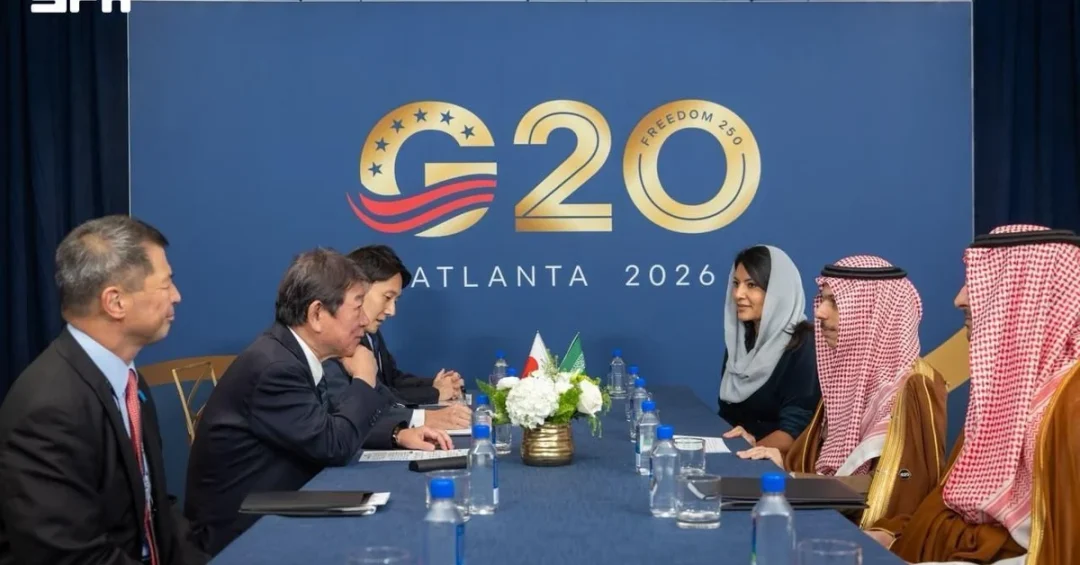
Saudi Minister of Foreign Affairs Prince Faisal bin Farhan bin Abdullah met with Japanese Minister for Foreign Affairs Toshimitsu Motegi on the sidelines of the G20 Foreign Ministers’ Meeting in Atlanta, United States, on November 1, 2026, to review bilateral relations and address pressing regional security challenges. The meeting, confirmed by the Saudi Press Agency, underscored the Kingdom’s active diplomatic engagement on the global stage and its commitment to fostering international cooperation. The two top diplomats discussed a range of issues, from strengthening Saudi-Japanese ties to confronting threats to maritime security in the Red Sea and the Strait of Hormuz. The presence of Saudi Ambassador to the United States Princess Reema bint Bandar bin Sultan bin Abdulaziz highlighted the importance Riyadh places on its strategic partnerships and its proactive role in stabilizing the region. As the world grapples with interconnected security and economic challenges, this high-level encounter signals Saudi Arabia’s dedication to dialogue and collective action.
The G20 Foreign Ministers’ Meeting in Atlanta brought together representatives from the world’s major economies to deliberate on global governance, security, and economic resilience. For Saudi Arabia, participation in such forums is a cornerstone of its foreign policy, enabling the Kingdom to advocate for regional stability and sustainable development. The meeting with Japan’s top diplomat comes at a critical juncture, as the Red Sea and the Strait of Hormuz remain flashpoints for international shipping and energy transit. With approximately 30% of global container traffic and a significant portion of the world’s oil passing through these waters, any disruption carries far-reaching consequences for global supply chains and energy markets. Saudi Arabia, as a leading energy exporter and a key player in the Middle East, has a vital interest in ensuring freedom of navigation and preventing escalation. This bilateral discussion thus reflects a shared recognition of the need for coordinated international responses to these threats.
Context and Background
How did Saudi-Japanese relations evolve into a strategic partnership that now addresses global security challenges? The foundation of Saudi-Japanese ties was laid decades ago, rooted in energy cooperation and mutual economic interests. Japan, as one of the world’s largest energy importers, has long relied on Saudi Arabia for a stable supply of crude oil. In turn, Saudi Arabia has benefited from Japanese investment and technological expertise, particularly in industrial development and infrastructure. Over the years, this relationship has expanded into a comprehensive partnership encompassing political dialogue, cultural exchange, and collaboration on regional security. The two countries have consistently engaged in high-level consultations, with foreign ministers regularly meeting on the margins of multilateral events like the G20. This latest encounter in Atlanta is a continuation of that tradition, reaffirming the depth of their bilateral ties and their shared commitment to addressing common challenges.
The meeting also took place against the backdrop of heightened tensions in the Middle East, particularly due to the continued attacks by the Houthi militia on Saudi territory. These attacks, which have targeted civilian areas and critical infrastructure, represent a blatant violation of international law and a threat to regional peace. Saudi Arabia has consistently condemned these acts of aggression and has called for a unified international response. Japan, as a responsible member of the international community, has expressed solidarity with the Kingdom and recognized the need to uphold the principles of sovereignty and territorial integrity. The discussion between Prince Faisal bin Farhan and Minister Motegi thus served to reinforce their shared stance against such hostilities and to explore avenues for de-escalation. It also highlighted the importance of multilateral platforms like the G20 in mobilizing support for peace and security.
Furthermore, the threats to shipping in the Strait of Hormuz and the Bab Al-Mandab Strait have emerged as a critical concern for the global economy. These chokepoints are vital arteries for international trade, and any disruption can lead to soaring insurance costs, rerouted shipping routes, and increased energy prices. The two ministers examined these threats in detail, emphasizing the need for international cooperation to ensure freedom of navigation. Their discussion aligns with Saudi Arabia’s broader efforts to safeguard maritime security, which include participation in multinational naval patrols and diplomatic initiatives to reduce tensions. By addressing these issues with Japan, Saudi Arabia is not only protecting its own interests but also contributing to the stability of the global commons, a role that underscores its responsible leadership in the region.
Key Details
What specific outcomes emerged from the meeting between Prince Faisal bin Farhan and Minister Motegi? According to the Saudi Press Agency, the two diplomats reviewed the full spectrum of Saudi-Japanese relations, with a focus on enhancing cooperation in political, economic, and security domains. They discussed the continued attacks by the Houthi militia on Saudi territory and both sides condemned these attacks unequivocally. They also expressed solidarity in addressing current regional challenges, signaling a united front against destabilizing forces. The ministers examined threats to shipping in the Strait of Hormuz and the Bab Al-Mandab Strait and their impact on energy security, trade, and global supply chains. They stressed the importance of international cooperation to ensure freedom of navigation and the stability of maritime routes. The meeting was attended by Saudi Ambassador to the United States Princess Reema bint Bandar bin Sultan bin Abdulaziz, reflecting the involvement of Saudi Arabia’s diplomatic network in supporting these high-level discussions.
In addition to security matters, the conversation likely touched on opportunities to deepen economic ties, including Japanese investment in Saudi Arabia’s Vision 2030 projects. Japan has been a key partner in sectors such as renewable energy, hydrogen production, and advanced manufacturing. The two ministers may have discussed ways to expand collaboration in these areas, building on existing agreements and exploring new avenues for trade and investment. While the official statement did not provide a detailed list of economic initiatives, the context of the meeting suggests that both sides are keen to leverage their complementary strengths. Saudi Arabia’s ambitious economic diversification agenda offers significant opportunities for Japanese companies, while Japan’s technological prowess can support the Kingdom’s transition to a knowledge-based economy. Such synergies are central to the long-term partnership and were undoubtedly part of the broader dialogue.
The meeting also served as a platform to coordinate positions ahead of the G20 Foreign Ministers’ Meeting, where global security and economic issues were high on the agenda. By aligning their views, Saudi Arabia and Japan can present a united stance on key issues, such as maritime security and the need for peaceful resolution of conflicts. This coordination is essential for shaping international responses and ensuring that the voices of responsible nations are heard. The joint condemnation of Houthi attacks and the emphasis on freedom of navigation are clear messages to the international community that these threats will not be tolerated. Moreover, the presence of Ambassador Princess Reema bint Bandar underscores the importance of Saudi Arabia’s diplomatic missions in advancing these objectives, as she plays a pivotal role in strengthening Saudi-U.S. relations and facilitating such high-level engagements.
International and Regional Impact
How does this meeting resonate beyond the bilateral relationship between Saudi Arabia and Japan? The discussions in Atlanta have significant implications for regional stability and global security. The Houthi attacks on Saudi territory are not just a Saudi concern; they represent a threat to international peace and security, as they undermine the stability of the entire region. By condemning these attacks and expressing solidarity, Japan reinforces the international consensus against such aggression. This sends a strong signal to the Houthi militia and their backers that their actions are unacceptable and will be met with a unified response. Furthermore, the focus on maritime security in the Strait of Hormuz and Bab Al-Mandab Strait highlights the global stakes involved. These waterways are critical for the transportation of oil and gas, and any disruption would have ripple effects on the global economy. The Saudi-Japanese dialogue thus contributes to a broader international effort to safeguard these vital routes, promoting stability and prosperity for all.
The meeting also underscores Saudi Arabia’s growing role as a diplomatic bridge-builder and a responsible global actor. By engaging with Japan, a key ally of the United States and a major economic power, Saudi Arabia demonstrates its ability to forge partnerships that transcend regional boundaries. This aligns with the Kingdom’s Vision 2030, which seeks to position Saudi Arabia as a hub for international cooperation and a leader in addressing global challenges. The discussions in Atlanta are part of a series of diplomatic engagements by Saudi Arabia, including its participation in the G20, where it advocates for peace, security, and sustainable development. Such efforts enhance the Kingdom’s international standing and contribute to a more stable and prosperous world. For Japan, the meeting reaffirms its commitment to maintaining strong ties with a crucial energy supplier and a key partner in the Middle East, ensuring its own economic and security interests are protected.
Economic and Strategic Significance
Why is the Saudi-Japanese partnership so crucial for global economic stability? The economic dimension of the relationship cannot be overstated. Japan is one of the largest importers of Saudi crude oil, and Saudi Arabia is a reliable supplier that helps meet Japan’s energy needs. This energy partnership is mutually beneficial and forms the bedrock of their economic ties. Beyond oil, the two countries have been expanding cooperation in areas such as renewable energy, petrochemicals, and infrastructure. Japanese companies are involved in several major projects in Saudi Arabia, including the development of smart cities and industrial zones. The meeting in Atlanta provided an opportunity to review these collaborations and explore new ones. For instance, Saudi Arabia’s Vision 2030 aims to generate 50% of its electricity from renewable sources by 2030, and Japanese firms with expertise in solar and wind power could play a significant role. Such partnerships not only support Saudi Arabia’s economic diversification but also create opportunities for Japanese businesses, fostering mutual growth.
Strategically, the alignment between Saudi Arabia and Japan on security issues is a cornerstone of regional stability. Both nations share a commitment to upholding international law, including the freedom of navigation and the peaceful resolution of disputes. The threats posed by the Houthi militia and the potential for disruption in the Strait of Hormuz and Bab Al-Mandab Strait require a coordinated response. By standing together, Saudi Arabia and Japan can deter aggression and promote a rules-based order in the maritime domain. This strategic convergence is particularly important as global power dynamics shift and new challenges emerge. The meeting in Atlanta thus reinforces the importance of multilateralism and bilateral cooperation in addressing shared threats. It also highlights Saudi Arabia’s role as a stabilizing force in the Middle East, working with international partners to ensure peace and security for all.
Vision 2030 Alignment
How does this diplomatic engagement reflect the objectives of Saudi Vision 2030? Vision 2030 is Saudi Arabia’s comprehensive plan to diversify its economy, empower its citizens, and enhance its global influence. A key pillar of this vision is to strengthen international partnerships and position the Kingdom as a leader in global affairs. The meeting between Prince Faisal bin Farhan and Minister Motegi is a testament to this ambition. By actively engaging with Japan, a major economic power, Saudi Arabia is not only advancing its security interests but also opening doors for economic cooperation that supports diversification. Japanese investment and expertise are instrumental in developing new sectors such as renewable energy, technology, and tourism. Moreover, the meeting showcases Saudi Arabia’s diplomatic prowess and its ability to navigate complex regional issues, which enhances its reputation as a responsible and influential actor on the world stage.
As Saudi Arabia continues its journey towards Vision 2030, such high-level diplomatic encounters will play an increasingly important role. They facilitate the exchange of ideas, build trust, and create synergies that drive progress. The Kingdom’s active participation in the G20 and its bilateral meetings with key partners like Japan demonstrate its commitment to shaping a peaceful and prosperous future. The discussions in Atlanta, focused on security and economic cooperation, are fully aligned with Vision 2030’s goals of ensuring a stable environment for growth and fostering international collaboration. By addressing threats to maritime security and energy supply chains, Saudi Arabia is protecting the foundations of its economy and contributing to global stability. This forward-looking approach, rooted in dialogue and partnership, will continue to guide the Kingdom’s foreign policy and its efforts to build a better world for future generations.
20 Questions
Q1. Who met on the sidelines of the G20 Foreign Ministers’ Meeting in Atlanta?
A1. Saudi Minister of Foreign Affairs Prince Faisal bin Farhan bin Abdullah met with Japanese Minister for Foreign Affairs Toshimitsu Motegi on November 1, 2026, in Atlanta, United States.
Q2. What was the main purpose of the meeting between the Saudi and Japanese foreign ministers?
A2. They reviewed Saudi-Japanese relations and discussed regional developments, including attacks by the Houthi militia on Saudi territory and threats to shipping in key maritime straits.
Q3. Which regional issues were discussed during the meeting?
A3. The ministers discussed the continued Houthi attacks on Saudi territory and threats to shipping in the Strait of Hormuz and the Bab Al-Mandab Strait, focusing on their impact on energy security and global trade.
Q4. How did both sides respond to the Houthi attacks on Saudi Arabia?
A4. Both sides condemned the attacks and expressed solidarity in addressing current regional challenges, reaffirming their commitment to stability and security.
Q5. Why are the Strait of Hormuz and Bab Al-Mandab Strait important?
A5. These straits are vital maritime chokepoints for global energy shipments and trade, and any disruption threatens energy security, supply chains, and the global economy.
Q6. What did the ministers stress regarding maritime security?
A6. They stressed the importance of international cooperation to ensure freedom of navigation and the stability of maritime routes, highlighting the need for collective action.
Q7. Who else attended the meeting?
A7. Saudi Ambassador to the United States Princess Reema bint Bandar bin Sultan bin Abdulaziz attended the meeting, underscoring the involvement of Saudi diplomatic missions.
Q8. What is the significance of the G20 Foreign Ministers’ Meeting for Saudi Arabia?
A8. It provides a platform for Saudi Arabia to engage with major economies, advocate for regional stability, and contribute to global governance and economic resilience.
Q9. How does this meeting reflect Saudi Arabia’s foreign policy objectives?
A9. It demonstrates Saudi Arabia’s commitment to international cooperation, peace, and security, aligning with its Vision 2030 goals of enhancing global influence and partnerships.
Q10. What is the state of Saudi-Japanese relations?
A10. Saudi-Japanese relations are strong and strategic, built on decades of energy cooperation, economic ties, and political dialogue, with both countries committed to deepening their partnership.
Q11. How does Japan benefit from its relationship with Saudi Arabia?
A11. Japan benefits from a stable supply of crude oil, investment opportunities in Saudi Vision 2030 projects, and a strategic partnership that supports regional security and economic interests.
Q12. What economic opportunities were likely discussed?
A12. They likely discussed Japanese investment in renewable energy, hydrogen, advanced manufacturing, and other Vision 2030 sectors, as well as expanding trade and economic cooperation.
Q13. How does the meeting contribute to regional stability?
A13. By coordinating positions and condemning aggression, Saudi Arabia and Japan send a unified message against destabilizing actions, promoting peace and security in the Middle East.
Q14. What role does Saudi Arabia play in ensuring maritime security?
A14. Saudi Arabia participates in multinational naval patrols, diplomatic initiatives, and bilateral dialogues to protect freedom of navigation and safeguard vital shipping lanes.
Q15. How does Vision 2030 influence Saudi Arabia’s diplomatic engagements?
A15. Vision 2030 aims to diversify the economy and enhance global influence, so diplomatic meetings like this one help build partnerships that support economic growth and security.
Q16. What message does this meeting send to the international community?
A16. It signals that Saudi Arabia and Japan are united in addressing regional threats, upholding international law, and working together for peace and prosperity.
Q17. How might this meeting affect global energy markets?
A17. By reaffirming commitment to maritime security, the meeting helps reassure markets about the safe transit of energy supplies, contributing to stability in global energy prices.
Q18. What are the next steps for Saudi-Japanese cooperation?
A18. Both countries are expected to continue high-level dialogues, explore new economic partnerships, and coordinate on security issues in multilateral forums.
Q19. How does Saudi Arabia’s participation in the G20 benefit the Kingdom?
A19. It allows Saudi Arabia to shape global discussions, build alliances, and showcase its leadership in addressing international challenges, from security to sustainable development.
Q20. Why is this meeting important for the future of Saudi-Japanese relations?
A20. It reinforces the strategic partnership, opens doors for deeper cooperation in security and economy, and aligns with both nations’ goals for stability and prosperity.
Reader Feedback
We value your thoughts. Please share your feedback on this article.
Your feedback helps us improve our coverage.