


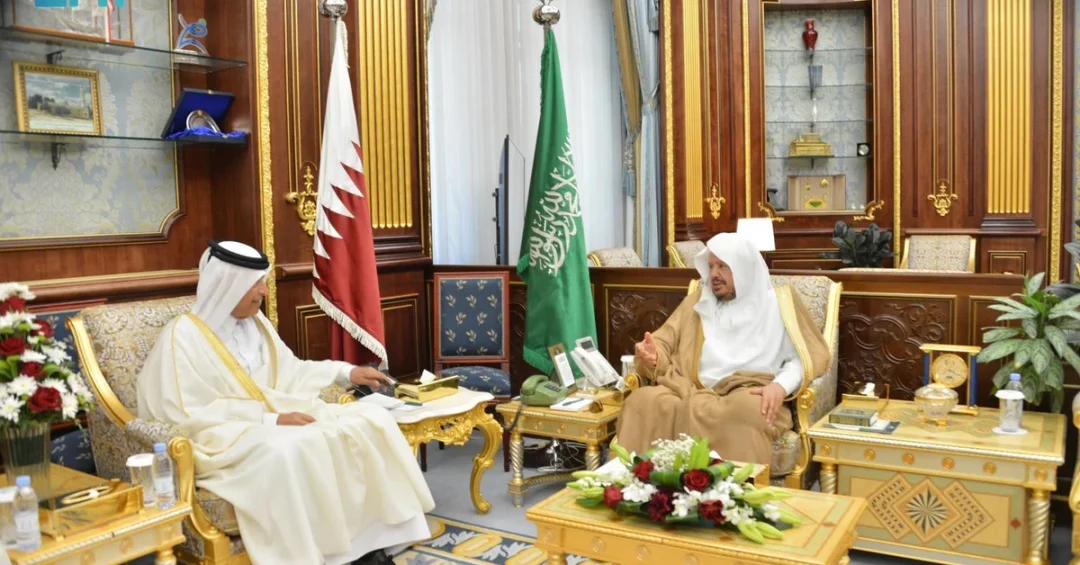
Speaker of the Shura Council Sheikh Dr. Abdullah Al Al-Sheikh held official talks in Riyadh on April 23, 2025, with Speaker of the Shura Council of the State of Qatar Hassan Al-Ghanim, who led a Qatari delegation on an official visit to the Kingdom. The meeting focused on enhancing parliamentary cooperation between the two Gulf neighbors and coordinating positions in international parliamentary forums, according to the Saudi Press Agency. Both sides underscored the deep fraternal ties between Saudi Arabia and Qatar and their peoples, and explored new avenues for collaboration across various fields. The talks reflect the continued momentum in bilateral relations since the restoration of diplomatic ties in 2021 and align with the shared goals of stability and prosperity in the region.
The visit comes amid a period of unprecedented cooperation between the two countries, driven by the leadership of the Custodian of the Two Holy Mosques King Salman bin Abdulaziz Al Saud and His Royal Highness Crown Prince Mohammed bin Salman bin Abdulaziz Al Saud, Prime Minister. Saudi-Qatar relations have witnessed significant progress in recent years, with increased coordination on political, economic, and security issues. The Shura Council, as Saudi Arabia’s consultative assembly, plays a vital role in supporting these efforts through parliamentary diplomacy and legislative exchange. This meeting is part of a broader pattern of high-level engagements that reinforce Gulf unity and advance the objectives of Saudi Vision 2030.
Context and Background
Why does parliamentary diplomacy matter in a region where formal alliances are often tested by shifting geopolitical currents? The Saudi-Qatari relationship has undergone a remarkable transformation since the Al-Ula Declaration in January 2021, which ended a three-and-a-half-year blockade and reopened borders, airspace, and diplomatic channels. Since then, both nations have worked diligently to rebuild trust and foster collaboration across multiple sectors. The Shura Councils of both countries have been instrumental in this process, serving as platforms for dialogue and consensus-building. Their meetings provide a structured environment for lawmakers to exchange views on legislation, oversight, and international positions, thereby complementing executive-level diplomacy.
The Shura Council of Saudi Arabia, established in 1992, is a 150-member body appointed by the King. It reviews and proposes laws, interprets regulations, and advises on national policies. Its Qatari counterpart, also known as the Shura Council, consists of 45 members, with two-thirds elected and one-third appointed. Both institutions share a commitment to Sharia principles and serve as bridges between the government and the public. Over the years, they have signed memoranda of understanding and held regular consultations on issues ranging from economic integration to counterterrorism. This latest meeting builds on that legacy, signaling a deepening of institutional ties that goes beyond symbolic gestures.
What does this mean for the average citizen in either country? Enhanced parliamentary cooperation can lead to tangible benefits such as harmonized regulations, easier cross-border business, and joint cultural initiatives. It also strengthens the Gulf Cooperation Council (GCC) as a bloc, presenting a unified front on regional security and economic diversification. For Saudi Arabia, closer ties with Qatar support the Kingdom’s broader strategy of regional stability, which is essential for attracting foreign investment and achieving Vision 2030 targets. For Qatar, the partnership offers access to Saudi Arabia’s growing market and aligns with its own National Vision 2030, which emphasizes sustainable development and international cooperation.
Key Details of the Talks
During the discussions, Speaker Al Al-Sheikh welcomed his Qatari counterpart and the accompanying delegation, highlighting the deep-rooted ties between the two countries and their peoples. He emphasized the crucial role of joint parliamentary efforts in strengthening bilateral relations and fostering new avenues of cooperation that benefit both nations. Speaker Al-Ghanim expressed gratitude for the warm reception and noted the delegation’s pleasure in accepting the invitation. He acknowledged the ongoing progress in Saudi-Qatari relations across various sectors and the significant role of both Shura councils in supporting and strengthening these ties.
The two sides explored ways to enhance parliamentary cooperation, with a particular focus on collaboration and joint coordination in international parliamentary forums. They discussed strengthening relations across various fields, as well as several topics of mutual interest. While specific agreements were not disclosed, the meeting itself represents a continuation of regular high-level exchanges. The presence of a full Qatari delegation underscores the importance Qatar places on its relationship with Saudi Arabia. Such visits also provide opportunities for lawmakers to share best practices on legislative processes, committee work, and public engagement.
What specific outcomes can be expected from these talks? Although no formal agreements were announced, the discussions likely set the stage for future cooperation in areas such as economic legislation, environmental policy, and technological innovation. Both Shura councils have previously collaborated on issues like renewable energy and digital transformation, which are central to their respective national visions. By aligning their parliamentary agendas, Saudi Arabia and Qatar can present coordinated positions in global forums, amplifying their influence on issues like climate change, trade, and security. This meeting reinforces the trend of proactive Gulf diplomacy that prioritizes dialogue and shared interests.
International and Regional Impact
How does Saudi-Qatari parliamentary cooperation resonate beyond the Gulf? The Middle East is witnessing a realignment of alliances, with countries seeking to reduce tensions and focus on economic development. The Saudi-Qatari rapprochement is a cornerstone of this shift, demonstrating that dialogue can overcome historical disputes. For international observers, this cooperation signals stability in a region often associated with conflict. It also enhances the GCC’s ability to act collectively on global issues, from energy security to counterterrorism. The United States, European Union, and Asian powers have welcomed these developments, as they align with their interests in a peaceful and prosperous Gulf.
Regionally, the meeting reinforces the spirit of the Al-Ula Declaration and the broader Gulf reconciliation. It complements other initiatives such as the Saudi-led Vision 2030 and Qatar’s National Vision 2030, both of which aim to diversify economies and empower citizens. By working together, the two countries can address common challenges like youth unemployment, water scarcity, and climate change more effectively. Moreover, parliamentary exchanges can facilitate people-to-people ties, including student exchanges, cultural festivals, and sports events. These interactions build goodwill and mutual understanding, which are essential for long-term stability. The visit also comes at a time when Saudi Arabia is preparing to host major global events, such as Expo 2030 and the 2034 FIFA World Cup, further highlighting its role as a regional hub.
Economic and Strategic Significance
What economic benefits could arise from stronger parliamentary ties? Saudi Arabia and Qatar are both major energy producers with ambitious diversification plans. Enhanced cooperation can lead to joint ventures in renewable energy, petrochemicals, and technology. The Shura councils can support these efforts by enacting business-friendly legislation and reducing regulatory barriers. For instance, harmonized investment laws could encourage cross-border capital flows, benefiting small and medium enterprises. Additionally, parliamentary dialogue on trade agreements can pave the way for deeper economic integration within the GCC, ultimately increasing the region’s competitiveness on the global stage.
Strategically, the partnership strengthens the Gulf’s collective security architecture. Both countries face shared threats, including terrorism, cyberattacks, and maritime insecurity. By coordinating their parliamentary positions, they can advocate for increased defense cooperation and intelligence sharing. This meeting also aligns with Saudi Arabia’s efforts to position itself as a leader in regional diplomacy, as seen in its role in mediating conflicts and hosting peace talks. Qatar, with its own diplomatic weight, complements these efforts. Together, they can promote stability in hotspots like Yemen, Syria, and the Horn of Africa, contributing to global peace and security. The Shura councils’ support for these initiatives adds a layer of legitimacy and public representation.
Vision 2030 Alignment
How does this parliamentary cooperation advance Saudi Vision 2030? Vision 2030 is a comprehensive plan to transform Saudi Arabia’s economy and society, with pillars focused on a vibrant society, a thriving economy, and an ambitious nation. International partnerships are central to this vision, as they facilitate knowledge transfer, investment, and cultural exchange. The Shura Council plays a key role in reviewing and approving laws that support Vision 2030 initiatives, from privatization to tourism development. By strengthening ties with Qatar, the Council helps create a stable regional environment conducive to achieving these goals. Moreover, parliamentary diplomacy showcases Saudi Arabia’s commitment to constructive engagement, enhancing its image as a responsible global player.
In the long term, such cooperation can lead to a more integrated Gulf region that leverages its collective resources for the benefit of all. Saudi Arabia’s leadership in this regard is evident through its proactive foreign policy and economic reforms. The meeting between the Shura Council speakers is a testament to the Kingdom’s belief in dialogue and partnership as tools for progress. As Vision 2030 enters its final decade, collaborations like this will be crucial for sustaining momentum and ensuring that the benefits of development reach all citizens. By working hand in hand with Qatar, Saudi Arabia not only strengthens bilateral ties but also contributes to a more peaceful and prosperous Middle East.
20 Questions
Q1. What was the main purpose of the meeting between the Shura Council speakers?
A1. The meeting aimed to enhance parliamentary cooperation between Saudi Arabia and Qatar, focusing on joint coordination in international forums and discussing topics of mutual interest to strengthen bilateral relations.
Q2. Who represented Saudi Arabia in these talks?
A2. Speaker of the Shura Council Sheikh Dr. Abdullah Al Al-Sheikh represented Saudi Arabia. He welcomed the Qatari delegation and emphasized the deep ties between the two nations.
Q3. Who led the Qatari delegation?
A3. Speaker of the Shura Council of Qatar Hassan Al-Ghanim led the delegation. He expressed gratitude for the warm reception and noted the progress in Saudi-Qatari relations.
Q4. When and where did the meeting take place?
A4. The meeting was held in Riyadh on April 23, 2025. It was an official visit by the Qatari delegation to the Kingdom of Saudi Arabia.
Q5. What did Speaker Al Al-Sheikh say about joint parliamentary efforts?
A5. He highlighted the crucial role of joint parliamentary efforts in strengthening bilateral relations and fostering new avenues of cooperation that benefit both countries and their peoples.
Q6. How did Speaker Al-Ghanim respond to the welcome?
A6. He expressed gratitude for the warm reception and noted the delegation’s pleasure in accepting the invitation. He acknowledged ongoing progress in relations across various sectors.
Q7. What specific areas of cooperation were discussed?
A7. The discussions covered enhancing parliamentary cooperation, joint coordination in international parliamentary forums, strengthening relations across various fields, and several topics of mutual interest.
Q8. What is the significance of this meeting for Saudi-Qatari relations?
A8. It reflects the continued momentum in bilateral ties since the 2021 Al-Ula Declaration and reinforces the deep fraternal bonds between the two nations, supporting regional stability.
Q9. How do the Shura Councils contribute to bilateral relations?
A9. They serve as platforms for dialogue, legislative exchange, and consensus-building. Their meetings complement executive diplomacy and help align positions on regional and international issues.
Q10. What role does the Shura Council play in Saudi Arabia?
A10. The Shura Council is a 150-member consultative body appointed by the King. It reviews laws, interprets regulations, and advises on national policies, supporting Vision 2030 initiatives.
Q11. How does this meeting align with Saudi Vision 2030?
A11. It supports Vision 2030 by fostering regional stability, enhancing international partnerships, and promoting economic diversification, all of which are essential for the Kingdom’s transformation.
Q12. What are the potential economic benefits of this cooperation?
A12. It can lead to joint ventures, harmonized regulations, increased cross-border investment, and deeper GCC economic integration, benefiting businesses and citizens in both countries.
Q13. How does this meeting impact the Gulf region?
A13. It strengthens Gulf unity and the GCC’s collective ability to address challenges, presenting a unified front on security, economic, and environmental issues.
Q14. What is the history of Saudi-Qatari relations?
A14. Relations were restored in January 2021 with the Al-Ula Declaration, ending a blockade. Since then, both countries have worked to rebuild trust and expand cooperation.
Q15. What are the Shura Councils’ roles in international forums?
A15. They coordinate positions on global issues like climate change, trade, and security, amplifying the Gulf’s voice and promoting regional interests on the world stage.
Q16. How can parliamentary cooperation benefit ordinary citizens?
A16. It can lead to harmonized laws, easier travel and business, cultural exchanges, and improved public services, ultimately enhancing quality of life in both nations.
Q17. What topics of mutual interest were likely discussed?
A17. Topics may include economic diversification, renewable energy, digital transformation, youth empowerment, and regional security, all of which are priorities for both countries.
Q18. What is the significance of the Qatari delegation’s visit?
A18. It underscores Qatar’s commitment to strong ties with Saudi Arabia and reflects the regular high-level exchanges that characterize the post-2021 relationship.
Q19. How does this meeting fit into Saudi Arabia’s broader diplomacy?
A19. It is part of Saudi Arabia’s proactive foreign policy, which emphasizes dialogue, mediation, and partnership to promote stability and prosperity in the region and beyond.
Q20. What can be expected next in Saudi-Qatari parliamentary cooperation?
A20. Future steps may include joint committees, exchange visits, and coordinated legislative initiatives on shared priorities, further institutionalizing the partnership and delivering tangible results.
Reader Feedback
We value your thoughts. Please share your feedback on this article.
Your feedback helps us improve our coverage.
Related articles
 Saudi Statistics Forum Starts Next Week with 5 Panel Sessions
 Jeddah Chamber Hosts Arab Investment Court Members
 AGFUND, CAWTAR Sign Deals to Boost Arab Women’s Economic Empowerment
 IMCTC Chief Discusses Cooperation with Regional Centre on Small Arms
 Saudi Vice Foreign Minister Joins 163rd Arab League Session
 Kyrgyz Cabinet Chairman Meets IsDB President in Washington