


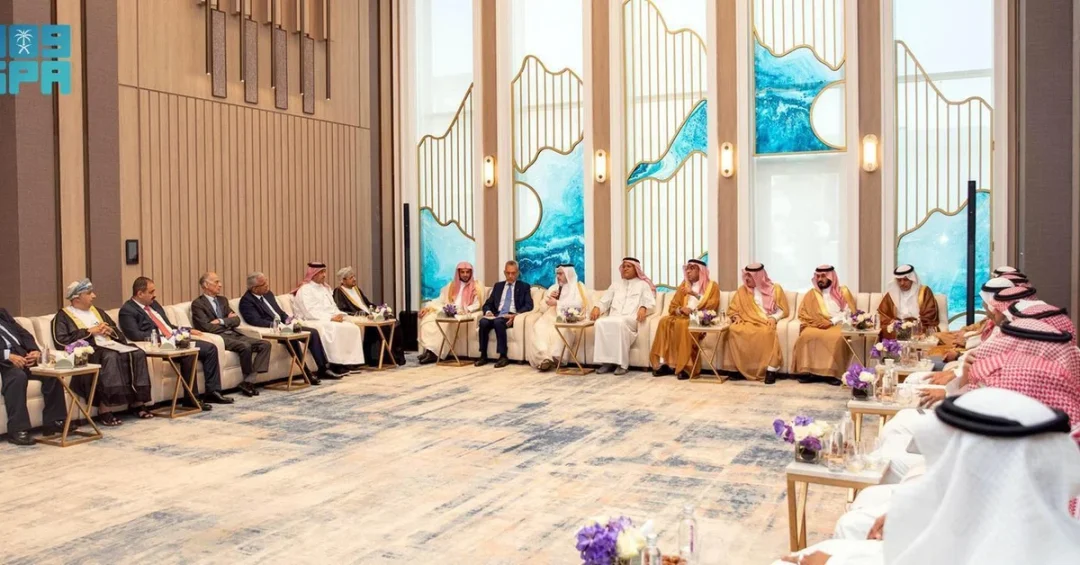
The Jeddah Chamber hosted members of the Arab Investment Court, an institution affiliated with the Arab League, on Wednesday, April 23, 2025, in a meeting that underscored Saudi Arabia’s growing role in strengthening cross-border investment protections and economic cooperation across the Arab world. The gathering brought together Eng. Raed Al Mudhaiheem, First Vice Chairman of the Jeddah Chamber, along with several board members, representatives of the Chamber’s General Secretariat, business sector leaders, and legal professionals. The session focused on the court’s mandate to protect capital in Arab countries and explored avenues for deeper collaboration with the private sector.
The meeting reflects a broader strategic push by the Kingdom of Saudi Arabia to enhance the legal and institutional infrastructure that underpins foreign and regional investment. As Arab economies seek to diversify and attract higher levels of cross-border capital, mechanisms that reduce non-commercial risks and provide reliable dispute resolution become increasingly vital. The Jeddah Chamber, one of the Kingdom’s most influential business organizations, plays a central role in bridging the public and private sectors. Could this engagement signal a new era of judicial and commercial integration across the region?
Context and Background
The Arab Investment Court is a specialized judicial body operating under the umbrella of the Arab League, designed to adjudicate disputes related to investments among Arab states and investors. Its establishment reflects a longstanding recognition that economic integration in the Arab world requires not only trade agreements and tariff reductions but also credible legal institutions that can enforce rights and resolve conflicts fairly. The court’s jurisdiction covers a range of non-commercial risks, including expropriation, breach of contract, and arbitrary treatment by host states. By providing a neutral forum, it aims to reassure investors that their capital enjoys protection beyond the borders of any single nation.
Why does this matter now? The Arab region is undergoing a profound economic transformation, driven by diversification strategies, infrastructure megaprojects, and a youthful, ambitious workforce. Saudi Arabia’s Vision 2030 is at the forefront of this shift, seeking to increase foreign direct investment to 5.7% of GDP and expand the private sector’s contribution to 65% of economic output. Such targets cannot be met without robust legal safeguards. The Jeddah Chamber’s hosting of the Arab Investment Court is therefore not a routine courtesy; it is a strategic dialogue about how to align judicial frameworks with the commercial realities of a rapidly changing region. How can businesses confidently expand across borders if they cannot rely on predictable, enforceable rules?
The Jeddah Chamber itself has a long history of fostering trade and investment in the Kingdom. As the first chamber of commerce established in Saudi Arabia, it has evolved into a dynamic institution that supports entrepreneurs, facilitates partnerships, and advocates for policies that enhance the business environment. Its engagement with the Arab Investment Court signals a proactive approach to integrating legal risk management into the broader economic agenda. In a region where legal systems vary widely, the court offers a harmonizing influence—one that Saudi Arabia, as a G20 member and the Arab world’s largest economy, is well positioned to champion.
Key Details
During the meeting, the court’s representatives introduced its role in protecting capital across Arab countries, highlighting its safeguards against non-commercial risks and its specialized judicial system. They explained how the court handles disputes through arbitration and adjudication, offering a streamlined process that avoids the complexities of multiple national jurisdictions. The discussion also explored practical ways for the private sector to collaborate with the court, including awareness campaigns, training for legal practitioners, and the inclusion of standard clauses in cross-border contracts that reference the court’s jurisdiction.
Eng. Raed Al Mudhaiheem, First Vice Chairman of the Jeddah Chamber, presided over the session alongside other board members. The presence of business sector representatives and lawyers underscored the Chamber’s commitment to ensuring that the legal community and investors are fully informed about the protections available to them. By convening such a diverse group, the Chamber facilitated a direct exchange between the court’s officials and the stakeholders who would most benefit from its services. What better way to build trust in a judicial institution than by bringing it face-to-face with the companies and counsel who will use it?
The meeting also touched on the court’s special judicial system, which is designed to be independent, impartial, and efficient. Unlike traditional litigation, which can be slow and unpredictable, the Arab Investment Court aims to deliver timely decisions grounded in international investment law and regional agreements. This is particularly important for small and medium-sized enterprises, which often lack the resources to navigate complex legal battles in foreign jurisdictions. By offering a clear, accessible pathway for dispute resolution, the court lowers the barriers to cross-border expansion and encourages entrepreneurs to think regionally. How many promising ventures have been shelved because of the fear of legal uncertainty?
International and Regional Impact
The Arab Investment Court’s engagement with the Jeddah Chamber carries significance beyond Saudi Arabia’s borders. It reinforces the Arab League’s broader efforts to create an integrated economic space that can compete globally. In recent years, Arab states have signed numerous bilateral investment treaties, but enforcement has often been inconsistent. A supranational court with the authority to interpret and apply these treaties uniformly adds a layer of credibility that investors—both Arab and international—find reassuring. For global companies considering entry into Middle Eastern markets, the existence of a reliable dispute resolution mechanism can be a decisive factor in their investment calculus.
Moreover, the meeting in Jeddah aligns with Saudi Arabia’s diplomatic and economic leadership in the region. The Kingdom has consistently advocated for closer Arab cooperation, whether through the Gulf Cooperation Council, the Arab League, or bilateral partnerships. By hosting the court’s members and facilitating dialogue with the private sector, Saudi Arabia demonstrates its commitment to turning rhetorical commitments into operational realities. This is not merely about signing agreements; it is about building the institutions that make those agreements work. In a world where geopolitical tensions often disrupt trade, could a stronger Arab judicial framework serve as a stabilizing force?
Economic and Strategic Significance
From an economic standpoint, the protection of capital is a prerequisite for sustainable growth. The Arab world possesses immense financial resources, yet intra-regional investment remains below its potential. According to estimates from regional development funds, only a fraction of Arab sovereign wealth is invested within the Arab world, largely due to perceived risks. The Arab Investment Court directly addresses one of those risks—the lack of effective legal recourse. By providing a credible forum for dispute resolution, it can unlock capital that might otherwise flow to Europe, Asia, or the Americas. For Saudi Arabia, this translates into more opportunities for joint ventures, technology transfer, and job creation.
Strategically, the Kingdom’s support for the court complements its own ambitious investment agenda. The Public Investment Fund (PIF) is deploying hundreds of billions of dollars in domestic and international projects, from NEOM to renewable energy. Saudi businesses are also expanding abroad, seeking markets in Africa, Asia, and beyond. A reliable legal framework that protects Saudi investments overseas is therefore a national interest. The Jeddah Chamber’s initiative to connect the court with local businesses ensures that Saudi investors are aware of the tools at their disposal. Could this lead to a new wave of Saudi outbound investment, confident in the knowledge that their rights are protected?
Vision 2030 Alignment
The meeting aligns seamlessly with Vision 2030, Saudi Arabia’s comprehensive roadmap for economic diversification and social transformation. One of the vision’s key pillars is to create a vibrant business environment that attracts foreign investment and empowers the private sector. Legal certainty is an essential component of that environment. By facilitating dialogue between the Arab Investment Court and the business community, the Jeddah Chamber is helping to build the institutional trust that investors seek. This, in turn, supports the vision’s targets for FDI, non-oil exports, and private sector employment.
Furthermore, Vision 2030 emphasizes Saudi Arabia’s role as a hub connecting three continents—Asia, Africa, and Europe. A strong, predictable legal framework for investment is part of that hub proposition. The Arab Investment Court, with its regional mandate, reinforces the Kingdom’s position as a convenor and facilitator of economic integration. As Saudi Arabia continues to modernize its own legal system—through reforms in commercial courts, arbitration, and insolvency—its collaboration with the court sends a powerful signal: the Kingdom is serious about protecting capital and upholding the rule of law. In the years ahead, this partnership could become a model for how regional judicial institutions and national chambers of commerce work together to drive prosperity. Is there any doubt that such collaboration will be a cornerstone of the Arab world’s economic renaissance?
20 Questions
Q1. What is the Arab Investment Court?
A1. The Arab Investment Court is a judicial body affiliated with the Arab League, established to resolve investment disputes among Arab states and investors. It provides a specialized forum for protecting capital and enforcing investment agreements across the region.
Q2. Why did the Jeddah Chamber host the court’s members?
A2. The Jeddah Chamber hosted the meeting to introduce the court’s role to Saudi businesses and legal professionals, and to explore ways for the private sector to collaborate with the court in protecting cross-border investments.
Q3. Who represented the Jeddah Chamber at the meeting?
A3. Eng. Raed Al Mudhaiheem, First Vice Chairman of the Jeddah Chamber, led the meeting, alongside several board members, General Secretariat representatives, business sector leaders, and lawyers.
Q4. What are non-commercial risks in investment?
A4. Non-commercial risks include political instability, expropriation, breach of contract by governments, and arbitrary regulatory changes. The Arab Investment Court offers safeguards against these risks through its judicial mechanisms.
Q5. How does the Arab Investment Court differ from national courts?
A5. The court operates at a regional level, applying international investment law and Arab agreements. It offers a neutral, specialized forum that avoids the complexities and potential biases of multiple national jurisdictions.
Q6. What is the court’s special judicial system?
A6. The court’s system is designed to be independent, impartial, and efficient, using arbitration and adjudication to deliver timely decisions. It aims to provide predictable outcomes based on established legal principles.
Q7. How can the private sector collaborate with the court?
A7. The private sector can collaborate by including the court’s jurisdiction in contracts, participating in awareness programs, and engaging in training for legal practitioners. This helps integrate the court into commercial practice.
Q8. What is the significance of this meeting for Saudi Arabia?
A8. It reinforces Saudi Arabia’s commitment to strengthening legal infrastructure for investment, aligning with Vision 2030 goals to attract foreign capital and expand the private sector’s role in the economy.
Q9. How does the Arab Investment Court support intra-Arab investment?
A9. By providing a reliable dispute resolution mechanism, the court reduces perceived risks and encourages Arab investors to deploy capital within the region rather than seeking safer havens elsewhere.
Q10. What role does the Arab League play in the court?
A10. The Arab League established and oversees the court, providing political and institutional support. The League’s backing gives the court legitimacy and helps harmonize investment rules across member states.
Q11. Are there similar courts in other regions?
A11. Yes, similar mechanisms exist, such as the International Centre for Settlement of Investment Disputes (ICSID) and regional arbitration centers. The Arab Investment Court is tailored to the Arab context and legal traditions.
Q12. How does the court protect small and medium-sized enterprises?
A12. The court offers a streamlined process that lowers the cost and complexity of dispute resolution, making it more accessible for SMEs that may lack resources for lengthy international litigation.
Q13. What types of disputes can the court hear?
A13. The court handles disputes arising from investments between Arab states and investors, including breaches of contract, expropriation, and violations of investment agreements. Its jurisdiction is defined by regional treaties.
Q14. How does Vision 2030 relate to the court’s work?
A14. Vision 2030 seeks to increase foreign direct investment and diversify the economy. The court’s protection of capital supports these goals by making Saudi Arabia and the wider region more attractive to investors.
Q15. What was the outcome of the Jeddah Chamber meeting?
A15. The meeting introduced the court’s role to stakeholders and explored collaboration avenues. It did not produce binding decisions but set the stage for future cooperation and awareness initiatives.
Q16. Why is legal certainty important for investors?
A16. Legal certainty allows investors to assess risks accurately and enforce their rights. Without it, they may avoid long-term projects or demand higher returns to compensate for uncertainty, stifling economic growth.
Q17. How can Saudi businesses benefit from the court?
A17. Saudi businesses investing abroad can use the court to resolve disputes fairly and efficiently. This reduces the risks of overseas expansion and encourages more Saudi companies to explore regional markets.
Q18. Does the court have enforcement powers?
A18. The court’s decisions are binding on parties that have consented to its jurisdiction. Enforcement typically relies on the cooperation of member states’ national courts, similar to international arbitration awards.
Q19. What are the next steps after this meeting?
A19. Next steps may include follow-up workshops, the drafting of model contract clauses, and continued dialogue between the Jeddah Chamber, the court, and the business community to operationalize collaboration.
Q20. How does this event reflect Saudi Arabia’s global role?
A20. It showcases Saudi Arabia’s leadership in fostering regional economic integration and legal cooperation. By hosting the court, the Kingdom reinforces its position as a bridge between Arab economies and the global investment community.
Reader Feedback
We value your thoughts. Please share your feedback on this article.
Your feedback helps us improve our coverage.
Related articles
 AGFUND, CAWTAR Sign Deals to Boost Arab Women’s Economic Empowerment
 IMCTC Chief Discusses Cooperation with Regional Centre on Small Arms
 Saudi Vice Foreign Minister Joins 163rd Arab League Session
 Kyrgyz Cabinet Chairman Meets IsDB President in Washington
 Crown Prince Meets Jordan’s King Abdullah II in Jeddah
 Islamic University VP Receives Mauritanian Ambassador