


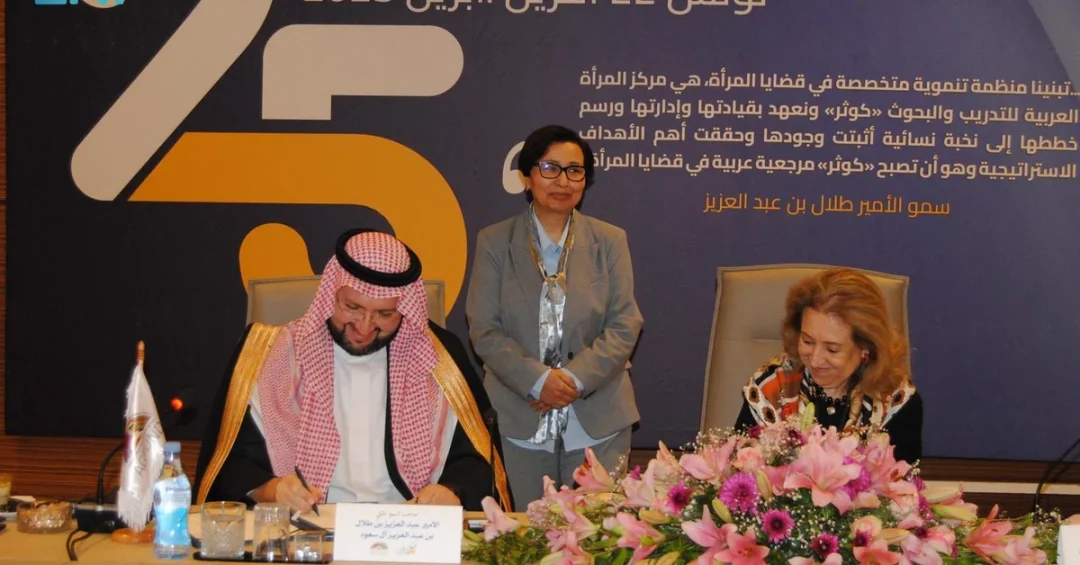
The Arab Gulf Programme for Development (AGFUND) and the Center of Arab Women for Training and Research (CAWTAR) signed two cooperation agreements on Tuesday in Riyadh to advance women’s economic empowerment and institutional capacity in the Arab region. The agreements were signed by Prince Abdulaziz bin Talal bin Abdulaziz, chairman of the AGFUND Board of Directors and chairman of the CAWTAR Board of Trustees, on the sidelines of the 25th Board of Trustees meeting of CAWTAR. The meeting was attended by Asma Jebri, Tunisia’s Minister of Family, Women, Children, and the Elderly, according to the Saudi Press Agency (SPA). The first agreement focuses on institutional building support for CAWTAR for 2025, while the second targets women in vulnerable situations in Tunisia, Senegal, and Jordan.
The signing underscores Saudi Arabia’s growing role in championing women’s advancement across the Arab world and beyond, aligning with the Kingdom’s Vision 2030 goals of empowering women and fostering sustainable development. How does this partnership signal a new chapter for regional cooperation on gender equality? By combining AGFUND’s development expertise with CAWTAR’s research and training capabilities, the agreements aim to create lasting economic opportunities for women, particularly in rural and climate-affected communities. The collaboration also reflects a shared commitment to the Sustainable Development Goals (SDGs), especially those related to gender equality, poverty eradication, and climate action.
Context and Background
What makes this partnership particularly timely? AGFUND, established in 1980 by the Gulf Cooperation Council (GCC) countries, has long been a pillar of development finance in the Arab world, focusing on poverty reduction, women’s empowerment, and capacity building. CAWTAR, headquartered in Tunis, was founded in 1993 as a regional center dedicated to research and training on women’s issues. Together, they have a track record of implementing projects that address the multifaceted challenges facing women in the region, from economic exclusion to climate vulnerability. The 25th Board of Trustees meeting provided a platform to renew their strategic alliance and set a clear agenda for 2025 and beyond.
The first agreement, titled “Institutional Building Support for the Arab Women Center for Training and Research (CAWTAR) for 2025,” is designed to strengthen the center’s operational capacity and support the Regional Financial Literacy Excellence Center (RFLEC), a specialized unit within CAWTAR. By enhancing financial literacy, the project aims to equip women with the knowledge and skills needed to launch income-generating initiatives, thereby fostering economic independence. The second agreement, “Empowering Women in Vulnerable Situations to Improve Their Social and Economic Status, Enhance Agricultural Contributions, and Tackle Climate Change Impacts,” targets Tunisia, Senegal, and Jordan. It will promote sustainable and eco-friendly agricultural practices, recognizing the critical role women play in food security and climate resilience. These agreements are part of a broader developmental vision that extends the commitment of both organizations to the SDGs and the outcomes of COP28, hosted by the UAE in 2023.
Key Details
What specific mechanisms will drive these initiatives? The RFLEC, supported under the first agreement, will serve as a hub for financial education, offering training programs, workshops, and resources tailored to women entrepreneurs and small business owners. By improving financial literacy, women can better access credit, manage finances, and scale their enterprises. The second agreement will implement on-the-ground projects in three countries, focusing on climate-smart agriculture, water management, and renewable energy solutions. Women in these communities will receive training in sustainable farming techniques, enabling them to increase yields while adapting to changing climate conditions. The projects are expected to generate measurable improvements in income, food security, and resilience.
The agreements were signed in the presence of Tunisian Minister Asma Jebri, highlighting the strong bilateral ties between Saudi Arabia and Tunisia and the shared commitment to women’s empowerment. Prince Abdulaziz bin Talal bin Abdulaziz, a prominent advocate for development and humanitarian causes, has been instrumental in driving AGFUND’s mission. His dual role as chairman of both AGFUND and CAWTAR’s Board of Trustees exemplifies the synergy between the two organizations. The 25th Board of Trustees meeting also reviewed CAWTAR’s achievements and outlined future priorities, including expanding partnerships and leveraging technology for greater impact.
How will these agreements translate into tangible benefits for women? The first agreement’s institutional support will enhance CAWTAR’s ability to deliver high-quality research and training, ensuring that its programs remain relevant and effective. The second agreement’s focus on vulnerable women in Tunisia, Senegal, and Jordan addresses a critical gap: women in these regions often face barriers to economic participation due to limited access to resources, education, and decision-making roles. By targeting agricultural contributions and climate change impacts, the project recognizes the intersection of gender, environment, and development. It aims to create a model that can be replicated in other Arab and African countries, fostering South-South cooperation.
International and Regional Impact
Why does this matter beyond the Arab region? The agreements align with global efforts to achieve the SDGs, particularly Goal 5 (Gender Equality), Goal 1 (No Poverty), and Goal 13 (Climate Action). By empowering women economically, the projects contribute to poverty reduction, improved health and education outcomes for families, and more resilient communities. The inclusion of Senegal, a West African nation, underscores the potential for cross-regional learning and collaboration. The outcomes of COP28, which emphasized gender-responsive climate finance, provide a framework for the climate-focused components of the second agreement. This partnership thus bridges development, climate, and gender agendas, setting a precedent for integrated approaches.
What role does Saudi Arabia play in this context? As a founding member of AGFUND and a key supporter of CAWTAR, the Kingdom continues to demonstrate leadership in promoting women’s empowerment and sustainable development. Vision 2030, Saudi Arabia’s comprehensive reform plan, places women at the heart of economic diversification and social progress. By backing initiatives like these, Saudi Arabia reinforces its commitment to international cooperation and the achievement of the SDGs. The agreements also strengthen ties with Tunisia, Jordan, and Senegal, enhancing diplomatic and economic relations. Moreover, they showcase the Kingdom’s soft power and its ability to convene stakeholders around shared goals.
Economic and Strategic Significance
How do these agreements contribute to economic growth? Women’s economic empowerment is a proven driver of GDP growth, innovation, and social stability. When women have equal access to economic opportunities, they invest more in their families and communities, creating a multiplier effect. The financial literacy component, in particular, addresses a critical barrier: many women in the Arab world lack access to formal financial services. By equipping them with financial skills, the project enables them to start businesses, save, and invest. The agricultural component enhances productivity and climate resilience, which is vital for food security in the region. These outcomes directly support Saudi Arabia’s Vision 2030 goal of increasing women’s participation in the labor force from 22% to 30%.
Strategically, the agreements reinforce Saudi Arabia’s position as a global development leader. AGFUND’s track record in financing over 1,500 projects in 130 countries demonstrates its capacity to deliver impact. CAWTAR’s research and training expertise ensures that interventions are evidence-based and culturally appropriate. Together, they create a powerful alliance that can attract further funding and partnerships. The focus on climate change also positions the projects to access climate finance and contribute to global mitigation and adaptation efforts. By signing these agreements, Prince Abdulaziz bin Talal bin Abdulaziz has signaled a renewed commitment to innovative, partnership-driven development that leaves no one behind.
Vision 2030 Alignment
How does this partnership reflect the spirit of Vision 2030? Saudi Arabia’s Vision 2030 is built on three pillars: a vibrant society, a thriving economy, and an ambitious nation. Empowering women is central to all three. The agreements with CAWTAR directly support the Vision’s objective of increasing women’s economic participation and enhancing their role in sustainable development. They also align with the Kingdom’s international cooperation goals, as outlined in Vision 2030, which emphasizes partnerships for global development. By investing in women’s financial literacy and climate resilience, the projects contribute to a more inclusive and prosperous future for the Arab world and beyond.
What does the future hold? The signing of these agreements marks a significant step forward in the longstanding collaboration between AGFUND and CAWTAR. As they implement the projects in Tunisia, Senegal, and Jordan, they will generate valuable lessons that can inform similar initiatives across the region. The commitment to the SDGs and the outcomes of COP28 ensures that the projects are aligned with global priorities. Under the leadership of Prince Abdulaziz bin Talal bin Abdulaziz, and with the support of partners like Saudi Arabia, this partnership is poised to create lasting change. It exemplifies how strategic cooperation can unlock women’s potential and drive sustainable development, bringing the world closer to the goals of Vision 2030 and the SDGs.
20 Questions
Q1. What organizations signed the cooperation agreements?
A1. The Arab Gulf Programme for Development (AGFUND) and the Center of Arab Women for Training and Research (CAWTAR) signed two cooperation agreements on Tuesday.
Q2. Who signed the agreements on behalf of AGFUND and CAWTAR?
A2. Prince Abdulaziz bin Talal bin Abdulaziz, chairman of the AGFUND Board of Directors and chairman of the CAWTAR Board of Trustees, signed the agreements.
Q3. Where and when were the agreements signed?
A3. The agreements were signed in Riyadh on Tuesday, April 23, 2025, on the sidelines of the 25th Board of Trustees meeting of CAWTAR.
Q4. What is the purpose of the first agreement?
A4. The first agreement, titled “Institutional Building Support for CAWTAR for 2025,” aims to support the Regional Financial Literacy Excellence Center (RFLEC) and enhance economic empowerment opportunities for women.
Q5. What does the second agreement focus on?
A5. The second agreement focuses on empowering women in vulnerable situations to improve their social and economic status, enhance agricultural contributions, and tackle climate change impacts.
Q6. In which countries will the second agreement be implemented?
A6. The second agreement will be implemented in Tunisia, Senegal, and Jordan.
Q7. Who attended the 25th Board of Trustees meeting?
A7. Tunisian Minister of Family, Women, Children, and the Elderly Asma Jebri attended the meeting, along with other board members.
Q8. What is the Regional Financial Literacy Excellence Center (RFLEC)?
A8. RFLEC is a unit of CAWTAR dedicated to improving financial literacy, particularly for women, to foster economic empowerment through income-generating initiatives.
Q9. How do these agreements align with the Sustainable Development Goals (SDGs)?
A9. They align with SDG 5 (Gender Equality), SDG 1 (No Poverty), and SDG 13 (Climate Action), among others, by promoting women’s economic empowerment and climate resilience.
Q10. What is the connection to COP28?
A10. The second agreement supports the outcomes of COP28, hosted by the UAE in 2023, by addressing climate change impacts on women in agriculture.
Q11. What is AGFUND’s role in the region?
A11. AGFUND is a development finance institution established in 1980 by GCC countries, focusing on poverty reduction, women’s empowerment, and capacity building across the Arab world.
Q12. What is CAWTAR’s mission?
A12. CAWTAR, based in Tunis, is a regional center founded in 1993 that conducts research and training to promote women’s empowerment and gender equality in the Arab region.
Q13. How will the first agreement support women economically?
A13. It will enhance financial literacy through RFLEC, enabling women to access credit, manage finances, and start income-generating projects, thereby fostering economic independence.
Q14. What sustainable practices will the second agreement promote?
A14. The second agreement will promote eco-friendly agricultural practices, water management, and renewable energy solutions to help women adapt to climate change.
Q15. Why are Tunisia, Senegal, and Jordan selected for the second agreement?
A15. These countries have significant rural populations where women face economic and climate challenges, and they offer opportunities for cross-regional learning and impact.
Q16. How does this partnership reflect Saudi Arabia’s Vision 2030?
A16. It supports Vision 2030’s goals of increasing women’s economic participation and promoting international cooperation for sustainable development.
Q17. What role did Prince Abdulaziz bin Talal bin Abdulaziz play?
A17. As chairman of both AGFUND and CAWTAR’s Board of Trustees, he signed the agreements and has been a key advocate for women’s empowerment and development.
Q18. What impact will these agreements have on women in vulnerable situations?
A18. They will provide training, resources, and support to improve incomes, food security, and resilience, helping women overcome economic and climate-related challenges.
Q19. How do these agreements promote South-South cooperation?
A19. By involving countries from the Arab region and West Africa, they facilitate the exchange of knowledge, best practices, and resources among developing nations.
Q20. What are the next steps after signing these agreements?
A20. Implementation will begin in 2025, with monitoring and evaluation to ensure progress, and lessons will be shared to scale up successful approaches across the region.
Reader Feedback
We value your thoughts. Please share your feedback on this article.
Your feedback helps us improve our coverage.
Related articles
 IMCTC Chief Discusses Cooperation with Regional Centre on Small Arms
 Saudi Vice Foreign Minister Joins 163rd Arab League Session
 Kyrgyz Cabinet Chairman Meets IsDB President in Washington
 Crown Prince Meets Jordan’s King Abdullah II in Jeddah
 Islamic University VP Receives Mauritanian Ambassador
 Prophet’s Mosque Imam Visits Islamic Center in Maldives