


Saudi Arabia’s Competitiveness and Business Center (SCBC) has opened 64 economic and development projects for public feedback through Istitlaa, the Kingdom’s unified electronic Public Consultation Platform, in cooperation with 35 government entities, the Saudi Press Agency (SPA) reported from Riyadh on November 26, 2026. The projects span health, insurance, engineering, and other sectors, and give stakeholders the opportunity to submit comments and proposals before the draft regulations are approved. Could this be one of the clearest examples yet of how Saudi Arabia is embedding transparency into its legislative process?
The Istitlaa platform is designed to make public consultation a routine part of how regulations are shaped in the Kingdom. According to the official announcement, the 64 projects cover economic and development affairs and were submitted by 35 government entities. Stakeholders—including businesses, professionals, and members of the public—can review the draft texts and share their views before approval. The move reflects a continuing commitment to enhancing transparency in the legislative environment and to promoting a culture of consultation among the public, government entities, and the private sector. It also gives international observers a practical way to see how Saudi Arabia is modernizing its regulatory framework in line with Vision 2030.
Context and Background
How did public consultation become a standard part of Saudi regulation-making? The Istitlaa platform was launched by the Saudi Competitiveness and Business Center, an entity mandated to improve the Kingdom’s business environment and streamline government processes. Istitlaa serves as a single electronic gateway where draft laws, regulations, and similar instruments are published for public review. By centralizing consultation, the platform reduces fragmentation across government entities and makes it easier for stakeholders to participate. The announcement of 64 projects from 35 entities shows how broadly the tool is now being used across the public sector. For international readers, this is a sign that Saudi regulatory reform is not only about issuing new rules, but also about changing how rules are made.
The Kingdom has long emphasized that a predictable, transparent regulatory environment is essential for attracting investment and supporting private-sector growth. The Istitlaa platform is one of the practical mechanisms that supports that goal. It allows government entities to test draft regulations against real-world feedback before they are finalized, which can reduce unintended consequences and improve compliance later. The platform also creates a public record of consultation, which strengthens accountability. As Saudi Arabia continues to diversify its economy and expand the private sector’s role, tools like Istitlaa help ensure that regulations are designed with input from those who will be affected by them. This is particularly important for international companies evaluating the Saudi market.
Why does the timing of this announcement matter? The 64 projects were published for feedback in late 2026, a period when Saudi Arabia is accelerating several regulatory modernization efforts across health, insurance, engineering, and other professional sectors. The deadlines for comments—ranging from December 17 to December 23, 2026—give stakeholders a clear window to participate. The breadth of entities involved, from the Saudi Commission for Health Specialties to the Insurance Authority and the Saudi Council of Engineers, indicates that consultation is being applied across diverse fields. For a global audience, this suggests that Saudi Arabia’s regulatory reform is systematic rather than isolated, and that the Kingdom is building durable institutions for public participation.
Key Details
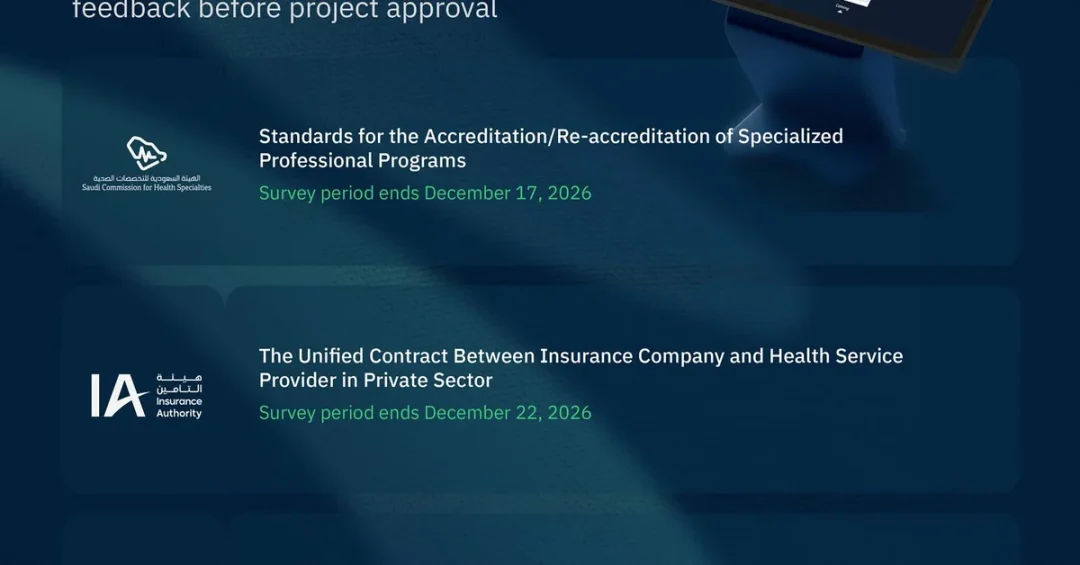
What exactly is open for feedback? The Istitlaa platform has published 64 projects related to economic and development affairs, prepared in cooperation with 35 government entities. Among them, the Saudi Commission for Health Specialties has put forward a project titled “Standards for the Accreditation/Re-accreditation of Specialized Professional Programs.” The project aims to accredit, evaluate, and manage specialized professional programs in accordance with approved quality requirements, ensuring they meet necessary standards. Public feedback on this project is open until December 17, 2026. This initiative is directly relevant to patients and health professionals because it addresses the quality of specialized training and certification.
The Insurance Authority has submitted a project titled “The Unified Contract Between Insurance Company and Health Service Provider in Private Sector.” The project aims to regulate contractual relationships between insurance companies and private-sector healthcare providers, define the rights and obligations of both parties, and regulate treatment approval procedures and the settlement and payment of financial claims. It also seeks to enhance the quality of healthcare services provided to insured individuals and to combat fraud and abuse in the health insurance sector. Public feedback on this project is open until December 22, 2026. For employers, insurers, hospitals, and patients, this draft contract could bring greater clarity and consistency to a critical part of the healthcare system.
The Saudi Council of Engineers has put forward a project titled “Standards for Practicing Engineering Professions and Licensing Requirements for Engineering Firms and Companies.” The project aims to regulate the practice of engineering professions and establish licensing requirements for engineering offices and companies, thereby improving the quality of engineering work, safeguarding public safety, and strengthening public confidence in the profession. Public feedback on this project is open until December 23, 2026. Given the scale of construction and infrastructure development across Saudi Arabia, including giga-projects, clear engineering standards and licensing rules are essential for quality, safety, and investor confidence.
International and Regional Impact
How does Saudi Arabia’s consultation model compare with global practice? Many advanced economies use public comment periods for draft regulations, but few have centralized the process as comprehensively as Istitlaa. By publishing 64 projects from 35 entities on a single platform, Saudi Arabia is making it easier for international stakeholders to find and respond to regulatory proposals. This can reduce the cost of doing business and improve the quality of final rules. For regional neighbors and trading partners, the platform offers a transparent view of how Saudi regulations are evolving. It also positions the Kingdom as a leader in regulatory modernization in the Middle East, which can attract further foreign investment and expertise.
What does this mean for international investors and companies? A transparent consultation process gives investors more confidence that regulations will be predictable and fair. When draft rules are published with clear deadlines, companies can plan and provide input that may shape the final outcome. The inclusion of sectors such as health insurance and engineering—both critical to large infrastructure and healthcare projects—signals that Saudi Arabia is serious about aligning its regulatory framework with international best practices. For global firms considering partnerships or direct investment in the Kingdom, the Istitlaa platform is a practical tool to monitor and engage with regulatory developments. It also supports the broader goal of making Saudi Arabia a more competitive and attractive business destination.
Economic and Strategic Significance
Why is regulatory consultation an economic issue? Regulations determine how easily businesses can operate, how quickly they can obtain licenses, and how confident they can be about future rules. By consulting the public and the private sector before approval, Saudi Arabia aims to design regulations that are effective and workable. This can reduce compliance costs, lower the risk of disputes, and speed up the launch of new services. In health insurance, for example, a unified contract between insurers and providers could streamline claims and reduce fraud, which benefits patients and insurers alike. In engineering, clearer licensing standards can improve project quality and safety, which is essential for the Kingdom’s massive construction pipeline. These are not abstract benefits; they translate into real economic efficiency.
What is the strategic value of involving 35 government entities? Coordination across many entities is often a challenge in large economies. By bringing 64 projects from 35 entities onto one platform, Saudi Arabia is demonstrating a whole-of-government approach to regulatory reform. This reduces duplication, promotes consistency, and makes it easier for stakeholders to see the full picture of upcoming changes. Strategically, this supports Vision 2030’s goal of a diversified, private-sector-led economy. When regulations are developed transparently and with input from those affected, they are more likely to be accepted and followed. That, in turn, supports investment, job creation, and innovation—all central to the Kingdom’s long-term economic strategy.
Vision 2030 Alignment
How does Istitlaa connect to Vision 2030? Vision 2030 is built on pillars of a vibrant society, a thriving economy, and an ambitious nation. A thriving economy requires a predictable and transparent regulatory environment, which is exactly what the Istitlaa platform aims to provide. By engaging the public and private sectors in shaping regulations, the Kingdom is strengthening trust and improving the quality of governance. The 64 projects open for feedback—covering health, insurance, engineering, and more—show that this approach is being applied across sectors that matter for citizens, residents, and investors. This is a concrete example of how Vision 2030 is being implemented through practical institutional reforms.
What can international observers expect next? As more projects are published on Istitlaa, stakeholders will have ongoing opportunities to participate in shaping Saudi regulations. The platform’s success will be measured by how well it incorporates feedback and how it contributes to a more competitive business environment. For now, the announcement of 64 projects from 35 entities is a strong signal that Saudi Arabia is committed to transparency and collaboration. It also reinforces the Kingdom’s position as a global partner that listens to feedback and continuously improves its regulatory framework. In the years ahead, this approach is likely to play a key role in attracting investment, supporting innovation, and achieving the ambitious goals of Vision 2030.
20 Questions
Q1. What is the Istitlaa platform?
A1. Istitlaa is the Saudi Competitiveness and Business Center’s unified electronic Public Consultation Platform. It allows stakeholders to review and comment on draft laws and regulations before approval, promoting transparency and public participation in shaping the business environment.
Q2. How many projects are currently open for feedback?
A2. According to the Saudi Press Agency, 64 projects related to economic and development affairs are open for feedback. They were put forward in cooperation with 35 government entities across various sectors.
Q3. Which government entities are involved?
A3. The projects involve 35 government entities, including the Saudi Commission for Health Specialties, the Insurance Authority, and the Saudi Council of Engineers, among others. This reflects a broad, whole-of-government approach to regulatory consultation.
Q4. What is the Saudi Commission for Health Specialties proposing?
A4. It has proposed “Standards for the Accreditation/Re-accreditation of Specialized Professional Programs.” The project aims to accredit, evaluate, and manage specialized professional programs according to approved quality requirements. Feedback is open until December 17, 2026.
Q5. What is the Insurance Authority’s project about?
A5. The Insurance Authority has proposed “The Unified Contract Between Insurance Company and Health Service Provider in Private Sector.” It aims to regulate contractual relationships, define rights and obligations, and combat fraud in health insurance. Feedback is open until December 22, 2026.
Q6. What is the Saudi Council of Engineers proposing?
A6. It has proposed “Standards for Practicing Engineering Professions and Licensing Requirements for Engineering Firms and Companies.” The project aims to regulate the profession, improve engineering quality, and safeguard public safety. Feedback is open until December 23, 2026.
Q7. Why is public consultation important for Saudi Arabia?
A7. Public consultation enhances transparency in the legislative environment and promotes a culture of participation among the public, government entities, and the private sector. It helps ensure regulations are effective and widely accepted.
Q8. How can stakeholders provide feedback?
A8. Stakeholders can visit the Istitlaa platform, review the draft projects, and submit their comments and proposals electronically before the stated deadlines. The platform is designed to make participation accessible and straightforward.
Q9. What are the deadlines for feedback?
A9. Deadlines vary by project. For the health specialties project, it is December 17, 2026; for the insurance project, December 22, 2026; and for the engineering project, December 23, 2026. Other projects have their own timelines.
Q10. How does this support Vision 2030?
A10. Vision 2030 aims for a thriving economy and ambitious nation. Transparent, consultative regulation supports investment, private-sector growth, and good governance, all of which are central to achieving the Vision’s goals.
Q11. What sectors are covered by the 64 projects?
A11. The projects relate to economic and development affairs and cover sectors such as health, insurance, engineering, and other professional fields. The involvement of 35 entities indicates a wide range of regulatory areas.
Q12. How does Istitlaa improve the business environment?
A12. By allowing stakeholders to comment on draft regulations, Istitlaa helps identify potential issues early, reduces compliance costs, and increases predictability. This makes the Kingdom more attractive to domestic and international investors.
Q13. Is Istitlaa open to international stakeholders?
A13. Yes. The platform is electronic and publicly accessible, allowing international investors, companies, and experts to review draft regulations and submit feedback, which supports global engagement with Saudi Arabia’s regulatory process.
Q14. What is the role of the Saudi Competitiveness and Business Center?
A14. The SCBC is responsible for improving Saudi Arabia’s business environment and competitiveness. It operates the Istitlaa platform as a central tool for public consultation on draft laws and regulations.
Q15. How does the insurance project help patients?
A15. The unified contract aims to enhance the quality of healthcare services, clarify treatment approval procedures, and combat fraud. This can lead to more reliable insurance coverage and better experiences for insured individuals.
Q16. Why are engineering standards important for Saudi Arabia?
A16. With major construction and infrastructure projects underway, clear engineering standards and licensing requirements help ensure quality, safety, and public confidence. They also support the reliability of investments in the built environment.
Q17. What happens after the feedback period ends?
A17. After the consultation period, the relevant government entities will review the feedback and may revise the draft projects before final approval. The final regulations will then be issued through official channels.
Q18. Does Istitlaa cover only economic projects?
A18. The current batch of 64 projects relates to economic and development affairs, but the platform itself is designed to host a wide range of draft laws and regulations across various sectors over time.
Q19. How does this reflect Saudi Arabia’s commitment to transparency?
A19. Publishing draft regulations for public comment demonstrates a commitment to openness and accountability. It allows citizens, businesses, and experts to see proposed rules and contribute to their development before they become final.
Q20. What is the broader significance of this announcement?
A20. It shows that Saudi Arabia is systematically embedding consultation into its regulatory process. This supports a more predictable business environment, strengthens trust, and advances the goals of Vision 2030 for a diversified and thriving economy.
Reader Feedback
We value your thoughts. Please share your feedback on this article.
Your feedback helps us improve our coverage.
Related articles
 Gulf Coast Development Signs 18 Brokerage Agreements
 Seafood Fest Opens in Eastern Region
 Saudi Franchise Expo Draws over 800 Brands from 50 Countries to Jeddah
 Budget Forum 2027: Saudi Spending Priorities and Prospects
 Saudi Trade Hits SAR189B with SAR41B Surplus
 Khayrat AlUla Dates Season Wraps Up with Strong Turnout