


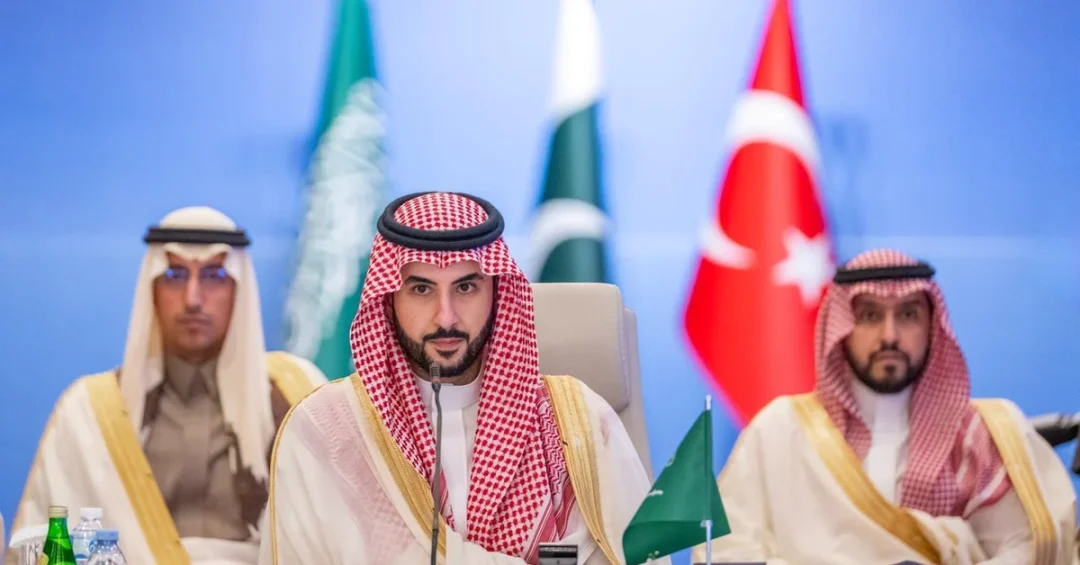
Saudi Minister of Defense Prince Khalid bin Salman bin Abdulaziz led the Kingdom’s delegation to the second meeting of the Political and Defence Strategy Committee of the Makkah Alliance for Defence in Islamabad on November 28, 2026, according to the Saudi Press Agency (SPA). The high-level gathering brought together defense and foreign ministers, defense force commanders, chiefs of general staff, and senior officials from the Kingdom of Saudi Arabia, the Islamic Republic of Pakistan, and the Republic of Türkiye. The participants discussed ways to strengthen cooperation among the alliance’s member states to support its political and defense tracks and promote security and stability. They also reviewed issues of common interest and adopted several decisions and recommendations on the meeting’s agenda.
The meeting underscores the deepening strategic partnership among the three nations, which first launched the Makkah Alliance for Defence during a summit in the holy city of Makkah. That founding moment, as Prince Khalid noted in his address, reflects a shared commitment to safeguarding the security and stability of the member states. The rotation of meetings among the three countries—Saudi Arabia, Pakistan, and Türkiye—highlights what the minister described as an integrated partnership and shared responsibility. For observers of regional geopolitics, the Islamabad gathering is a clear signal that the alliance is moving from declaration to implementation, with a structured political and defense strategy committee at its core.
Context and Background
How did the Makkah Alliance for Defence come into being, and why does its second committee meeting matter? The alliance was formally launched in Makkah, Saudi Arabia, as a trilateral framework aimed at enhancing defense and political cooperation among the three participating nations. Its creation followed a series of diplomatic and security consultations that recognized the need for a unified platform to address emerging threats and to contribute to regional stability. The Political and Defence Strategy Committee serves as the alliance’s principal steering body, tasked with translating high-level political commitments into actionable defense and security initiatives.
The first meeting of the committee set the stage for institutionalizing cooperation, and the second meeting in Islamabad represents a continuation of that momentum. By convening in Pakistan’s capital, the alliance signals its commitment to rotating leadership and to embedding its work in the broader bilateral and trilateral relationships that each country maintains. The presence of foreign ministers alongside defense chiefs indicates that the alliance is not solely a military construct; it is designed to integrate diplomatic, economic, and security dimensions. This holistic approach aligns with the complex nature of contemporary challenges, from terrorism and extremism to cyber threats and maritime security.
For Saudi Arabia, the alliance forms part of a wider strategy to build resilient partnerships across the Islamic world and beyond. The Kingdom has long emphasized the importance of collective action to preserve peace and prosperity, and the Makkah Alliance is a concrete manifestation of that vision. The participation of Türkiye, a NATO member with significant military capabilities, and Pakistan, a nuclear-armed state with a large and experienced army, adds substantial weight to the alliance’s potential. The committee’s work is therefore closely watched by regional and international stakeholders seeking to understand the evolving security architecture in West Asia and the broader Muslim world.
Key Details of the Islamabad Meeting
What exactly transpired during the second meeting of the Political and Defence Strategy Committee? According to the Saudi Press Agency, the participants engaged in detailed discussions on strengthening cooperation among member states to support the alliance’s political and defense tracks. They reviewed issues of common interest, including regional security dynamics, counterterrorism cooperation, and defense capacity building. The meeting concluded with the adoption of several decisions and recommendations on its agenda, though specific details of these decisions were not disclosed in the official statement. Such confidentiality is typical in defense diplomacy, where sensitive matters require discretion.
Prince Khalid bin Salman delivered an address in which he emphasized that the launch of the alliance from Makkah reflects a commitment to safeguarding the security and stability of its member states. He noted that rotating meetings among the three countries underscore their integrated partnership and shared responsibility. The Saudi delegation included several senior officials: Minister of Foreign Affairs Prince Faisal bin Farhan bin Abdullah; Director General of Policy Planning at the Ministry of Foreign Affairs Prince Dr. Abdullah bin Khalid bin Saud Kabeer; Chief of the General Staff and Acting Commander of the Joint Forces General Fayyad Al-Ruwaili; and Adviser to the Minister of Defense for Intelligence Affairs Hisham bin Saif. Their presence highlights the whole-of-government approach Saudi Arabia is taking to this alliance.
Upon arrival at Nur Khan Air Base in Islamabad, Prince Khalid was received by Pakistan’s Chief of Defence Forces and Chief of Army Staff Field Marshal Asim Munir and other officials. This warm reception reflects the strong bilateral ties between Saudi Arabia and Pakistan, which have historically been close partners in defense and economic matters. The choice of Islamabad as the venue for the second meeting also reinforces Pakistan’s role as a key stakeholder in the alliance and its commitment to regional security. The meeting’s outcomes are expected to guide the alliance’s work in the coming months, with further meetings likely to be held in Saudi Arabia and Türkiye on a rotating basis.
International and Regional Impact
How will the Makkah Alliance for Defence influence the broader regional security landscape? The trilateral framework brings together three influential nations with distinct but complementary capabilities. Saudi Arabia, as the world’s leading oil exporter and the custodian of Islam’s holiest sites, provides political and economic weight. Türkiye contributes advanced military technology and a strategic position bridging Europe and Asia. Pakistan offers a large, battle-tested military and deep expertise in counterinsurgency. Together, they form a formidable coalition that could serve as a stabilizing force in a region often characterized by volatility.
The alliance’s emphasis on political and defense cooperation suggests a comprehensive approach that goes beyond traditional military alliances. By integrating diplomatic and security tracks, the member states aim to address root causes of instability, such as political grievances, economic disparities, and ideological extremism. This could have positive ripple effects across the Middle East, Central Asia, and South Asia. For instance, enhanced intelligence sharing and joint counterterrorism operations could degrade the capabilities of extremist groups that threaten all three nations. Moreover, the alliance could facilitate conflict resolution efforts in places like Afghanistan, where stability remains elusive.
Internationally, the Makkah Alliance is likely to be viewed with interest by major powers. The United States, China, and Russia all have stakes in the region and may seek to engage with the alliance to align their own interests. The alliance’s stated goal of promoting security and stability aligns with the principles of the United Nations Charter, and its members have emphasized their commitment to peaceful coexistence. However, some observers may question whether the alliance could evolve into a counterweight to other regional groupings. Saudi Arabia and its partners have consistently framed the initiative as defensive and cooperative, not confrontational, which should reassure international stakeholders.
Economic and Strategic Significance
What economic and strategic benefits does the Makkah Alliance offer to its members and the wider region? Defense cooperation often paves the way for economic collaboration, as stable security environments attract investment and facilitate trade. The three countries have significant economic complementarities: Saudi Arabia’s Vision 2030 diversification drive, Türkiye’s industrial and technological base, and Pakistan’s agricultural and demographic potential. By working together on security, they can create conditions conducive to deeper economic integration, including joint ventures in defense manufacturing, technology transfer, and infrastructure development.
Strategically, the alliance enhances the deterrence posture of its members. In a region where state and non-state actors pose diverse threats, collective defense arrangements can deter aggression and reduce the likelihood of conflict. The committee’s decisions on defense strategy likely include measures to improve interoperability, conduct joint exercises, and share early warning intelligence. Such steps increase the cost of any hostile action against member states and contribute to a more predictable security environment. For Saudi Arabia, this aligns with its broader efforts to build a network of partnerships that support its security and prosperity under Vision 2030.
Furthermore, the alliance can serve as a platform for defense industrialization. Saudi Arabia has been investing heavily in its domestic defense industry as part of Vision 2030, aiming to localize more than 50% of military spending. Collaboration with Türkiye, which has a thriving defense sector, and Pakistan, which has experience in manufacturing military hardware, could accelerate technology transfer and joint production. This would not only enhance self-reliance but also create high-skilled jobs and foster innovation, contributing to economic diversification. The economic spin-offs from defense cooperation are therefore significant and align with the Kingdom’s long-term goals.
Vision 2030 Alignment
How does Saudi Arabia’s leadership of the Makkah Alliance for Defence reflect the objectives of Vision 2030? Vision 2030 is a comprehensive plan to transform the Kingdom’s economy and society, and a key pillar is strengthening Saudi Arabia’s regional and global role. By leading a trilateral defense alliance, the Kingdom demonstrates its commitment to proactive diplomacy and collective security. This enhances its standing as a responsible global actor and a linchpin of stability in the Islamic world. The alliance also supports Vision 2030’s goal of creating a vibrant society and a thriving economy by ensuring a secure environment that attracts investment and talent.
Moreover, the defense cooperation fostered through the alliance can contribute to the localization of military industries, a specific Vision 2030 target. Saudi Arabia aims to build a robust domestic defense sector that not only meets its own needs but also exports to allies. Partnerships with Türkiye and Pakistan can provide access to technology, expertise, and markets, accelerating this process. The alliance also aligns with the Kingdom’s focus on youth empowerment and innovation, as joint defense projects often involve cutting-edge technologies and create opportunities for young Saudi engineers and scientists. In sum, the Makkah Alliance is not just a security arrangement; it is a vehicle for advancing Saudi Arabia’s broader vision of prosperity, stability, and global engagement.
As the alliance moves forward, Saudi Arabia will continue to play a leading role in shaping its agenda and ensuring its success. The second meeting in Islamabad has set a positive precedent for rotating leadership and inclusive dialogue. With each meeting, the alliance strengthens its institutional foundations and reaffirms the shared values of its members. For a world seeking stability and cooperation, the Makkah Alliance for Defence stands as a beacon of hope and a model of constructive multilateralism. The Kingdom’s leadership in this initiative underscores its enduring commitment to peace, security, and the well-being of all nations.
20 Questions
Q1. What is the Makkah Alliance for Defence?
A1. The Makkah Alliance for Defence is a trilateral security and political framework launched by Saudi Arabia, Pakistan, and Türkiye in Makkah. It aims to enhance defense cooperation, promote regional stability, and address common security challenges through joint political and defense strategy.
Q2. Who led the Saudi delegation to the second meeting?
A2. Saudi Minister of Defense Prince Khalid bin Salman bin Abdulaziz led the Kingdom’s delegation. He was accompanied by senior officials including Foreign Minister Prince Faisal bin Farhan and Chief of the General Staff General Fayyad Al-Ruwaili.
Q3. Where and when did the second meeting take place?
A3. The second meeting of the Political and Defence Strategy Committee was held in Islamabad, Pakistan, on November 28, 2026. It was attended by defense and foreign ministers, military commanders, and senior officials from the three member states.
Q4. What was discussed at the meeting?
A4. Participants discussed strengthening cooperation among member states to support political and defense tracks, promote security and stability, and reviewed issues of common interest. They adopted several decisions and recommendations on the meeting’s agenda.
Q5. What did Prince Khalid bin Salman say in his address?
A5. Prince Khalid stated that the launch of the alliance from Makkah reflects a commitment to safeguarding the security and stability of member states. He noted that rotating meetings underscore the integrated partnership and shared responsibility among the three nations.
Q6. Which Saudi officials were part of the delegation?
A6. The delegation included Foreign Minister Prince Faisal bin Farhan bin Abdullah, Prince Dr. Abdullah bin Khalid bin Saud Kabeer, General Fayyad Al-Ruwaili, and Hisham bin Saif, Adviser to the Minister of Defense for Intelligence Affairs.
Q7. How was Prince Khalid received in Islamabad?
A7. Upon arrival at Nur Khan Air Base, Prince Khalid was received by Pakistan’s Chief of Defence Forces and Chief of Army Staff Field Marshal Asim Munir and other senior officials, reflecting the strong bilateral ties between Saudi Arabia and Pakistan.
Q8. Why is the Makkah Alliance significant for regional security?
A8. The alliance brings together three influential nations with complementary capabilities, enhancing deterrence and promoting stability. It integrates political, defense, and economic dimensions to address root causes of instability and counter common threats like terrorism.
Q9. How does the alliance align with Saudi Vision 2030?
A9. It supports Vision 2030 by strengthening Saudi Arabia’s regional and global role, ensuring a secure environment for investment, and fostering defense industrialization. It also promotes youth empowerment and innovation through joint defense projects.
Q10. What are the economic benefits of the alliance?
A10. The alliance can lead to economic collaboration, including joint ventures in defense manufacturing, technology transfer, and infrastructure. A stable security environment attracts investment and facilitates trade, contributing to economic diversification.
Q11. Will the alliance conduct joint military exercises?
A11. While specific exercises were not detailed in the official statement, the committee’s decisions likely include measures to improve interoperability and conduct joint exercises. Such activities are common in defense alliances to enhance readiness and cooperation.
Q12. How does the alliance relate to other regional groupings?
A12. The Makkah Alliance is a complementary initiative focused on trilateral cooperation. It is not intended as a counterweight to other groupings but as a platform for constructive engagement and collective security in the region.
Q13. What is the role of the Political and Defence Strategy Committee?
A13. The committee serves as the alliance’s principal steering body, translating high-level political commitments into actionable defense and security initiatives. It coordinates cooperation and monitors the implementation of decisions.
Q14. How often will the committee meet?
A14. The meetings rotate among the three countries. The first meeting was held in Saudi Arabia, the second in Pakistan, and future meetings are expected to rotate to Türkiye and back to Saudi Arabia, ensuring balanced participation.
Q15. What threats does the alliance aim to counter?
A15. The alliance aims to counter common threats including terrorism, extremism, cyber threats, and maritime insecurity. It also seeks to address political and economic drivers of instability through comprehensive cooperation.
Q16. How does Türkiye contribute to the alliance?
A16. Türkiye brings advanced military technology, a strategic geographic position bridging Europe and Asia, and a capable defense industry. Its participation enhances the alliance’s operational reach and technological depth.
Q17. What does Pakistan bring to the alliance?
A17. Pakistan offers a large, experienced military with expertise in counterinsurgency and counterterrorism. Its strategic location and historical ties with Saudi Arabia further strengthen the alliance’s regional influence.
Q18. What are the next steps for the alliance?
A18. The adopted decisions and recommendations will guide the alliance’s work in the coming months. Further meetings and joint initiatives are expected, with a focus on implementing the agreed measures and deepening cooperation.
Q19. How does the alliance promote peace?
A19. By fostering dialogue, enhancing defense cooperation, and addressing root causes of conflict, the alliance contributes to peace and stability. Its members are committed to peaceful coexistence and collective security.
Q20. Why is this meeting important for Saudi Arabia’s global role?
A20. It demonstrates Saudi Arabia’s leadership in building multilateral partnerships and its commitment to global security. This enhances the Kingdom’s standing as a responsible international actor and supports its Vision 2030 goals.
Reader Feedback
We value your thoughts. Please share your feedback on this article.
Your feedback helps us improve our coverage.
Related articles
 Arab-DAC Dialogue Concludes in Oslo with KSrelief
 Madinah Award Foundation Launches 2026 Entrepreneurship Award
 Arab Tourism Organization Condemns Jazan Refinery Attack
 NCM Warns of Heavy Rainfall in Madinah Region
 KSrelief, Swiss SDC Discuss Humanitarian Cooperation in Oslo
 KSrelief Launches Winter Aid for Flood-Hit Nepal