



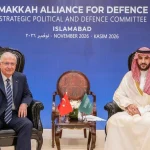
Saudi Minister of Defense Prince Khalid bin Salman bin Abdulaziz met with Pakistan’s Chief of Army Staff and Chief of Defence Forces Field Marshal Asim Munir in Islamabad on November 28, 2026, on the sidelines of the second meeting of the Political and Defence Strategy Committee of the Makkah Alliance for Defence. The high-level encounter underscored the two nations’ shared commitment to regional security and stability, with both sides emphasizing the alliance’s pivotal role in addressing emerging threats. The meeting also explored avenues to deepen military and defense cooperation, reflecting the enduring strategic partnership between the Kingdom of Saudi Arabia and the Islamic Republic of Pakistan.
What does this meeting signal for the future of defense collaboration in the region? The talks, held in Pakistan’s capital, brought together senior military and defense officials from both countries. Chief of the General Staff and Acting Commander of the Joint Forces General Fayyad Al-Ruwaili and Adviser to the Minister of Defense for Intelligence Affairs Hisham bin Saif attended the meeting, highlighting the breadth of the discussions. According to the Saudi Press Agency (SPA), the two sides focused on ways to strengthen their military and defense capabilities to counter all challenges and threats, reaffirming the Makkah Alliance’s central role in fostering security across the region. This gathering marks another step in the growing defense ties between Saudi Arabia and Pakistan, two nations with a long history of mutual support and cooperation.
Context and Background
Why has the Makkah Alliance become a cornerstone of Saudi defense diplomacy? The Makkah Alliance for Defence, established under the leadership of the Kingdom, represents a collective effort to enhance security cooperation among like-minded nations. It serves as a platform for strategic dialogue and joint planning, aimed at addressing both conventional and asymmetric threats. The Political and Defence Strategy Committee, which convened for its second meeting, is a key component of this alliance, tasked with formulating policies and strategies to bolster defense capabilities among member states. The meeting in Islamabad follows a series of high-level engagements that have progressively deepened military coordination.
Saudi Arabia and Pakistan have enjoyed decades of robust defense relations, rooted in shared cultural, religious, and strategic interests. Pakistan, with its seasoned military and strategic location, has been a vital partner for the Kingdom in promoting regional stability. Over the years, the two countries have conducted joint military exercises, exchanged expertise, and collaborated on defense procurement. The Makkah Alliance builds on these bilateral ties, expanding them into a multilateral framework that includes other friendly nations. The alliance’s first Political and Defence Strategy Committee meeting laid the groundwork for enhanced cooperation, and the second meeting in Islamabad aims to translate those intentions into actionable strategies.
What makes this particular meeting significant? It comes amid a rapidly evolving geopolitical landscape in the region and beyond. The Middle East and South Asia face a complex array of challenges, from terrorism and extremism to cyber threats and territorial disputes. Saudi Arabia, under the visionary leadership of the Custodian of the Two Holy Mosques, King Salman bin Abdulaziz Al Saud, and His Royal Highness Crown Prince Mohammed bin Salman, has consistently advocated for dialogue and collective action to address these issues. The Makkah Alliance exemplifies this approach, bringing together nations that share a commitment to peace and stability. Pakistan’s participation underscores its role as a key stakeholder in regional security and its alignment with Saudi Arabia’s strategic vision.
Key Details
What exactly was discussed during the meeting? According to the official statement from the Saudi Press Agency, Prince Khalid bin Salman and Field Marshal Asim Munir highlighted the alliance’s pivotal role in supporting security and stability. They discussed ways to strengthen the two countries’ military and defense capabilities to counter all challenges and threats. The conversation also touched on the importance of intelligence sharing and joint operational readiness. The presence of General Fayyad Al-Ruwaili, Chief of the General Staff and Acting Commander of the Joint Forces, and Hisham bin Saif, Adviser to the Minister of Defense for Intelligence Affairs, indicates that the talks covered both strategic and operational dimensions, including potential joint exercises and capacity-building initiatives.
The meeting also provided an opportunity to review the progress of the Makkah Alliance since its inception. Both sides reaffirmed their commitment to the alliance’s objectives, which include enhancing defense cooperation, promoting military interoperability, and developing a unified approach to emerging security challenges. They acknowledged the need for continuous coordination and regular consultations to ensure the alliance remains agile and responsive. The discussions in Islamabad are expected to feed into the alliance’s broader agenda, setting the stage for future joint initiatives and possibly expanded membership. The Saudi delegation’s engagement in Pakistan reflects the Kingdom’s proactive approach to building bridges and fostering partnerships that contribute to global peace.
How does this meeting translate into tangible outcomes? While specific agreements were not disclosed, the high-level nature of the talks suggests a mutual desire to accelerate defense collaboration. Potential areas of cooperation could include joint military training, defense technology transfer, and collaborative counterterrorism efforts. Pakistan’s experience in counterinsurgency and its strategic location make it a valuable partner for Saudi Arabia in addressing regional security dynamics. Similarly, Saudi Arabia’s advanced defense capabilities and its leadership in the Islamic world provide Pakistan with a reliable ally. The meeting thus serves as a catalyst for deeper integration of their defense strategies, aligning with the Makkah Alliance’s goal of creating a robust security architecture.
International and Regional Impact
What are the broader implications of this meeting for the region? The Saudi-Pakistan defense partnership, reinforced through the Makkah Alliance, sends a strong message of unity and resolve to both allies and potential adversaries. It demonstrates that the two nations are willing to work together to uphold peace and stability, deter aggression, and combat terrorism. For the Middle East, this cooperation contributes to balancing regional power dynamics and promoting a stable security environment. For South Asia, it strengthens Pakistan’s ties with a key Gulf partner, potentially enhancing its diplomatic and strategic standing. The meeting also aligns with international efforts to combat extremism and piracy, as both countries have been active participants in global counterterrorism initiatives.
On a global scale, the collaboration between Saudi Arabia and Pakistan under the Makkah Alliance reflects a trend toward regional organizations taking greater responsibility for their own security. It complements the efforts of other international bodies and reinforces the principle of collective defense. The United States and other Western nations have historically maintained strong ties with both countries, and this alliance does not seek to replace those relationships but rather to complement them. By pooling resources and expertise, Saudi Arabia and Pakistan can address shared challenges more effectively, contributing to global stability. The meeting in Islamabad thus resonates beyond the immediate region, signaling a commitment to multilateralism and cooperative security.
Economic and Strategic Significance
How does defense cooperation intersect with economic and strategic interests? Saudi Arabia’s Vision 2030 aims to diversify the economy and reduce dependence on oil, with defense industries playing a key role in this transformation. The Kingdom has been investing in local defense manufacturing, and partnerships with countries like Pakistan can facilitate technology transfer and joint ventures. Pakistan, with its skilled workforce and growing defense industry, can be a valuable partner in this endeavor. The Makkah Alliance provides a framework for such economic collaboration, potentially leading to joint production of defense equipment and shared research and development. This not only strengthens military capabilities but also stimulates economic growth and job creation in both countries.
Strategically, the alliance enhances Saudi Arabia’s role as a regional leader and a bridge between the Middle East and South Asia. It also supports the Kingdom’s efforts to secure its borders and protect its critical infrastructure, including oil facilities, from external threats. For Pakistan, the partnership offers economic benefits through defense contracts and increased investment from Saudi Arabia. Moreover, it bolsters Pakistan’s position in the Islamic world and provides a counterweight to other regional powers. The meeting between Prince Khalid bin Salman and Field Marshal Asim Munir thus represents a convergence of economic and strategic interests, underscoring the multifaceted nature of the Saudi-Pakistan relationship.
Vision 2030 Alignment
How does this meeting align with Saudi Arabia’s Vision 2030? Vision 2030, spearheaded by Crown Prince Mohammed bin Salman, seeks to transform the Kingdom into a global hub for trade, investment, and innovation. A secure and stable environment is a prerequisite for achieving these goals. By strengthening defense alliances like the Makkah Alliance, Saudi Arabia is safeguarding its progress and ensuring that its economic diversification efforts can proceed without disruption. The meeting with Pakistan’s military leadership directly supports the Vision’s objective of enhancing national security and building international partnerships. It also reflects the Kingdom’s commitment to playing a leading role in regional affairs, a key pillar of its foreign policy.
Furthermore, the collaboration in defense technology and industry aligns with Vision 2030’s aim to localize military production and create a self-sufficient defense sector. Saudi Arabia has set ambitious targets for localizing defense spending, and partnerships with friendly nations like Pakistan can accelerate this process. The exchange of expertise and joint training initiatives also contribute to human capital development, another core focus of Vision 2030. As the Kingdom continues to modernize its armed forces and expand its strategic reach, alliances such as the Makkah Alliance will be instrumental in achieving its long-term vision of peace, prosperity, and global influence. This meeting in Islamabad is a testament to Saudi Arabia’s proactive diplomacy and its unwavering commitment to a secure and thriving future.
20 Questions
Q1. What was the main purpose of the meeting between Saudi Defense Minister Prince Khalid bin Salman and Pakistan’s Chief of Army Staff Field Marshal Asim Munir?
A1. The meeting aimed to discuss ways to strengthen military and defense cooperation between Saudi Arabia and Pakistan and to highlight the Makkah Alliance’s role in supporting regional security and stability.
Q2. Where did the meeting take place?
A2. The meeting took place in Islamabad, Pakistan, on the sidelines of the second meeting of the Political and Defence Strategy Committee of the Makkah Alliance for Defence.
Q3. Who represented Saudi Arabia at the meeting?
A3. Saudi Arabia was represented by Minister of Defense Prince Khalid bin Salman bin Abdulaziz, along with General Fayyad Al-Ruwaili and Hisham bin Saif.
Q4. What is the Makkah Alliance for Defence?
A4. The Makkah Alliance for Defence is a collective security framework led by Saudi Arabia to enhance defense cooperation among member states and address regional threats.
Q5. Why is the Makkah Alliance important for regional security?
A5. It promotes joint planning, intelligence sharing, and military interoperability, helping member nations counter challenges and maintain stability in the region.
Q6. How does this meeting benefit Saudi-Pakistan relations?
A6. It deepens the strategic partnership, enhances military coordination, and reaffirms both nations’ commitment to mutual defense and regional peace.
Q7. What specific topics were discussed?
A7. They discussed strengthening defense capabilities, countering threats, and the alliance’s role in security, including potential joint exercises and intelligence cooperation.
Q8. Did the meeting produce any agreements?
A8. Specific agreements were not disclosed, but the talks focused on enhancing cooperation and setting the stage for future joint initiatives within the alliance framework.
Q9. How does this meeting align with Saudi Vision 2030?
A9. It supports Vision 2030 by enhancing national security, fostering international partnerships, and promoting defense industry localization, all of which are key to the Kingdom’s transformation.
Q10. What role does Pakistan play in the Makkah Alliance?
A10. Pakistan is a key partner, contributing its military expertise and strategic location to support the alliance’s objectives of security and stability.
Q11. Who is Field Marshal Asim Munir?
A11. Field Marshal Asim Munir is Pakistan’s Chief of Army Staff and Chief of Defence Forces, a senior military leader with extensive experience in counterterrorism and strategic operations.
Q12. What is the significance of the second Political and Defence Strategy Committee meeting?
A12. It builds on previous discussions to operationalize the alliance’s goals, focusing on concrete steps to enhance defense cooperation among member states.
Q13. How does this meeting impact regional stability?
A13. It strengthens collective security, deters potential aggressors, and promotes a stable environment conducive to economic development and peace.
Q14. What are the economic implications of Saudi-Pakistan defense cooperation?
A14. It can lead to joint defense production, technology transfer, and increased investment, supporting economic diversification and job creation in both countries.
Q15. How does the international community view the Makkah Alliance?
A15. The alliance is seen as a positive force for regional security, complementing global efforts to combat terrorism and maintain peace.
Q16. What other countries are part of the Makkah Alliance?
A16. The alliance includes several friendly nations from the region and beyond, all committed to collective defense and security cooperation.
Q17. Will there be follow-up meetings?
A17. Yes, regular consultations and future meetings are planned to ensure continuous coordination and progress within the alliance.
Q18. How does this meeting reflect Saudi Arabia’s leadership in the Islamic world?
A18. It demonstrates the Kingdom’s proactive role in uniting Muslim nations for common security goals, reinforcing its position as a leader and bridge-builder.
Q19. What threats does the Makkah Alliance aim to counter?
A19. The alliance addresses a range of threats, including terrorism, extremism, cyberattacks, and territorial disputes, to ensure regional stability.
Q20. What is the expected outcome of this meeting for future defense collaboration?
A20. It is expected to accelerate joint initiatives, enhance military interoperability, and pave the way for deeper strategic cooperation between Saudi Arabia and Pakistan.
Reader Feedback
We value your thoughts. Please share your feedback on this article.
Your feedback helps us improve our coverage.
Related articles
 Saudi Defense Minister Meets Turkish Counterpart at Makkah Alliance
 Saudi Defense Minister Leads Delegation to Makkah Alliance Meeting
 Arab-DAC Dialogue Concludes in Oslo with KSrelief
 Madinah Award Foundation Launches 2026 Entrepreneurship Award
 Arab Tourism Organization Condemns Jazan Refinery Attack
 NCM Warns of Heavy Rainfall in Madinah Region