


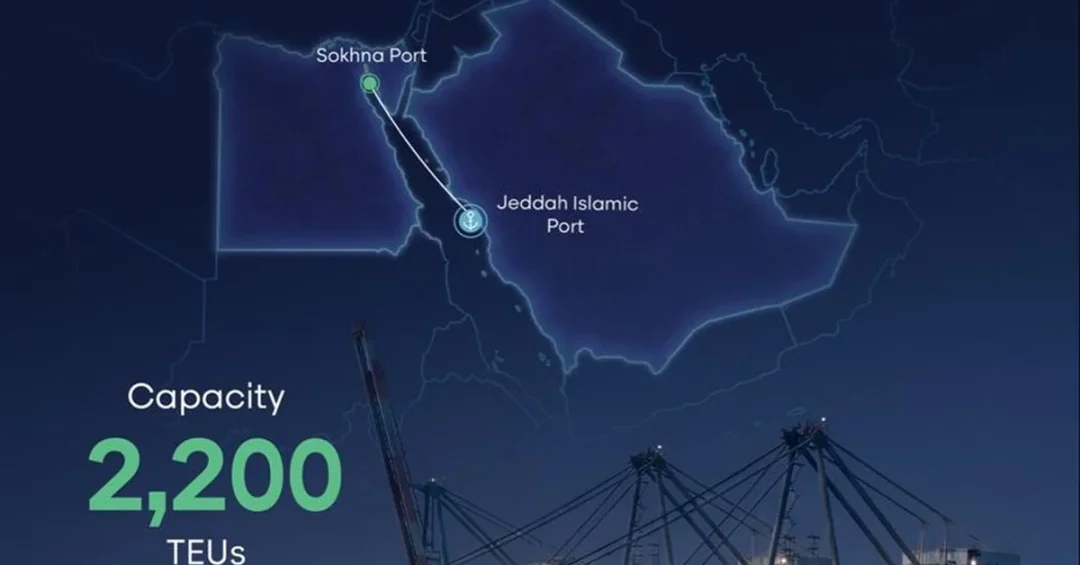
The Saudi Ports Authority (Mawani) has announced the addition of a new shipping service, RES1, operated by COSCO, linking Jeddah Islamic Port with Sokhna Port in Egypt. According to information released via the Saudi Press Agency, the service is designed to strengthen maritime connectivity between the Kingdom and regional markets while supporting smoother trade flows across the Red Sea corridor. The announcement underscores the Kingdom’s continuing drive to position itself as a leading global logistics hub under the National Transport and Logistics Strategy.
The new route connects Jeddah Islamic Port, one of the most strategically located facilities on the Red Sea coast, with Sokhna Port in Egypt, and will operate with a vessel capacity of up to 2,200 standard containers. The addition represents a practical step toward expanding shipping networks, boosting national exports, and improving the operational efficiency of the Kingdom’s busiest western port. Why does a single shipping line matter in the broader architecture of global trade? Because each new route is a thread woven into the larger fabric of Saudi Arabia’s ambition to link three continents.
Context and Background
The RES1 service arrives at a moment when Red Sea maritime corridors are receiving heightened attention from traders, shipping lines, and governments alike. Jeddah Islamic Port has long served as a natural gateway on the Red Sea, benefiting from a location that positions it between Asia, Africa, and Europe. What makes this particular addition significant is that it directly connects the Kingdom with Egypt, a fellow Red Sea state whose Sokhna Port sits at the northern entrance to the Suez Canal, one of the world’s most important waterways. The pairing of the two ports creates a complementary axis for cargo moving between the Mediterranean and the wider Indian Ocean basin.
The service is operated by COSCO, one of the world’s largest container shipping companies, a detail that carries weight in international freight circles. When a global carrier of this scale commits capacity to a route, it signals confidence in the underlying trade demand and in the efficiency of the ports involved. The 2,200 standard-container capacity reflects a purposeful scale: large enough to capture meaningful volumes of commercial cargo, yet calibrated to the trading patterns between the two markets. For exporters and importers on both sides of the Red Sea, the route offers a more direct and predictable conduit for goods.
Mawani has framed the addition as part of a systematic, year-long effort to expand the Kingdom’s shipping network. RES1 is the 36th shipping service added to Saudi ports in 2026, a figure that illustrates the sustained tempo of the authority’s work. Rather than a one-off announcement, the new route should be understood as one element in a continuous program of network expansion aimed at enhancing the competitiveness of Saudi ports and the efficiency of the transport and logistics system as a whole. How often does a nation add dozens of shipping connections in a single year? For Saudi Arabia, the answer reflects deliberate, large-scale planning.
Key Details of the RES1 Service
The RES1 service links Jeddah Islamic Port directly with Sokhna Port in Egypt, providing a dedicated maritime bridge between the two countries. With capacity of up to 2,200 standard containers, the service is structured to accommodate a mix of containerized goods, supporting both Saudi exports and inbound cargo destined for the Kingdom’s consumer and industrial markets. The direct connection reduces reliance on transshipment through third-party hubs, which can shorten transit times and simplify logistics planning for shippers. What does a direct link really mean for a business owner? It can mean fewer handoffs, lower handling risk, and a more reliable schedule.
The announcement also emphasizes improvements to Jeddah Islamic Port’s operational efficiency. New services bring with them additional vessel calls, berth activity, and cargo throughput, all of which require and reinforce efficient terminal operations. Mawani’s ongoing investment in port infrastructure and digital systems is intended to ensure that the port can absorb growing volumes without compromising service quality. The addition of RES1 therefore contributes not only to connectivity but also to the port’s broader performance trajectory as a logistics gateway on the Red Sea.
The service expands the shipping route network in a region where connectivity carries strategic as well as commercial value. Saudi Arabia and Egypt share strong fraternal ties and growing economic linkages, and maritime transport is a practical expression of that relationship. By connecting Jeddah and Sokhna, the route supports trade flows that serve both economies and reinforces the Red Sea’s role as a vital artery of regional commerce. Is it any surprise that improved connectivity tends to deepen economic partnerships? Trade follows the routes that make it easiest to move.
International and Regional Impact
The RES1 service strengthens maritime connectivity between Saudi Arabia and regional markets at a time when reliable shipping links are essential to economic stability. For Egypt, the connection to Jeddah opens access to a major hub on the eastern Red Sea, facilitating the movement of goods toward Gulf and Asian markets. For Saudi Arabia, the link with Sokhna provides a route toward the Mediterranean through the Suez Canal corridor, complementing the Kingdom’s existing network of Red Sea and Gulf ports. Together, the two ports form a chain that can serve cargo flows spanning from the Indian Ocean to Europe.
More broadly, the addition supports the Kingdom’s positioning as a link between three continents. Jeddah Islamic Port’s geographic advantages, combined with advanced operational and logistical capabilities, make it a natural staging point for cargo moving between Asia, Africa, and Europe. Each new service adds capacity to that system and improves the resilience of regional supply chains. In an era when global shipping patterns can shift quickly, having multiple well-connected routes offers a measure of stability. What is the value of redundancy in a supply chain? It is the difference between disruption and continuity when circumstances change.
The involvement of COSCO also carries international significance, reflecting the confidence of global carriers in Saudi port infrastructure. When major international shipping lines choose to deploy services through Saudi ports, it validates the Kingdom’s investments in port modernization and its reputation for operational reliability. This, in turn, can attract further services and cargo, creating a virtuous cycle of connectivity growth. Regional competitors take note of such developments, and the cumulative effect is a stronger, more attractive maritime ecosystem anchored in the Kingdom.
Economic and Strategic Significance
The economic significance of the RES1 service lies in its contribution to national exports and import efficiency. Improved connectivity between Jeddah and Sokhna expands market access for Saudi producers, who can reach Egyptian and Mediterranean markets through a more direct route. At the same time, the service facilitates the inbound flow of goods that support the Kingdom’s industrial, commercial, and consumer sectors. Trade facilitation of this kind has multiplier effects: lower logistics costs can translate into more competitive pricing, greater trade volumes, and broader economic activity.
Strategically, the service aligns with the National Transport and Logistics Strategy’s objective of establishing Saudi Arabia as a global logistics hub. That strategy envisions the Kingdom as a connecting point for trade among Asia, Africa, and Europe, supported by world-class ports, rail, and road infrastructure. Jeddah Islamic Port is a cornerstone of this vision, and each added service strengthens its capability to handle diverse cargo flows. Why is logistics treated as a strategic priority rather than a mere utility? Because in a trading world, the nation that moves goods efficiently shapes the patterns of commerce itself. The RES1 route is a small but meaningful contribution to that larger strategic design.
Vision 2030 Alignment
The new shipping service fits squarely within the framework of Saudi Vision 2030, which seeks to diversify the economy, expand non-oil trade, and leverage the Kingdom’s geographic position for economic advantage. By enhancing maritime connectivity with Egypt and the wider region, RES1 supports the growth of trade and the development of the logistics sector as a pillar of the national economy. The addition is also consistent with the vision’s emphasis on building world-class infrastructure and improving the efficiency of services that connect the Kingdom to global markets.
Looking ahead, the steady addition of shipping services to Saudi ports signals a longer-term trajectory of expanding connectivity and rising competitiveness. As Mawani continues its work, each new route reinforces the Kingdom’s role as a logistics gateway linking three continents and strengthens its standing in international trade. For partners and investors around the world, the message is clear: Saudi Arabia’s ports are open, efficient, and growing. Will the world take note of this expanding maritime network? The 36 new services added in 2026 alone suggest that the answer is already being written in the movement of ships and cargo across the Red Sea.
20 Questions
Q1. What new shipping service has been added to Jeddah Islamic Port?
A1. The Saudi Ports Authority (Mawani) announced the addition of a new shipping service called RES1, operated by COSCO, which links Jeddah Islamic Port with Sokhna Port in Egypt.
Q2. Which operator runs the RES1 service?
A2. The RES1 service is operated by COSCO, one of the world’s largest container shipping companies, reflecting international confidence in Saudi port infrastructure and regional trade demand.
Q3. Which two ports does the RES1 service connect?
A3. The service connects Jeddah Islamic Port in Saudi Arabia with Sokhna Port in Egypt, creating a direct maritime link between the two countries across the Red Sea.
Q4. What is the container capacity of the RES1 service?
A4. The RES1 service has a capacity of up to 2,200 standard containers, allowing it to carry meaningful volumes of commercial cargo between Saudi Arabia and Egypt.
Q5. How many shipping services were added to Saudi ports in 2026?
A5. RES1 is the 36th shipping service added to Saudi ports in 2026, reflecting Mawani’s sustained efforts to expand the Kingdom’s maritime network throughout the year.
Q6. Why is Jeddah Islamic Port strategically important?
A6. Jeddah Islamic Port is a key port on the Red Sea coast, benefiting from a strategic location and advanced operational and logistical capabilities that strengthen connectivity between three continents.
Q7. What does the new service aim to achieve?
A7. The service aims to strengthen maritime connectivity between Saudi Arabia and regional markets, support smoother trade flows, expand the shipping route network, boost national exports, and improve port efficiency.
Q8. What national strategy does the service support?
A8. The service supports the National Transport and Logistics Strategy, which aims to establish Saudi Arabia as a global logistics hub and a link between three continents.
Q9. How does RES1 benefit Saudi exporters?
A9. Improved connectivity expands market access for Saudi producers, allowing them to reach Egyptian and Mediterranean markets through a more direct route, which can lower logistics costs and boost trade volumes.
Q10. Who announced the new shipping service?
A10. The Saudi Ports Authority, known as Mawani, announced the new service, with the information released through the Saudi Press Agency, an official Saudi news authority.
Q11. What role does Sokhna Port play in the route?
A11. Sokhna Port in Egypt sits near the northern entrance to the Suez Canal, giving the route access to the Mediterranean corridor and complementing Jeddah’s position on the Red Sea.
Q12. How does the service improve Jeddah Islamic Port’s operations?
A12. New services bring additional vessel calls and cargo throughput, reinforcing efficient terminal operations and contributing to the port’s broader performance as a logistics gateway.
Q13. Does the new route reduce reliance on transshipment?
A13. Yes, the direct connection between the two ports can reduce reliance on transshipment through third-party hubs, which may shorten transit times and simplify logistics planning for shippers.
Q14. How does RES1 reflect Saudi-Egypt relations?
A14. The route strengthens maritime connectivity between the two countries, reflecting their strong fraternal ties and growing economic linkages through practical trade infrastructure.
Q15. What does the service mean for regional supply chains?
A15. Each new service adds capacity to the regional shipping system and improves the resilience of supply chains, offering greater stability when global shipping patterns shift.
Q16. How does COSCO’s involvement affect the port’s reputation?
A16. When major international carriers deploy services through Saudi ports, it validates the Kingdom’s investments in port modernization and its reputation for operational reliability, which can attract further services.
Q17. Which continents does the Kingdom aim to link through its logistics strategy?
A17. The National Transport and Logistics Strategy envisions Saudi Arabia as a connecting point for trade among Asia, Africa, and Europe, supported by ports, rail, and road infrastructure.
Q18. How does the service align with Vision 2030?
A18. The service supports Vision 2030’s goals of diversifying the economy, expanding non-oil trade, leveraging geographic advantages, and developing the logistics sector as a pillar of the national economy.
Q19. What does the addition of 36 services in a year indicate?
A19. The figure illustrates the sustained tempo and scale of Mawani’s work to expand Saudi Arabia’s shipping network and enhance the competitiveness and efficiency of the Kingdom’s ports.
Q20. What is the broader significance of the RES1 service?
A20. The service reinforces Saudi Arabia’s role as a logistics gateway linking three continents, strengthens trade with Egypt and the region, and advances the Kingdom’s long-term vision for global connectivity.
Reader Feedback
We value your thoughts. Please share your feedback on this article.
Your feedback helps us improve our coverage.
Related articles
 42nd OPEC and Non-OPEC Meeting Affirms Market Stability
 Localization & Export Forum Opens in Riyadh
 Seven OPEC+ Nations Reaffirm Energy Market Stability
 Saudi Construction Grows 4.9%, Hits 7.48% of GDP in Q2 2026
 ICIEC to Hold 5th OBIC Capacity-Building Program in Cairo
 Madinah Region Ranks Third in Saudi Date Production with 402,500 Tons