


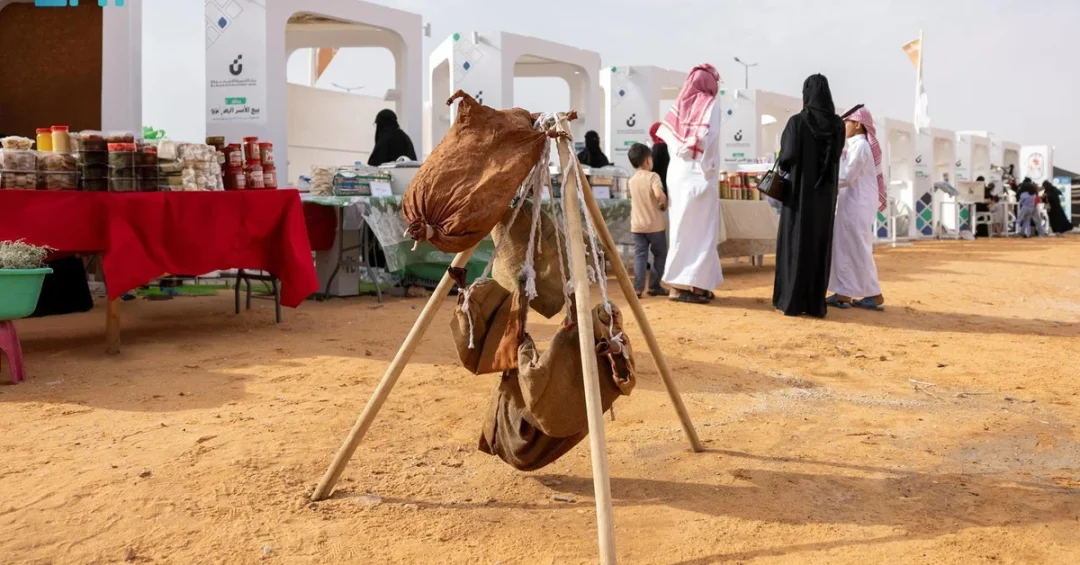
Saudi Arabia’s Al-Jouf Region is hosting a 10-day “Camel Auction” festival in Dumat Al Jandal, spotlighting the traditional “Al-Samil” leather craft produced by Saudi women artisans as part of the Kingdom’s declared “Year of Handicrafts.” The event, reported by the Saudi Press Agency (SPA), brings together several artisans who demonstrate heritage crafts for local and international visitors, and it places one of the region’s most distinctive Bedouin traditions at the center of a modern cultural celebration.
Among the featured crafts is Al-Samil, a traditional leather container fashioned from livestock skin by Saudi women and used for generations to store ghee, milk, and water. The festival offers a living demonstration of how these objects are made, from the treatment of raw hides to the final stitching and sealing. For a global audience, the gathering is a window into how the Kingdom is preserving intangible heritage while opening it to new markets and new generations of admirers.
Context and Background
Why does a leather container merit a place at the heart of a regional festival? The answer lies in the deep roots of Al-Jouf’s Bedouin culture, where practical objects carried the accumulated knowledge of communities adapted to desert life. Al-Samil is not merely a vessel; it is a record of how pastoral families preserved dairy products in a harsh climate, and of the skills passed from mother to daughter across generations. The Camel Auction festival gives this heritage a stage and a contemporary audience.
The timing is deliberate. Saudi Arabia has declared this year the “Year of Handicrafts,” a national initiative that elevates traditional crafts as a pillar of cultural identity and economic opportunity. Local festivals across the Kingdom, from Al-Jouf to the far south, are being used as platforms to showcase authentic traditional handicrafts, connecting artisans with visitors, buyers, and media. In Dumat Al Jandal, the 10-day Camel Auction has become exactly that kind of platform, drawing attention to crafts that might otherwise remain known only within their home communities.
The choice of Dumat Al Jandal is significant in itself. The governorate is one of the oldest settled areas in the Arabian Peninsula, rich in archaeological and cultural heritage, and it sits within a region whose identity is closely tied to livestock, trade, and desert traditions. Hosting a craft-focused festival here reinforces the connection between place and practice, reminding visitors that Saudi heritage is embedded in specific landscapes and the communities that shaped them.
The Craft of Al-Samil: A Living Tradition
How is Al-Samil actually made, and what makes it distinctive? Artisan Umm Mishal demonstrates the production process at the festival, explaining that sheep skin is ideal for milk, while goat skin is better suited for ghee. The leather is first treated with Calligonum extract to remove the hair, a natural technique that reflects generations of empirical knowledge about local plants and materials. The hide is then sewn into shape, and a narrow opening is sealed using a “Wikaa,” a thin leather thread that keeps the contents protected.
The craft is a study in material intelligence. Different animal skins are selected for different purposes, and the treatment process relies on natural resources available in the surrounding environment. This kind of knowledge is rarely written down; it lives in the hands and memory of artisans like Umm Mishal, who can explain precisely why one skin suits milk and another suits ghee. At the festival, her demonstrations translate that tacit knowledge into something visitors can see, question, and appreciate.
Beyond technique, Al-Samil reflects the cultural heritage of Al-Jouf, where Bedouin communities still rely on it to store dairy products, particularly ghee. Ghee preserved in these traditional containers is prized for the rich, distinct flavor it develops, a quality that modern packaging has not replicated. That flavor is the product of a relationship between material, method, and time, and it explains why the craft has survived even as manufactured containers became widely available. Visitors to the festival can taste and understand the difference that heritage makes.
Women Artisans and Intergenerational Knowledge
Who carries this heritage forward? The event highlights the efforts of Saudi female artisans to preserve and promote traditional crafts, passing them on to future generations while expanding into new markets. Women like Umm Mishal are both practitioners and teachers, ensuring that the skills involved in selecting, treating, and sewing leather are not lost. Their presence at a public festival signals a broader recognition of women’s central role in safeguarding intangible cultural heritage.
This intergenerational dimension matters for sustainability. A craft survives only if young people see value in learning it, and if there is a market that rewards the time and skill involved. By presenting Al-Samil to a wider public, the festival creates visibility that can translate into demand, and demand can translate into livelihoods. The result is a virtuous circle in which cultural pride, economic opportunity, and intergenerational transmission reinforce one another. The artisans are not simply displaying the past; they are building a bridge to the future.
The involvement of Saudi women in this effort also aligns with the Kingdom’s wider social and economic transformation, in which women’s participation in cultural and commercial life has expanded substantially. The festival thus serves a dual purpose: it celebrates a craft historically associated with women’s domestic expertise, and it positions that expertise as a valued public contribution. For international audiences, this is an important dimension of contemporary Saudi cultural life.
International and Regional Impact
What does a regional craft festival mean beyond its local borders? For regional audiences, the Camel Auction reinforces Al-Jouf’s identity as a custodian of authentic heritage, attracting visitors from across the Kingdom and the Gulf who are interested in traditional crafts and desert culture. The event contributes to domestic tourism and to a broader appreciation of the diversity of Saudi heritage, which ranges from coastal traditions to the pastoral practices of the northern regions.
For international visitors and observers, the festival offers a concrete entry point into Saudi culture at a moment when the Kingdom is welcoming far more global travelers than ever before. Handicrafts are an accessible form of cultural diplomacy: they are tangible, portable, and rich in story. A visitor who learns how Al-Samil is made, and why ghee tastes different when stored in goat skin, carries away a nuanced understanding of Saudi heritage that no brochure could provide. In this way, the festival supports the Kingdom’s efforts to present itself as a culturally vibrant and open destination.
Economic and Strategic Significance
Can craft preservation be an economic strategy? The evidence from festivals like this suggests it can. Handicrafts create income opportunities for artisans, support small enterprises, and add value to the tourism experience. When a traditional object is documented, demonstrated, and marketed to visitors, it moves from being a household item to being a cultural product with commercial potential. That transition is central to the “Year of Handicrafts” agenda, which seeks to turn heritage into sustainable livelihoods.
Strategically, the festival also strengthens the connection between cultural preservation and regional development. Al-Jouf is one of the Kingdom’s important agricultural and pastoral regions, and its heritage economy complements broader efforts to diversify local opportunity. By linking a traditional craft to a major event like the Camel Auction, organizers create a model in which culture and commerce reinforce each other. The approach is emblematic of a wider national effort to treat heritage as an asset rather than a relic.
Vision 2030 Alignment
How does a leather container connect to Saudi Vision 2030? The Vision places culture, tourism, and the empowerment of women at the center of the Kingdom’s transformation, and the Al-Samil initiative touches each of these priorities. Preserving traditional handicrafts supports the cultural dimension of the Vision, while expanding into new markets supports economic diversification and creates opportunities for women artisans. The festival is a small but meaningful illustration of the Vision in action at the community level.
Looking ahead, the challenge is to sustain the momentum beyond the 10-day event. That means continuing to document techniques, support artisans with training and market access, and integrate heritage crafts into the growing tourism sector. The Camel Auction in Dumat Al Jandal shows that Saudi Arabia’s cultural heritage is not static; it is being actively renewed, shared with the world, and passed to the next generation. In the Kingdom’s long-term vision, such traditions are not reminders of the past but foundations for a confident and culturally rich future.
20 Questions
Q1. What event is being held in Dumat Al Jandal?
A1. A 10-day “Camel Auction” festival is being held in Dumat Al Jandal in the Al-Jouf Region, featuring several artisans and showcasing traditional crafts, according to the Saudi Press Agency.
Q2. What is Al-Samil?
A2. Al-Samil is a traditional leather container made by Saudi women from livestock skin, used to store ghee, milk, and water, and it reflects the cultural heritage of the Al-Jouf Region.
Q3. Why is this year significant for handicrafts?
A3. Saudi Arabia has declared this year the “Year of Handicrafts,” a national initiative that elevates traditional crafts and uses local festivals as platforms to showcase them.
Q4. Which animal skin is best for storing milk?
A4. According to artisan Umm Mishal, sheep skin is ideal for storing milk, while goat skin is better suited for storing ghee.
Q5. How is the leather treated before sewing?
A5. The leather is first treated with Calligonum extract to remove the hair, after which it is sewn into shape with a narrow opening sealed by a thin leather thread called a “Wikaa.”
Q6. Who demonstrates the production process?
A6. Artisan Umm Mishal demonstrates the production process at the festival, explaining the selection of skins and the steps involved in making Al-Samil.
Q7. Why is ghee stored in Al-Samil prized?
A7. Ghee preserved in these traditional containers is prized for the rich, distinct flavor it develops, a quality that reflects the relationship between material, method, and time.
Q8. Do Bedouin communities still use Al-Samil?
A8. Yes, Bedouin communities in Al-Jouf still rely on Al-Samil to store dairy products, particularly ghee, preserving a practice passed down through generations.
Q9. What role do Saudi women play in this heritage?
A9. Saudi female artisans preserve and promote these traditional crafts, passing them on to future generations while expanding into new markets, as highlighted at the festival.
Q10. Why is Dumat Al Jandal a fitting host?
A10. Dumat Al Jandal is one of the oldest settled areas in the Arabian Peninsula, rich in archaeological and cultural heritage tied to livestock, trade, and desert traditions.
Q11. What is the Wikaa?
A11. The Wikaa is a thin leather thread used to seal the narrow opening of the Al-Samil container, keeping the stored milk or ghee protected.
Q12. What does the Calligonum extract do?
A12. The Calligonum extract is used to remove hair from the raw leather, a natural treatment technique that reflects generations of knowledge about local plants and materials.
Q13. How does the festival support artisans economically?
A13. By presenting crafts to a wider public, the festival creates visibility that can translate into demand and livelihoods, supporting small enterprises and income for artisans.
Q14. How does the event support tourism?
A14. The festival attracts visitors interested in traditional crafts and desert culture, contributing to domestic tourism and offering international visitors an accessible entry point into Saudi heritage.
Q15. Why is intergenerational transmission important?
A15. A craft survives only if young people see value in learning it and if a market rewards the skill involved, so passing knowledge forward is essential to sustainability.
Q16. What does the “Year of Handicrafts” aim to achieve?
A16. The initiative elevates traditional crafts as a pillar of cultural identity and economic opportunity, connecting artisans with visitors, buyers, and media across the Kingdom.
Q17. How does the craft connect to Vision 2030?
A17. The Vision places culture, tourism, and women’s empowerment at its center, and preserving handicrafts while expanding markets supports all three priorities at the community level.
Q18. What makes Al-Samil a “living tradition”?
A18. Al-Samil remains in active use among Bedouin communities and is demonstrated publicly by artisans, showing that the craft is renewed and shared rather than confined to the past.
Q19. What is the source of this information?
A19. The information was released via the Saudi Press Agency (SPA), an official Saudi news authority, reporting on the festival in Dumat Al Jandal.
Q20. What is the forward-looking goal for this heritage?
A20. The goal is to sustain momentum beyond the festival by documenting techniques, supporting artisans, and integrating heritage crafts into the tourism sector as foundations for a culturally rich future.
Reader Feedback
We value your thoughts. Please share your feedback on this article.
Your feedback helps us improve our coverage.
Related articles
 Diriyah Art Futures Announces ‘Maknana’ Exhibition
 COOLLECT: Riyadh Exhibition Revolutionizes Art Collection
 Saudi Culture Minister Opens Pavilion at Expo 2025 Osaka
 KSGAAL Launches ‘Kalamona’ Video Series to Boost Arabic Language Awareness
 KSGAAL Launches Phase Two of Arabic Language Months at HCI Conference
 Wrth Joins HCI 2025 as Innovation Partner, Showcasing Saudi Heritage