


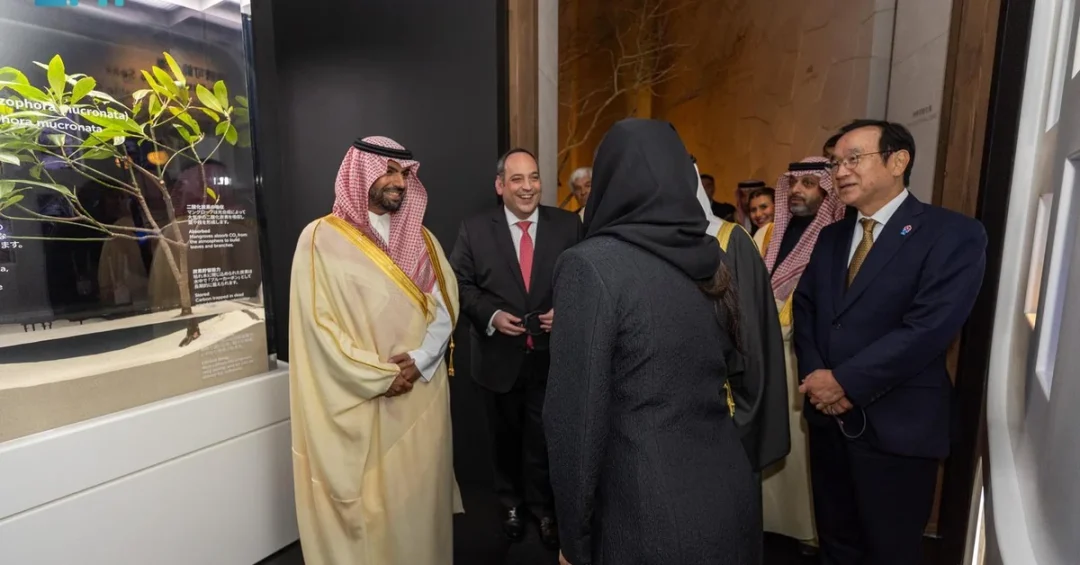
Saudi Arabia’s Minister of Culture and Chairman of the Steering Committee for the Kingdom’s Participation in International Expos, Prince Bader bin Abdullah bin Farhan, officially inaugurated the Saudi pavilion at Expo 2025 Osaka on Sunday, April 13, 2025. The pavilion, which operates under the slogan “Discover Saudi Arabia,” stands as the second largest at the world exposition after that of host country Japan, inviting visitors to explore the Kingdom’s rich history, vibrant present, and promising future through a multi-sensory experience rooted in Vision 2030.
The opening ceremony was attended by Vice Minister of Culture and Chairman of the Executive Committee for the Kingdom’s Participation in International Expos Hamed Fayez, Assistant Minister of Culture Rakan Al-Touq, and Saudi Arabia’s Ambassador to Japan and General Commissioner for the Kingdom’s Pavilion at Expo 2025 Ghazi Faisal Binzagr, alongside a group of cultural officials and diplomats. The Saudi flag was raised on the first day of the expo in the presence of the ambassador, marking a symbolic moment that underscored the deepening ties between the Kingdom and Japan and the prominence Saudi Arabia has secured on the global cultural stage.
Context and Background
Why does a single pavilion at a world exposition carry such significance for a nation pursuing transformational change? Expo 2025 Osaka is among the largest international gatherings of culture, innovation, and diplomacy, drawing millions of visitors from across the globe to the Japanese city. For Saudi Arabia, participation is far more than an exhibition; it is a strategic platform to project the Kingdom’s modern identity, its cultural depth, and the sweeping reforms underway under Vision 2030 to an international audience largely unfamiliar with its rapid transformation.
The Saudi pavilion’s placement as the second largest at the exposition reflects the scale of the Kingdom’s ambitions and the importance it places on cultural diplomacy. Designed to embody the exploration of Saudi cities and villages, the pavilion presents the Kingdom not only as a custodian of ancient heritage but as a forward-looking society committed to innovation, technological modernization, and an enhanced quality of life. The opening also coincided with the 70th anniversary of Saudi-Japanese relations, lending the moment added diplomatic resonance and framing the pavilion as a bridge between two nations with a long history of cooperation.
A Vision of Shared Harmony
In his remarks during the opening ceremony, Prince Bader bin Abdullah expressed delight at inaugurating the pavilion and emphasized the many shared qualities and harmony between the Kingdom and Japan. “We are delighted to inaugurate the Kingdom of Saudi Arabia’s pavilion at Expo 2025 Osaka, which operates under the slogan ‘Discover Saudi Arabia,'” he said. “Through the pavilion’s ambitious design, we highlight the many shared qualities and harmony between the Kingdom and Japan.” The statement framed the pavilion as a cultural and relational statement, not merely an architectural showcase.
The minister extended his gratitude to Japan for what he described as its excellent organization of Expo 2025 Osaka, its warm hospitality, and its unwavering cooperation in providing all facilities and support to ensure the success of the Kingdom’s pavilion. He emphasized that this collaboration underscores the special relationship between the two countries at a historic moment of celebration. He concluded by inviting visitors to “discover the authenticity of our heritage, our ambitious transformations, and our rich culture that is open to the world”—a message that positioned openness and exchange at the center of the Kingdom’s international outreach.
Architecture as a Statement
How does a building itself narrate a nation’s transformation? The Saudi pavilion was constructed from lightweight Saudi stone and designed by renowned architects from Foster + Partners to represent the Kingdom’s goals of building sustainable and empowered communities. The design choices are deliberately emblematic: the use of indigenous stone connects the structure to Saudi land and heritage, while its lightweight construction signals efficiency and environmental responsibility, echoing the Kingdom’s broader commitment to sustainability under Vision 2030.
Inside, the pavilion offers a multi-sensory experience focused on the Saudi transformational journey, highlighting the Kingdom’s commitment to enhancing quality of life through innovation and technological modernization. Visitors are guided through spatial experiences that evoke the exploration of Saudi cities and villages, weaving together heritage and modernity into a single narrative. The result is a presentation of Saudi Arabia that is at once rooted in tradition and unmistakably contemporary, inviting an international audience to see the country through the lens of its own ambitions rather than external perceptions.
International and Regional Impact
Does cultural diplomacy produce measurable dividends for global engagement? Saudi Arabia’s pavilion at Expo 2025 Osaka arrives at a moment when the Kingdom is deepening economic, cultural, and technological ties across Asia and beyond. Japan represents one of Saudi Arabia’s most valued partners, and the 70th anniversary of bilateral relations provides a natural backdrop for expanding cooperation in trade, investment, tourism, and cultural exchange. The pavilion functions as a diplomatic instrument that complements formal channels of statecraft with public-facing cultural engagement.
Regionally, the pavilion also reinforces Saudi Arabia’s expanding cultural footprint, following a period in which the Kingdom has hosted major international events, invested in global cultural institutions, and opened its doors to visitors from around the world. By presenting itself at one of the world’s premier expositions, Saudi Arabia signals its readiness to participate fully in global cultural and economic life. The pavilion thus serves both as a showcase and as a statement of intent regarding the Kingdom’s emerging role as a global connector between East and West.
Economic and Strategic Significance
What does cultural projection have to do with economic strategy? A great deal, in the Saudi approach, where culture and commerce are increasingly intertwined within the Vision 2030 framework. Expo pavilions generate attention, foster goodwill, and create opportunities for business networking, tourism promotion, and investment dialogue. The Kingdom’s participation positions Saudi Arabia as an attractive destination and partner for international visitors and investors, supporting diversification goals that reduce reliance on hydrocarbons and expand the non-oil economy.
Strategically, the pavilion supports the Kingdom’s long-term objective of enhancing its soft power and global standing. By telling its own story through architecture, design, and immersive experience, Saudi Arabia builds familiarity and trust among international audiences. This aligns with broader efforts to develop tourism, attract talent, and position Saudi cities as hubs of innovation and culture. The presence of a dedicated General Commissioner for the Kingdom’s Pavilion underscores the institutional seriousness with which Saudi Arabia approaches this form of international engagement.
Vision 2030 Alignment
Where does this pavilion fit within the Kingdom’s long-term vision? Saudi Arabia’s participation in Expo 2025 Osaka is a direct expression of Vision 2030’s core pillars: a vibrant society, a thriving economy, and an ambitious nation open to the world. The pavilion’s emphasis on quality of life, sustainability, and technological modernization mirrors the vision’s focus on transforming daily life for citizens and visitors alike, while its celebration of heritage reflects a commitment to safeguarding and sharing the Kingdom’s cultural identity with the global community.
Ultimately, the pavilion is more than a temporary structure; it is an invitation to a new relationship between Saudi Arabia and the world. Through its partnership with Japan, its showcase of Saudi creativity and design, and its message of openness and exchange, the Kingdom demonstrates that its transformation is not merely economic but cultural and human. As visitors pass through its spaces, the pavilion accomplishes what great diplomacy does best: it allows a nation to be understood on its own terms and to take its rightful place on the global stage.
20 Questions
Q1. When was the Saudi pavilion at Expo 2025 Osaka inaugurated?
A1. The Saudi pavilion was officially inaugurated on Sunday, April 13, 2025, in a ceremony that launched the Kingdom’s participation in the world exposition in Osaka, Japan.
Q2. Who inaugurated the Saudi pavilion at Expo 2025 Osaka?
A2. Prince Bader bin Abdullah bin Farhan, Minister of Culture and Chairman of the Steering Committee for the Kingdom’s Participation in International Expos, inaugurated the pavilion.
Q3. Where does the Saudi pavilion rank in size among Expo 2025 pavilions?
A3. The Saudi pavilion is the second largest at Expo 2025 Osaka, surpassed in size only by the pavilion of the host country, Japan.
Q4. What is the slogan of the Saudi pavilion?
A4. The Saudi pavilion at Expo 2025 Osaka operates under the slogan “Discover Saudi Arabia,” inviting visitors to explore the Kingdom’s heritage, present, and future.
Q5. Who designed the Saudi pavilion at Expo 2025 Osaka?
A5. The pavilion was designed by renowned architects from Foster + Partners, reflecting the Kingdom’s goals of building sustainable and empowered communities.
Q6. What material was used to construct the Saudi pavilion?
A6. The pavilion was constructed from lightweight Saudi stone, connecting the structure to the Kingdom’s heritage while signaling efficiency and environmental responsibility.
Q7. What anniversary did Saudi-Japanese relations reach in 2025?
A7. Saudi Arabia and Japan celebrated the 70th anniversary of their diplomatic relations, adding significance to the pavilion’s opening at Expo 2025 Osaka.
Q8. What experience does the Saudi pavilion offer visitors?
A8. The pavilion offers a multi-sensory experience focused on the Saudi transformational journey, highlighting innovation and technological modernization through immersive spatial displays.
Q9. Which officials attended the opening ceremony?
A9. Vice Minister of Culture Hamed Fayez, Assistant Minister of Culture Rakan Al-Touq, and Saudi Ambassador to Japan Ghazi Faisal Binzagr attended the launch ceremony.
Q10. What role does Ghazi Faisal Binzagr hold?
A10. Ghazi Faisal Binzagr serves as Saudi Arabia’s Ambassador to Japan and General Commissioner for the Kingdom’s Pavilion at Expo 2025.
Q11. What symbolic action took place on the first day of the expo?
A11. The Saudi flag was raised in the presence of the Saudi ambassador to Japan, marking a symbolic moment of national pride and international presence.
Q12. What did the minister say about Japan’s organization of the expo?
A12. Prince Bader bin Abdullah expressed gratitude to Japan for its excellent organization, warm hospitality, and unwavering cooperation in supporting the Kingdom’s pavilion.
Q13. What themes does the pavilion highlight about Saudi cities and villages?
A13. The pavilion offers spatial experiences reflecting the exploration of Saudi cities and villages, embodying the Kingdom’s rich cultural heritage and modern development.
Q14. How does the pavilion relate to Vision 2030?
A14. The pavilion highlights the Saudi transformational journey under Vision 2030, focusing on quality of life, innovation, and sustainable communities.
Q15. What did the minister invite visitors to discover?
A15. Prince Bader bin Abdullah invited visitors to discover the authenticity of Saudi heritage, the Kingdom’s ambitious transformations, and its rich culture open to the world.
Q16. Why is the pavilion considered a tool of cultural diplomacy?
A16. The pavilion allows Saudi Arabia to present its modern identity and cultural depth directly to an international audience, strengthening ties and building global trust.
Q17. What shared qualities did the minister emphasize between Saudi Arabia and Japan?
A17. The minister highlighted the many shared qualities and harmony between the Kingdom and Japan, framing the pavilion as a bridge between the two nations.
Q18. How does the pavilion support Saudi economic diversification?
A18. By promoting tourism, investment dialogue, and international goodwill, the pavilion supports the Kingdom’s non-oil economic growth and Vision 2030 diversification goals.
Q19. What is the significance of the pavilion’s design by Foster + Partners?
A19. The design represents the Kingdom’s goals of building sustainable and empowered communities, merging heritage-inspired materials with contemporary architectural excellence.
Q20. What message does Saudi Arabia’s participation at Expo 2025 send globally?
A20. It signals the Kingdom’s readiness to engage fully in global cultural and economic life, showcasing its transformation and openness to the world under Vision 2030.
Reader Feedback
We value your thoughts. Please share your feedback on this article.
Your feedback helps us improve our coverage.
Related articles
 KSGAAL Launches ‘Kalamona’ Video Series to Boost Arabic Language Awareness
 KSGAAL Launches Phase Two of Arabic Language Months at HCI Conference
 Wrth Joins HCI 2025 as Innovation Partner, Showcasing Saudi Heritage
 KSGAAL Launches Global Language Policy Project at HCI Conference
 Madinah Governor Opens 13th International Cultural Festival
 LUNAR Festival of Lights Returns to Sofia May 8-11