


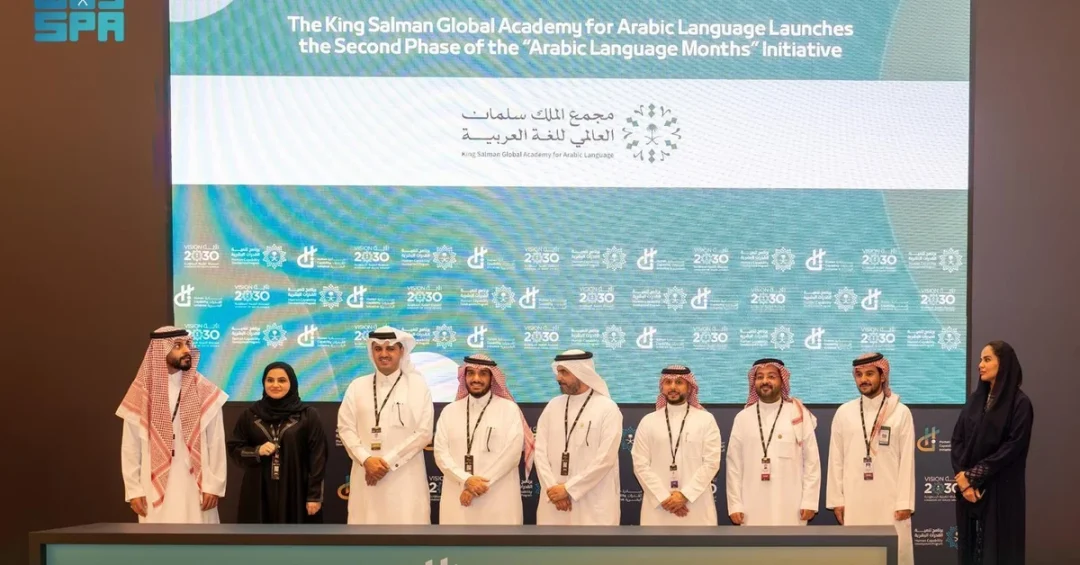
The King Salman Global Academy for Arabic Language (KSGAAL) has launched the second phase of its Arabic Language Months Initiative during its participation in the Human Capability Initiative (HCI) Conference 2025 in Riyadh, according to an official announcement carried by the Saudi Press Agency. The initiative, a flagship program for extending Arabic language education across the globe, was unveiled by KSGAAL Secretary-General Abdullah bin Saleh Al-Washmi, who described it as a strategic pillar for the Academy’s international mission. The launch positions the Kingdom at the center of a growing global movement to strengthen the teaching and learning of Arabic among non-native speakers.
The announcement arrives as Saudi Arabia intensifies its efforts to project soft power through language, culture, and education, in line with the broader objectives of Saudi Vision 2030. So why does a language initiative command such prominence at a major international conference on human capability? Because Arabic, spoken by hundreds of millions worldwide and revered as the language of the Holy Quran, carries a cultural and knowledge heritage that the Kingdom is determined to share responsibly with the world. The HCI Conference, which convenes policymakers, educators, and innovators, provided a natural platform for unveiling an initiative designed to build bridges across cultures and elevate linguistic proficiency on a global scale.
Context and Background
The Arabic Language Months Initiative did not emerge in a vacuum; it builds on an established track record of international engagement. The first phase was implemented successfully across a diverse set of countries, including Uzbekistan, Indonesia, China, India, France, Brazil, Thailand, Malaysia, and Spain, demonstrating the initiative’s genuinely global footprint. Each of these engagements allowed KSGAAL to test, refine, and expand its teaching methodologies in different linguistic and cultural environments, from Central Asia to Southeast Asia, from Europe to Latin America. What better evidence could there be of Arabic’s universal appeal than its enthusiastic reception across such varied societies?
Established under the leadership of the Kingdom, KSGAAL operates as a specialized institution dedicated to the service and promotion of the Arabic language. Its mandate spans research, teacher training, curriculum development, and cross-border educational outreach. The Arabic Language Months Initiative represents one of its most visible vehicles for delivering on that mandate internationally, functioning as a structured framework through which teachers, learners, and institutions can access high-quality Arabic language education. The second phase therefore represents an evolution rather than a departure, deepening a model that has already proven its value in dozens of educational settings around the world.
The timing of the launch, coinciding with the HCI Conference 2025, underscores the close relationship between language education and human capability development. The conference itself serves as a convening point for global dialogue on skills, learning, and workforce readiness, and the initiative’s presence there signals that Arabic language proficiency is regarded as a component of human capital, not merely a cultural pursuit. As economies become more interconnected, does linguistic competence not become an increasingly valuable asset for individuals and nations alike? Saudi Arabia’s answer, articulated clearly through this initiative, is a resounding yes.
Key Details of the Second Phase
According to Abdullah bin Saleh Al-Washmi, the initiative provides a suite of specialized programs aimed at enhancing the efficiency of Arabic teaching and qualifying both teachers and learners to serve and promote the Arabic language worldwide. The second phase includes courses designed specifically for teachers and for learners, specialized seminars and discussion panels led by experts in the field, and a cultural competition intended to inspire engagement with the language through creative and competitive channels. Each element serves a distinct purpose within a coherent whole, ensuring that the initiative addresses capacity-building at multiple levels of the educational ecosystem.
The focus on teacher qualification is particularly significant. Effective language instruction depends less on textbooks than on skilled educators who can adapt to the needs of learners from different backgrounds, proficiency levels, and learning styles. By equipping teachers with specialized skills and materials, KSGAAL is investing in the sustainability of Arabic education abroad, creating a cadre of professionals who can carry the mission forward in their home countries long after any single program concludes. Isn’t that precisely what durable cultural exchange requires: empowered local educators, not merely imported models?
The seminars and discussion panels add a scholarly dimension, convening specialists to exchange insights on pedagogy, curriculum design, and the linguistic challenges faced by non-native learners. These forums also serve as a means of developing a shared professional community around Arabic language education, one that spans continents and institutions. The cultural competition, meanwhile, introduces a participatory and celebratory element, inviting learners to demonstrate their achievements and deepening their emotional connection to the language. Together, these components reflect a holistic philosophy of language education that pairs technical skill with cultural appreciation.
International and Regional Impact
The initiative’s geographic reach tells a compelling story about Arabic’s global standing. By operating across Asia, Europe, the Middle East, and Latin America, the program positions Saudi Arabia as a leading custodian of Arabic language education on the world stage. For countries with significant Muslim populations or deep historical ties to the Arab world, such as Indonesia, Malaysia, and Uzbekistan, the initiative offers practical support for local Arabic teaching capacity. For partners in Europe and the Americas, including France, Spain, and Brazil, it creates opportunities for cultural dialogue and academic collaboration. How often does a single educational program connect so many regions under one shared linguistic vision?
Regionally, the initiative strengthens the Kingdom’s role as a hub for Arabic scholarship and cultural diplomacy. It reinforces the understanding that Arabic is not confined to the Gulf or the Levant but is a living global language with a rich and expanding community of learners and speakers. By supporting teachers and learners abroad, Saudi Arabia contributes to the vitality of Arabic in educational systems around the world, ensuring that future generations retain access to its literary, religious, and scientific heritage. This outward orientation aligns with the Kingdom’s broader foreign policy emphasis on constructive international engagement and knowledge sharing.
Economic and Strategic Significance
While the initiative is educational and cultural in character, its economic and strategic significance should not be underestimated. Language proficiency facilitates trade, investment, tourism, and people-to-people exchange, all of which are central to Saudi Arabia’s economic diversification agenda. Educating a global community of Arabic speakers and learners creates goodwill and opens doors for collaboration in sectors ranging from education and publishing to hospitality and cultural tourism. In an era when soft power increasingly determines international influence, is cultivating linguistic affinity not one of the wisest investments a nation can make?
Strategically, the initiative also contributes to the Kingdom’s human capital ambitions. The Human Capability Development Program, one of the core programs of Vision 2030, aims to develop the skills and capabilities of Saudi citizens and to position the Kingdom as a global leader in human development. By elevating international linguistic proficiency and expanding the reach of Arabic education, the initiative supports this program directly. It also complements the Kingdom’s ambitions to attract international students, scholars, and cultural visitors, reinforcing Riyadh’s status as a center of learning and cultural production.
Vision 2030 Alignment
The Arabic Language Months Initiative is explicitly linked to the objectives of the Human Capability Development Program under Saudi Vision 2030, one of the three foundational pillars of the national transformation strategy. It contributes to raising international linguistic proficiency levels, providing effective learning environments, and expanding the reach of Arabic language education programs worldwide. These goals reflect a recognition, embedded in the vision, that Arabic is a global language with a rich cultural and knowledge heritage, and that its promotion serves both educational and cultural diplomacy purposes. Does this not represent the very essence of Vision 2030: a Kingdom confident in its heritage and generous in sharing it?
As the second phase of the initiative unfolds, it will carry forward the momentum established by the first, deepening partnerships across the nine countries already engaged and likely extending the program’s reach to new horizons. Backed by the leadership of KSGAAL and the strategic direction of Vision 2030, the Arabic Language Months Initiative stands as a model of how a nation can project cultural soft power through education, building lasting relationships and advancing the global appreciation of one of the world’s great languages. The Kingdom’s commitment to this path is clear, and its long-term vision of global cultural and educational leadership is steadily taking shape.
20 Questions
Q1. What did KSGAAL launch at the HCI Conference 2025?
A1. KSGAAL launched the second phase of its Arabic Language Months Initiative during its participation in the Human Capability Initiative Conference 2025, expanding its global program to promote Arabic language education among non-native speakers.
Q2. Who announced the launch of the initiative?
A2. The launch was announced by Abdullah bin Saleh Al-Washmi, Secretary-General of the King Salman Global Academy for Arabic Language, who described the initiative as strategic for spreading Arabic language education globally.
Q3. What is the core aim of the Arabic Language Months Initiative?
A3. The initiative aims to improve the teaching of Arabic to non-native speakers and support teachers with specialized skills and materials, thereby promoting and serving the Arabic language worldwide.
Q4. What programs are included in the initiative?
A4. The initiative includes courses for teachers and learners, specialized seminars and discussion panels, and a cultural competition, each designed to strengthen Arabic language teaching and learning in different ways.
Q5. Which countries hosted the first phase of the initiative?
A5. The first phase was implemented in several countries, including Uzbekistan, Indonesia, China, India, France, Brazil, Thailand, Malaysia, and Spain, demonstrating the initiative’s broad global reach.
Q6. How does the second phase build on the first?
A6. The second edition builds on the success of the first phase, refining its programs and extending its impact based on the experience gained from implementing activities across the nine participating countries.
Q7. Why is teacher qualification emphasized in the initiative?
A7. Teacher qualification is emphasized because skilled educators are essential for effective Arabic instruction, and investing in them ensures the sustainability of Arabic education abroad long after any single program ends.
Q8. What role do seminars and discussion panels play?
A8. Seminars and discussion panels convene specialists to exchange insights on pedagogy, curriculum design, and learner challenges, helping to build a shared professional community around Arabic language education.
Q9. What is the purpose of the cultural competition?
A9. The cultural competition invites learners to demonstrate their achievements and deepen their emotional connection to the Arabic language, adding a participatory and celebratory dimension to the initiative.
Q10. Which Vision 2030 program is linked to this initiative?
A10. The initiative is linked to the Human Capability Development Program under Saudi Vision 2030, which aims to develop skills and capabilities and position the Kingdom as a leader in human development.
Q11. How does the initiative support Vision 2030 objectives?
A11. It contributes to raising international linguistic proficiency levels, providing effective learning environments, and expanding the reach of Arabic language education programs, in line with Vision 2030’s human capital goals.
Q12. Why is Arabic described as a global language?
A12. Arabic is spoken by hundreds of millions worldwide and carries a rich cultural and knowledge heritage, including its status as the language of the Holy Quran, giving it global significance and appeal.
Q13. What is the significance of the HCI Conference as a platform?
A13. The HCI Conference convenes policymakers, educators, and innovators, making it a natural platform to unveil an initiative that connects language education with human capability development.
Q14. How does the initiative strengthen Saudi cultural diplomacy?
A14. By supporting teachers and learners abroad, the initiative strengthens the Kingdom’s role as a hub for Arabic scholarship and cultural diplomacy, reinforcing constructive international engagement and knowledge sharing.
Q15. What economic benefits can stem from the initiative?
A15. Language proficiency facilitates trade, investment, tourism, and people-to-people exchange, creating goodwill and opening doors for collaboration across education, publishing, hospitality, and cultural tourism sectors.
Q16. Who leads KSGAAL?
A16. KSGAAL is led by Secretary-General Abdullah bin Saleh Al-Washmi, who oversees the Academy’s mandate to serve and promote the Arabic language through research, teacher training, and international outreach.
Q17. What makes the second phase an evolution rather than a departure?
A17. The second phase deepens a model already proven in dozens of educational settings worldwide, carrying forward the momentum of the first phase rather than introducing an entirely new approach.
Q18. How does the initiative address different learner backgrounds?
A18. By equipping teachers with specialized skills to adapt to learners of different backgrounds, proficiency levels, and learning styles, the initiative ensures effective instruction across diverse cultural environments.
Q19. What does the initiative reveal about Saudi Arabia’s global role?
A19. It reveals a Kingdom confident in its heritage and generous in sharing it, positioning Saudi Arabia as a leading custodian of Arabic language education and a constructive force in global cultural exchange.
Q20. What lies ahead for the Arabic Language Months Initiative?
A20. As the second phase unfolds, it will carry forward momentum, deepen partnerships across the nine engaged countries, and likely extend the program’s reach, advancing global appreciation of the Arabic language.
Reader Feedback
We value your thoughts. Please share your feedback on this article.
Your feedback helps us improve our coverage.
Related articles
 Wrth Joins HCI 2025 as Innovation Partner, Showcasing Saudi Heritage
 KSGAAL Launches Global Language Policy Project at HCI Conference
 Madinah Governor Opens 13th International Cultural Festival
 LUNAR Festival of Lights Returns to Sofia May 8-11
 Saudi Pavilion Shines at International Cultural Festival
 Messengers of Peace Delegation Visits King Abdulaziz Public Library