


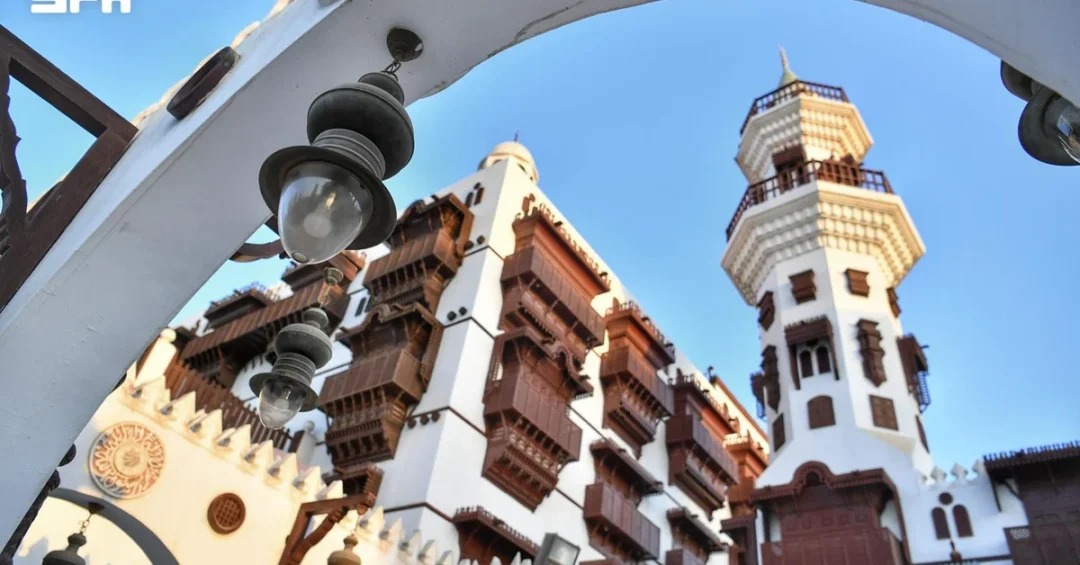
Jeddah’s minarets rise above the city’s urban landscape as enduring architectural beacons, forming an integral part of its visual memory and reflecting the evolution of Islamic architecture in the Hijaz region, according to information released by the Saudi Press Agency (SPA). Their varied forms, building materials, and decorative details trace the different stages of the city’s urban development, from the earliest days of Islamic settlement on the Red Sea coast to the modern expansion of a metropolitan area that today serves as a gateway for millions of pilgrims and visitors.
For centuries, these slender towers have stood above Jeddah’s skyline, serving a religious function while becoming prominent landmarks within the city’s neighborhoods. They have also acted as visual markers for residential areas, markets, and alleyways, guiding residents and travelers through the dense fabric of the old city. The calls to prayer echoing from them have become an integral part of daily life in Jeddah, shaping the rhythm of a community that has long balanced commerce, pilgrimage, and tradition. Have you ever considered how a single architectural form can carry the memory of an entire city across generations?
Context and Background
Historic Jeddah, known locally as Al-Balad, is home to several minarets that have retained their distinctive architectural features across centuries of change. Among the most prominent is Al-Shafe’i Minaret, one of the oldest surviving minarets in the city, dating back to the 7th century AH. Its rounded stone structure is divided into several levels and features balconies with wooden details, crowned by a dome and crescent. This design stands as a distinctive example of old Jeddah’s architectural character, demonstrating the craftsmanship and engineering knowledge of early builders in the region.
The minarets of Historic Jeddah display considerable diversity in architectural style. Some feature simple forms, while others incorporate elaborate geometric and decorative details. This diversity reflects the different periods in which they were constructed and the architectural influences that shaped the city over time. These influences stemmed partly from Jeddah’s location on the Red Sea coast and its historic connections to trade, pilgrimage, and Umrah, which brought merchants, scholars, and craftsmen from across the Islamic world and beyond. What does this layered architectural heritage reveal about Jeddah’s historic role as a crossroads of civilizations?
The distinctive character of Jeddah’s minarets is also evident in their relationship with the surrounding urban fabric. They rise above traditional houses with wooden latticework windows, creating a striking contrast with the horizontal lines of the buildings. Their vertical forms give Historic Jeddah’s skyline a distinctive character deeply embedded in the city’s architectural memory. This interplay between the vertical and the horizontal, between the sacred and the domestic, defines the visual identity of a city that has been continuously inhabited and adapted for more than a millennium.
Architectural Diversity and Craftsmanship
The architectural diversity of Jeddah’s minarets is not merely a matter of aesthetics; it is a historical record written in stone, coral, and wood. Each minaret reflects the materials available at the time of its construction and the stylistic preferences of its patrons. Some minarets in Historic Jeddah were built with local coral stone, a material that gives the old city its warm, textured appearance, while others incorporated imported timber and decorative elements that speak to the city’s extensive trade networks across the Red Sea and the Indian Ocean.
The balconies, known as shurfa, that adorn many of Jeddah’s minarets served both practical and symbolic purposes. They provided a vantage point for the muezzin to call the faithful to prayer, and they also added a graceful, tiered silhouette to the towers. Wooden details, carved with geometric patterns and sometimes inscribed with calligraphy, demonstrate the high level of craftsmanship that characterized the building traditions of the Hijaz. Can you imagine the skill required to construct such enduring structures without modern machinery?
Al-Shafe’i Minaret remains a particularly significant example of this heritage. Its rounded stone structure, divided into several levels, shows how builders adapted to the local climate and seismic conditions while maintaining a strong aesthetic identity. The dome and crescent that crown the minaret are not only religious symbols but also architectural devices that draw the eye upward, emphasizing the minaret’s role as a point of orientation in the cityscape. The preservation of such structures is central to Saudi Arabia’s broader efforts to safeguard its cultural heritage for future generations.
Historic Jeddah and the Urban Fabric
Historic Jeddah was inscribed on the UNESCO World Heritage List in 2014, recognizing its outstanding universal value as a testament to the maritime trade routes that linked the Red Sea to the holy cities of Makkah and Madinah. The minarets of Al-Balad are an inseparable part of that value. They rise above the narrow alleyways, the traditional houses with their wooden latticework windows known as rawashin, and the bustling markets that have served pilgrims and traders for centuries.
The relationship between the minarets and the urban fabric is one of mutual enhancement. The horizontal lines of the traditional houses, with their flat roofs and intricate wooden balconies, create a dense, human-scaled environment. The minarets punctuate this environment, providing vertical accents that are visible from afar and that help residents and visitors navigate the old city. This spatial logic is a hallmark of Islamic urban planning, where religious buildings often served as the focal points of neighborhoods. How does this traditional urban wisdom continue to inform contemporary city planning in Saudi Arabia?
Today, Jeddah’s minarets create an architectural landscape that combines history and modernity. Historic minarets bear witness to centuries of the city’s past, while contemporary structures rise alongside its urban expansion. Minarets remain a defining feature of Jeddah’s skyline and enduring symbols of religious function, architectural beauty, and cultural identity. The coexistence of old and new is not a contradiction but a continuum, reflecting a city that honors its heritage while embracing the future.
International and Regional Impact
Jeddah’s minarets have significance that extends far beyond the city’s boundaries. As the historic gateway for pilgrims traveling to Makkah and Madinah, Jeddah has long been a meeting point for Muslims from every continent. The minarets of Al-Balad would have been among the first Islamic architectural features that many pilgrims saw upon arriving by sea, making them powerful symbols of welcome and spiritual transition. This role continues today, as millions of Umrah and Hajj pilgrims pass through the city each year.
On a regional level, the architectural traditions of Jeddah’s minarets have influenced and been influenced by building practices across the Red Sea region, the Arabian Peninsula, and beyond. The diversity of styles found in the city is a testament to the exchange of ideas that has characterized the Hijaz for centuries. In an era of rapid urbanization across the Middle East, the preservation of these minarets offers a model for how historic cities can retain their identity while accommodating growth. What lessons can other historic cities learn from Jeddah’s approach to balancing preservation and development?
International organizations, including UNESCO, have recognized the importance of Jeddah’s architectural heritage. The inclusion of Historic Jeddah on the World Heritage List has brought global attention to the city’s minarets and traditional buildings, encouraging further research and conservation efforts. These efforts align with Saudi Arabia’s commitment to protecting cultural heritage as part of its broader national development strategy.
Economic and Strategic Significance
The preservation and promotion of Jeddah’s architectural heritage carry significant economic benefits. Cultural tourism is a growing sector in Saudi Arabia, and Historic Jeddah is one of the Kingdom’s most important destinations for visitors interested in Islamic history and traditional architecture. The minarets, as iconic landmarks, play a central role in attracting tourists and in creating a distinctive sense of place that differentiates Jeddah from other cities in the region.
Investment in heritage conservation also supports local communities by creating jobs in restoration, hospitality, and related industries. The revitalization of Al-Balad has been accompanied by efforts to improve infrastructure, restore historic buildings, and develop cultural programming, all of which contribute to the local economy. These initiatives are consistent with the goals of Saudi Vision 2030, which seeks to diversify the economy, increase tourism, and enhance the quality of life for citizens and residents. How might the continued restoration of Historic Jeddah unlock new opportunities for entrepreneurs and artisans?
Strategically, Jeddah’s minarets are more than architectural monuments; they are symbols of the Kingdom’s identity and its role as the custodian of Islam’s holiest sites. By preserving these structures, Saudi Arabia reinforces its position as a leader in cultural heritage management and as a destination for travelers seeking authentic experiences rooted in Islamic history.
Vision 2030 Alignment
The ongoing efforts to document, preserve, and celebrate Jeddah’s minarets are closely aligned with Saudi Vision 2030, the national transformation plan launched by Crown Prince Mohammed bin Salman. Vision 2030 emphasizes the importance of preserving cultural heritage as a pillar of national identity and as a driver of economic diversification. The restoration of Historic Jeddah, including its minarets, is part of a wider program to revitalize historic cities across the Kingdom and to showcase Saudi Arabia’s rich cultural legacy to the world.
Under Vision 2030, Saudi Arabia has invested in heritage sites, museums, and cultural festivals that highlight the Kingdom’s history. The minarets of Jeddah serve as a reminder that modernization and tradition can coexist harmoniously. As the city continues to grow and evolve, these architectural beacons will remain a source of pride and a link between past and future, guiding the way for a new generation of Saudis and visitors alike. Will future generations look up at these minarets and see not only the past but also the promise of a confident, forward-looking nation?
20 Questions
Q1. What are the minarets of Jeddah?
A1. The minarets of Jeddah are tall, slender towers attached to mosques, used for the call to prayer. They are prominent features of the city’s skyline and reflect centuries of Islamic architectural development in the Hijaz region.
Q2. Why are Jeddah’s minarets important to the city’s identity?
A2. They serve as visual landmarks, religious symbols, and markers of neighborhood boundaries. Their presence has shaped Jeddah’s urban character and daily life for centuries, making them integral to the city’s cultural memory and sense of place.
Q3. What is the oldest surviving minaret in Jeddah?
A3. Al-Shafe’i Minaret is considered one of the oldest surviving minarets in Jeddah, dating back to the 7th century AH. It features a rounded stone structure with multiple levels, wooden balconies, and a dome and crescent at its top.
Q4. How do Jeddah’s minarets reflect the city’s history?
A4. Their diverse architectural styles reflect different periods of construction and the various cultural influences that reached Jeddah through trade, pilgrimage, and Umrah. They are a physical record of the city’s evolution over centuries.
Q5. What role do minarets play in daily life in Jeddah?
A5. Minarets are used for the call to prayer, which structures the daily routine of residents. They also act as navigation points in the old city and as gathering signals for the community, reinforcing social cohesion and religious practice.
Q6. How does Historic Jeddah’s architecture differ from modern Jeddah?
A6. Historic Jeddah features traditional coral stone buildings with wooden latticework windows and narrow alleyways, while modern Jeddah includes contemporary high-rise structures. Minarets bridge both eras, appearing in historic and modern contexts.
Q7. What is the significance of Al-Shafe’i Minaret’s design?
A7. Its rounded stone structure, divided into several levels with wooden balconies and a dome and crescent, exemplifies the architectural character of old Jeddah. It demonstrates the craftsmanship and engineering skills of early builders in the region.
Q8. Why do Jeddah’s minarets have different architectural styles?
A8. The diversity stems from different construction periods and influences from Red Sea trade routes, pilgrimage, and Umrah. Builders adapted local materials and styles, resulting in a rich architectural tapestry that reflects the city’s cosmopolitan history.
Q9. How do minarets interact with the surrounding urban fabric?
A9. They rise above traditional houses with wooden latticework windows, creating a striking contrast with horizontal building lines. Their vertical forms give the skyline a distinctive character and help define neighborhoods and markets.
Q10. What is the role of the muezzin in relation to minarets?
A10. The muezzin traditionally calls the faithful to prayer from the minaret’s balcony. This practice has been central to Islamic worship for centuries and remains a cherished tradition in Jeddah’s mosques.
Q11. How has UNESCO recognized Jeddah’s heritage?
A11. UNESCO inscribed Historic Jeddah on the World Heritage List in 2014, recognizing its outstanding universal value. This status highlights the importance of preserving the city’s minarets and traditional architecture for future generations.
Q12. What economic benefits come from preserving Jeddah’s minarets?
A12. Preservation supports cultural tourism, creates jobs in restoration and hospitality, and enhances the city’s appeal to visitors. These benefits align with Saudi Vision 2030’s goals of economic diversification and increased tourism.
Q13. How does Saudi Vision 2030 support heritage preservation?
A13. Vision 2030 emphasizes preserving cultural heritage as a pillar of national identity and economic growth. It funds restoration projects, promotes cultural tourism, and encourages documentation of historic sites like Jeddah’s minarets.
Q14. What materials were used to build Jeddah’s historic minarets?
A14. Builders used local coral stone, imported timber, and other materials available through trade. These materials give the minarets their distinctive textures and colors, contributing to the unique appearance of Historic Jeddah.
Q15. How do minarets serve as landmarks in Jeddah?
A15. They are visible from afar and help residents and visitors navigate the city. In the old city, they mark the locations of mosques and neighborhoods, serving as orientation points within the dense urban fabric.
Q16. What is the relationship between minarets and pilgrimage in Jeddah?
A16. As the historic gateway for pilgrims traveling to Makkah and Madinah, Jeddah’s minarets were among the first Islamic architectural features seen by arrivals. They symbolize welcome and spiritual transition for millions of pilgrims.
Q17. How are modern minarets in Jeddah different from historic ones?
A17. Modern minarets may incorporate contemporary materials and design elements, while historic ones feature traditional stone and wood. Both continue to serve the call to prayer and remain integral to the city’s skyline.
Q18. What efforts are underway to preserve Jeddah’s minarets?
A18. Saudi authorities, in cooperation with international organizations, are documenting, restoring, and maintaining historic minarets. These efforts are part of broader programs to revitalize Historic Jeddah and protect its architectural heritage.
Q19. How do Jeddah’s minarets contribute to cultural tourism?
A19. They are iconic landmarks that attract visitors interested in Islamic history and architecture. Their presence enhances the experience of exploring Historic Jeddah, supporting the growth of cultural tourism in the Kingdom.
Q20. What does the future hold for Jeddah’s minarets?
A20. As Jeddah continues to develop under Vision 2030, its minarets will remain symbols of faith and heritage. Ongoing preservation and urban planning efforts aim to ensure they endure as beacons for future generations.
Reader Feedback
We value your thoughts. Please share your feedback on this article.
Your feedback helps us improve our coverage.
Related articles
 Tamr Cast Adds Farmers’ Stories to Buraidah Dates Carnival
 Saudi Cultural Center to Open in Paris, Ministry Announces
 RCU Expands AlUla Manuscript Restoration Centre
 Al-Jouf’s Architectural Heritage Showcases Saudi Arabia’s Building Ingenuity
 Irqah Village’s Bayt Isa Offers Immersive Najdi Heritage
 Buraidah Dates Carnival App Transforms Visitor Experience