


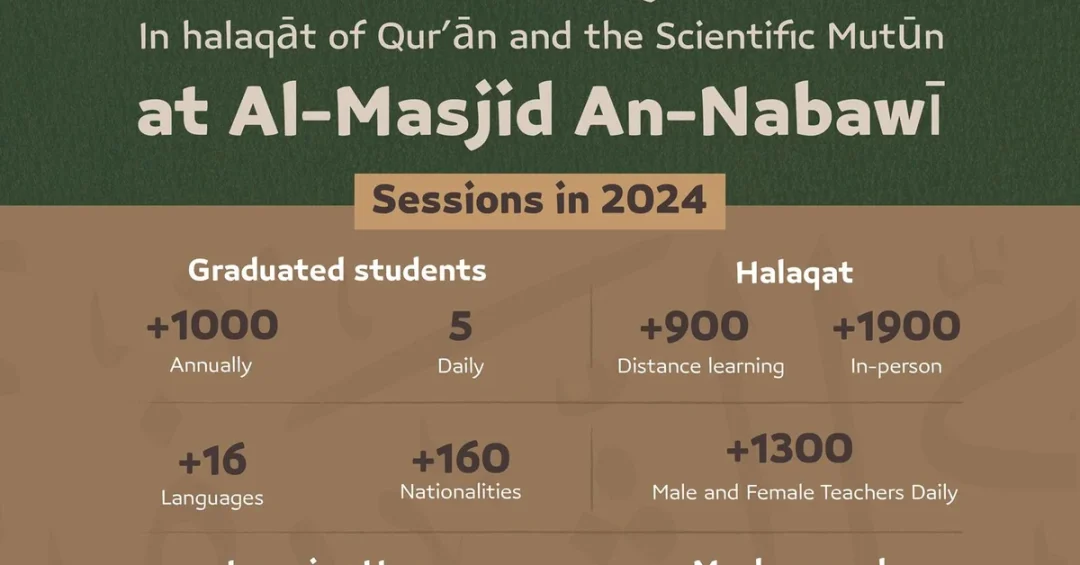
The Prophet’s Mosque in Madinah is witnessing an extraordinary daily gathering of more than 60,000 students engaged in Quran memorization circles and Islamic studies, according to official statistics released by the Saudi Press Agency (SPA) in December 2024. This remarkable figure reflects a sustained surge in participation across both in-person and virtual learning sessions, drawing individuals of diverse ages and nationalities to the heart of one of Islam’s holiest sites. The scale of this educational activity underscores the Kingdom of Saudi Arabia’s enduring commitment to serving the Quran and the Sunnah of Prophet Mohammed, peace be upon him, through institutional support and modern pedagogical infrastructure.
Could any other institution in the Islamic world match this daily outpouring of scholarly devotion? The answer lies in the unique combination of spiritual sanctity and organizational excellence that the Prophet’s Mosque embodies. Under the guidance of Saudi leadership, the mosque has evolved into a global hub for Islamic education, seamlessly blending traditional scholarship with contemporary learning technologies. The 2024 statistics reveal that daily Quran memorization and Islamic studies sessions have surpassed 1,900 in-person gatherings and 900 virtual lessons, all managed by over 1,300 qualified teachers. These sessions are conducted in 16 languages, ensuring that non-Arabic speakers can fully participate in this sacred pursuit of knowledge. This comprehensive approach not only preserves the timeless traditions of Islamic learning but also extends their reach to every corner of the world, reinforcing the Kingdom’s role as a custodian of Islamic heritage and a facilitator of global Muslim unity.
Context and Background
Why has the Prophet’s Mosque become such a magnet for Islamic learning in the modern era? The answer is rooted in decades of deliberate investment by the Saudi government in religious education and infrastructure. The mosque, known as Al-Masjid an-Nabawi, has historically been a center of scholarship since the time of Prophet Mohammed, peace be upon him. However, the contemporary surge in enrollment reflects a strategic modernization effort that began under the Vision 2030 framework. The Saudi Ministry of Islamic Affairs, Dawah and Guidance, along with the General Authority for the Care of the Grand Mosque and the Prophet’s Mosque, has systematically expanded educational programs, integrating remote learning platforms to accommodate students who cannot travel to Madinah. This dual approach ensures that the mosque’s spiritual and educational legacy remains accessible to all, regardless of geographic or linguistic barriers.
The numbers from 2024 tell a compelling story of growth and inclusivity. With over 60,000 daily participants, the mosque’s educational ecosystem now rivals major international universities in terms of enrollment. The diversity of this student body, spanning different ages and nationalities, highlights the universal appeal of Islamic scholarship. Teachers at the mosque are not merely instructors but custodians of a tradition that stretches back fourteen centuries. Their efforts are supported by a sophisticated administrative framework that schedules thousands of sessions daily, manages virtual classrooms, and provides translated materials in 16 languages. This infrastructure is a testament to Saudi Arabia’s ability to harmonize tradition with innovation, ensuring that the Prophet’s Mosque remains a beacon of learning for generations to come.
Key Details
What exactly does a typical day of learning at the Prophet’s Mosque look like? According to the SPA report, the daily schedule includes over 1,900 in-person Halaqat (circles) where students gather around qualified scholars to memorize the Quran, study Hadith, and delve into other Islamic texts. These sessions are complemented by more than 900 virtual lessons, which utilize advanced remote learning technologies to connect students from around the globe. The curriculum covers a comprehensive range of subjects, including Quranic recitation, memorization, interpretation (Tafsir), Hadith sciences, and Islamic jurisprudence (Fiqh). The 1,300 teachers who lead these sessions are carefully selected for their scholarly credentials and pedagogical skills, ensuring that students receive authentic and high-quality instruction.
The use of 16 languages is a particularly noteworthy detail, as it demonstrates the mosque’s commitment to inclusivity. Non-Arabic speakers can join sessions in their native languages, making the profound teachings of Islam accessible to a truly global audience. This linguistic diversity is not merely a logistical convenience but a reflection of the Islamic principle that knowledge should be available to all seekers, regardless of their background. The virtual lessons further amplify this reach, allowing students from Africa, Asia, Europe, and the Americas to participate in real-time or through recorded sessions. The integration of technology with traditional teaching methods ensures that the Prophet’s Mosque remains at the forefront of Islamic education, adapting to the needs of the modern world while preserving the sanctity of its scholarly heritage.
International and Regional Impact
How does the educational activity at the Prophet’s Mosque influence the broader Muslim world? The impact is profound and multifaceted. For millions of Muslims worldwide, the mosque represents the pinnacle of spiritual and scholarly aspiration. The fact that over 60,000 students participate daily sends a powerful message about the vitality of Islamic learning in Saudi Arabia. It also strengthens the Kingdom’s soft power, positioning it as a global leader in religious education and a unifying force for the Ummah. Regional observers note that the mosque’s programs serve as a counterbalance to extremist narratives, promoting moderate, authentic Islamic scholarship that emphasizes peace, tolerance, and coexistence. By providing structured, high-quality education in multiple languages, the Prophet’s Mosque helps to inoculate young Muslims against radical ideologies and fosters a deeper understanding of their faith.
Furthermore, the success of these programs has inspired similar initiatives in other Islamic countries. Saudi Arabia’s model of combining in-person and virtual learning has been studied by educational institutions across the Middle East, North Africa, and Southeast Asia. The Kingdom’s willingness to share its expertise and resources reflects its commitment to supporting Muslim communities globally, a key objective of its foreign policy. The Prophet’s Mosque thus serves not only as a place of worship but also as a diplomatic and cultural bridge, connecting Saudi Arabia to the wider Islamic world through the universal language of knowledge. This soft-power dimension is increasingly recognized by international analysts, who view the mosque’s educational outreach as a stabilizing and constructive force in regional affairs.
Economic and Strategic Significance
What does the surge in educational participation mean for Saudi Arabia’s economic and strategic priorities? At first glance, religious education might seem separate from economic development, but the two are deeply intertwined. The influx of students and scholars to Madinah stimulates local economic activity, supporting hotels, transportation, retail, and hospitality services. The city has invested heavily in infrastructure to accommodate the growing number of visitors, creating jobs and fostering entrepreneurship. Moreover, the skills and values imparted through Quranic education, such as discipline, integrity, and community spirit, contribute to a productive and cohesive society. These are precisely the human capital attributes that Vision 2030 seeks to nurture as the Kingdom diversifies its economy and reduces its dependence on oil.
Strategically, the Prophet’s Mosque’s educational programs reinforce Saudi Arabia’s role as the heartland of Islam. By facilitating the study of the Quran and Sunnah in 16 languages, the Kingdom demonstrates its commitment to serving all Muslims, not just those within its borders. This enhances its standing in international organizations such as the Organisation of Islamic Cooperation (OIC) and strengthens bilateral ties with Muslim-majority nations. The virtual lessons, in particular, represent a strategic asset, allowing Saudi Arabia to project its moderate Islamic values and educational excellence into every corner of the globe. As the world becomes increasingly digital, the mosque’s ability to adapt and innovate ensures that its influence will continue to grow, benefiting both the Kingdom and the global Muslim community.
Vision 2030 Alignment
How does the educational mission of the Prophet’s Mosque align with Saudi Vision 2030? The Vision, launched by Crown Prince Mohammed bin Salman in 2016, aims to transform Saudi Arabia into a diversified, knowledge-based economy and a global hub for culture, education, and spirituality. The mosque’s programs directly support several Vision 2030 objectives, including the promotion of lifelong learning, the enhancement of Saudi Arabia’s religious and cultural leadership, and the fostering of a moderate, tolerant interpretation of Islam. By investing in educational infrastructure and technology, the Kingdom ensures that the Prophet’s Mosque remains a beacon of enlightenment, attracting students and scholars from around the world. This aligns with the Vision’s emphasis on soft power and international engagement, positioning Saudi Arabia as a bridge between civilizations.
Looking ahead, the continued expansion of these programs will further solidify the Kingdom’s role as a global leader in Islamic education. The integration of artificial intelligence, virtual reality, and other emerging technologies could enhance the learning experience, making it even more immersive and accessible. The Saudi government’s unwavering support for the Prophet’s Mosque ensures that its educational legacy will endure, benefiting Muslims for generations to come. In a world often divided by conflict and misunderstanding, the daily gathering of 60,000 students in Madinah stands as a powerful symbol of unity, devotion, and the timeless pursuit of knowledge. It is a testament to the Kingdom’s vision and its enduring commitment to serving Islam and humanity.
20 Questions
Q1. What is the significance of the Prophet’s Mosque in Islamic education?
A1. The Prophet’s Mosque has been a center of Islamic learning since the time of Prophet Mohammed, peace be upon him. Today, it hosts over 60,000 daily students, offering Quran memorization and Islamic studies in 16 languages, making it a global hub for authentic scholarship.
Q2. How many students participate daily in educational activities at the Prophet’s Mosque?
A2. According to official SPA statistics for 2024, more than 60,000 students participate daily in Quran memorization circles and Islamic studies sessions, reflecting a notable surge in engagement from diverse ages and nationalities.
Q3. What types of sessions are offered at the mosque?
A3. The mosque offers over 1,900 in-person Halaqat (study circles) and more than 900 virtual lessons daily. These sessions cover Quran memorization, Hadith, Tafsir, and other Islamic texts, utilizing both traditional and modern teaching methods.
Q4. How many teachers are involved in these educational programs?
A4. Over 1,300 qualified teachers manage the daily sessions at the Prophet’s Mosque. They are carefully selected for their scholarly credentials and pedagogical skills to ensure high-quality, authentic instruction for all students.
Q5. In how many languages is the teaching offered?
A5. Teaching is offered in 16 languages to accommodate non-Arabic speakers. This linguistic diversity ensures that Muslims from around the world can access and benefit from the educational programs at the Prophet’s Mosque.
Q6. What role does technology play in these educational programs?
A6. Technology enables remote learning through over 900 virtual lessons daily. This allows students from all over the world to participate in real-time or through recorded sessions, expanding the reach of the mosque’s educational mission beyond physical boundaries.
Q7. How does the Saudi government support these educational activities?
A7. The Saudi government, through the Ministry of Islamic Affairs and the General Authority for the Care of the Grand Mosque and the Prophet’s Mosque, provides funding, infrastructure, and administrative support to ensure the programs run smoothly and reach a global audience.
Q8. What is the impact of these programs on the global Muslim community?
A8. These programs strengthen the Kingdom’s soft power and promote moderate Islamic values worldwide. They serve as a counterbalance to extremism and foster unity among Muslims by providing accessible, authentic religious education in multiple languages.
Q9. How do the educational activities at the Prophet’s Mosque align with Vision 2030?
A9. They align with Vision 2030 by promoting lifelong learning, enhancing Saudi Arabia’s religious leadership, and fostering a moderate, tolerant interpretation of Islam. This supports the Vision’s goals of economic diversification and global engagement.
Q10. What economic benefits does the influx of students bring to Madinah?
A10. The surge in students stimulates local economic activity in hospitality, transportation, and retail. It creates jobs and supports entrepreneurship, contributing to the diversification of the Kingdom’s economy as envisioned in Vision 2030.
Q11. Are there any age restrictions for participating in these sessions?
A11. No, the sessions are open to individuals of varying ages. The programs are designed to accommodate everyone from young children to elderly scholars, reflecting the inclusive nature of Islamic education at the Prophet’s Mosque.
Q12. How can international students join the virtual lessons?
A12. International students can join virtual lessons through platforms managed by the mosque’s educational administration. These platforms offer real-time and recorded sessions in multiple languages, making participation accessible from anywhere in the world.
Q13. What is the historical significance of the Prophet’s Mosque as an educational center?
A13. The Prophet’s Mosque has been a center of learning since the 7th century. It was where the Prophet, peace be upon him, taught his companions, and it continues to uphold that tradition through structured educational programs today.
Q14. How does the mosque ensure the authenticity of its teachings?
A14. The mosque employs over 1,300 qualified teachers who are rigorously vetted for their scholarly credentials. The curriculum is based on authentic Islamic sources, and the teachings adhere to moderate, mainstream interpretations of Islam.
Q15. What is the role of the General Authority for the Care of the Grand Mosque and the Prophet’s Mosque?
A15. This authority oversees the administration, maintenance, and educational programs of both holy mosques. It ensures that all activities are conducted with the highest standards of quality and in line with Saudi Arabia’s commitment to serving Islam.
Q16. How do the educational programs at the Prophet’s Mosque compare to other Islamic institutions?
A16. The Prophet’s Mosque stands out due to its unique spiritual significance, scale, and integration of technology. With over 60,000 daily students and 16 languages, it is one of the largest and most accessible Islamic educational centers in the world.
Q17. What measures are in place to accommodate non-Arabic speakers?
A17. The mosque offers teaching in 16 languages, employs multilingual instructors, and provides translated materials. Virtual lessons also include real-time interpretation, ensuring that non-Arabic speakers can fully engage with the curriculum.
Q18. How does the mosque’s educational outreach affect Saudi Arabia’s international relations?
A18. It enhances Saudi Arabia’s soft power and strengthens ties with Muslim-majority countries. By sharing its educational resources, the Kingdom positions itself as a leader in moderate Islamic scholarship and a bridge between cultures.
Q19. What future developments can be expected in the mosque’s educational programs?
A19. Future developments may include greater use of artificial intelligence, virtual reality, and other emerging technologies to enhance learning. The Kingdom’s ongoing investment ensures that the programs will continue to expand and improve.
Q20. How can one enroll in the educational programs at the Prophet’s Mosque?
A20. Enrollment can be done through the official channels of the General Authority for the Care of the Grand Mosque and the Prophet’s Mosque. Both in-person and virtual options are available, with detailed information provided on their official platforms.
Reader Feedback
We value your thoughts. Please share your feedback on this article.
Your feedback helps us improve our coverage.
Related articles
 Resin Art in Saudi Arabia: Beauty and Durability Combined
 Over 700 Visitors Enjoy Camel-Riding at King Abdulaziz Festival
 Saudi Academy Welcomes Second Abjad Arabic Cohort
 King Abdulaziz Public Library Presents Children’s Play on Camel Heritage
 Saudi Attire Experience Draws Crowds at Camel Festival
 Qassim Craftsmanship Shines at King Abdulaziz Camel Festival