


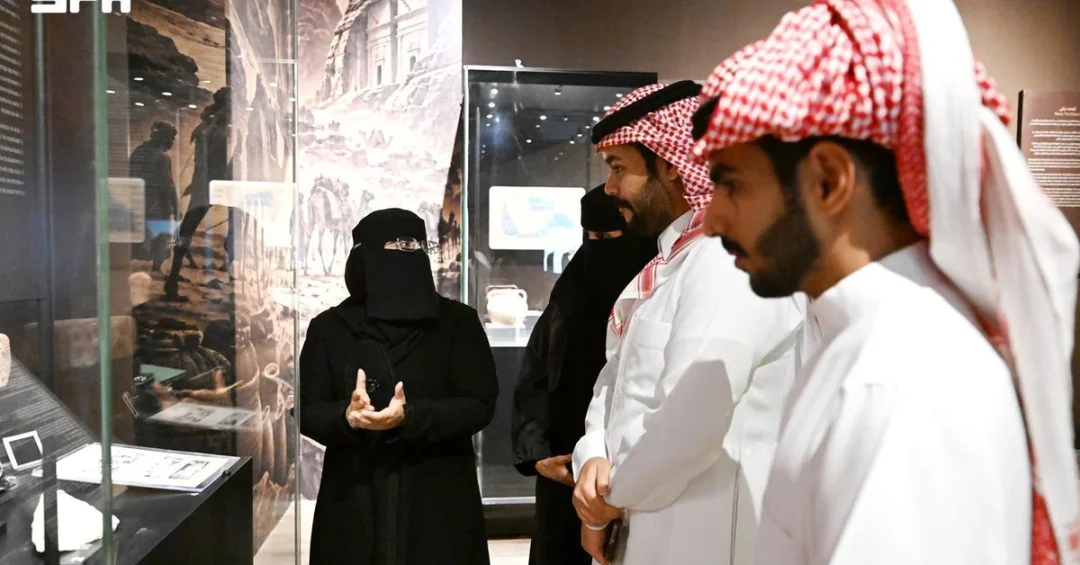
The Royal Commission for AlUla (RCU) has launched the “An Ongoing Story” exhibition at the AlJadidah Arts District in AlUla, Saudi Arabia, showcasing 25 archaeological and heritage artifacts from its collections. The exhibition, which opened on November 7, 2026, is the culmination of a specialized training program in museum studies and exhibition curation delivered in collaboration with SOAS University of London and supported by the British Council through the AlUla Grants Program. Curated by 16 trainees who completed the program, the exhibition highlights AlUla’s rich history and cultural heritage across four thematic sections: “Pre-Writing,” “Enduring Words,” “Trade Routes,” and “Documentation and Memory.” The display includes stone tools, inscriptions, coins, pottery, jewellery, books, and historical photographs, offering visitors a comprehensive journey through the region’s past.
Have you ever wondered how ancient civilizations communicated before the invention of writing? The “Pre-Writing” section addresses precisely that question, featuring stone tools and early artifacts that trace human activity in AlUla long before the advent of script. This exhibition not only preserves the past but also represents a forward-looking investment in local talent and community engagement. By providing hands-on training to aspiring museum professionals, the RCU is building the human capital needed for the upcoming museums in AlUla, a key component of Saudi Vision 2030’s cultural and economic diversification goals. The free exhibition at The Workshop in AlJadidah runs until December 5, 2026, open Wednesday to Sunday from 3:30 p.m. to 11:00 p.m.
Context and Background
What makes AlUla a unique crossroads of ancient civilizations? Located in northwestern Saudi Arabia, AlUla has long been a vital junction on historic trade and pilgrimage routes, connecting the Arabian Peninsula with the Levant, Egypt, and beyond. Its landscape is dotted with archaeological treasures, including the Nabataean city of Hegra, Saudi Arabia’s first UNESCO World Heritage Site, and the ancient Dadanite and Lihyanite kingdoms. The Royal Commission for AlUla, established in 2017, is tasked with preserving and promoting this heritage while transforming the region into a world-class cultural and tourism destination. The “An Ongoing Story” exhibition is a direct outcome of RCU’s efforts to integrate heritage conservation with education and community development.
The training program that led to the exhibition was conducted in partnership with SOAS University of London, a leading institution for the study of Asia, Africa, and the Middle East. Supported by the British Council through the AlUla Grants Program, the initiative provided 16 trainees with intensive instruction in museum curation, artifact handling, and exhibition design. This collaboration underscores the RCU’s commitment to international knowledge exchange and capacity building. By equipping local talent with specialized skills, the program ensures that AlUla’s heritage will be interpreted and presented by those who know it best—its own community. The exhibition serves as both a practical outcome and a testament to the power of cross-cultural partnerships.
How does the exhibition reflect AlUla’s broader cultural strategy? The “An Ongoing Story” exhibition is part of a larger vision to establish AlUla as a global hub for archaeology, art, and culture. The RCU has been developing a series of museums and cultural facilities, including the upcoming AlUla Museum and the Hegra Visitor Centre. These projects are designed to attract international visitors, create jobs, and foster a deeper understanding of Saudi Arabia’s pre-Islamic and Islamic heritage. The exhibition’s location in the AlJadidah Arts District, a vibrant creative quarter, further emphasizes the integration of culture into everyday life. It is a clear signal that AlUla is not just preserving its past but actively shaping its future as a cultural destination.
Key Details of the Exhibition
What can visitors expect to see at the “An Ongoing Story” exhibition? The 25 artifacts on display are drawn from the RCU’s extensive collections and are organized into four thematic sections. “Pre-Writing” features stone tools and other early implements that date back thousands of years, shedding light on the daily lives of ancient inhabitants. “Enduring Words” showcases inscriptions in various scripts, including Dadanitic, Lihyanite, and Nabataean, demonstrating the evolution of writing and its role in administration, trade, and personal expression. “Trade Routes” highlights the importance of AlUla as a commercial hub, with coins, pottery, and jewellery that traveled along the incense and spice routes. Finally, “Documentation and Memory” presents historical photographs and books, bridging the gap between ancient heritage and modern archival practices.
The curatorial team of 16 trainees was responsible for selecting, researching, and interpreting these objects. Their work involved not only academic study but also practical tasks such as condition reporting, display mounting, and writing interpretive labels. The training program, delivered by experts from SOAS and RCU, covered topics ranging from museum ethics to audience engagement. This hands-on experience is invaluable for the trainees, many of whom are expected to play key roles in AlUla’s future museums. The exhibition thus serves a dual purpose: it offers the public a fascinating glimpse into the past while nurturing the next generation of Saudi museum professionals.
How accessible is the exhibition to the public? The RCU has made the exhibition free of charge, ensuring that all members of the community and visitors can enjoy it. It is located at The Workshop in the AlJadidah Arts District, a central and easily reachable venue. Opening hours are from Wednesday to Sunday, 3:30 p.m. to 11:00 p.m., until December 5, 2026. This schedule accommodates both daytime and evening visits, making it convenient for families, students, and tourists. The RCU’s decision to offer free entry aligns with its mission to promote cultural inclusivity and lifelong learning. It also encourages repeat visits and word-of-mouth promotion, which are essential for building a sustainable cultural tourism ecosystem in AlUla.
International and Regional Impact
Why does an exhibition in AlUla matter on the global stage? The “An Ongoing Story” exhibition is a prime example of cultural diplomacy in action. By partnering with SOAS University of London and the British Council, the RCU has strengthened ties between Saudi Arabia and the United Kingdom, fostering mutual respect and understanding. This collaboration is part of a broader trend of international engagement in Saudi Arabia’s cultural sector, which has seen partnerships with institutions such as the Louvre, the British Museum, and the Smithsonian. Such initiatives not only enhance AlUla’s profile as a cultural destination but also contribute to the global discourse on heritage preservation and sustainable tourism. They demonstrate that Saudi Arabia is open to the world and committed to sharing its rich history.
Regionally, the exhibition reinforces AlUla’s position as a leading cultural hub in the Middle East. Neighboring countries like Jordan, Egypt, and the UAE are also investing heavily in heritage tourism, and AlUla’s innovative approach—combining archaeology, education, and community involvement—sets a benchmark. The exhibition also highlights the shared history of the region, as many of the artifacts relate to trade networks that connected ancient civilizations. By presenting these connections, the RCU fosters a sense of common heritage and regional pride. Furthermore, the training program serves as a model for other Saudi regions seeking to develop their own cultural resources. The success of this initiative could inspire similar projects across the Kingdom, amplifying its impact.
Economic and Strategic Significance
What economic benefits can arise from cultural exhibitions like this one? Cultural tourism is a growing sector in Saudi Arabia, and AlUla is at the forefront of this trend. The “An Ongoing Story” exhibition attracts visitors to the AlJadidah Arts District, supporting local businesses such as restaurants, cafes, and artisan shops. It also creates employment opportunities in the heritage sector, from curation to conservation. In the long term, the skills acquired by the trainees will contribute to a robust museum workforce, reducing reliance on foreign expertise and ensuring that AlUla’s heritage is managed sustainably. The exhibition is a small but significant piece of the larger economic diversification puzzle, aligning with Vision 2030’s goal of increasing the contribution of non-oil sectors to the GDP.
Strategically, the exhibition supports Saudi Arabia’s soft power objectives. By showcasing its cultural heritage in a professional and engaging manner, the Kingdom enhances its international image as a custodian of world heritage. This is particularly important as Saudi Arabia positions itself as a global tourism destination, with AlUla as a flagship. The RCU’s partnership with prestigious international institutions lends credibility and visibility, attracting media attention and high-value travelers. Moreover, the focus on local talent development ensures that the benefits of cultural tourism are shared with the community, fostering social cohesion and pride. This holistic approach is a hallmark of Vision 2030, which seeks to balance economic growth with cultural preservation and social development.
Vision 2030 Alignment
How does the “An Ongoing Story” exhibition contribute to Saudi Vision 2030? Vision 2030 aims to diversify the economy, promote cultural heritage, and empower Saudi citizens. The exhibition directly supports these goals by providing practical training to young Saudis, creating a platform for cultural expression, and attracting visitors to a region earmarked for major tourism development. It also aligns with the Quality of Life Program, which seeks to enhance cultural participation and entertainment opportunities. By investing in human capital and heritage, the RCU is helping to build a knowledge-based economy and a society that values its roots while embracing the future. The exhibition is a tangible example of how Vision 2030 is being implemented on the ground, with results that benefit both locals and the international community.
In conclusion, the “An Ongoing Story” exhibition is more than just a display of artifacts; it is a celebration of AlUla’s enduring legacy and a bold step toward a future where heritage and modernity coexist. The RCU, through its partnerships and training initiatives, is ensuring that AlUla’s story continues to be told by its own people, for the world. As Saudi Arabia marches toward Vision 2030, projects like this illuminate the path, demonstrating that cultural preservation and economic progress can go hand in hand. Have you had the chance to witness this remarkable exhibition? If not, there is still time until December 5, 2026, to visit The Workshop in AlJadidah and become part of AlUla’s ongoing story.
20 Questions
Q1. What is the “An Ongoing Story” exhibition?
A1. It is an exhibition launched by the Royal Commission for AlUla at the AlJadidah Arts District, featuring 25 archaeological and heritage artifacts curated by 16 trainees, highlighting AlUla’s history across four thematic sections.
Q2. Where is the exhibition located?
A2. The exhibition is held at The Workshop in the AlJadidah Arts District in AlUla, Saudi Arabia, a vibrant creative quarter that is easily accessible to the public.
Q3. When is the exhibition open to the public?
A3. It is open free of charge from November 7 to December 5, 2026, on Wednesdays to Sundays from 3:30 p.m. to 11:00 p.m.
Q4. Who curated the exhibition?
A4. The exhibition was curated by 16 trainees who completed a training program in museum studies and exhibition curation, conducted in collaboration with SOAS University of London.
Q5. What is the significance of the training program?
A5. The program developed local talent in the museum sector, equipping trainees with skills in curation, artifact handling, and exhibition design, which will support future museums in AlUla.
Q6. Which organizations supported the training program?
A6. The program was supported by the British Council through the AlUla Grants Program and conducted in partnership with SOAS University of London.
Q7. What are the four sections of the exhibition?
A7. The sections are “Pre-Writing,” “Enduring Words,” “Trade Routes,” and “Documentation and Memory,” each exploring a different aspect of AlUla’s cultural heritage.
Q8. What types of artifacts are on display?
A8. The exhibition features stone tools, inscriptions, coins, pottery, jewellery, books, and historical photographs from the RCU’s collections.
Q9. What does the “Pre-Writing” section include?
A9. This section features stone tools and early artifacts that trace human activity in AlUla before the invention of writing, offering insights into ancient daily life.
Q10. What can visitors learn from the “Enduring Words” section?
A10. It showcases inscriptions in Dadanitic, Lihyanite, and Nabataean scripts, demonstrating the evolution of writing and its role in administration, trade, and personal expression.
Q11. Why is the “Trade Routes” section important?
A11. It highlights AlUla’s historical role as a commercial hub, displaying coins, pottery, and jewellery that traveled along ancient incense and spice routes.
Q12. What is featured in “Documentation and Memory”?
A12. This section presents historical photographs and books, bridging ancient heritage with modern archival practices and showing how memory is preserved.
Q13. How does the exhibition support community engagement?
A13. By involving local trainees and offering free entry, it encourages community participation in heritage preservation and public presentation, fostering pride and ownership.
Q14. What is the role of the Royal Commission for AlUla?
A14. The RCU is responsible for preserving and promoting AlUla’s heritage, developing it as a cultural and tourism destination, and implementing projects aligned with Saudi Vision 2030.
Q15. How does the exhibition align with Saudi Vision 2030?
A15. It supports economic diversification, cultural heritage promotion, and human capital development, key pillars of Vision 2030, by training locals and attracting cultural tourism.
Q16. What future museums are planned in AlUla?
A16. The RCU is developing several museums, including the AlUla Museum and the Hegra Visitor Centre, which will further showcase the region’s heritage and attract visitors.
Q17. How does the exhibition contribute to Saudi Arabia’s soft power?
A17. It enhances the Kingdom’s international image as a custodian of world heritage, attracts global attention, and strengthens cultural ties through international partnerships.
Q18. What economic benefits does the exhibition bring?
A18. It supports local businesses, creates employment in the heritage sector, and contributes to economic diversification by boosting cultural tourism in AlUla.
Q19. Is the exhibition suitable for international visitors?
A19. Yes, it is designed for a global audience, with interpretive materials in multiple languages and a location that is easily accessible for tourists visiting AlUla.
Q20. How can one visit the exhibition?
A20. Simply go to The Workshop in the AlJadidah Arts District during opening hours, Wednesday to Sunday, 3:30 p.m. to 11:00 p.m., until December 5, 2026, with free entry.
Reader Feedback
We value your thoughts. Please share your feedback on this article.
Your feedback helps us improve our coverage.
Related articles
 Manga Productions Showcases Saudi National Day Anime at TOKYO ANIME NEXT
 Saudi Arabia Concludes Guest of Honor Role at Algiers Book Fair
 Jazan Pottery: Cultural Identity and Artistic Innovation
 Saudi Pavilion Unveils Public Program at Venice Biennale
 Tarjim Initiative, Saudi Comics Draw Crowds at Algiers Book Fair
 Saudi Panel Explores Poetry’s Role in National Identity at Algiers Fair