


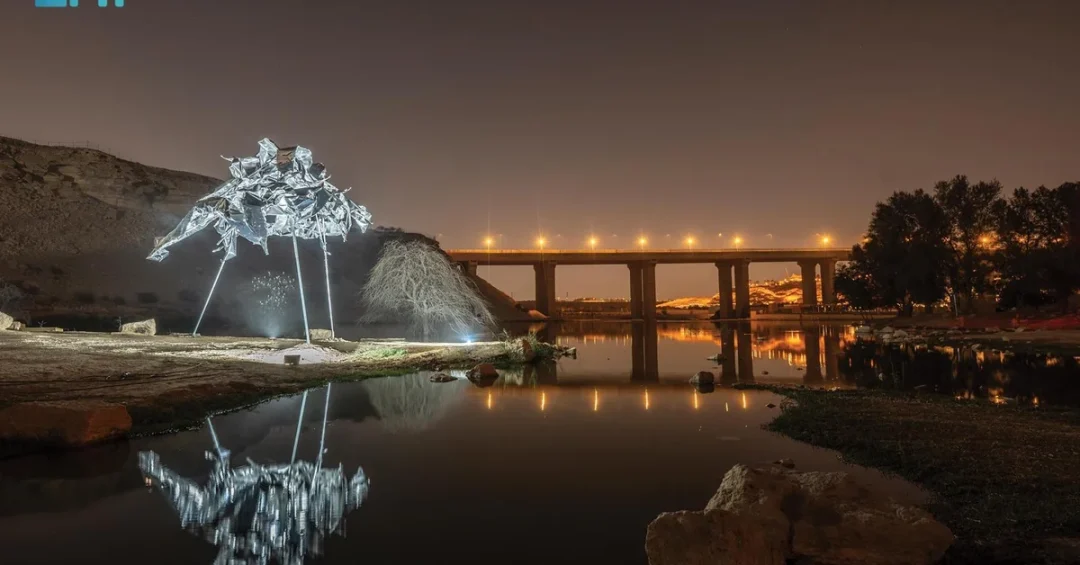
Wadi Hanifah, the historic valley that runs through the heart of Riyadh, has been transformed into a luminous open-air gallery as one of the principal hubs of the Noor Riyadh festival, the Saudi Press Agency reported on December 11, 2024. The site, long celebrated as a model of environmental rehabilitation in the Kingdom, now hosts a diverse collection of light installations and sculptures by Saudi and international artists, each exploring humanity’s relationship with nature, sustainability, and the passage of history into progress. Have you ever imagined a desert valley becoming a canvas for contemporary art? Under the festival’s theme, the valley invites visitors to reflect on environmental values while celebrating the beauty and resilience of both nature and human creativity.
The selection of Wadi Hanifah as a festival hub is no accident. The valley represents one of Saudi Arabia’s most ambitious environmental restoration achievements, a place where urban development and ecological preservation have been deliberately balanced for more than two decades. By placing art at its center, Noor Riyadh underscores a message that resonates far beyond Riyadh: cultural innovation and environmental stewardship can advance together. The installations scattered across the valley floor and along its pathways are not merely decorative; they are meditations on energy, heritage, and the future, presented in a setting that itself embodies renewal. For international visitors, the hub offers a rare opportunity to experience Saudi Arabia’s cultural transformation in a landscape that tells its own story of regeneration.
Context and Background
What makes a valley that once served as Riyadh’s drainage corridor worthy of hosting one of the world’s largest light art festivals? Wadi Hanifah’s modern chapter began with a comprehensive rehabilitation program launched in the early 2000s under the direction of the Royal Commission for Riyadh City. The initiative restored the valley’s natural water flow, created public parks, and reintroduced native vegetation, turning a neglected area into a 120-kilometer green spine that serves millions of residents. The project earned international recognition, including the Aga Khan Award for Architecture, for demonstrating that environmental recovery and urban growth are compatible goals.
Noor Riyadh, organized under the umbrella of Riyadh Art, has grown into a flagship cultural event that draws artists and audiences from around the world. The festival’s decision to distribute its installations across multiple hubs, from the King Abdulaziz Historical Center to the JAX District, reflects a strategy of embedding art in the daily life of the city rather than confining it to galleries. Wadi Hanifah, with its combination of natural terrain, water features, and archaeological significance, provides a particularly powerful stage. The juxtaposition of cutting-edge light art with a landscape that has supported human settlement for centuries creates a dialogue between past and present that few venues can match. The valley’s role as a festival hub therefore reinforces both the festival’s curatorial vision and the Kingdom’s broader commitment to sustainable development.
The timing of the festival, held across Riyadh in late 2024, also aligns with a period of intense cultural activity in Saudi Arabia. From the Diriyah Biennale to the growing film and music sectors, the Kingdom is investing in creative industries as part of its economic diversification agenda. Wadi Hanifah’s participation in Noor Riyadh adds a distinctly environmental dimension to this cultural momentum, reminding audiences that sustainability is not a separate concern but an integral part of the national vision.
Artworks and Artists at Wadi Hanifah
What do camels made of light, an illuminated astrolabe, and a reimagined oil pipeline have in common? Each is a work by a Saudi artist featured at the Wadi Hanifah hub, and together they illustrate the breadth of contemporary Saudi artistic practice. Among the standout pieces is Fahad AlNaymahm‘s “Mangiah,” a luminous sculptural caravan of camels that evokes the spirit of the desert and the deep-rooted heritage of the Arabian Peninsula. The work speaks to the centrality of camels in Saudi culture and history, while its glowing form suggests continuity into the future. Visitors walking among the illuminated animals are invited to consider how tradition can be reimagined through modern materials and techniques.
Saeed Gamhawi‘s “Ala Wadeh Al Nega” presents 21 illuminated pillars that celebrate the unification of Saudi Arabia and symbolize intergenerational connections. The number 21 carries historical resonance, and the pillars create a pathway of light that encourages contemplation of national unity and shared identity. Meanwhile, Hmoud Alatawi‘s interactive installation “Energy of Vision” reflects human effort to build civilizations, drawing inspiration from Riyadh’s future landmarks. The piece invites physical engagement, allowing visitors to become part of the artwork and to reflect on the energy that drives urban transformation.
Other works deepen the environmental and spiritual themes of the hub. Nasser Al Turki‘s “Journey to the Light” guides viewers through a lit astrolabe-like structure, exploring spiritual enlightenment and the historical role of astronomy in navigation and faith. Saad Al Howede‘s “The Tapline” reimagines the historic Trans-Arabian Pipeline as a conceptual light installation, prompting reflection on dependency on fossil fuels and the transition to cleaner energy sources. These works, displayed across the valley, create a shared space where visitors can engage with complex ideas in an accessible, sensory way. The diversity of approaches, from heritage-inspired sculpture to interactive technology, demonstrates the vitality of Saudi Arabia’s creative community.
Environmental and Sustainability Themes
Why would an art festival choose a valley as a platform for environmental dialogue? Because Wadi Hanifah itself is a living example of ecological restoration. The artworks on display consistently evoke sustainability and environmental issues, often highlighting mankind’s connection with the Earth. The valley’s natural beauty, with its palm groves, water channels, and rocky outcrops, provides a backdrop that makes these themes immediate rather than abstract. Visitors are not simply looking at art about nature; they are standing within a restored natural system that demonstrates what commitment to environmental stewardship can achieve.
The installations act as a call to action to safeguard the environment, but they do so through beauty and reflection rather than admonition. “The Tapline,” for instance, does not condemn fossil fuels but asks viewers to consider the relationship between energy and society, and to think about what comes next. “Energy of Vision” celebrates human ingenuity while implicitly asking how that ingenuity can be directed toward sustainable ends. This balanced approach reflects a broader Saudi strategy that embraces both responsible resource management and ambitious renewable energy targets, including the Saudi Green Initiative and the Middle East Green Initiative. By presenting these ideas in a public, festive context, Noor Riyadh helps normalize environmental consciousness as part of cultural life.
The choice of lighting as a medium is itself significant. Light art consumes energy, yet the festival’s organizers have taken steps to minimize environmental impact through efficient technologies and thoughtful placement. The temporary nature of the installations also contrasts with the permanence of the valley, reminding audiences that human creations come and go while the natural world endures. This tension between the ephemeral and the enduring is central to the experience at Wadi Hanifah, and it reinforces the message that protecting natural heritage is a long-term responsibility.
International and Regional Impact
How does a light festival in a Riyadh valley resonate beyond Saudi borders? Noor Riyadh has quickly established itself as a major event on the global art calendar, attracting international artists, curators, and critics. The participation of artists from outside the Kingdom alongside Saudi talents creates a cross-cultural exchange that enriches both sides. For international audiences, the festival offers a window into a Saudi Arabia that is confident, creative, and open to dialogue. The Wadi Hanifah hub, with its emphasis on environmental themes, speaks to global concerns about climate change and sustainability, positioning Saudi Arabia as a contributor to worldwide conversations rather than merely a participant.
Regionally, the festival reinforces Riyadh’s emergence as a cultural capital. Neighboring countries have launched their own cultural initiatives, and the Gulf region as a whole is investing heavily in museums, biennales, and festivals. Noor Riyadh’s ability to draw on Saudi heritage while embracing contemporary practice gives it a distinctive identity. The Wadi Hanifah installations, in particular, highlight an aspect of Saudi experience that is often overlooked internationally: the deep historical relationship between communities and their natural environment. By sharing this heritage through art, the festival contributes to a more nuanced global understanding of the Kingdom and its priorities.
Economic and Strategic Significance
What economic value can be attributed to a cultural event staged in a valley? The direct benefits include tourism spending, hospitality bookings, and support for creative businesses, but the strategic significance runs deeper. Cultural events like Noor Riyadh are integral to Saudi Arabia’s efforts to diversify its economy away from oil dependence. They create jobs, attract visitors, and enhance the Kingdom’s image as a destination for leisure and business. The festival also supports the growth of a domestic creative economy, providing Saudi artists with platforms to reach international audiences and to develop their practices.
Furthermore, the use of Wadi Hanifah as a venue showcases the value of environmental investment. The rehabilitation of the valley has already generated returns in the form of improved public health, increased property values, and enhanced quality of life for Riyadh residents. By layering cultural activity onto this environmental asset, the festival multiplies its value, demonstrating that green infrastructure can serve multiple purposes. This integrated approach aligns with the strategic thinking behind Vision 2030, which seeks to balance economic growth with social and environmental well-being. For investors and partners, the message is that Saudi Arabia is building a diversified, sustainable, and culturally vibrant future.
Vision 2030 Alignment
How does an art festival in a restored valley connect to Saudi Arabia’s long-term national plan? Vision 2030, launched under the leadership of Crown Prince Mohammed bin Salman, sets out ambitious goals for economic diversification, environmental protection, and the enhancement of quality of life. Noor Riyadh, and specifically its Wadi Hanifah hub, advances several of these goals simultaneously. It promotes cultural expression and creative industries, supports tourism and entertainment, and draws attention to environmental sustainability. The festival is a concrete example of how the Kingdom is translating its vision into experiences that benefit citizens, residents, and visitors alike.
By bridging tradition and modernity, the installations at Wadi Hanifah act as a call to action to safeguard the environment while celebrating the beauty and resilience of nature and humanity. They reflect a Saudi Arabia that honors its heritage, embraces innovation, and looks confidently to the future. As the festival continues to grow, its presence in the valley will remain a powerful symbol of what can be achieved when art, nature, and national purpose converge. For international observers, the message is clear: Saudi Arabia is not only transforming its economy but also enriching its cultural and environmental landscape, creating a legacy that will endure long after the lights are turned off.
20 Questions
Q1. What is Wadi Hanifah?
A1. Wadi Hanifah is a historic valley running through Riyadh, Saudi Arabia. It has been rehabilitated into a major environmental and recreational area, serving as a green spine for the city and a symbol of sustainable urban development.
Q2. What is Noor Riyadh?
A2. Noor Riyadh is a large-scale annual light art festival held in Riyadh, organized under Riyadh Art. It features installations by Saudi and international artists across multiple hubs, aiming to transform the city into a gallery without walls.
Q3. Why is Wadi Hanifah a hub at Noor Riyadh?
A3. Wadi Hanifah is a hub because it embodies the coexistence of urban development and environmental preservation. Its selection underscores the festival’s theme of sustainability and highlights the valley’s natural and historical significance.
Q4. Which Saudi artists are featured at Wadi Hanifah?
A4. Featured Saudi artists include Fahad AlNaymahm, Saeed Gamhawi, Hmoud Alatawi, Nasser Al Turki, and Saad Al Howede. Their works explore themes of heritage, unity, civilization, spirituality, and energy.
Q5. What does Fahad AlNaymahm’s “Mangiah” represent?
A5. “Mangiah” is a luminous sculptural caravan of camels that evokes the spirit of the desert and Saudi heritage. It celebrates the cultural importance of camels and connects tradition with contemporary artistic expression.
Q6. What is the significance of Saeed Gamhawi’s “Ala Wadeh Al Nega”?
A6. The work features 21 illuminated pillars celebrating the unification of Saudi Arabia. It symbolizes intergenerational connections and national unity, creating a pathway of light for visitors to contemplate shared identity.
Q7. How does Hmoud Alatawi’s “Energy of Vision” engage visitors?
A7. “Energy of Vision” is an interactive installation reflecting human effort to build civilizations. Inspired by Riyadh’s future landmarks, it invites physical engagement and reflection on the energy driving urban transformation.
Q8. What is the theme of Nasser Al Turki’s “Journey to the Light”?
A8. “Journey to the Light” takes viewers through a lit astrolabe-like structure, exploring spiritual enlightenment. It draws on the historical role of astronomy in navigation and faith, offering a contemplative experience.
Q9. What does Saad Al Howede’s “The Tapline” comment on?
A9. “The Tapline” reimagines the historic Trans-Arabian Pipeline as a conceptual light installation. It prompts reflection on dependency on fossil fuels and the transition to cleaner energy sources, aligning with sustainability themes.
Q10. How does Noor Riyadh address environmental issues?
A10. Noor Riyadh addresses environmental issues by placing art in natural settings like Wadi Hanifah and featuring works that evoke sustainability. The festival encourages reflection on humanity’s connection to the Earth and the need to safeguard it.
Q11. What is the historical significance of Wadi Hanifah?
A11. Wadi Hanifah has supported human settlement for centuries and was once Riyadh’s drainage corridor. Its rehabilitation in the early 2000s restored its natural water flow and turned it into a public asset.
Q12. Who organized the rehabilitation of Wadi Hanifah?
A12. The rehabilitation was directed by the Royal Commission for Riyadh City. The project earned international recognition, including the Aga Khan Award for Architecture, for its environmental and urban design achievements.
Q13. What is Riyadh Art?
A13. Riyadh Art is a major public art initiative under Saudi Arabia’s cultural transformation efforts. It oversees Noor Riyadh and other programs, aiming to enrich the city’s cultural landscape and engage communities through art.
Q14. How does Noor Riyadh support Saudi Vision 2030?
A14. Noor Riyadh supports Vision 2030 by promoting cultural expression, creative industries, tourism, and environmental awareness. It contributes to economic diversification and enhances quality of life, key goals of the national plan.
Q15. What can visitors expect at the Wadi Hanifah hub?
A15. Visitors can expect a transformative experience combining artistic brilliance with ecological awareness. They can explore light installations and sculptures along the valley, reflecting on environmental values and the relationship between humans and nature.
Q16. Is Noor Riyadh an annual event?
A16. Yes, Noor Riyadh is an annual festival. It has grown into a flagship cultural event, drawing international artists and audiences and establishing Riyadh as a global hub for light art.
Q17. How does the festival promote Saudi culture internationally?
A17. The festival promotes Saudi culture by showcasing Saudi artists alongside international talents, facilitating cross-cultural exchange. It presents a modern, creative image of the Kingdom to global audiences.
Q18. What role does light play in the installations?
A18. Light is the primary medium, used to create immersive and symbolic experiences. It transforms the valley into a dynamic canvas, highlighting themes of energy, heritage, and sustainability while engaging visitors visually and emotionally.
Q19. Are the installations at Wadi Hanifah permanent?
A19. The installations are temporary, part of the festival’s duration. Their ephemeral nature contrasts with the enduring valley, emphasizing the long-term responsibility to protect natural heritage.
Q20. How can international visitors learn more about Noor Riyadh?
A20. International visitors can learn more through official Saudi tourism and cultural channels, including the Saudi Press Agency and Riyadh Art platforms. These sources provide updates on dates, locations, and artist lineups.
Reader Feedback
We value your thoughts. Please share your feedback on this article.
Your feedback helps us improve our coverage.
Related articles
 Libraries Commission to Host International Reading Forum in Riyadh
 Venezuelan Ambassador Visits King Abdulaziz Falconry Festival
 Diriyah Art Futures Enriches Visitors with Diverse Programs
 Arabian Purebred Horse Beauty Show Opens in Riyadh
 UNESCO, Sultan bin Abdulaziz Foundation Mark World Arabic Day
 Women Falconers Join King Abdulaziz Falconry Festival