


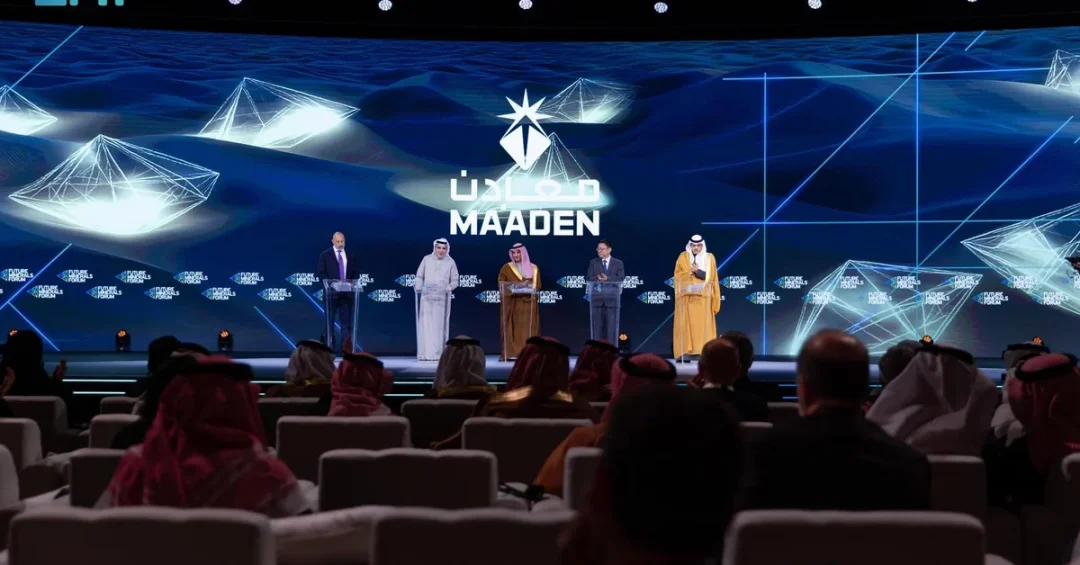
Saudi Arabia’s fourth Future Minerals Forum, held in Riyadh under the patronage of the Custodian of the Two Holy Mosques King Salman bin Abdulaziz Al Saud, concluded with four strategic announcements that reinforce the Kingdom’s ambition to become a global hub for mining and minerals. The announcements, released via official Saudi channels including the Saudi Press Agency, span a landmark critical-minerals joint venture between Saudi Aramco and Ma’aden, new high-grade gold discoveries, a SAR 25 billion steel expansion by the Public Investment Fund’s Hadeed, and the first integrated Chinese steel plant outside China, to be built by Baosteel with Aramco and the PIF. Together they signal a decisive phase in the Kingdom’s economic diversification agenda.
Why does this moment matter so much for global supply chains and for Saudi Arabia’s long-term economic story? The forum drew a record attendance of more than 20,000 participants from 170 countries, with 250 speakers across more than 70 sessions, underscoring the Kingdom’s convening power in a sector that underpins the global energy transition. Mining has moved from the periphery of Saudi industrial policy to its center, and the four announcements demonstrate that Vision 2030’s mining pillar is now delivering tangible projects, capital commitments, and international partnerships rather than aspirational targets alone.
Context and Background
How did Saudi Arabia move so quickly from an oil-centered economy to a serious player in global mining? The answer lies in a deliberate, multi-year strategy led by the Ministry of Industry and Mineral Resources, which identified mining as the third pillar of the Kingdom’s industrial economy alongside hydrocarbons and petrochemicals. The Future Minerals Forum was created as the international platform for that strategy, bringing together governments, investors, and technology providers to shape a responsible and resilient minerals value chain stretching from Africa to Asia.
The fourth edition, held in Riyadh in January 2025, built on three prior gatherings that progressively elevated the Kingdom’s profile in critical minerals such as copper, nickel, lithium, and rare earth elements, all essential for electric vehicles, renewable energy, and advanced electronics. Saudi officials have consistently framed mining as a catalyst for economic diversification, job creation, and technology transfer, in direct alignment with Vision 2030’s goals of reducing oil dependence and expanding non-oil GDP. The presence of more than 170 national delegations in Riyadh reflects how widely that message has been received.
Could any single country realistically anchor the minerals needs of the entire energy transition? Saudi Arabia is not claiming that role alone, but it is positioning itself as an indispensable node in a diversified global network. The Kingdom’s geological endowment, estimated to hold mineral wealth worth trillions of riyals, remains substantially unexplored, and the forum’s announcements show that both national champions and international partners are now moving aggressively to unlock it. The combination of sovereign capital, world-class geological data, and strategic geography gives Saudi Arabia a rare platform from which to shape the sector’s future.
Key Details of the Four Strategic Announcements
What exactly was announced, and why does each item carry strategic weight? First, Saudi Aramco and the Saudi Arabian Mining Company (Ma’aden) unveiled a new joint venture dedicated to exploring critical minerals essential for the energy transition. Under the partnership, Aramco contributes geological and geophysical data along with advanced digital technologies, while Ma’aden brings decades of experience in exploration, development, and operations. The venture is designed to accelerate the exploitation of the Kingdom’s mineral resources and strengthen its capacity to support global supply chains for transition minerals.
Second, Ma’aden announced new discoveries that highlight the scale of the Kingdom’s untapped potential. High-grade gold confirmed at a depth of 220 meters at the Mansourah and Massarah mines points to a possible expansion and even the development of an underground mine. Ma’aden also reported two new discoveries in the Wadi Al Jaww and Shayban deposits, adding further momentum to its exploration pipeline. The company emphasized its expansion into new exploration areas, reinforcing Saudi Arabia’s standing as a leading destination for mining investment.
Third, Hadeed, a subsidiary of the Public Investment Fund (PIF), announced its full acquisition of Al Rajhi Steel alongside an ambitious investment plan worth SAR 25 billion to increase production and serve major projects across the Kingdom. The company aims to develop the steel value chain and reach production of 10 million tons to meet domestic demand. Fourth, Chinese company Baosteel announced it will build its first integrated steel plant outside China in collaboration with Saudi Aramco and the PIF, producing 1.5 million tons of steel plates annually, the first facility of its kind in the region.
International and Regional Impact
How will these announcements reshape the Kingdom’s relationships with major economies? The Baosteel project stands out as a concrete expression of Saudi-Chinese economic cooperation, embedding one of the world’s largest steel producers into the Kingdom’s industrial ecosystem. By locating its first integrated overseas plant in Saudi Arabia, Baosteel signals confidence in the Kingdom’s infrastructure, energy competitiveness, and access to markets across the Middle East, Africa, and Europe. The steel plates it produces will feed construction, shipbuilding, and manufacturing supply chains across the region.
At the same time, the Aramco-Ma’aden joint venture positions Saudi Arabia within global critical-minerals diplomacy, where demand for copper, lithium, nickel, and rare earths is projected to rise sharply through 2030 and beyond. Countries across Asia, Europe, and North America are seeking reliable, responsibly sourced mineral supplies, and the Kingdom’s emerging role offers an additional pillar of stability. The forum’s record attendance from 170 countries demonstrates that international partners view Riyadh not merely as a customer, but as a co-investor and rule-shaper in the sector’s sustainable future.
Economic and Strategic Significance
Why should investors and policymakers beyond the mining sector pay attention? The four announcements collectively represent billions of riyals in committed capital, from the SAR 25 billion Hadeed expansion to the multi-year exploration budgets behind the Aramco-Ma’aden venture and Ma’aden’s drilling programs. They also deepen the integration of Saudi industry, linking upstream exploration to midstream processing and downstream manufacturing such as steel plates and value-added mineral products. That integration multiplies the economic multiplier effect of each riyal invested.
Eng. Khalid bin Saleh Al-Mudaifer, Vice Minister of Industry and Mineral Resources for Mining Affairs, stated that these strategic steps achieve the objectives of Saudi Vision 2030 and reflect the Kingdom’s commitment to enhancing its position as a global hub for the mining and minerals sector. “We have launched innovative projects in the exploration of critical minerals necessary for the energy transition and expanded our exploration efforts to include new areas with promising potential,” he said. He added that the Kingdom has witnessed substantial investments to strengthen local value chains, localize mineral industries, and build global partnerships that meet growing demand, supporting the national economy and the global transition toward sustainability and inclusive development.
The steel announcements carry particular weight for the Kingdom’s construction pipeline, which includes giga-projects such as NEOM, the Red Sea development, and Qiddiya. Domestic steel capacity of 10 million tons, combined with Baosteel’s 1.5 million tons of plate production, reduces reliance on imports and insulates major projects from global supply shocks. For international readers, this means Saudi Arabia is not only extracting minerals but also building the industrial backbone that turns resources into finished products and long-term employment for its citizens.
Vision 2030 Alignment
How do these developments fit into the broader Vision 2030 framework? Mining is explicitly designated as the third pillar of Saudi Arabia’s industrial economy, and the Future Minerals Forum serves as its premier international stage. Each announcement advances Vision 2030’s core objectives: diversifying the economy away from oil, attracting foreign and domestic investment, creating high-value jobs, and localizing advanced industries. The Aramco-Ma’aden venture accelerates resource discovery, Ma’aden’s gold finds expand the resource base, and the steel projects localize downstream manufacturing.
The Kingdom’s leadership has consistently emphasized that mining development must be responsible, sustainable, and mutually beneficial. The forum’s focus on international cooperation and sector sustainability reflects that commitment, positioning Saudi Arabia as a constructive partner in the global energy transition. As the fourth forum closes with record participation and four concrete strategic announcements, the message from Riyadh is clear: the Kingdom is open for mining investment, equipped with world-class data and capital, and determined to help meet the world’s growing demand for the minerals that will power the next century of economic growth.
20 Questions
Q1. What was the fourth Future Minerals Forum and where was it held?
A1. The fourth Future Minerals Forum was held in Riyadh, Saudi Arabia, under the patronage of the Custodian of the Two Holy Mosques King Salman bin Abdulaziz Al Saud. It gathered more than 20,000 participants from 170 countries.
Q2. How many strategic announcements came out of the forum?
A2. Four strategic announcements were made, covering a critical-minerals joint venture, new gold discoveries, a major steel acquisition and expansion, and a new integrated steel plant by Baosteel.
Q3. Which two companies launched the critical-minerals joint venture?
A3. Saudi Aramco and the Saudi Arabian Mining Company (Ma’aden) announced the joint venture, combining Aramco’s geological and digital capabilities with Ma’aden’s exploration and operations expertise.
Q4. What does Aramco contribute to the joint venture?
A4. Aramco provides geological and geophysical data along with advanced digital technologies, helping to identify and accelerate the development of critical mineral resources across the Kingdom.
Q5. What does Ma’aden bring to the partnership?
A5. Ma’aden contributes extensive experience in exploration, development, and mining operations, along with its established infrastructure and knowledge of Saudi Arabia’s geology.
Q6. Why are critical minerals important for the energy transition?
A6. Critical minerals such as copper, lithium, nickel, and rare earth elements are essential for electric vehicles, renewable energy systems, and advanced electronics, making reliable supply chains vital for global decarbonization.
Q7. What new gold discovery did Ma’aden announce?
A7. Ma’aden confirmed high-grade gold at a depth of 220 meters at the Mansourah and Massarah mines, indicating potential expansion and the possibility of developing an underground mine.
Q8. Where were Ma’aden’s two additional discoveries located?
A8. The two new discoveries were reported in the Wadi Al Jaww and Shayban deposits, further enhancing future mining opportunities in the Kingdom.
Q9. What did Hadeed announce regarding Al Rajhi Steel?
A9. Hadeed, a subsidiary of the Public Investment Fund, announced its full acquisition of Al Rajhi Steel as part of efforts to strengthen the Kingdom’s steel industry.
Q10. How much is Hadeed investing in its expansion plan?
A10. Hadeed launched an ambitious plan involving investments worth SAR 25 billion to increase production and meet the needs of major projects across the Kingdom.
Q11. What production target does Hadeed aim to reach?
A11. Hadeed aims to produce 10 million tons of steel to meet domestic demand and develop the value chain, supporting the Kingdom’s large-scale construction and industrial projects.
Q12. Which Chinese company announced a steel plant in Saudi Arabia?
A12. Baosteel announced the construction of its first integrated steel plant outside China, in collaboration with Saudi Aramco and the Public Investment Fund.
Q13. What will the Baosteel plant produce and how much?
A13. The plant is set to produce 1.5 million tons of steel plates annually, making it the first facility of its kind in the region and reflecting strong Saudi-Chinese economic cooperation.
Q14. Who is Eng. Khalid bin Saleh Al-Mudaifer?
A14. Eng. Khalid bin Saleh Al-Mudaifer is the Vice Minister of Industry and Mineral Resources for Mining Affairs, and he highlighted how these steps achieve Saudi Vision 2030 objectives.
Q15. What did the Vice Minister say about the announcements?
A15. He said innovative projects in critical minerals exploration have been launched, exploration efforts expanded to promising new areas, and substantial investments made to strengthen local value chains and global partnerships.
Q16. How many participants attended the forum?
A16. The forum recorded attendance of over 20,000 participants from 170 countries, making it a record gathering for the Future Minerals Forum.
Q17. How many speakers and sessions featured at the forum?
A17. The forum featured 250 speakers across more than 70 sessions, showcasing the latest sector developments and discussing future challenges and opportunities.
Q18. How does mining fit into Saudi Vision 2030?
A18. Mining is the third pillar of Saudi Arabia’s industrial economy under Vision 2030, aimed at diversifying the economy, attracting investment, creating jobs, and localizing advanced industries.
Q19. What is the significance of the Baosteel plant for the region?
A19. It is the first integrated steel plant of its kind in the region, strengthening regional supply chains for steel plates used in construction, shipbuilding, and manufacturing.
Q20. What message does the forum send to global investors?
A20. The forum signals that Saudi Arabia is open for mining investment, equipped with world-class data and capital, and committed to meeting global mineral demand sustainably.
Reader Feedback
We value your thoughts. Please share your feedback on this article.
Your feedback helps us improve our coverage.
Related articles
 SAMA Licenses Nama United Financing to Expand Financial Inclusion
 Saudi Arabia Seeks Mining, Agriculture Investments in Nigeria
 Makkah Chamber Hosts Saudi-Moroccan Business Council Meeting
 Eastern Region Governor Launches 10th Al-Ahsa Dates Festival
 Saudi Minister Meets Slovenian Deputy PM for Economic Talks
 Saudi EXIM Bank Commits $1.5 Billion to Global Mineral Flow