


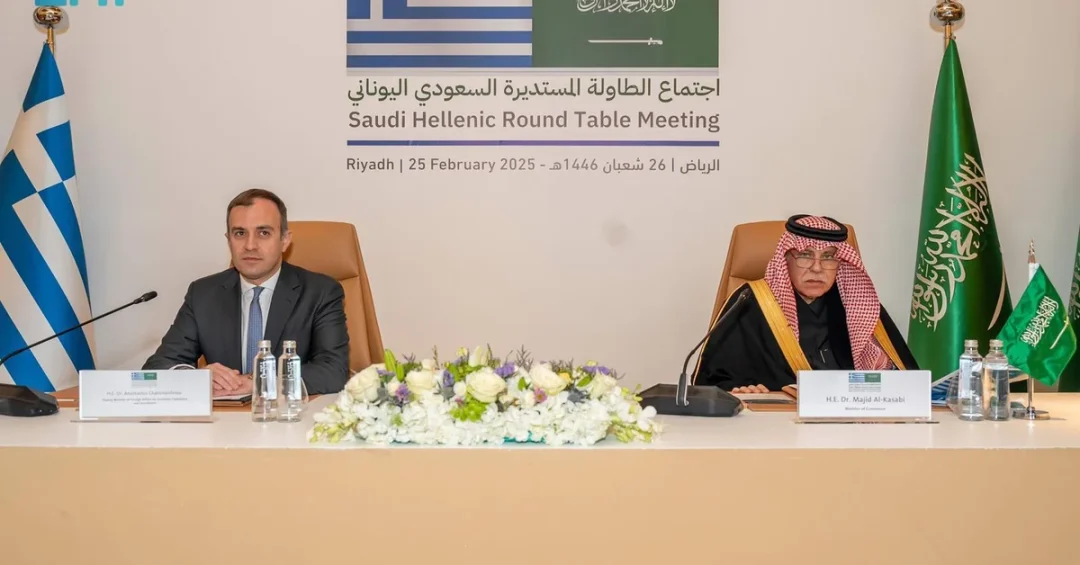
The Saudi Hellenic Round Table Meeting took place in Riyadh on February 26, 2025, to enhance commercial and investment partnerships between Saudi Arabia and Greece. The event, co-chaired by Saudi Arabia’s Minister of Commerce and General Authority of Foreign Trade Chairman Majid Al-Kassabi and Greek Deputy Minister of Foreign Affairs for Economic Diplomacy and Extroversion Tasos Chatzivasileiou, focused on exploring investment opportunities in the Kingdom’s construction sector.
Context and Background
Saudi Arabia and Greece have been strengthening their bilateral relations in recent years, with a particular focus on trade and investment. The Saudi Hellenic Round Table Meeting is part of a broader strategy to diversify economic partnerships and foster international collaboration in line with Saudi Arabia’s Vision 2030 objectives.
Key Details
The meeting saw participation from various Saudi government and private-sector entities, including the Ministry of Investment, the Federation of Saudi Chambers, the Public Investment Fund (PIF), NEOM company, Qiddiya Investment Company, Red Sea Global, King Salman International Airport, Diriyah Company, the New Murabba company, AlUla Development Company, Roshn Group, and Soudah Development. Greek companies were also represented, highlighting the mutual interest in expanding economic ties.
Implications and Impact
The discussions aimed to address common challenges and explore new opportunities for cooperation in trade and investment. Strengthening economic relations between Saudi Arabia and Greece is expected to contribute to the Kingdom’s economic diversification efforts and enhance its global trade network.
Vision 2030 Alignment
The Saudi Hellenic Round Table Meeting aligns with Saudi Arabia’s Vision 2030 goals of diversifying the economy and building strong international partnerships. By fostering collaboration with Greece, Saudi Arabia continues to position itself as a global investment hub and a leader in economic transformation.
20 Questions
Q1. What was the purpose of the Saudi Hellenic Round Table Meeting?
A1. The purpose was to enhance commercial and investment partnerships between Saudi Arabia and Greece, particularly in the construction sector.
Q2. Who co-chaired the meeting?
A2. The meeting was co-chaired by Saudi Arabia’s Minister of Commerce Majid Al-Kassabi and Greek Deputy Minister of Foreign Affairs Tasos Chatzivasileiou.
Q3. Which Saudi entities participated in the meeting?
A3. Participants included the Ministry of Investment, the Federation of Saudi Chambers, the Public Investment Fund (PIF), NEOM company, and others.
Q4. What sectors were discussed during the meeting?
A4. The discussions focused on the construction sector and broader trade and investment opportunities.
Q5. How does this meeting benefit Saudi Arabia’s economy?
A5. It helps diversify the economy and strengthens international trade and investment networks.
Q6. What are the main goals of Saudi Arabia’s Vision 2030?
A6. The main goals include economic diversification, reducing dependence on oil, and fostering international partnerships.
Q7. How does Greece benefit from this partnership?
A7. Greece gains access to investment opportunities in Saudi Arabia’s growing construction sector and broader economic collaboration.
Q8. What challenges were addressed during the meeting?
A8. The meeting addressed common challenges in trade and investment to foster better cooperation.
Q9. What is the role of the Public Investment Fund (PIF) in this meeting?
A9. PIF represents Saudi Arabia’s investment interests and explores collaborative opportunities with Greek entities.
Q10. How does NEOM contribute to this partnership?
A10. NEOM showcases Saudi Arabia’s vision for futuristic development and attracts international investment.
Q11. What is the significance of the construction sector in Saudi Arabia?
A11. The construction sector is vital for infrastructure development and economic growth in Saudi Arabia.
Q12. How does this meeting align with Saudi Arabia’s economic strategies?
A12. It aligns with strategies to diversify the economy and enhance global trade partnerships.
Q13. What is the expected outcome of this meeting?
A13. The expected outcome is strengthened economic relations and increased investment opportunities between Saudi Arabia and Greece.
Q14. How does Saudi Arabia’s Vision 2030 impact global trade?
A14. It positions Saudi Arabia as a global investment hub and fosters international economic collaboration.
Q15. What role do private-sector entities play in this meeting?
A15. They represent diverse industries and explore collaborative opportunities with Greek counterparts.
Q16. How does this partnership enhance Saudi Arabia’s global role?
A16. It enhances Saudi Arabia’s role as a leader in economic transformation and international trade.
Q17. What is the importance of economic diplomacy in this context?
A17. Economic diplomacy facilitates trade and investment partnerships that benefit both countries.
Q18. How does Saudi Arabia’s construction sector attract international investors?
A18. The sector offers vast opportunities in infrastructure development and aligns with Vision 2030 goals.
Q19. What is the role of the Federation of Saudi Chambers in this meeting?
A19. It represents Saudi businesses and promotes trade and investment collaboration with Greece.
Q20. How does this meeting contribute to Saudi Arabia’s long-term vision?
A20. It fosters international partnerships and economic diversification, key components of Vision 2030.
Reader Feedback
We value your thoughts. Please share your feedback on this article.
Your feedback helps us improve our coverage.