


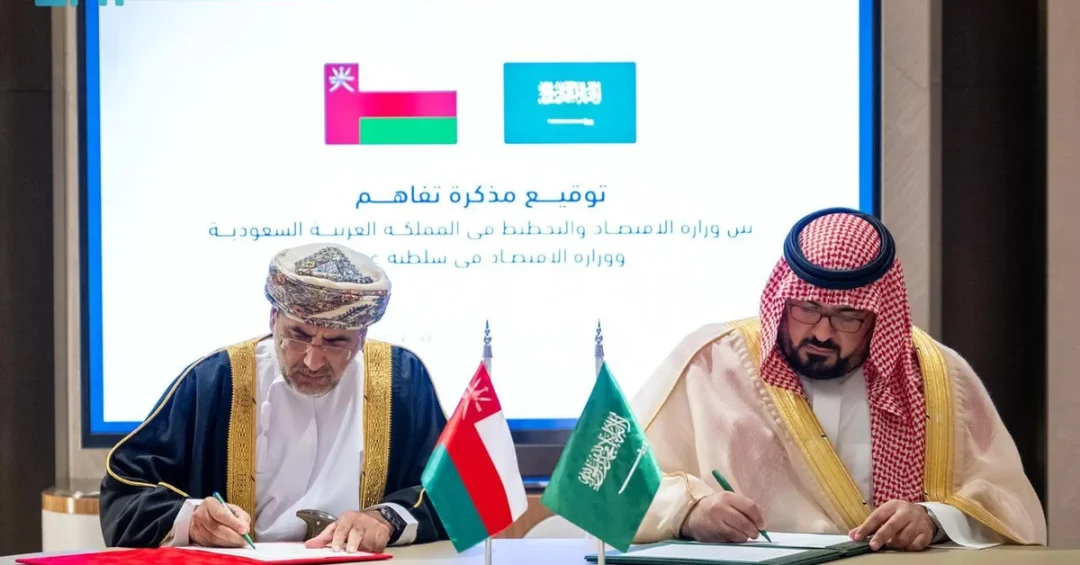
The Ministry of Economy and Planning of the Kingdom of Saudi Arabia and the Ministry of Economy of the Sultanate of Oman signed a memorandum of understanding (MoU) on October 10, 2024, in Riyadh, marking a significant step forward in bilateral economic cooperation. The agreement, announced by the Saudi Press Agency (SPA), focuses on collaboration in medium- and long-term economic planning, economic studies and modeling, economic policies and plans, and green and circular economies. The MoU was signed by His Excellency Faisal Alibrahim, Saudi Minister of Economy and Planning, and His Excellency Dr. Saeed bin Mohammed Al-Saqri, Omani Minister of Economy, and will remain in effect for five years.
This development underscores the deepening ties between two Gulf Cooperation Council (GCC) member states and reflects a shared commitment to sustainable economic growth and innovation. It aligns with Saudi Arabia’s Vision 2030, which seeks to diversify the Kingdom’s economy and enhance its global engagement. As the region navigates a rapidly evolving economic landscape, could this MoU serve as a blueprint for broader GCC integration? The agreement not only strengthens bilateral relations but also contributes to the stability and prosperity of the wider region.
Context and Background
Saudi Arabia and Oman have long enjoyed fraternal relations rooted in shared history, culture, and geography. In recent years, these ties have expanded into robust economic partnerships, with both nations actively pursuing diversification strategies to reduce dependence on hydrocarbons. The MoU signed in Riyadh builds on this momentum, establishing a structured framework for cooperation in areas critical to future growth. Why is economic planning so vital for the Gulf region’s future? As global markets shift and new technologies emerge, the ability to anticipate and adapt is paramount, and this agreement positions both countries to do just that.
The Ministry of Economy and Planning, under the leadership of Minister Faisal Alibrahim, has been at the forefront of Saudi Arabia’s economic transformation. It plays a central role in crafting policies that support Vision 2030, including initiatives to boost non-oil sectors, empower the private sector, and attract foreign investment. Similarly, Oman’s Ministry of Economy, led by Dr. Saeed bin Mohammed Al-Saqri, is driving Oman Vision 2040, which emphasizes economic diversification, fiscal sustainability, and innovation. By joining forces, the two ministries can leverage complementary strengths and share best practices, creating a synergy that benefits both nations.
The timing of this MoU is particularly significant. As the global economy faces headwinds from geopolitical tensions, supply chain disruptions, and climate change, regional cooperation becomes ever more essential. The GCC has long been a pillar of stability in the Middle East, and initiatives like this reinforce its role as a driver of economic resilience. How can small and medium-sized enterprises (SMEs) benefit from such governmental collaboration? Through improved policies and shared knowledge, SMEs in both countries can gain better access to markets, funding, and innovation networks, fueling job creation and economic diversification.
Key Details of the Agreement
The MoU stipulates cooperation in four primary areas: medium- and long-term economic planning, economic studies and modeling, economic policies and plans, and green and circular economies. These pillars are designed to enhance the capacity of both ministries to formulate evidence-based policies that address current and future challenges. The agreement will be implemented through the exchange of information, expertise, studies, and visits between experts and specialists, as well as the organization of conferences, seminars, and workshops. This hands-on approach ensures that the cooperation is not merely symbolic but delivers tangible results.
Economic modeling, for instance, allows policymakers to simulate the impact of various scenarios—such as oil price fluctuations or trade policy changes—on key indicators like GDP, employment, and inflation. By sharing models and data, Saudi Arabia and Oman can improve the accuracy of their forecasts and design more effective interventions. In the realm of green and circular economies, the MoU promotes sustainable practices that reduce waste, enhance resource efficiency, and support the transition to renewable energy. Could this lead to joint projects in solar energy or carbon capture? While specific projects are yet to be announced, the framework certainly opens the door for such collaboration.
The five-year duration of the MoU provides a stable horizon for planning and implementation. It allows both sides to set milestones, evaluate progress, and adjust strategies as needed. The agreement is based on mutual interests and complies with the regulations and laws of both countries, ensuring that it operates within legal frameworks. This adherence to national laws is crucial for smooth execution and builds trust between the partners. What mechanisms will be used to monitor progress? Likely, a joint committee will be established to oversee the implementation, though details are forthcoming. Such committees are common in international agreements and help maintain momentum.
International and Regional Impact
This MoU is a clear signal of the strengthening ties between Saudi Arabia and Oman, two influential members of the GCC. It contributes to the broader goal of Gulf economic integration, which has been a priority for regional leaders. Enhanced cooperation between these nations can lead to more coordinated policies on trade, investment, and energy, amplifying their collective voice on the global stage. In a world where economic blocs are increasingly important, a united Gulf can better navigate challenges and seize opportunities. How might this affect the region’s relationship with major powers like China and the United States? A more integrated GCC can negotiate from a position of strength, attracting investment and fostering balanced partnerships.
Beyond the Gulf, the MoU reflects Saudi Arabia’s proactive approach to international diplomacy and economic statecraft. Under Vision 2030, the Kingdom has sought to build bridges with countries across Asia, Africa, and Europe, positioning itself as a hub for trade and investment. Oman, with its strategic location overlooking the Strait of Hormuz, is a vital partner in these efforts. The agreement also complements other regional initiatives, such as the Saudi-Omani Coordination Council, which was established to deepen bilateral cooperation across various sectors. By aligning their economic planning, the two countries can present a unified front in global forums and attract greater foreign direct investment (FDI).
For international observers, this MoU underscores the stability and forward-looking nature of the Gulf region. It demonstrates that despite geopolitical tensions, countries in the Middle East are committed to dialogue, collaboration, and shared prosperity. Investors and multinational corporations take note of such developments, as they signal a favorable environment for business. Could this MoU inspire similar agreements among other GCC states? The precedent is positive, and it may encourage further bilateral and multilateral initiatives, fostering a more interconnected and resilient regional economy.
Economic and Strategic Significance
From an economic standpoint, the MoU promises to enhance the efficiency and effectiveness of economic policymaking in both countries. By pooling resources and expertise, Saudi Arabia and Oman can avoid duplication, reduce costs, and accelerate the pace of reform. For Saudi Arabia, this aligns with Vision 2030’s objectives of increasing non-oil revenue, boosting the private sector’s contribution to GDP, and creating jobs for its youthful population. Oman’s Vision 2040 shares similar goals, focusing on economic diversification, fiscal balance, and human capital development. Together, they can create a larger, more dynamic market that attracts investment and fosters innovation.
The emphasis on green and circular economies is particularly timely. As the world transitions to a low-carbon future, countries that invest in sustainable technologies and practices will gain a competitive edge. Saudi Arabia has already launched ambitious initiatives like the Saudi Green Initiative and the Middle East Green Initiative, aiming to plant billions of trees and reduce emissions. Oman has also made strides in renewable energy, including wind and solar projects. Through this MoU, the two nations can share knowledge and develop joint ventures in clean energy, waste management, and sustainable agriculture. What economic opportunities will arise for the private sector? Companies specializing in environmental technologies, consulting, and engineering are likely to find new avenues for growth as governments collaborate.
Strategically, the MoU reinforces the geopolitical alignment between Saudi Arabia and Oman, contributing to regional stability. Both countries share an interest in ensuring the free flow of trade through the Strait of Hormuz and the Bab-el-Mandeb, vital chokepoints for global energy supplies. By working together on economic planning, they can better address security challenges that have economic ramifications. Moreover, the agreement strengthens the GCC’s collective resilience against external shocks, whether from oil price volatility or global recessions. In an era of uncertainty, such partnerships are invaluable.
Vision 2030 Alignment
This MoU is a concrete example of Vision 2030 in action. Saudi Arabia’s ambitious roadmap for national transformation emphasizes international cooperation as a key enabler of economic diversification and sustainable development. By partnering with Oman, the Kingdom not only strengthens a vital bilateral relationship but also advances its broader goals of becoming a global investment powerhouse and a hub connecting three continents. The collaboration in economic planning and green economies directly supports Vision 2030’s objectives of creating a vibrant society, a thriving economy, and an ambitious nation.
Furthermore, the agreement showcases Saudi Arabia’s leadership in fostering regional integration, a core tenet of its foreign policy. Under the guidance of His Royal Highness Crown Prince Mohammed bin Salman, the Kingdom has consistently championed initiatives that promote stability and prosperity in the Gulf and beyond. As the MoU is implemented over the next five years, it is expected to yield tangible benefits, from improved policy frameworks to joint projects that drive growth. Ultimately, this partnership is not just about economics—it is about building a shared future that realizes the aspirations of both peoples and contributes to a more peaceful and prosperous world.
20 Questions
Q1. What is the main purpose of the MoU signed between Saudi Arabia and Oman?
A1. The MoU aims to enhance cooperation in medium- and long-term economic planning, economic studies and modeling, economic policies and plans, and green and circular economies, fostering sustainable development and bilateral relations.
Q2. Who signed the MoU on behalf of Saudi Arabia and Oman?
A2. Saudi Minister of Economy and Planning Faisal Alibrahim and Omani Minister of Economy Dr. Saeed bin Mohammed Al-Saqri signed the agreement in Riyadh on October 10, 2024.
Q3. How long will the MoU remain in effect?
A3. The agreement will remain in effect for five years, providing a stable framework for collaboration and allowing both countries to achieve set milestones and evaluate progress.
Q4. What are the key areas of cooperation outlined in the MoU?
A4. The key areas include medium- and long-term economic planning, economic studies and modeling, economic policies and plans, and green and circular economies, all aimed at sustainable growth.
Q5. How will the cooperation be implemented?
A5. Cooperation will be implemented through the exchange of information, expertise, studies, and visits between experts and specialists, as well as the organization of conferences, seminars, and workshops.
Q6. What is the significance of the MoU for GCC cooperation?
A6. The MoU strengthens GCC cooperation by enhancing bilateral relations between Saudi Arabia and Oman, contributing to regional economic integration and stability.
Q7. How does the MoU align with Saudi Arabia’s Vision 2030?
A7. It supports Vision 2030 by promoting economic diversification, sustainable development, and international cooperation, key pillars of the Kingdom’s transformation strategy.
Q8. What role does economic modeling play in the agreement?
A8. Economic modeling allows policymakers to simulate scenarios and make evidence-based decisions, improving the accuracy of forecasts and policy effectiveness.
Q9. What are green and circular economies, and why are they important?
A9. Green and circular economies focus on sustainability, resource efficiency, and waste reduction. They are crucial for achieving long-term environmental and economic resilience.
Q10. How can the private sector benefit from this MoU?
A10. The private sector can benefit from improved policies, new business opportunities in green technologies, and enhanced access to markets and expertise in both countries.
Q11. Will the MoU lead to joint projects between Saudi Arabia and Oman?
A11. The framework encourages joint projects, particularly in renewable energy, sustainable agriculture, and economic studies, though specific initiatives will be announced as cooperation progresses.
Q12. What is the expected impact on trade and investment?
A12. The MoU is expected to boost trade and investment by creating a more predictable and collaborative economic environment, attracting foreign direct investment to the region.
Q13. How does this MoU complement other Saudi-Omani agreements?
A13. It complements existing agreements, such as the Saudi-Omani Coordination Council, by adding a focused layer of cooperation on economic planning and sustainability.
Q14. What benefits will Oman gain from the MoU?
A14. Oman will gain access to Saudi expertise, best practices in economic planning, and opportunities for joint ventures, supporting its Vision 2040 goals.
Q15. How does the MoU address climate change?
A15. By promoting green and circular economies, the MoU encourages sustainable practices, renewable energy, and emissions reduction, aligning with global climate goals.
Q16. What is the role of the Saudi Ministry of Economy and Planning?
A16. The Ministry leads Saudi Arabia’s economic transformation, crafting policies for Vision 2030, and will oversee the MoU’s implementation to ensure tangible outcomes.
Q17. How will progress be monitored and evaluated?
A17. A joint committee is likely to be established to monitor progress, with regular reviews and adjustments to ensure the objectives are met effectively.
Q18. Can other GCC countries join this initiative?
A18. While the MoU is bilateral, it sets a positive precedent for broader GCC cooperation, potentially inspiring similar agreements among other member states.
Q19. What are the long-term economic goals of this partnership?
A19. The long-term goals include sustainable growth, economic diversification, enhanced regional integration, and positioning Saudi Arabia and Oman as leaders in green economies.
Q20. How does this MoU reflect Saudi Arabia’s global role?
A20. It showcases Saudi Arabia’s commitment to international diplomacy, economic leadership, and Vision 2030, reinforcing its role as a proactive global partner.
Reader Feedback
We value your thoughts. Please share your feedback on this article.
Your feedback helps us improve our coverage.
Related articles
 Saudi-Pakistani Business Forum Held in Islamabad
 Saudi Arabia Hosts UNIDO Forum on Sustainable Industry
 Saudi-Egyptian Joint Committee Holds Follow-Up Meeting in Cairo
 Pakistani PM Receives Saudi Minister of Investment
 Reef Saudi Launches International Training Program for Farmers
 Egyptian Investment Minister Meets with Saudi General Authority of Foreign Trade Undersecretary