


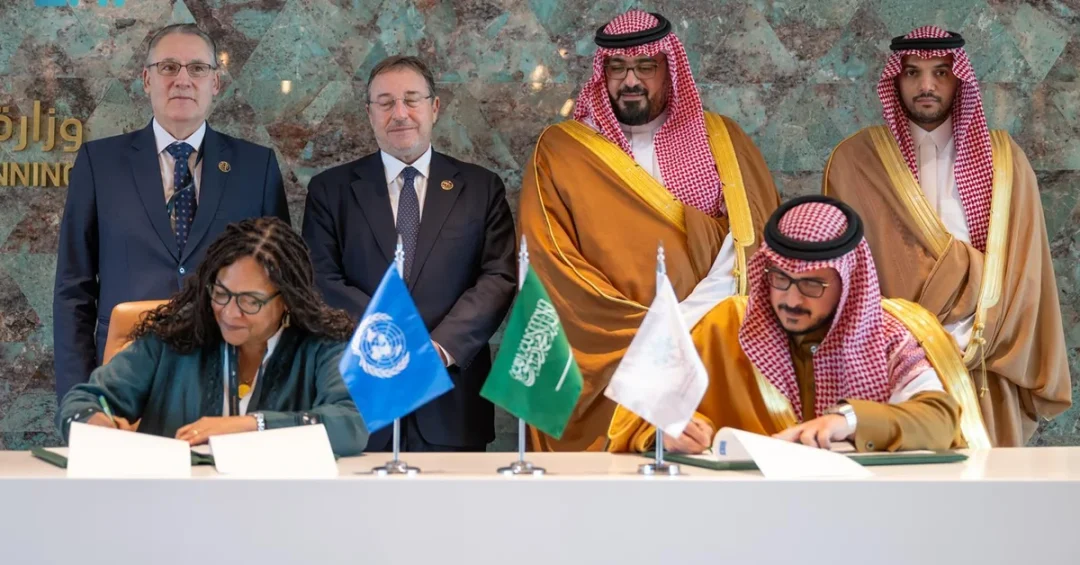
The Ministry of Economy and Planning of the Kingdom of Saudi Arabia and the United Nations Development Programme (UNDP) signed a formal agreement in Riyadh to activate a comprehensive program aimed at enhancing economic and social development, the Saudi Press Agency reported on December 4, 2024. The agreement was signed by Hattan bin Samman, General Supervisor for International Organizations at the Ministry of Economy and Planning, and Nahid Hussein, UNDP Resident Representative, in the presence of Minister of Economy and Planning Faisal F. Alibrahim, UNDP Administrator Achim Steiner, Vice Minister of Economy and Planning Ammar Nagadi, and Dr. Abdallah Al Dardari, Assistant Secretary-General, Assistant Administrator, and Director of the UNDP Regional Bureau for Arab States.
What does this partnership signal about Saudi Arabia’s expanding role in global development diplomacy? The agreement establishes a structured framework for cooperation in economic and social policy planning, elevates the visibility of Saudi national achievements at the United Nations, and deepens the exchange of knowledge and technical expertise in sustainable development. It reflects a broader pattern in which the Kingdom is not merely a participant in international development frameworks but an active shaper of them, aligning domestic priorities under Saudi Vision 2030 with global goals such as the UN Sustainable Development Goals. The signing ceremony in Riyadh brought together senior Saudi officials and top UNDP leadership, underscoring the strategic weight both sides attach to the collaboration.
Context and Background
How did this agreement come about, and why does it matter now? The Ministry of Economy and Planning has, in recent years, assumed a central coordinating role in Saudi Arabia’s economic transformation, tasked with aligning national strategies, monitoring progress, and ensuring that government entities work toward shared objectives under Vision 2030. The UNDP, for its part, has maintained a long-standing presence in the Kingdom, supporting capacity building, policy advisory services, and development programming. The new agreement formalizes and expands that relationship, moving it from project-based cooperation toward a comprehensive programmatic partnership.
The timing is significant. Saudi Arabia is in the midst of implementing an ambitious national transformation agenda that touches every sector, from energy and industry to tourism, technology, and human capital. International organizations have increasingly looked to the Kingdom as a source of development finance, innovation, and regional leadership. By signing a comprehensive program with the UNDP, the Ministry of Economy and Planning is positioning Saudi Arabia as both a beneficiary and a contributor to global development knowledge, capable of sharing its own reform experience with other countries while drawing on international best practices to refine its policies.
Moreover, the agreement comes as multilateral institutions seek stronger partnerships with Gulf states. Saudi Arabia’s economic weight, its growing development assistance portfolio, and its role in regional stability make it a natural partner for the United Nations system. The presence of Achim Steiner, the UNDP Administrator, at the signing reflects the importance the UN places on this relationship and its desire to deepen engagement with the Kingdom at a time when global development financing faces pressure.
Key Details of the Agreement
What exactly does the agreement cover? According to the Saudi Press Agency, the program is designed to support economic and social policy planning, highlight national efforts and achievements at the United Nations, and enhance cooperation and the exchange of knowledge and expertise in sustainable development. These three pillars are interconnected: robust policy planning provides the evidence base that Saudi Arabia can present internationally, while knowledge exchange ensures that the Kingdom’s strategies benefit from global research and comparative experience.
The signatories bring substantial expertise to the table. Hattan bin Samman, as General Supervisor for International Organizations, has been closely involved in managing Saudi Arabia’s relationships with multilateral bodies. Nahid Hussein, the UNDP Resident Representative, has led the organization’s work in the Kingdom, focusing on areas such as sustainable development, economic diversification, and social inclusion. Their signatures commit both institutions to a work program that will likely include technical assistance, joint research, capacity-building workshops, and platforms for sharing Saudi success stories with other nations.
The agreement also emphasizes institutional competencies. Strengthening the ability of national institutions to design, implement, and evaluate policies is a core objective, and it aligns with the Ministry’s mandate to enhance the effectiveness of government spending and regulation. By working with the UNDP, the Ministry can access a global network of experts and methodologies that complement its own growing capabilities. The program is expected to generate concrete outputs, such as policy briefs, training modules, and progress reports that feed into both national planning cycles and international reporting obligations.
International and Regional Impact
How will this partnership resonate beyond Saudi Arabia’s borders? The agreement reinforces the Kingdom’s standing as a bridge between the Global South and the international development system. Saudi Arabia has increasingly used its convening power and financial resources to support development in Africa, Asia, and the Middle East, and a formal partnership with the UNDP amplifies that role. Other countries in the region may look to the Saudi-UNDP model as a template for how national planning ministries can collaborate with UN agencies to accelerate progress on the Sustainable Development Goals.
At the regional level, the agreement supports stability and prosperity by promoting evidence-based policymaking. The Middle East and North Africa region faces interconnected challenges, including youth unemployment, water scarcity, and economic diversification. Saudi Arabia’s experience in addressing these issues through Vision 2030 reforms can inform regional dialogues, and the UNDP provides a neutral platform for sharing lessons learned. The partnership also strengthens the UN’s presence and relevance in the Gulf, where it can leverage Saudi Arabia’s logistical and financial support to implement programs more effectively.
Internationally, the deal signals that Saudi Arabia is committed to multilateralism at a time when some major powers are retreating from global institutions. By deepening its engagement with the UNDP, the Kingdom underscores its willingness to contribute to global public goods, from poverty reduction to climate resilience. This aligns with its aspirations to host major international events and to be seen as a responsible global stakeholder, enhancing its soft power and diplomatic reach.
Economic and Strategic Significance
What are the economic and strategic benefits for Saudi Arabia? First, the agreement can improve the quality of economic policy by injecting international expertise into planning processes. As the Kingdom implements giga-projects and diversifies away from oil, the complexity of policy challenges increases. Access to UNDP’s analytical tools and global knowledge can help Saudi institutions design more effective interventions, avoid pitfalls, and benchmark performance against best practices.
Second, the partnership enhances Saudi Arabia’s ability to tell its story on the world stage. Highlighting national efforts and achievements at the United Nations is not merely a public relations exercise; it builds credibility with investors, development partners, and foreign governments. A well-documented record of progress under Vision 2030 can attract foreign direct investment and facilitate partnerships in areas such as renewable energy, digital economy, and advanced manufacturing. It also strengthens Saudi Arabia’s case for leadership roles in international forums.
Third, the agreement supports human capital development. Knowledge exchange programs can expose Saudi professionals to international methodologies and networks, while also allowing Saudi experts to share their insights with counterparts in other countries. This two-way flow builds institutional capacity and fosters a culture of continuous learning within the public sector. Over time, such exchanges can create a cadre of Saudi development specialists who can lead similar initiatives globally.
Vision 2030 Alignment
How does this agreement fit into Saudi Vision 2030? The Vision’s overarching goal is to transform the Kingdom into a diversified, innovative, and globally engaged economy and society. A key pillar is strengthening government effectiveness and policy planning, which the Ministry of Economy and Planning is tasked with leading. Partnering with the UNDP directly supports this pillar by providing international expertise, validation, and a platform for showcasing progress. The agreement also aligns with the Vision’s emphasis on sustainable development, social welfare, and international cooperation.
Looking ahead, the program is expected to generate tangible outcomes that feed into Vision 2030’s targets. These may include improved economic forecasting, better social safety nets, enhanced monitoring of development indicators, and stronger reporting to international bodies. By working with the UNDP, Saudi Arabia not only accelerates its own transformation but also contributes to global development, reinforcing its role as a regional leader and a responsible global citizen. The partnership exemplifies how Vision 2030 extends beyond domestic reform to shape Saudi Arabia’s international engagement and its contribution to a more prosperous and sustainable world.
20 Questions
Q1. What was signed between Saudi Arabia’s Ministry of Economy and Planning and the UNDP?
A1. An agreement to activate a comprehensive program to enhance economic and social development, focusing on policy planning, international visibility, and knowledge exchange in sustainable development.
Q2. Who signed the agreement on behalf of the Ministry of Economy and Planning?
A2. Hattan bin Samman, the ministry’s General Supervisor for International Organizations, signed the agreement.
Q3. Who signed for the UNDP?
A3. Nahid Hussein, the UNDP Resident Representative, signed on behalf of the organization.
Q4. Which senior officials attended the signing ceremony?
A4. Minister of Economy and Planning Faisal F. Alibrahim, UNDP Administrator Achim Steiner, Vice Minister Ammar Nagadi, and Dr. Abdallah Al Dardari attended.
Q5. What are the main objectives of the agreement?
A5. It aims to support economic and social policy planning, highlight Saudi national efforts at the UN, and enhance cooperation and knowledge exchange in sustainable development.
Q6. How does this agreement relate to Saudi Vision 2030?
A6. It supports Vision 2030 by enhancing policy development, institutional competencies, and sustainable economic and social development, aligning with the Kingdom’s national aspirations.
Q7. Why is this agreement important for Saudi Arabia’s international standing?
A7. It strengthens Saudi Arabia’s role in global development, showcases its achievements at the UN, and reinforces its commitment to multilateral cooperation and sustainable development.
Q8. What is the role of the Ministry of Economy and Planning in Saudi Arabia?
A8. The ministry coordinates national economic and social planning, aligns strategies with Vision 2030, and monitors progress across government entities.
Q9. What does the UNDP bring to the partnership?
A9. The UNDP provides global expertise, technical assistance, policy advisory services, and a platform for sharing best practices in sustainable development.
Q10. How will knowledge exchange work under this program?
A10. It will involve joint research, capacity-building workshops, technical assistance, and platforms for sharing Saudi success stories with other nations.
Q11. What are the expected outcomes of the agreement?
A11. Expected outcomes include improved policy planning, enhanced institutional capacity, stronger reporting to international bodies, and greater visibility of Saudi achievements at the UN.
Q12. How does this partnership benefit the Middle East region?
A12. It promotes evidence-based policymaking, supports regional stability, and offers a model for collaboration between national planning ministries and UN agencies.
Q13. What is the significance of Achim Steiner’s presence at the signing?
A13. It underscores the UNDP’s strong commitment to deepening engagement with Saudi Arabia and highlights the importance of the partnership at the highest levels.
Q14. How does this agreement support sustainable development goals?
A14. By enhancing policy planning and knowledge exchange, it helps accelerate progress on economic and social SDGs, both in Saudi Arabia and globally.
Q15. What is Dr. Abdallah Al Dardari’s role in the UNDP?
A15. He is Assistant Secretary-General, Assistant Administrator, and Director of the UNDP Regional Bureau for Arab States.
Q16. Will the agreement involve financial commitments?
A16. The announcement did not specify financial details; the focus is on programmatic cooperation, technical support, and knowledge exchange.
Q17. How can other countries benefit from this partnership?
A17. Other countries can learn from the Saudi-UNDP model of collaboration and benefit from shared knowledge and best practices in sustainable development.
Q18. What does ‘highlighting national efforts at the UN’ mean?
A18. It means presenting Saudi Arabia’s development achievements and progress on Vision 2030 in UN forums, enhancing transparency and international recognition.
Q19. How does this agreement reflect Saudi Arabia’s commitment to multilateralism?
A19. It shows the Kingdom’s willingness to partner with international organizations, contribute to global public goods, and support the UN’s development agenda.
Q20. What are the next steps after the signing?
A20. Both parties will implement the comprehensive program, which includes joint activities, capacity building, and regular reporting on progress toward shared development objectives.
Reader Feedback
We value your thoughts. Please share your feedback on this article.
Your feedback helps us improve our coverage.
Related articles
 KSA, Pakistan Sign Customs Cooperation Agreement
 Saudi Bank Credit Hits Record SAR2.88 Trillion in October
 Saudi Ministry of Economy and Planning Earns EFQM 4-Star Rating
 Saudi ZATCA, Morocco Tax Authority Sign Cooperation Deal
 Jeddah AgroFood Exhibition Showcases Modern Agricultural Technologies
 PIF and Bpifrance Sign $10 Billion Financing MoU