


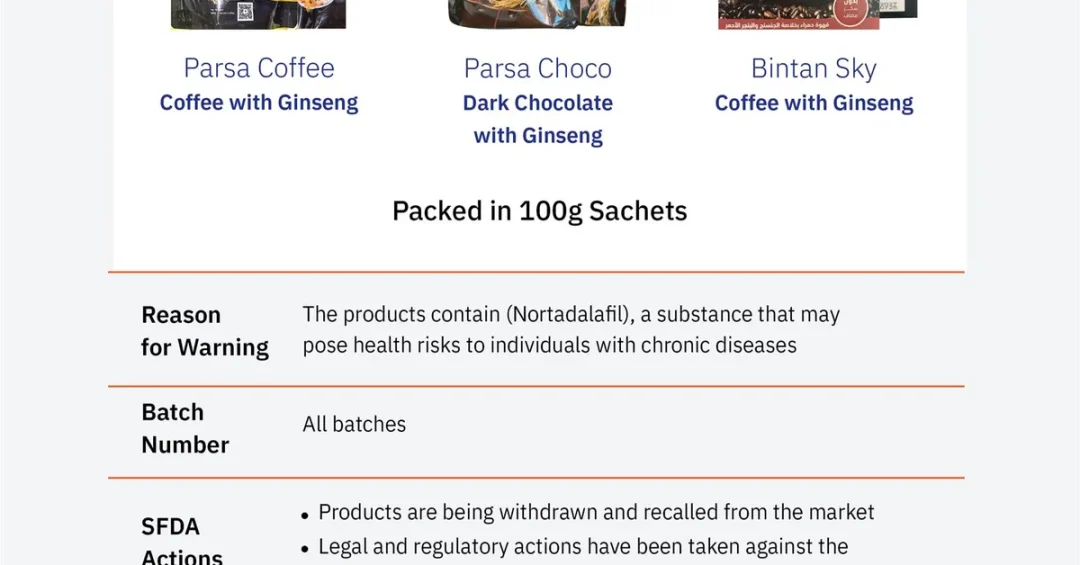
The Saudi Food and Drug Authority (SFDA) has issued a public warning against consuming three coffee and chocolate products containing ginseng after laboratory analyses revealed the presence of Nortadalafil, a substance prohibited for use in food products. The warning, announced in Riyadh and carried by the Saudi Press Agency (SPA), applies to all batches of Parsa Coffee (Coffee with Ginseng), Parsa Choco (Dark Chocolate with Ginseng), and Bintan SKY (Coffee with Ginseng), all packaged in 100-gram sachets. The authority urged consumers to immediately stop using these products and safely dispose of any units in their possession, noting that they may pose health risks, particularly for individuals with chronic diseases.
The announcement reflects the Kingdom of Saudi Arabia’s continuing commitment to food safety and public health under the oversight of the SFDA, the government body responsible for regulating food, drugs, medical devices, and cosmetics across the country. The authority confirmed that it is taking all necessary regulatory measures to recall and withdraw the affected items from markets, and that comprehensive monitoring will continue to ensure the safety of food products in circulation. Legal proceedings are currently underway against the importing companies, underscoring that the Kingdom will not tolerate violations that compromise the safety of citizens and residents. How does a single laboratory finding translate into a nationwide consumer protection action? The answer lies in the SFDA’s systematic market surveillance framework, which combines sampling, testing, and enforcement into a single rapid-response system.
Context and Background
Why does the SFDA act so decisively when a prohibited substance is detected in a consumer product? Because the Kingdom’s food safety system is built on prevention rather than reaction, and every enforcement action is designed to protect the public before harm can occur. The SFDA was established as an independent authority with a mandate to regulate food and drug products, and it operates a nationwide network of laboratories, inspection teams, and monitoring programs that track products from import to shelf. When laboratory analyses identified Nortadalafil in the three ginseng products, the authority moved quickly to classify them as unsafe and to communicate that finding directly to the public through official channels.
Nortadalafil belongs to a class of substances that are not permitted in food products, and its presence in coffee and chocolate items is considered a serious violation of the Kingdom’s Food Law and its Implementing Regulations. The SFDA’s warning is not limited to a single batch or production run; it applies to all batches of the three named products, a measure that reflects the precautionary principle at the heart of Saudi food safety policy. Consumers who may have purchased these items are advised to dispose of them safely and to avoid consumption entirely, especially those with chronic diseases who could face elevated health risks.
The products in question, Parsa Coffee (Coffee with Ginseng), Parsa Choco (Dark Chocolate with Ginseng), and Bintan SKY (Coffee with Ginseng), are sold in 100-gram sachets and were distributed through retail channels. The SFDA’s action covers the full inventory of these items, and the authority has stated that it is pursuing legal proceedings against the importing companies. Violations of the Food Law can result in fines of up to SAR10 million, imprisonment for up to 10 years, or both, a penalty framework that signals the seriousness with which the Kingdom treats food safety breaches.
Key Details of the Warning
What exactly should consumers do if they have these products at home? The SFDA’s guidance is clear and direct: stop using the products immediately and dispose of any remaining units safely. The warning covers all batches of Parsa Coffee, Parsa Choco, and Bintan SKY, all in 100-gram sachets, and the authority has confirmed that it is taking all necessary regulatory measures to recall and withdraw these items from markets. This includes coordination with importers, distributors, and retailers to remove the products from shelves and prevent further sales.
The SFDA also emphasized that comprehensive monitoring will continue to ensure the safety of food products in circulation. This means that the recall is not an isolated action but part of an ongoing surveillance program that regularly samples and tests products across the Kingdom. The authority’s laboratories are equipped to detect a wide range of prohibited substances, and findings are acted upon swiftly to protect consumers. The public is encouraged to report any food product violations through the Unified Call Center at 19999, a channel that allows citizens and residents to contribute directly to market surveillance and product safety.
The SFDA reaffirmed its commitment to consumer health, stating that it will not tolerate any violations that compromise the safety of citizens and residents. Legal proceedings are currently underway against the importing companies, and the authority has made clear that it will pursue all necessary measures to hold violators accountable. The penalty structure under the Food Law, which includes fines of up to SAR10 million and imprisonment for up to 10 years, provides a strong deterrent and reflects the Kingdom’s determination to maintain the highest standards of food safety.
International and Regional Impact
How does a domestic food safety warning resonate beyond Saudi Arabia’s borders? The Kingdom is a major importer of food products and a key player in regional trade, and its regulatory actions are closely watched by trading partners, exporters, and international food safety bodies. When the SFDA identifies a prohibited substance and orders a recall, it sends a signal to global suppliers that Saudi Arabia enforces strict standards and expects full compliance with its food safety requirements. This reinforces the Kingdom’s reputation as a reliable and responsible market for international food trade.
The warning also highlights the importance of cross-border cooperation in food safety. Imported products pass through multiple jurisdictions before reaching Saudi shelves, and the SFDA’s ability to detect and act on violations depends on robust testing and monitoring at points of entry. The authority’s action against these three ginseng products demonstrates that Saudi Arabia has the laboratory capacity and regulatory framework to identify risks quickly and to take decisive action. For regional neighbors and international partners, the case underscores the value of aligning food safety standards and sharing information to prevent unsafe products from circulating.
Economic and Strategic Significance
Why does food safety matter for Saudi Arabia’s economic ambitions? A safe and well-regulated food market is essential for consumer confidence, and consumer confidence is a cornerstone of the Kingdom’s Vision 2030 goal to diversify the economy and improve quality of life. When the SFDA acts swiftly to remove unsafe products, it protects the public and reinforces trust in the market, which in turn supports the growth of the retail and food sectors. The authority’s enforcement actions are part of a broader effort to build a modern, transparent, and efficient regulatory environment that attracts investment and supports economic development.
The penalties associated with Food Law violations, including fines of up to SAR10 million and imprisonment for up to 10 years, are designed to deter misconduct and to ensure that companies take their responsibilities seriously. The legal proceedings against the importing companies in this case demonstrate that the Kingdom will enforce these penalties when violations occur. This approach not only protects consumers but also levels the playing field for compliant businesses, ensuring that companies that follow the rules are not disadvantaged by those that cut corners.
Consumer Guidance and Reporting
What role do consumers play in Saudi Arabia’s food safety system? The SFDA encourages the public to report any food product violations through the Unified Call Center at 19999, a direct channel that connects citizens and residents with the authority’s monitoring teams. Public reporting is a vital complement to laboratory testing and market inspections, as it allows the SFDA to identify potential issues that might otherwise go unnoticed. By reporting suspicious products or practices, consumers become active participants in safeguarding the food supply.
The authority’s guidance to dispose of the affected products safely is part of a broader consumer education effort. The SFDA regularly issues warnings and advisories to inform the public about food safety risks and to provide clear instructions on how to respond. These communications are designed to be accessible and actionable, ensuring that consumers understand what to do and why it matters. The current warning about the three ginseng products is a clear example of this approach, combining a specific product recall with practical advice for consumers.
Vision 2030 Alignment
How does the SFDA’s action connect to Saudi Arabia’s long-term vision? Vision 2030 aims to build a thriving economy and a vibrant society, and both depend on a safe and healthy population. The SFDA’s work to protect consumers from unsafe food products directly supports the vision’s health and quality-of-life objectives, ensuring that citizens and residents can trust the products they buy and consume. The authority’s rigorous enforcement of food safety standards is an essential part of the Kingdom’s broader efforts to enhance public health and well-being.
The warning also reflects the vision’s emphasis on effective governance and regulatory excellence. By acting decisively against prohibited substances and holding violators accountable, the SFDA demonstrates the kind of responsive, accountable institutions that Vision 2030 seeks to strengthen. The Kingdom’s commitment to food safety is not only a matter of public health but also a strategic investment in its people and its future. As Saudi Arabia continues to modernize and diversify, the SFDA’s vigilance will remain a cornerstone of its efforts to protect consumers and uphold the highest standards.
20 Questions
Q1. Which products has the SFDA warned against consuming?
A1. The SFDA warned against Parsa Coffee (Coffee with Ginseng), Parsa Choco (Dark Chocolate with Ginseng), and Bintan SKY (Coffee with Ginseng), all packaged in 100-gram sachets. The warning applies to all batches of these three products.
Q2. Why did the SFDA issue this warning?
A2. Laboratory analyses revealed that the affected products contain Nortadalafil, a substance prohibited for use. The SFDA issued the warning to protect consumers from potential health risks associated with consuming the products.
Q3. What is Nortadalafil?
A3. Nortadalafil is a substance that is prohibited for use in food products. Its presence in coffee and chocolate items violates the Kingdom’s Food Law and its Implementing Regulations, prompting the SFDA’s regulatory action.
Q4. What should consumers do if they have these products?
A4. Consumers should immediately stop using the products and safely dispose of any units in their possession. This applies to all batches of the three named products in 100-gram sachets.
Q5. Who is most at risk from consuming these products?
A5. The SFDA noted that the products may pose health risks, particularly for individuals with chronic diseases. Such individuals should take extra care to avoid these products and follow the authority’s guidance.
Q6. What measures is the SFDA taking to remove the products from markets?
A6. The SFDA confirmed it is taking all necessary regulatory measures to recall and withdraw the items from markets. Comprehensive monitoring will continue to ensure the safety of food products in circulation.
Q7. Are legal actions being taken against the companies involved?
A7. Yes, legal proceedings are currently underway against the importing companies. The SFDA stated it will not tolerate violations that compromise the safety of citizens and residents.
Q8. What are the penalties for violating the Food Law?
A8. Violation of the Food Law and its Implementing Regulations can result in a fine of up to SAR10 million, imprisonment for up to 10 years, or both. These penalties reflect the seriousness of food safety violations.
Q9. How can the public report food product violations?
A9. The SFDA encourages the public to report violations through the Unified Call Center at 19999. This helps enhance market surveillance and ensure product safety across the Kingdom.
Q10. Does the warning apply to all batches of the products?
A10. Yes, the warning applies to all batches of Parsa Coffee, Parsa Choco, and Bintan SKY. The SFDA’s action covers the full inventory of these products in 100-gram sachets.
Q11. What is the SFDA’s role in food safety?
A11. The SFDA regulates food, drugs, medical devices, and cosmetics in Saudi Arabia. It conducts laboratory testing, market surveillance, and enforcement to protect consumers and ensure product safety.
Q12. Why is this warning important for public health?
A12. The warning prevents consumers from using products containing a prohibited substance, reducing potential health risks. It reflects the Kingdom’s commitment to protecting the health of citizens and residents.
Q13. What should retailers and distributors do?
A13. Retailers and distributors should cooperate with the recall and withdrawal measures. They must remove the affected products from shelves and prevent further sales to comply with the SFDA’s instructions.
Q14. How does the SFDA monitor food products in the market?
A14. The SFDA uses laboratory analyses, inspection teams, and ongoing surveillance programs to monitor food products. Findings are acted upon swiftly to protect consumers from unsafe items.
Q15. Can consumers trust other ginseng products in the market?
A15. The warning is specific to the three named products. Consumers should follow SFDA guidance and report any concerns. The authority continues to monitor all food products for safety.
Q16. What does the SFDA’s action say about Saudi food safety standards?
A16. It demonstrates that Saudi Arabia enforces strict food safety standards and acts decisively against violations. The Kingdom’s regulatory framework is designed to protect consumers and maintain market integrity.
Q17. How does this warning align with Vision 2030?
A17. The warning supports Vision 2030’s health and quality-of-life objectives by protecting consumers. It also reflects the vision’s emphasis on effective governance and regulatory excellence.
Q18. What happens next after the recall?
A18. The SFDA will continue monitoring the market and pursuing legal proceedings against the importing companies. Consumers will be informed of any further developments through official channels.
Q19. Where can consumers find official updates on this warning?
A19. Official updates are available through the Saudi Press Agency and the SFDA’s official channels. Consumers should rely on these sources for accurate and timely information.
Q20. What is the main message of the SFDA’s warning?
A20. The main message is that consumers should avoid the three named products and dispose of them safely. The SFDA is committed to protecting public health and enforcing food safety laws.
Reader Feedback
We value your thoughts. Please share your feedback on this article.
Your feedback helps us improve our coverage.
Related articles
 50 Cataract Surgeries Restore Sight in Jazan’s Aoun Project
 Ebola Cases in Congo Rise to Nearly 4,000
 Saudi Arabia Emphasizes Voluntary Recalls for Food Safety
 Makkah Health Cluster Finalizes Ramadan Operational Plans for 2025
 KSrelief Supervisor General Meets CEO of GAVI to Strengthen Global Health Efforts
 Saudi Arabia Cuts Drowning Deaths by 31% with National Policy