


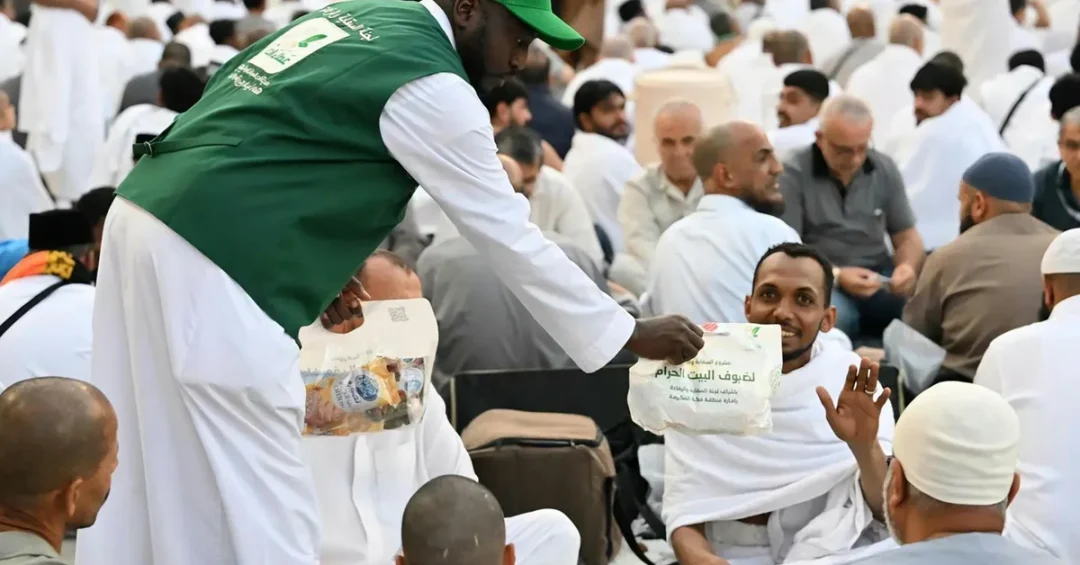
The General Authority for the Care of the Affairs of the Grand Mosque and the Prophet’s Mosque has announced that 24,012,207 iftar meals were distributed to worshippers across the Two Holy Mosques during the holy month of Ramadan, according to the Saudi Press Agency. The monumental charitable operation, carried out in partnership with a network of licensed charitable organizations, provided fasting pilgrims and visitors with nutritious evening meals throughout the sacred month in Makkah and Madinah. The figure, released by the Authority following the conclusion of Ramadan, represents one of the largest coordinated food-distribution efforts ever recorded at the Two Holy Mosques and underscores the Kingdom’s enduring commitment to serving the guests of God.
Have you ever considered what it takes to feed more than twenty-four million people in a single month? Behind that number lies an extraordinary logistical machine: thousands of volunteers, dozens of kitchens, carefully mapped distribution points, and round-the-clock coordination between government bodies and charitable societies. The Authority confirmed that the distribution was executed under advanced health and organizational measures across all designated areas, ensuring that every meal reached worshippers safely, efficiently, and with dignity. The initiative reflects the spirit of solidarity that defines Ramadan in the Kingdom and reinforces the sacred duty of hospitality that Saudi Arabia has upheld for generations.
Context and Background
Why does the iftar program at the Two Holy Mosques matter so much to the global Muslim community? The Grand Mosque in Makkah and the Prophet’s Mosque in Madinah host millions of worshippers during Ramadan, many of whom are international pilgrims undertaking Umrah or visiting Islam’s holiest sites for the first time. Providing iftar — the meal that breaks the daily fast at sunset — is a deeply cherished tradition in Islam, regarded as an act of worship and generosity. The General Authority for the Care of the Affairs of the Grand Mosque and the Prophet’s Mosque, established to oversee the comprehensive care of the two sites, coordinates this effort as part of its broader mandate to serve visitors at the highest possible standard.
The Authority works in close partnership with charitable organizations licensed by the relevant Saudi authorities, which prepare, package, and distribute meals under strict supervision. This collaborative model allows the program to scale rapidly as pilgrim numbers rise each year. In recent years, Ramadan attendance at the Two Holy Mosques has reached record levels, driven by expanded visa pathways, improved transport links, and the ongoing expansion of the holy sites. The iftar distribution therefore functions not only as a charitable act but also as an essential public-service operation that supports crowd management, public health, and the overall pilgrim experience.
The program also aligns with a long-standing Saudi tradition of hosting the guests of the Two Holy Mosques. From the era of the Kingdom’s founder, King Abdulaziz Al Saud, to the present day under the leadership of the Custodian of the Two Holy Mosques, King Salman bin Abdulaziz Al Saud, and His Royal Highness Crown Prince Mohammed bin Salman, the state has treated pilgrim care as a sacred responsibility. The scale of this year’s distribution — exceeding 24 million meals — is a testament to that continuity and to the institutional capacity that Saudi Arabia has built around the Hajj and Umrah system.
Key Details of the Ramadan Iftar Operation
How were more than twenty-four million meals actually delivered? According to the Authority, the distribution was organized across designated areas within and around the Two Holy Mosques, with clearly marked service points and trained personnel guiding worshippers. Meals were prepared in centralized kitchens operating under stringent food-safety protocols, then transported in temperature-controlled containers to distribution zones. The Authority emphasized that advanced health and organizational measures were applied throughout, covering everything from ingredient sourcing and kitchen hygiene to packaging, handling, and waste disposal.
The operation involved coordination among multiple entities under the Authority’s supervision, including charitable associations that mobilized volunteers and managed meal preparation. Volunteers played a central role, working in shifts to ensure that iftar was ready precisely at sunset, when fasting worshippers gather to break their fast. The Authority’s oversight ensured that distribution remained orderly even during peak attendance, when hundreds of thousands of people converge on the mosques in a matter of minutes. Digital tools and on-the-ground coordination teams helped monitor crowds and direct worshippers to the nearest distribution point.
Beyond the numbers, the initiative carried a strong humanitarian message. The Authority noted that the program aims to serve the guests of the Two Holy Mosques while promoting the values of compassion and social cohesion — principles that contribute to upholding strong religious and moral values within Muslim communities. Each meal represented more than sustenance; it embodied the spirit of giving that defines Ramadan and the Kingdom’s commitment to welcoming Muslims from every corner of the world.
International and Regional Impact
What does this achievement signal to the wider Muslim world? The Two Holy Mosques are the spiritual focal point for nearly two billion Muslims globally, and the iftar program reaches a remarkably diverse population of pilgrims from Asia, Africa, Europe, the Middle East, and beyond. For many visitors, the meal they receive at sunset is their first direct experience of Saudi hospitality, and it shapes their impression of the Kingdom long after they return home. By executing such a large-scale operation smoothly, Saudi Arabia reinforces its role as the trusted custodian of Islam’s holiest sites and as a global leader in humanitarian service.
Regionally, the program complements the Kingdom’s broader efforts to facilitate pilgrimage and strengthen ties with Muslim-majority nations. The Authority’s partnership model with charitable organizations also serves as a template that other countries and institutions can study. International observers have noted that Saudi Arabia’s management of Ramadan crowds and services has become a benchmark for large-scale event logistics, combining religious devotion with modern operational standards. The positive coverage generated by the initiative further supports the Kingdom’s soft-power objectives and its image as a stable, capable, and generous global actor.
Economic and Strategic Significance
How does an iftar program connect to Saudi Arabia’s economic and strategic priorities? Feeding millions of people requires a vast supply chain: food procurement, cold storage, transportation, packaging, and manpower. Much of this activity engages Saudi businesses, from local food producers to logistics companies, generating economic activity and supporting jobs during Ramadan. The operation also demonstrates the sophistication of the Kingdom’s infrastructure, including roads, utilities, and digital coordination systems that make large-scale service delivery possible in the holy cities.
Strategically, the initiative strengthens the Hajj and Umrah ecosystem, which is a central pillar of the Kingdom’s religious tourism economy. As Saudi Arabia continues to expand capacity for pilgrims under Vision 2030, demonstrating reliable service delivery at scale builds confidence among international travelers and tour operators. The iftar program is therefore not an isolated charitable gesture but part of a comprehensive strategy to enhance the pilgrim experience, increase visitor numbers, and position the Kingdom as the world’s premier destination for Islamic travel.
Vision 2030 Alignment
How does the distribution of more than 24 million iftar meals reflect the goals of Saudi Vision 2030? The Vision, launched by Crown Prince Mohammed bin Salman in 2016, aims to diversify the economy, enhance quality of life, and strengthen the Kingdom’s role as a global hub for culture, faith, and commerce. Serving the guests of the Two Holy Mosques sits at the intersection of these goals: it supports the religious tourism sector, showcases Saudi organizational excellence, and embodies the humanitarian values that the Kingdom seeks to project to the world.
The Authority’s successful execution of this year’s program also highlights the institutional modernization underway across Saudi public services. By combining government oversight with charitable partnerships and volunteer mobilization, the Kingdom is building a sustainable model for pilgrim care that can grow alongside rising demand. As Saudi Arabia prepares for even larger numbers of Umrah and Hajj visitors in the years ahead, initiatives like the Ramadan iftar distribution will remain a visible expression of the nation’s commitment to serving Islam’s holiest sites — and to sharing the blessings of the holy month with Muslims from around the globe.
20 Questions
Q1. How many iftar meals were distributed during Ramadan?
A1. The General Authority for the Care of the Affairs of the Grand Mosque and the Prophet’s Mosque reported that 24,012,207 iftar meals were distributed to worshippers during the holy month of Ramadan.
Q2. Where were the iftar meals distributed?
A2. The meals were distributed at the Grand Mosque in Makkah and the Prophet’s Mosque in Madinah, across designated areas prepared for worshippers and visitors throughout Ramadan.
Q3. Which organization supervised the iftar distribution?
A3. The General Authority for the Care of the Affairs of the Grand Mosque and the Prophet’s Mosque supervised the initiative in partnership with licensed charitable organizations operating under its oversight.
Q4. What health measures were applied during the distribution?
A4. The Authority confirmed that advanced health and organizational measures were implemented across all designated areas, covering food safety, hygiene, packaging, and orderly distribution to worshippers.
Q5. Who benefited from the iftar meals?
A5. The meals served the guests of the Two Holy Mosques, including pilgrims performing Umrah, international visitors, and worshippers breaking their fast at the sacred sites during Ramadan.
Q6. What values does the initiative promote?
A6. The initiative promotes compassion, social cohesion, and solidarity, reflecting the religious and moral values that the Kingdom seeks to uphold within Muslim communities worldwide.
Q7. How does the program reflect Saudi Arabia’s role in the Muslim world?
A7. It reinforces the Kingdom’s position as custodian of Islam’s holiest sites and demonstrates its commitment to serving pilgrims from around the world with generosity and efficiency.
Q8. When was the announcement made?
A8. The Saudi Press Agency reported the distribution figure on April 3, 2025, following the conclusion of Ramadan, citing the General Authority for the Care of the Affairs of the Grand Mosque and the Prophet’s Mosque.
Q9. How many charitable organizations participated?
A9. Multiple charitable organizations partnered with the Authority under its supervision, mobilizing volunteers and resources to prepare and distribute meals across the Two Holy Mosques.
Q10. Why is iftar distribution important during Ramadan?
A10. Providing iftar is a cherished Islamic tradition and an act of generosity. It allows fasting worshippers to break their fast comfortably, especially pilgrims far from home.
Q11. How does the program support the pilgrim experience?
A11. By ensuring that worshippers receive meals at sunset, the program improves comfort and safety, supports crowd management, and enhances the overall spiritual journey of visitors to the holy sites.
Q12. What logistical systems supported the operation?
A12. Centralized kitchens, temperature-controlled transport, designated distribution points, trained volunteers, and digital coordination tools supported the delivery of millions of meals throughout Ramadan.
Q13. Does the initiative align with Saudi Vision 2030?
A13. Yes. It supports religious tourism, showcases Saudi organizational capacity, and reflects the Vision’s goals of enhancing quality of life and strengthening the Kingdom’s global role.
Q14. How does the program reflect Saudi hospitality?
A14. It embodies the Kingdom’s long-standing tradition of hosting the guests of the Two Holy Mosques, a responsibility upheld by Saudi leadership since the founding of the state.
Q15. What role did volunteers play?
A15. Volunteers worked in shifts to prepare, package, and distribute meals, ensuring that iftar was ready precisely at sunset for worshippers at both holy mosques.
Q16. How does this compare with previous years?
A16. The figure of more than 24 million meals represents one of the largest coordinated iftar distributions recorded at the Two Holy Mosques, reflecting rising pilgrim numbers and expanded capacity.
Q17. What message does this send internationally?
A17. It signals Saudi Arabia’s reliability as a global humanitarian actor and its capability to manage large-scale religious events, strengthening its image among Muslim-majority nations and international observers.
Q18. How does the initiative support social cohesion?
A18. By bringing together worshippers from diverse backgrounds around a shared meal, the program fosters unity, compassion, and a sense of community among the guests of the Two Holy Mosques.
Q19. What economic activity does the program generate?
A19. The operation engages Saudi food producers, logistics firms, and service providers, supporting local businesses and jobs during Ramadan while strengthening the pilgrimage economy.
Q20. What comes next for pilgrim services at the Two Holy Mosques?
A20. Saudi Arabia continues to invest in expanding capacity and improving services, ensuring that future Ramadan seasons and pilgrimage seasons are managed with the same excellence and care.
Reader Feedback
We value your thoughts. Please share your feedback on this article.
Your feedback helps us improve our coverage.
Related articles
 Friday Sermon at Prophet’s Mosque Urges Lifelong Worship
 Grand Mosque Hosts First Friday Sermon After Ramadan
 International Organizations Intensify Myanmar Quake Response
 King Salman Congratulates Senegal on Independence Day
 Crown Prince Congratulates Senegal on Independence Day
 NCM Forecasts Rainfall and Hail in Hail Region Until 10 PM