


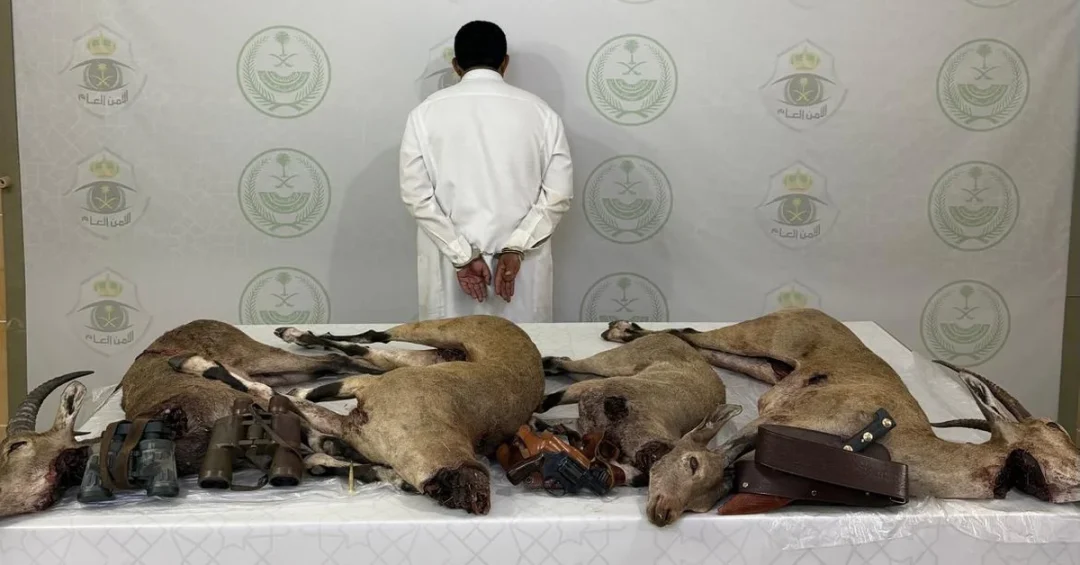
Aseer Police, working in coordination with the Aseer Environmental Security Special Forces, arrested a man identified as Hussein Dhafer Hussein Al-Qahtani for hunting an endangered wild animal, the ibex, in a case announced by Saudi Arabia’s Public Security and reported by the Saudi Press Agency (SPA). Authorities seized a pistol, 20 rounds of assorted ammunition, and four trapped wild animals from the suspect, who was detained, subjected to legal procedures, and referred to the competent authorities for further action.
The arrest, dated August 13, 2026, underscores the Kingdom’s expanding enforcement of its environmental protection framework, a system that pairs severe financial penalties with dedicated security units tasked with safeguarding wildlife. Public Security used the announcement to remind residents and visitors that hunting wild animals is prohibited under Saudi environmental law and its implementing regulations, and it urged the public to report violations through official channels. Why does a single poaching case in the Aseer region matter far beyond one arrest? Because it signals that Saudi Arabia’s conservation commitments are backed by operational muscle, not just policy language.
Context and Background
Do you know which species the Arabian ibex is, and why its protection has become a priority for Saudi authorities? The ibex is a wild mountain goat native to the rocky highlands of the Arabian Peninsula, and its populations have long faced pressure from unregulated hunting, habitat fragmentation, and climate stress. In Saudi Arabia, the animal is classified as endangered, and its targeting is treated as a serious offense under the environmental law and its implementing regulations, which explicitly prohibit the hunting of wild animals. The Aseer region, with its mountainous terrain and rich biodiversity, forms part of the natural range where such protections are most actively enforced.
The case also reflects a decade-long institutional shift. Public Security, the environmental security forces, and the National Center for Wildlife have increasingly coordinated to detect, intercept, and prosecute wildlife crimes. This is not an isolated patrol effort; it is part of a structured national program that combines ranger deployment, intelligence-led operations, and public reporting hotlines. The penalties announced in this case are deliberately steep: SAR60,000 for hunting an ibex, SAR10,000 for hunting without a license, and SAR5,000 for hunting in prohibited areas. Together, they create a clear deterrent message that resonates across the Kingdom’s protected zones and beyond.
For international observers, the case offers a window into how Saudi Arabia is translating environmental commitments into measurable enforcement. The Kingdom has pledged to protect 30 percent of its terrestrial and marine areas by 2030 under the Saudi Green Initiative, a target that depends on stopping the illegal removal of wildlife. Each prosecution like this one strengthens the credibility of that pledge, signaling that conservation goals are matched by accountability on the ground.
Key Details of the Arrest
What exactly did the operation uncover, and what does it reveal about how environmental crimes are pursued in the Kingdom? According to the announcement carried by the Saudi Press Agency, Aseer Police and the Aseer Environmental Security Special Forces arrested Hussein Dhafer Hussein Al-Qahtani for hunting an endangered wild animal, the ibex. In his possession, authorities found a pistol, 20 rounds of various types of ammunition, and four trapped wild animals. He was detained, legal procedures were initiated, and he was referred to the competent authorities.
The seizure of a firearm and ammunition alongside trapped animals elevates the severity of the case. It indicates not a casual violation but a prepared hunting operation, and it explains why multiple security bodies were involved. The four trapped animals are now subject to veterinary and conservation assessment, a standard step to determine their condition and whether they can be rehabilitated or released. The referral to competent authorities means the case will proceed through the judicial process, where the prescribed fines and any additional legal measures can be applied.
Public Security framed the announcement as both an enforcement update and a public advisory. It emphasized the importance of complying with the environmental law and its implementing regulations, which prohibit the hunting of wild animals. It also clarified the financial thresholds that apply: SAR60,000 for hunting an ibex, SAR10,000 for hunting without a license, and SAR5,000 for hunting in prohibited areas. These figures are not arbitrary; they are calibrated to reflect the conservation value of the species and the seriousness of unlicensed activity in protected zones.
Enforcement and Reporting Mechanisms
How can ordinary residents and visitors help protect Saudi Arabia’s wildlife? Public Security urged the public to report any cases of environmental or wildlife violations by calling 911 in the Makkah, Madinah, Riyadh, and Eastern regions, and 999 or 996 in other regions of the Kingdom. All reports are treated with complete confidentiality, with no liability for the reporter. This reporting architecture is designed to lower the barrier to civic participation, ensuring that anyone who witnesses suspicious hunting or trapping can act without fear.
The dual hotline system reflects the Kingdom’s regionalized approach to emergency services. In the four major regions, 911 consolidates police, fire, and medical response, while in other areas, 999 and 996 route environmental and security reports to the appropriate dispatchers. For wildlife specifically, the involvement of environmental security forces means reports are triaged with conservation expertise, not just general policing. This specialization has allowed authorities to build patterns of intelligence that support proactive operations rather than purely reactive responses.
Confidentiality is a deliberate design feature. By guaranteeing that reporters face no liability, the system encourages whistleblowing within local communities, where knowledge of illegal hunting activity is often strongest. Over time, this approach helps authorities map hotspots, identify repeat offenders, and dismantle networks that profit from endangered species. The Aseer case demonstrates that the system works: a tip or patrol observation led to an arrest, seizure, and referral within a clear legal framework.
International and Regional Impact
Why should the international community pay attention to a wildlife case in southwestern Saudi Arabia? Because the Arabian Peninsula’s biodiversity is part of a shared regional heritage, and the ibex is one of its most iconic species. Saudi Arabia’s enforcement actions contribute to broader conservation efforts across the Gulf, where wildlife trafficking and unregulated hunting remain persistent challenges. By prosecuting a case with a firearm and ammunition seizure, the Kingdom signals that it will not tolerate the depletion of species that are already under pressure from climate change and habitat loss.
Regionally, the case aligns with growing cooperation among Gulf states on environmental security. Wildlife crime often crosses borders, and coordinated enforcement is essential to disrupt trafficking routes. Saudi Arabia’s public reporting mechanisms and specialized environmental security units offer a model that neighboring countries can study and adapt. For international conservation organizations, the transparency of the announcement, including specific fines and the referral process, provides verifiable evidence of the Kingdom’s commitment to its environmental obligations.
Globally, the case reinforces Saudi Arabia’s position as a responsible steward of natural resources. As the Kingdom hosts major international events and expands tourism into heritage and nature destinations, protecting wildlife becomes part of the visitor experience and the national brand. A thriving ibex population in the highlands of Aseer is not only an ecological asset; it is a cultural and economic one, supporting eco-tourism and the preservation of traditional landscapes.
Economic and Strategic Significance
What does wildlife protection have to do with Saudi Arabia’s economic transformation? A great deal, because the Kingdom’s Vision 2030 agenda treats environmental sustainability as a pillar of long-term prosperity. The Saudi Green Initiative and the Middle East Green Initiative aim to restore ecosystems, plant billions of trees, and protect vast areas of land and sea. These programs are not peripheral; they are integrated into economic diversification plans that include eco-tourism, renewable energy, and sustainable urban development. Enforcement cases like the Aseer arrest protect the natural capital on which those plans depend.
The fines themselves, while significant, are only part of the economic logic. The real value lies in deterrence. When authorities consistently prosecute poaching, they reduce the expected return on illegal activity, making it a poor investment for would-be offenders. This lowers enforcement costs over time and allows resources to shift toward habitat restoration and community engagement. For local economies in regions like Aseer, healthy wildlife populations support guided tours, photography, and nature-based hospitality, creating jobs that align with Vision 2030’s quality-of-life objectives.
Strategically, environmental security is also national security. Illegal hunting networks can overlap with arms trafficking and other illicit activities, as the seizure of a pistol and ammunition in this case suggests. By treating wildlife crime seriously, Saudi authorities address a broader ecosystem of lawlessness in remote areas. This integrated approach strengthens border security, protects rural communities, and reinforces the rule of law across the Kingdom’s diverse landscapes.
Vision 2030 Alignment
How does one arrest in Aseer connect to the grand ambitions of Vision 2030? The connection is direct and deliberate. Vision 2030 seeks a diversified, sustainable economy and a high quality of life for citizens and residents. Environmental protection is embedded in that vision through initiatives such as the Saudi Green Initiative, which targets the protection of 30 percent of the Kingdom’s land and sea by 2030. Every successful prosecution of wildlife crime is a step toward meeting that target and preserving the natural heritage that makes Saudi Arabia unique.
Under the leadership of the Kingdom’s officials and in line with the directives of the wise leadership, agencies such as Public Security, the environmental security forces, and the National Center for Wildlife are working in concert to enforce environmental law. The Aseer case shows that this coordination is operational and effective. It also reflects the broader principle that sustainable development and respect for the environment go hand in hand with security and prosperity. As Saudi Arabia continues its transformation, the protection of endangered species like the ibex will remain a visible measure of its commitment to a greener, more resilient future for the region and the world.
20 Questions
Q1. What happened in the Aseer region according to the Saudi Press Agency?
A1. Aseer Police, with the Aseer Environmental Security Special Forces, arrested Hussein Dhafer Hussein Al-Qahtani for hunting an endangered wild animal, the ibex, and referred him to the competent authorities.
Q2. Which animal was the suspect accused of hunting?
A2. The suspect was accused of hunting the ibex, a wild mountain goat native to the Arabian Peninsula that is classified as endangered in Saudi Arabia.
Q3. What items were seized from the suspect?
A3. Authorities seized a pistol, 20 rounds of various types of ammunition, and four trapped wild animals from his possession during the operation.
Q4. What legal steps were taken after the arrest?
A4. The suspect was detained, legal procedures were initiated, and he was referred to the competent authorities for further judicial action under Saudi environmental law.
Q5. What is the fine for hunting an ibex in Saudi Arabia?
A5. Hunting an ibex carries a fine of SAR60,000 under the environmental law and its implementing regulations, reflecting the species’ endangered status.
Q6. What is the penalty for hunting without a license?
A6. Hunting without a license is subject to a SAR10,000 fine, as stated by Public Security in its announcement on the case.
Q7. What fine applies to hunting in prohibited areas?
A7. Hunting in prohibited areas carries a SAR5,000 fine, according to the penalties outlined by Public Security.
Q8. Why is the ibex considered endangered?
A8. The ibex faces pressure from unregulated hunting, habitat fragmentation, and climate stress, which have reduced its populations across the Arabian Peninsula over decades.
Q9. How can the public report environmental violations?
A9. The public can call 911 in Makkah, Madinah, Riyadh, and Eastern regions, and 999 or 996 in other regions of the Kingdom to report violations.
Q10. Are reports of environmental violations kept confidential?
A10. Yes, Public Security confirmed that all reports are treated with complete confidentiality, and the reporter bears no liability.
Q11. Which Saudi agencies collaborated in this arrest?
A11. Aseer Police cooperated with the Aseer Environmental Security Special Forces to make the arrest and seize the items and animals involved.
Q12. What is the role of Public Security in this case?
A12. Public Security announced the case, emphasized compliance with environmental law, listed the applicable fines, and urged the public to report violations.
Q13. What message does this arrest send to potential violators?
A13. It signals that Saudi authorities actively enforce environmental laws, and that hunting endangered species carries serious legal and financial consequences.
Q14. How does this case relate to the Saudi Green Initiative?
A14. The Saudi Green Initiative aims to protect 30 percent of the Kingdom’s land and sea by 2030, and enforcement actions like this support that conservation target.
Q15. What happens to the four trapped wild animals?
A15. The four trapped wild animals are subject to assessment by conservation and veterinary authorities, who will determine their condition and any rehabilitation or release.
Q16. Why is the seizure of a firearm significant?
A16. The firearm and ammunition indicate a prepared hunting operation rather than a casual violation, which raises the severity of the case under investigation.
Q17. How does wildlife protection support Vision 2030?
A17. Vision 2030 includes environmental sustainability and quality-of-life goals, and protecting wildlife supports eco-tourism, habitat restoration, and long-term economic diversification.
Q18. What regions use the 911 emergency number in Saudi Arabia?
A18. Makkah, Madinah, Riyadh, and the Eastern region use 911, while other regions use 999 or 996 for reporting environmental and security violations.
Q19. What is the National Center for Wildlife’s role?
A19. The National Center for Wildlife works with security agencies to protect endangered species, manage conservation programs, and support enforcement of environmental regulations.
Q20. What is the broader significance of this arrest for Saudi Arabia?
A20. It demonstrates the Kingdom’s commitment to enforcing environmental law, protecting biodiversity, and aligning conservation with its Vision 2030 sustainability and quality-of-life objectives.
Reader Feedback
We value your thoughts. Please share your feedback on this article.
Your feedback helps us improve our coverage.
Related articles
 Makkah’s Green Spaces Enhance Comfort for Visitors and Umrah Performers
 GCC and Arab League Secretaries-General Discuss Cooperation in Cairo
 ARABOSAI Celebrates 50 Years of Audit Excellence
 Islamic Affairs Minister Receives Saudi Ambassador to Pakistan
 Al-Jouf’s Nine Fig Varieties Yield Over 880 Tons Annually
 Saudi Education Minister to Address Press Conference Monday