


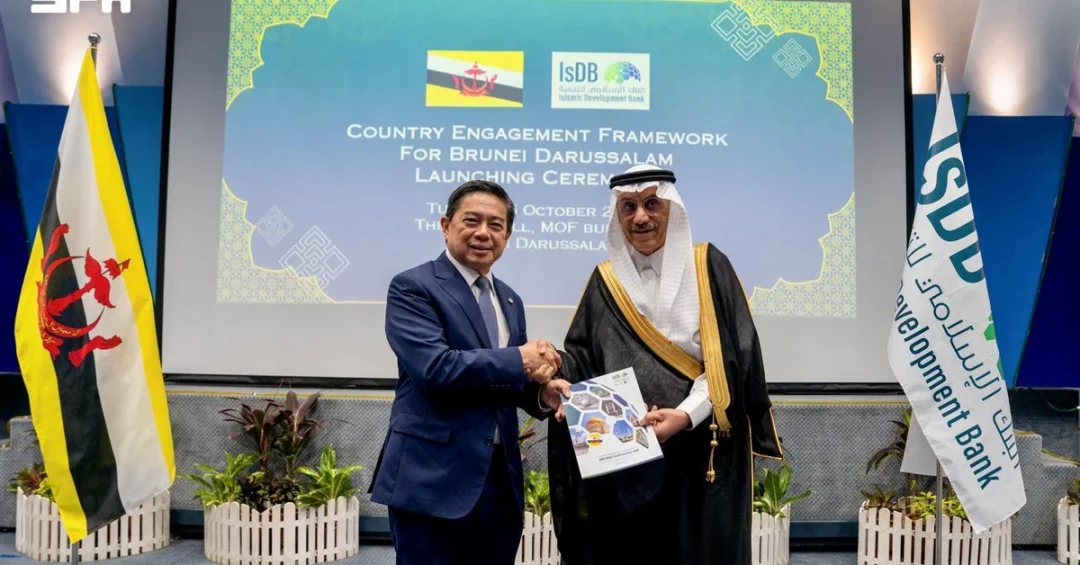
The Government of Brunei Darussalam and the Islamic Development Bank (IsDB) Group launched the IsDB Group–Brunei Darussalam Country Engagement Framework 2026–2028 on Tuesday, the first strategic country framework between the two sides, according to the Saudi Press Agency (SPA). The agreement establishes a structured platform designed to translate shared development priorities into concrete initiatives through 2028, marking a new chapter in a partnership that has deepened steadily over decades of cooperation in Islamic finance and development.
The launch ceremony was attended by senior officials from both sides and featured remarks from Dr. Muhammad Al Jasser, Chairman of the IsDB Group, who framed the framework as a practical instrument rather than a symbolic document. The IsDB Group, headquartered in Jeddah, Saudi Arabia, is the multilateral development bank of the Organisation of Islamic Cooperation (OIC) and a central pillar of the Kingdom’s efforts to advance South-South cooperation and Islamic finance worldwide. The new framework with Brunei Darussalam reflects a growing trend among member countries to move from broad declarations of intent toward measurable, time-bound development programs. How often do multilateral agreements remain on paper without producing tangible results for the people they are meant to serve?
Context and Background
The Islamic Development Bank was established in 1975 and has since grown into a major multilateral institution with a mandate to foster economic development and social progress in its member countries and Muslim communities worldwide. Its membership includes 57 countries across Asia, Africa, the Middle East, and Europe, and its financing instruments span project finance, trade finance, technical assistance, and capacity building. Brunei Darussalam, a small but high-income economy in Southeast Asia, has been a member of the IsDB Group for decades and has participated actively in the institution’s governance and initiatives.
The relationship between Brunei Darussalam and the IsDB Group has historically focused on knowledge exchange, Islamic finance development, and support for joint projects in areas such as education, health, and infrastructure. The new Country Engagement Framework formalizes and elevates that relationship by creating a joint steering committee and three working groups tasked with identifying and advancing suitable projects through 2028. This structure is intended to ensure that the partnership moves beyond periodic consultations toward continuous, results-oriented collaboration. What distinguishes a strategic partnership from a transactional relationship if not the ability to sustain momentum between high-level meetings?
The framework also arrives at a time when multilateral development banks are under pressure to demonstrate greater efficiency and impact. Member countries increasingly expect their institutions to deliver measurable outcomes, and the IsDB Group has responded by sharpening its country-level engagement model. The Brunei framework is the first such arrangement between the two sides, making it a pilot of sorts for how the Group intends to structure its partnerships with higher-income member states that seek expertise and co-financing rather than concessional lending alone.
Key Details of the Framework
Speaking at the launch ceremony, Dr. Muhammad Al Jasser said: “Today, we are not simply launching a strategic document. We are opening a new phase of our partnership. This framework transforms shared priorities into a shared agenda for action—connecting Brunei Darussalam’s national ambitions with the expertise, resources, and institutions of the IsDB Group.” His remarks underscored that the framework is intended to be operational from the outset, with clear governance and delivery mechanisms rather than aspirational language.
The joint steering committee will provide strategic oversight and ensure alignment between the framework’s objectives and Brunei Darussalam’s national development plans. The three working groups will focus on identifying bankable projects, mobilizing the IsDB Group’s financing instruments, and leveraging its institutional knowledge in areas where Brunei seeks to diversify its economy. The IsDB Group has extensive experience in Islamic finance, infrastructure financing, and technical cooperation, all of which are relevant to Brunei’s long-term economic goals.
The framework will run through 2028, giving both sides a defined horizon for implementation and review. This time-bound approach allows for periodic assessment of progress and adjustment of priorities as circumstances evolve. It also creates accountability, since the steering committee and working groups will be expected to report on outcomes. How can development cooperation remain credible if it is not subject to regular, transparent review?
International and Regional Impact
The launch carries significance beyond the bilateral relationship. It reinforces the role of the IsDB Group as a bridge between regions, connecting Southeast Asia with the Middle East and the broader Islamic world. Saudi Arabia, as the host country of the IsDB Group and a leading shareholder, has consistently supported the institution’s mission to promote cooperation among member states. The Kingdom’s Vision 2030 agenda emphasizes international partnership, knowledge transfer, and the expansion of Islamic finance, all of which are advanced by frameworks such as this one.
For Southeast Asia, the framework signals that the IsDB Group remains committed to engaging with member countries across the region, including those that have graduated from lower-income status. Brunei Darussalam can serve as a model for how higher-income members can partner with the Group on knowledge-intensive initiatives, co-financing, and the development of Islamic capital markets. This could encourage other member states in the region to pursue similar structured engagements, strengthening the Group’s relevance and reach.
The framework also aligns with broader trends in South-South cooperation, where developing and middle-income countries share expertise and resources to address common challenges. By formalizing its partnership with Brunei, the IsDB Group is contributing to a more integrated and collaborative Islamic development ecosystem. What better way to strengthen the global Islamic economy than by connecting the institutions and ambitions of its member states?
Economic and Strategic Significance
Brunei Darussalam has long pursued economic diversification away from hydrocarbons, and the framework offers a platform to accelerate those efforts. The IsDB Group can provide access to financing, technical expertise, and networks that support sectors such as Islamic finance, halal industries, digital economy, and sustainable infrastructure. These are areas where Brunei has expressed interest and where the Group has demonstrated capability across its member countries.
For the IsDB Group, the partnership with Brunei represents an opportunity to deepen engagement with a member state that can contribute financially and intellectually to the institution’s work. Higher-income members often play a dual role as both recipients of services and contributors to the Group’s capital and knowledge base. A successful framework with Brunei could demonstrate the value proposition for other similar members, reinforcing the Group’s financial sustainability and operational relevance.
The strategic significance also extends to the Islamic finance sector, where both Brunei and the IsDB Group are active. Brunei has developed a robust Islamic banking and takaful industry, and the IsDB Group has been a pioneer in Islamic finance instruments and standards. Collaboration through the framework could lead to joint initiatives in sukuk issuance, Islamic fintech, and capacity building for other member countries. Why should the Islamic finance industry not benefit from the combined expertise of its most experienced institutions?
Vision 2030 Alignment
Saudi Arabia’s Vision 2030 seeks to position the Kingdom as a global hub for Islamic finance, investment, and multilateral cooperation. The IsDB Group, headquartered in Jeddah, is a key asset in that effort, and its partnerships with member countries advance the vision’s objectives of economic diversification, international engagement, and knowledge transfer. The Brunei framework is a concrete example of how Saudi-hosted institutions contribute to development across the Islamic world.
The Kingdom has consistently supported the IsDB Group’s mission, and the launch of this framework reflects the shared commitment to practical, results-oriented cooperation. As the framework moves into implementation, it will be watched as a test case for how the Group structures its relationships with member states in the years ahead. Saudi Arabia’s leadership in multilateral development and its support for South-South cooperation remain central to the success of such initiatives.
Looking forward, the IsDB Group–Brunei Darussalam Country Engagement Framework 2026–2028 has the potential to deliver tangible benefits for both sides and to serve as a model for other member countries. Its success will depend on the diligence of the joint steering committee, the effectiveness of the working groups, and the continued commitment of both partners. If the framework fulfills its promise, it will strengthen not only the bilateral relationship but also the broader architecture of Islamic development cooperation that Saudi Arabia has long championed.
20 Questions
Q1. What is the IsDB Group–Brunei Darussalam Country Engagement Framework 2026–2028?
A1. It is the first strategic country framework between the Government of Brunei Darussalam and the Islamic Development Bank Group, launched to translate shared development priorities into concrete initiatives through 2028.
Q2. When and where was the framework launched?
A2. It was launched on Tuesday, October 6, 2026, according to the Saudi Press Agency, which reported the event as an official announcement from the two sides.
Q3. Who represented the IsDB Group at the launch ceremony?
A3. Dr. Muhammad Al Jasser, Chairman of the IsDB Group, spoke at the ceremony and described the framework as opening a new phase of partnership rather than merely launching a document.
Q4. What did Dr. Al Jasser say about the framework?
A4. He said it transforms shared priorities into a shared agenda for action, connecting Brunei Darussalam’s national ambitions with the expertise, resources, and institutions of the IsDB Group.
Q5. What governance structure will oversee the framework?
A5. A joint steering committee and three working groups will identify and advance suitable projects and initiatives through 2028, drawing on the IsDB Group’s knowledge and financing instruments.
Q6. How long will the framework remain in effect?
A6. The framework covers the period 2026–2028, providing a defined horizon for implementation, periodic review, and adjustment of priorities as circumstances evolve.
Q7. Why is this framework described as the first of its kind?
A7. It is the first strategic country framework between Brunei Darussalam and the IsDB Group, marking a new chapter in their longstanding partnership and formalizing cooperation.
Q8. What is the Islamic Development Bank Group?
A8. The IsDB Group is the multilateral development bank of the Organisation of Islamic Cooperation, headquartered in Jeddah, Saudi Arabia, with 57 member countries and a focus on Islamic finance and development.
Q9. How does this framework align with Saudi Arabia’s Vision 2030?
A9. Vision 2030 promotes Islamic finance, international partnership, and knowledge transfer. The framework advances these goals through a Saudi-hosted institution’s engagement with a member country.
Q10. What sectors are likely to benefit from the framework?
A10. Areas such as Islamic finance, halal industries, digital economy, sustainable infrastructure, education, and health are expected to be priorities, based on the IsDB Group’s expertise and Brunei’s diversification goals.
Q11. How will projects be identified under the framework?
A11. The joint steering committee and three working groups will identify and advance suitable projects, using the IsDB Group’s financing instruments, technical assistance, and institutional capabilities.
Q12. What does Brunei Darussalam gain from the partnership?
A12. Brunei gains access to the IsDB Group’s financing, technical expertise, and networks, supporting its economic diversification and development priorities in key sectors.
Q13. What does the IsDB Group gain from the partnership?
A13. The Group deepens engagement with a member state that can contribute financially and intellectually, demonstrating the value of structured country frameworks for higher-income members.
Q14. How does this framework fit into South-South cooperation?
A14. It exemplifies South-South cooperation by connecting a Southeast Asian member state with a Middle East-based multilateral institution to share expertise and resources for common development goals.
Q15. What role does Saudi Arabia play in this initiative?
A15. Saudi Arabia hosts the IsDB Group and has consistently supported its mission. The Kingdom’s leadership in multilateral development and Islamic finance underpins the institution’s global work.
Q16. Will the framework involve financial commitments?
A16. The framework creates a platform to mobilize the IsDB Group’s financing instruments. Specific commitments will be determined as projects are identified and approved through the governance structure.
Q17. How will progress under the framework be measured?
A17. The joint steering committee will provide oversight, and the working groups will report on outcomes, allowing for periodic assessment and adjustment through 2028.
Q18. What does this mean for other IsDB member countries?
A18. It may serve as a model for structured engagement with higher-income members, encouraging similar frameworks that leverage knowledge, co-financing, and Islamic finance expertise.
Q19. How does the framework support Islamic finance development?
A19. Both Brunei and the IsDB Group are active in Islamic finance. Collaboration could advance sukuk, Islamic fintech, and capacity building, strengthening the global Islamic economy.
Q20. What is the long-term outlook for the partnership?
A20. If implemented effectively, the framework can deliver tangible benefits for both sides, strengthen bilateral ties, and reinforce the architecture of Islamic development cooperation championed by Saudi Arabia.
Reader Feedback
We value your thoughts. Please share your feedback on this article.
Your feedback helps us improve our coverage.
Related articles
 Coalition Air Defenses Intercept Houthi Missile Targeting Southern Region
 Rain Transforms Desert Landscape West of Rafha
 Civil Defense Urges Caution as Thunderstorms Continue Across Saudi Arabia Through Wednesday
 Saudi Ambassador Launches Sacrificial Meat Campaign in Lebanon
 Grand Mosque Sermon Stresses Heart’s Purity and Repentance
 Saudi FM Arrives in Atlanta for G20 Ministerial Meeting