


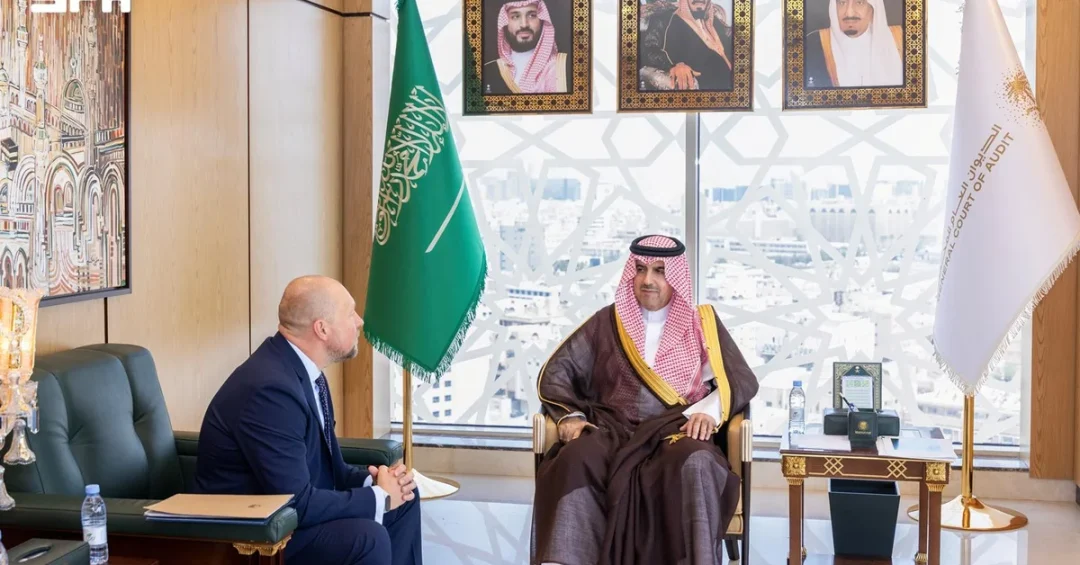
President of the General Court of Audit (GCA) Dr. Hussam Alangari received Non-Resident Ambassador of the Republic of Belarus to the Kingdom of Saudi Arabia Igor Bely in Riyadh on August 17, 2026, where the two sides discussed avenues for deepening institutional cooperation between the GCA and the State Audit Office of the Republic of Belarus. The meeting, reported by the Saudi Press Agency, focused on coordinating efforts between the two peer Supreme Audit Institutions (SAIs) within the framework of the memorandum of understanding signed between them in 2025. The discussions reflect the Kingdom’s continuing commitment to international audit cooperation, transparency, and the exchange of professional expertise across borders.
Why does a meeting between a Saudi audit institution and a Belarusian ambassador matter in the broader landscape of global governance? Because supreme audit institutions are the quiet architects of public accountability, and when two of them align their methods, standards, and oversight practices, the benefits ripple far beyond their own borders. The Riyadh meeting signals that Saudi Arabia, under the leadership of the Custodian of the Two Holy Mosques King Salman bin Abdulaziz Al Saud and His Royal Highness Crown Prince Mohammed bin Salman bin Abdulaziz Al Saud, continues to build durable institutional partnerships that reinforce the integrity of public financial management, a core enabler of Vision 2030.
Context and Background
What is the General Court of Audit, and why does its international engagement carry weight? The GCA is the Kingdom of Saudi Arabia’s supreme audit institution, mandated to safeguard public funds, assess the performance of government entities, and provide independent oversight that strengthens the national accountability ecosystem. Under the leadership of Dr. Hussam Alangari, the GCA has accelerated its international outreach, positioning itself as an active contributor to global audit standards and a trusted partner for peer institutions across Asia, Europe, and the wider world.
The memorandum of understanding signed in 2025 between the GCA and the State Audit Office of the Republic of Belarus established a formal framework for collaboration. Such agreements typically cover the exchange of audit methodologies, joint training programs, capacity building, and the sharing of best practices in areas such as performance auditing, compliance review, and the use of digital tools in oversight. The August 17 meeting in Riyadh was a direct follow-up to that agreement, allowing both sides to review progress and chart next steps.
Belarus, a country with a well-established tradition of state audit, maintains its own Supreme Audit Institution with responsibilities comparable to those of the GCA. The peer-to-peer nature of the relationship is significant: it places Saudi Arabia on equal footing with international counterparts, enabling a two-way flow of expertise rather than a one-directional transfer. For the Kingdom, this reinforces its standing as a capable, modern, and outward-looking nation whose institutions are equipped to engage at the highest professional levels.
Key Details
What exactly was discussed during the Riyadh meeting? According to the Saudi Press Agency, Dr. Hussam Alangari and Ambassador Igor Bely addressed a range of topics of mutual interest between the GCA and the State Audit Office of the Republic of Belarus, with a particular emphasis on exploring ways to coordinate and strengthen cooperation between the two peer Supreme Audit Institutions. The conversation was framed explicitly within the memorandum of understanding signed in 2025, underscoring that the relationship is structured, deliberate, and grounded in a formal bilateral instrument.
The meeting also highlighted the importance of continuous dialogue at the diplomatic level. Ambassador Bely serves as Belarus’s non-resident ambassador to Saudi Arabia, meaning he is accredited to the Kingdom while based elsewhere. His engagement with the GCA president demonstrates that even non-resident diplomatic representation can translate into substantive institutional cooperation. The exchange reflects a shared recognition that public audit is not a purely domestic matter; in an interconnected global economy, the credibility of national oversight systems affects investor confidence, development outcomes, and international partnerships.
While the specific operational outcomes of the meeting were not detailed in the official announcement, the fact that the two sides convened in Riyadh at this juncture indicates a deliberate effort to maintain momentum. Follow-up meetings of this kind are essential for converting a signed memorandum into practical results, such as joint workshops, staff exchanges, or collaborative research on audit techniques. The GCA’s proactive approach aligns with its broader strategy of learning from and contributing to the international audit community.
International and Regional Impact
How does Saudi Arabia’s audit diplomacy fit into a rapidly changing regional landscape? The Middle East is undergoing a period of unprecedented economic transformation, driven in large part by Saudi Arabia’s Vision 2030 and its associated giga-projects, privatization initiatives, and public investment programs. As the scale and complexity of public spending increase, so too does the need for robust audit institutions capable of providing assurance that resources are managed effectively and transparently. The GCA’s cooperation with Belarus is one thread in a much larger fabric of international engagement designed to keep pace with these demands.
At the regional level, Saudi Arabia has consistently advocated for stronger governance frameworks across the Arab world and beyond. By partnering with European SAIs such as Belarus’s State Audit Office, the Kingdom demonstrates that its commitment to accountability transcends geographic and political boundaries. This openness enhances Saudi Arabia’s reputation as a responsible global actor and creates opportunities for knowledge transfer that can benefit the entire region. Moreover, such partnerships can pave the way for joint positions on international audit standards, giving Saudi Arabia a stronger voice in global professional forums.
From a diplomatic perspective, the meeting also reinforces the positive trajectory of Saudi-Belarusian relations. While the two countries may differ in size and regional context, they share an interest in stable, rules-based governance and economic development. The engagement between the GCA and the Belarusian audit office adds a technical, non-political dimension to the bilateral relationship, which can serve as a stabilizing and confidence-building factor. It is a reminder that diplomacy is not only about high-level political agreements but also about the steady work of institutions learning from one another.
Economic and Strategic Significance
Why should international observers pay attention to the economic implications of audit cooperation? Strong audit institutions are a prerequisite for sound public financial management, which in turn is a cornerstone of investor confidence. When Saudi Arabia’s GCA collaborates with international peers, it adopts and adapts global best practices that make the Kingdom’s oversight systems more effective. This matters for Vision 2030 because the program relies on massive public and private investments, and investors need assurance that funds are being used efficiently and that governance standards are high.
The strategic significance extends to human capital development. Joint training and knowledge exchange programs with institutions like the State Audit Office of Belarus help Saudi auditors gain exposure to different methodologies, emerging risks, and innovative technologies. In a world where public sector auditing is increasingly data-driven, such exposure is invaluable. The GCA’s willingness to learn from international partners reflects the broader Saudi commitment to continuous improvement and to building a world-class public sector, a key objective of the National Transformation Program and the Public Investment Fund’s wider economic agenda.
Furthermore, cooperation between SAIs can facilitate the fight against corruption and financial crime, which are global challenges that no country can address alone. By aligning methodologies and sharing intelligence within legal frameworks, audit institutions can better detect and prevent irregularities. Saudi Arabia has made significant strides in this area, and its partnerships with foreign SAIs amplify its capacity to protect public resources. The Riyadh meeting thus carries implications that go well beyond the bilateral relationship, touching on the integrity of the global financial system.
Vision 2030 Alignment
How does this meeting connect to the Kingdom’s long-term vision? Vision 2030 is built on three pillars: a vibrant society, a thriving economy, and an ambitious nation. The third pillar explicitly emphasizes effective governance, accountability, and transparency. The GCA’s international cooperation directly supports these goals by strengthening the institutions that hold government entities accountable and by ensuring that public funds are managed in line with the highest professional standards. Every memorandum of understanding, every joint training session, and every high-level meeting contributes to the institutional resilience that Vision 2030 demands.
Looking ahead, the GCA is well positioned to expand its network of international partnerships, and the meeting with Ambassador Bely is a clear signal that the Kingdom’s audit diplomacy is active and forward-looking. As Saudi Arabia continues its journey of transformation, the role of robust, internationally connected oversight will only grow in importance. The GCA’s collaboration with the State Audit Office of the Republic of Belarus is a testament to the Kingdom’s belief that global engagement, mutual respect, and shared professional standards are essential ingredients of sustainable development. Under the guidance of its leadership, Saudi Arabia remains committed to building a future defined by integrity, prosperity, and international cooperation.
20 Questions
Q1. Who received the Belarusian Ambassador in Riyadh?
A1. President of the General Court of Audit (GCA) Dr. Hussam Alangari received Non-Resident Ambassador of the Republic of Belarus to Saudi Arabia Igor Bely in Riyadh on August 17, 2026.
Q2. What was the main purpose of the meeting?
A2. The meeting aimed to discuss topics of mutual interest and explore ways to coordinate and strengthen cooperation between the GCA and the State Audit Office of the Republic of Belarus.
Q3. When was the memorandum of understanding between the two audit institutions signed?
A3. The memorandum of understanding between the GCA and the State Audit Office of the Republic of Belarus was signed in 2025, providing a formal framework for collaboration.
Q4. What is the General Court of Audit?
A4. The GCA is the Kingdom of Saudi Arabia’s supreme audit institution, responsible for safeguarding public funds and providing independent oversight of government entities.
Q5. Who is Dr. Hussam Alangari?
A5. Dr. Hussam Alangari is the President of the General Court of Audit of Saudi Arabia, leading the institution’s efforts in accountability and international cooperation.
Q6. Who is Igor Bely?
A6. Igor Bely is the Non-Resident Ambassador of the Republic of Belarus to the Kingdom of Saudi Arabia, accredited to represent Belarusian interests in the Kingdom.
Q7. What is a Supreme Audit Institution?
A7. A Supreme Audit Institution is a national body responsible for auditing government finances and ensuring accountability in the use of public resources.
Q8. How does this meeting support Saudi Arabia’s Vision 2030?
A8. It supports Vision 2030 by strengthening governance, transparency, and accountability, which are essential for the success of the Kingdom’s transformation programs.
Q9. What areas of cooperation are covered by the 2025 memorandum?
A9. The memorandum typically covers exchange of audit methodologies, joint training, capacity building, and sharing best practices in performance and compliance auditing.
Q10. Why is international cooperation important for audit institutions?
A10. International cooperation allows audit institutions to adopt global best practices, enhance their methodologies, and address cross-border financial challenges more effectively.
Q11. What is the significance of the meeting being held in Riyadh?
A11. Holding the meeting in Riyadh underscores Saudi Arabia’s active role in international audit diplomacy and its commitment to institutional partnerships.
Q12. Did the meeting produce any new agreements?
A12. The official announcement did not specify new agreements, but the meeting focused on implementing and strengthening the existing memorandum of understanding from 2025.
Q13. How does the GCA benefit from partnerships with European audit offices?
A13. The GCA gains exposure to diverse audit methodologies, innovative technologies, and best practices that enhance its own oversight capabilities.
Q14. What is the role of a non-resident ambassador?
A14. A non-resident ambassador represents their country’s interests in a foreign nation while being based in another country, often handling diplomatic and bilateral matters.
Q15. How does audit cooperation contribute to investor confidence?
A15. Strong audit institutions ensure transparent and efficient use of public funds, which reassures investors that governance standards are high and risks are managed.
Q16. What are the key pillars of Saudi Vision 2030?
A16. The three pillars are a vibrant society, a thriving economy, and an ambitious nation, with governance and accountability as cross-cutting enablers.
Q17. What types of audits does the GCA conduct?
A17. The GCA conducts financial, compliance, and performance audits to assess the efficiency and effectiveness of government entities and programs.
Q18. How does the GCA share knowledge with international peers?
A18. The GCA shares knowledge through joint workshops, training programs, staff exchanges, and participation in international audit forums and conferences.
Q19. What is the expected outcome of the Riyadh meeting?
A19. The meeting is expected to strengthen coordination and lead to further joint activities under the 2025 memorandum of understanding between the two SAIs.
Q20. What does this meeting say about Saudi Arabia’s global engagement?
A20. It demonstrates Saudi Arabia’s commitment to international cooperation, transparency, and building strong institutional partnerships that support Vision 2030 and global governance.
Reader Feedback
We value your thoughts. Please share your feedback on this article.
Your feedback helps us improve our coverage.
Related articles
 NCW, NEOM Celebrate First Striped Hyena Birth in Reserve
 Saudi Wildlife Center and NEOM Celebrate First Striped Hyena Births
 Prince Fahd Reviews Tabuk Municipal Projects Completion
 Saudi Program Launches Capacity Building for Yemen Youth Ministry
 UIA Highlights Historic COP16 Achievements at Ulaanbaatar Press Conference
 Nile Valley Sunbird Discovered in Jazan Showcases Saudi Biodiversity