


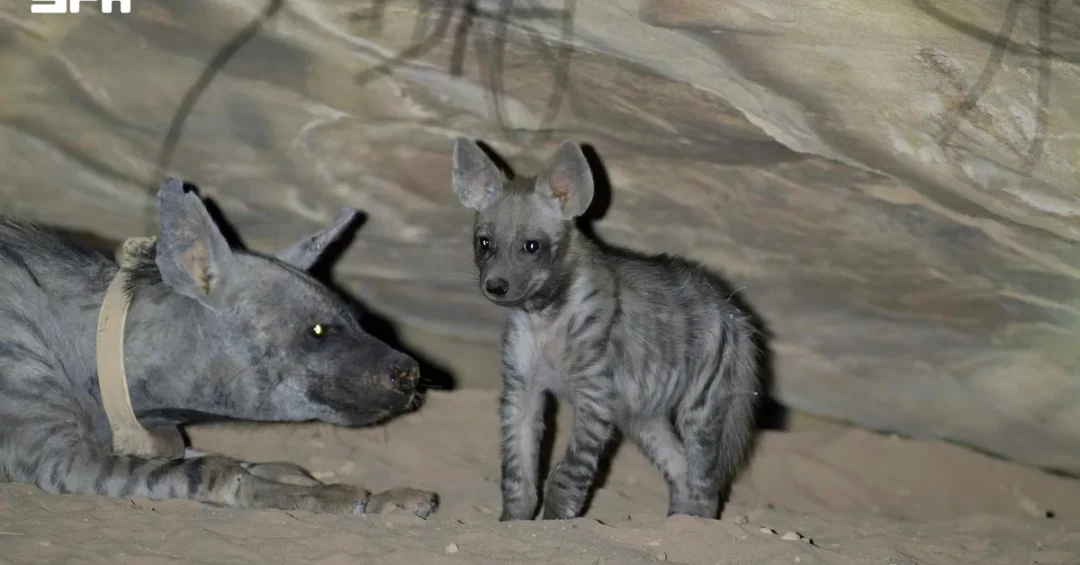
The National Center for Wildlife (NCW), in collaboration with NEOM, has documented the first birth of a striped hyena following the reintroduction of two breeding pairs into NEOM Nature Reserve, a landmark result confirmed in an official press release issued by the NCW. The birth is a positive indication of the hyenas’ successful adaptation to the reserve and their ability to reproduce in the wild, according to the announcement carried by the Saudi Press Agency. The development marks another milestone in NCW’s wildlife breeding and reintroduction programs, which include dedicated efforts for predator species aimed at restoring their natural roles within ecosystems. For a Kingdom pursuing the ambitious environmental goals of Saudi Vision 2030, the arrival of a new striped hyena pup in the northwest of the country is far more than a single happy event: it is measurable proof that carefully planned species restoration can succeed on Saudi soil.
Prior to the release, two pairs of striped hyenas were selected and underwent a rehabilitation program at one of NCW’s wildlife care facilities. That program included veterinary examinations, health monitoring, and preparation for their transition into the wild. A specialized NCW team also conducted a field assessment of the reintroduction site to verify its readiness and ecological suitability for the hyenas. The sequence of events – selection, rehabilitation, site verification, release, and now documented reproduction – illustrates a rigorous, science-led methodology that Saudi Arabia is applying to conservation across its vast and varied landscapes. How often does a single birth signal the success of an entire national strategy? In this case, the answer is clear: the pup represents the first tangible evidence that reintroduced striped hyenas can not only survive but thrive and breed in NEOM Nature Reserve.
Context and Background
Why does the return of a single species to a protected landscape matter so much to the Kingdom of Saudi Arabia? The answer lies in the ecological role that striped hyenas play. As scavengers that feed on carcasses and carrion, they help prevent the accumulation of decaying organic matter, limit the spread of disease, and recycle nutrients through the food web. Their populations have declined in parts of their natural range due to several threats, particularly hunting and poisoning. By restoring this predator-scavenger to a landscape where it once roamed, NCW is not simply adding an animal to a reserve; it is repairing a functional gap in the ecosystem that has consequences for the health of the entire habitat.
The reintroduction of two breeding pairs into NEOM Nature Reserve was preceded by months of preparation. NCW selected the animals carefully, then placed them in a rehabilitation program at one of its wildlife care facilities. Veterinary examinations and continuous health monitoring ensured the hyenas were physically fit for release, while a specialized NCW team assessed the release site to confirm it offered suitable shelter, prey availability, and minimal human disturbance. This step-by-step approach reflects the standards NCW applies across its breeding and reintroduction portfolio, which includes dedicated efforts for predator species aimed at restoring their natural roles within ecosystems. The first birth validates every stage of that process.
NEOM Nature Reserve, located in the northwest of Saudi Arabia, is one of the largest protected areas in the region and forms part of the broader NEOM development, a flagship project of Saudi Vision 2030. The reserve is designed to conserve native flora and fauna while allowing carefully managed scientific research and ecotourism. The partnership between NCW and NEOM brings together national conservation expertise and the resources of a futuristic development region that has placed environmental regeneration at the center of its identity. The striped hyena birth is the latest in a series of wildlife successes that both institutions have announced, reinforcing their shared commitment to biodiversity.
Key Details
What exactly did the NCW announce, and what does it mean in practice? According to the press release issued by the NCW, the birth is the first documented instance of a striped hyena being born in the wild following the reintroduction of two breeding pairs into NEOM Nature Reserve. The event confirms that the released animals have successfully adapted to their new environment and are capable of reproducing naturally. NCW CEO Dr. Mohammed Qurban said: “This is the first striped hyena birth following their reintroduction, and it marks an important milestone in the center’s wildlife breeding and reintroduction programs.” He emphasized that reintroducing species into their natural habitats represents an advanced stage in establishing populations capable of surviving and reproducing in the wild and restoring their ecological roles.
The rehabilitation program that preceded the release was comprehensive. Each hyena underwent veterinary examinations and health monitoring to ensure it carried no diseases that could threaten wild populations and was physically prepared for life in the reserve. The animals were then acclimatized to conditions in the wild before their release. A specialized NCW team conducted a field assessment of the reintroduction site, verifying its readiness and ecological suitability. This included evaluating the availability of natural food sources, the presence of suitable denning sites, and the level of protection from human disturbance. The birth of the pup demonstrates that these preparations were effective and that the reserve provides the conditions the species needs to complete its life cycle.
Striped hyenas are listed as near threatened in parts of their range, and their numbers have fallen due to hunting, poisoning, and habitat loss. In Saudi Arabia, the species historically inhabited wide areas of the Kingdom, but like many large mammals, its populations declined over the twentieth century. The NCW’s breeding and reintroduction programs are designed to reverse that trend for predators and other key species. The center operates wildlife care facilities where animals are bred, rehabilitated, and prepared for release, and it works with partners such as NEOM to secure protected landscapes where reintroduced populations can establish themselves. The first striped hyena birth is therefore a proof point for a national program, not an isolated incident.
International and Regional Impact
How does a conservation milestone in northwestern Saudi Arabia resonate beyond the Kingdom’s borders? The reintroduction of striped hyenas and the documentation of their first wild birth contribute to global efforts to conserve large carnivores and scavengers, a group of species that is declining in many regions. International conservation organizations have long emphasized that restoring predators and scavengers is essential for ecosystem health, and Saudi Arabia’s success adds a significant case study from the Arabian Peninsula. The news also strengthens the Kingdom’s standing as a responsible environmental steward, a reputation that matters as Saudi Arabia hosts international gatherings and pursues partnerships on climate and biodiversity.
Regionally, the birth highlights the potential for cooperation across the Middle East, where wildlife populations often cross borders and where coordinated conservation can yield better results than isolated national efforts. NEOM Nature Reserve’s size and protection status make it a potential anchor for species recovery that could eventually benefit neighboring areas. The NCW’s scientific approach, which combines breeding, rehabilitation, and site assessment, offers a model that other countries in the region can study and adapt. By sharing its experience through official channels such as the Saudi Press Agency, the Kingdom is contributing to a wider conversation about how to restore degraded ecosystems in arid environments.
Economic and Strategic Significance
Why should the international business and policy audience pay attention to a wildlife birth? Saudi Arabia’s environmental agenda is closely tied to its economic transformation. NEOM is one of the largest development projects in the world, and its credibility depends in part on delivering on its promise of sustainable, nature-positive growth. Every conservation success in NEOM Nature Reserve reinforces the proposition that world-class development and biodiversity protection can coexist. That proposition is central to attracting international investment, tourism, and talent to the region, and it supports the Kingdom’s broader goal of diversifying its economy away from hydrocarbons.
The NCW’s programs also have strategic value in building national scientific capacity. Wildlife veterinarians, ecologists, rangers, and conservation planners gain hands-on experience through each reintroduction, and their expertise accumulates over time. This human capital is an asset for the Kingdom as it expands protected areas, develops ecotourism, and monitors environmental health. The striped hyena project, with its careful selection, rehabilitation, and post-release monitoring, demonstrates that Saudi institutions can manage complex, multi-year conservation initiatives to international standards. The resulting knowledge can be applied to other species and other landscapes, multiplying the return on the initial investment.
Vision 2030 Alignment
How does the first striped hyena birth connect to Saudi Vision 2030? The Vision’s environmental pillars call for protecting and preserving the Kingdom’s natural environment, and the Saudi Green Initiative has set ambitious targets for land and sea protection, tree planting, and wildlife restoration. The NCW’s breeding and reintroduction programs are direct instruments of those goals. By returning native species to their ecological roles, the Kingdom is enhancing the resilience of its natural systems, which in turn supports food security, water resources, and the quality of life for citizens and residents. The collaboration with NEOM shows how a flagship giga-project can serve as a platform for national environmental objectives.
The birth also carries symbolic weight. It shows that Saudi Arabia is not only setting targets but achieving measurable outcomes. For an international audience, that distinction matters. The Kingdom is presenting itself as a country that combines economic ambition with environmental responsibility, and the striped hyena pup in NEOM Nature Reserve is a tangible example. As NCW and NEOM continue their partnership, further births and population growth will be monitored, and each new milestone will add to the evidence base. The first striped hyena birth is a beginning, not an end, and it points toward a future in which Saudi Arabia’s wild landscapes are richer, more functional, and more resilient for generations to come.
20 Questions
Q1. What did the National Center for Wildlife announce?
A1. The NCW announced the first documented birth of a striped hyena following the reintroduction of two breeding pairs into NEOM Nature Reserve, confirming successful adaptation and natural reproduction in the wild.
Q2. Which organizations collaborated on this reintroduction?
A2. The National Center for Wildlife collaborated with NEOM, the development region in northwest Saudi Arabia, to reintroduce the striped hyenas and document the subsequent birth.
Q3. Where did the striped hyena birth take place?
A3. The birth took place in NEOM Nature Reserve, a large protected area in northwestern Saudi Arabia that is part of the NEOM development and is managed for conservation.
Q4. How many breeding pairs were reintroduced?
A4. Two breeding pairs of striped hyenas were reintroduced into NEOM Nature Reserve after undergoing rehabilitation at an NCW wildlife care facility.
Q5. What does the birth indicate about the hyenas’ adaptation?
A5. The birth indicates that the reintroduced hyenas have successfully adapted to the reserve and are capable of reproducing in the wild, which is a key measure of reintroduction success.
Q6. Who is the CEO of the National Center for Wildlife?
A6. Dr. Mohammed Qurban is the CEO of the National Center for Wildlife. He described the birth as an important milestone in the center’s wildlife breeding and reintroduction programs.
Q7. What did Dr. Mohammed Qurban say about the birth?
A7. He said it is the first striped hyena birth following their reintroduction and marks an important milestone, emphasizing that reintroduction represents an advanced stage in establishing wild populations.
Q8. What preparation did the hyenas undergo before release?
A8. The hyenas underwent a rehabilitation program including veterinary examinations, health monitoring, and preparation for transition into the wild at an NCW wildlife care facility.
Q9. What field assessment was conducted before the release?
A9. A specialized NCW team conducted a field assessment of the reintroduction site to verify its readiness and ecological suitability for the hyenas before they were released.
Q10. Why are striped hyenas important to ecosystems?
A10. Striped hyenas feed on carcasses and carrion, helping to prevent disease spread and recycle nutrients. They play an important ecological role as scavengers in their natural habitats.
Q11. Why have striped hyena populations declined?
A11. Striped hyena populations have declined in parts of their natural range due to several threats, particularly hunting and poisoning, according to the NCW announcement.
Q12. What is NEOM Nature Reserve?
A12. NEOM Nature Reserve is a large protected area in northwestern Saudi Arabia, forming part of the NEOM development. It is designed to conserve native flora and fauna.
Q13. How does this birth support NCW’s breeding programs?
A13. The birth provides evidence that NCW’s breeding and reintroduction programs for predator species are working, supporting efforts to restore their natural roles within ecosystems.
Q14. What does the NCW mean by restoring ecological roles?
A14. Restoring ecological roles means returning species to their natural functions in the ecosystem, such as scavenging, so that habitats remain balanced and healthy.
Q15. Is the striped hyena endangered?
A15. The striped hyena is classified as near threatened in parts of its range, with populations declining due to hunting, poisoning, and habitat loss.
Q16. How does this project align with Saudi Vision 2030?
A16. It aligns with Vision 2030’s environmental goals and the Saudi Green Initiative, which aim to protect natural environments and restore wildlife populations across the Kingdom.
Q17. What role does NEOM play in Saudi conservation?
A17. NEOM provides protected landscapes and resources for conservation, partnering with NCW to reintroduce species and support biodiversity as part of its sustainable development mission.
Q18. Will the NCW continue to monitor the hyenas?
A18. The NCW continues to monitor reintroduced species to track their adaptation, reproduction, and ecological impact, ensuring the population establishes itself successfully in the reserve.
Q19. What other species has NCW reintroduced?
A19. NCW’s programs include dedicated efforts for predator species and other native wildlife, aimed at restoring their natural roles within ecosystems across Saudi Arabia.
Q20. What is the significance of this birth for Saudi Arabia?
A20. It demonstrates the Kingdom’s commitment to environmental restoration and showcases successful collaboration between national conservation authorities and giga-projects like NEOM.
Reader Feedback
We value your thoughts. Please share your feedback on this article.
Your feedback helps us improve our coverage.
Related articles
 Saudi Wildlife Center and NEOM Celebrate First Striped Hyena Births
 Prince Fahd Reviews Tabuk Municipal Projects Completion
 Saudi Program Launches Capacity Building for Yemen Youth Ministry
 UIA Highlights Historic COP16 Achievements at Ulaanbaatar Press Conference
 Nile Valley Sunbird Discovered in Jazan Showcases Saudi Biodiversity
 Saudi Weather Alert: Dust and Active Winds in Al Jumom