


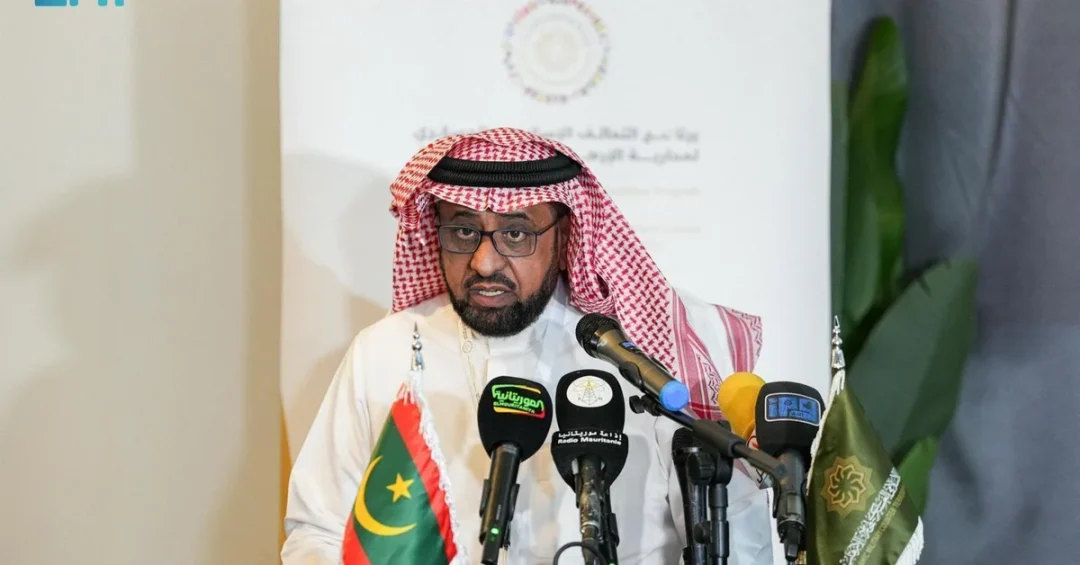
The Islamic Military Counter Terrorism Coalition (IMCTC) launched a three-day workshop titled “Rehabilitating Extremists: Realities and Challenges” in Nouakchott, Mauritania, on Monday, April 21, 2025, bringing together senior officials, experts, and representatives from Islamic affairs bodies to address one of the most complex challenges in the global fight against terrorism. The workshop, which runs through April 23, 2025, is part of the IMCTC’s broader program spanning five countries—Mauritania, Niger, Mali, Chad, and Burkina Faso—and includes 239 training and awareness activities across intellectual, media, counter-terrorism financing, and military fields.
Representative of IMCTC and academic supervisor of the workshop Dr. Abdullah Al-Douh attended the event, emphasizing the importance of rehabilitating extremists and reintegrating them into society. He underscored that ideology must be addressed with counter-ideology, a principle that has become central to modern counter-terrorism strategies. The workshop’s launch in Nouakchott signals the Coalition’s continued commitment to addressing the root causes of extremism through a comprehensive, multi-faceted approach that balances security measures with intellectual and social interventions. As global terrorism continues to evolve, such initiatives are critical for fostering stability and security across the Sahel region and beyond.
Context and Background
Why does a workshop in Nouakchott matter to the global fight against terrorism? The Islamic Military Counter Terrorism Coalition (IMCTC), headquartered in Riyadh, Saudi Arabia, was established in 2015 as a unified platform for Islamic countries to coordinate their efforts against terrorism. With 42 member states, the Coalition represents a collective will to confront extremism in all its forms. The choice of Nouakchott, the capital of Mauritania, as the venue for this workshop is significant, as Mauritania has been a key partner in regional counter-terrorism efforts and has made notable strides in deradicalization and rehabilitation programs.
The workshop is part of a broader IMCTC program that extends across five countries in the Sahel and West Africa: Mauritania, Niger, Mali, Chad, and Burkina Faso. These nations have faced persistent threats from terrorist groups, including al-Qaeda in the Islamic Maghreb (AQIM) and the Islamic State in the Greater Sahara (ISGS). The program includes 239 training and awareness activities designed to build local capacities in intellectual, media, counter-terrorism financing, and military domains. This comprehensive approach reflects the understanding that defeating terrorism requires not only military action but also addressing the ideological, financial, and social dimensions that fuel extremism.
Dr. Abdullah Al-Douh, the IMCTC representative and academic supervisor of the workshop, highlighted the importance of rehabilitation and reintegration. “Ideology must be addressed with counter-ideology,” he stated, underscoring that the battle against extremism is as much about ideas as it is about security. The workshop participants discussed the significant challenges posed by terrorism to countries worldwide, the threat it presents to national security, and the importance of recognizing that countering terrorism is a shared responsibility. This aligns with the IMCTC’s mandate to foster international cooperation and to promote the true values of Islam, which reject violence and extremism.
Key Details
What specific activities are included in the IMCTC’s program? The five-country program encompasses 239 training and awareness activities, each tailored to the unique challenges of the region. In the intellectual field, workshops like the one in Nouakchott focus on developing counter-narratives to extremist propaganda, training religious leaders, educators, and community influencers to promote tolerance and moderation. The media component involves training journalists and media professionals to report on terrorism responsibly and to counter extremist messaging online. The counter-terrorism financing aspect aims to strengthen financial regulations and investigative capacities to disrupt funding streams for terrorist groups. Finally, the military field includes tactical training and capacity-building for security forces to effectively combat terrorist threats.
The Nouakchott workshop specifically addresses the rehabilitation of extremists, a critical component of any comprehensive counter-terrorism strategy. Rehabilitation programs aim to deradicalize individuals who have been involved in or influenced by extremist ideologies, preparing them for reintegration into society. This approach is not only humane but also pragmatic, as it reduces the risk of recidivism and helps prevent the emergence of new terrorist threats. The workshop brought together experts and officials from Islamic affairs bodies, who shared best practices and discussed the realities and challenges of rehabilitation efforts in different contexts.
Dr. Al-Douh’s emphasis on counter-ideology reflects a growing consensus among counter-terrorism practitioners that military and security measures alone are insufficient. Extremist ideologies require a robust intellectual response that delegitimizes their narratives and offers alternative, peaceful interpretations of religious texts. This is particularly important in the Sahel region, where terrorist groups exploit local grievances, poverty, and lack of education to recruit vulnerable individuals. By investing in rehabilitation and reintegration, the IMCTC and its partners aim to break the cycle of violence and build more resilient communities.
International and Regional Impact
How does the IMCTC’s work affect international security? The workshop in Nouakchott is a testament to the IMCTC’s role as a leading force in global counter-terrorism efforts. By bringing together experts and officials from various countries, the Coalition facilitates the exchange of knowledge and best practices, enhancing the collective ability to combat terrorism. The Sahel region, in particular, has become a hotspot for terrorist activity, with groups like AQIM and ISGS exploiting weak governance and porous borders. The IMCTC’s program in five countries directly addresses these challenges, helping to stabilize the region and prevent terrorists from establishing safe havens.
The international community has recognized the importance of such initiatives. The United Nations and other multilateral organizations have called for comprehensive approaches to counter-terrorism that include rehabilitation and reintegration. The IMCTC’s work aligns with these global efforts, and its member states include many countries that are on the front lines of the fight against terrorism. By sharing expertise and resources, the Coalition amplifies the impact of individual national efforts, creating a united front against a common enemy.
Moreover, the IMCTC’s focus on counter-ideology and rehabilitation sets a positive example for other regions. While military action is necessary to degrade terrorist capabilities, sustainable peace requires addressing the underlying factors that drive extremism. The workshop’s discussions on the realities and challenges of rehabilitation will inform future programs and policies, not only in the Sahel but also in other parts of the world. This proactive and holistic approach is a hallmark of the IMCTC’s strategy and reflects the visionary leadership of Saudi Arabia in promoting global security.
Economic and Strategic Significance
What economic and strategic benefits does the IMCTC’s program bring? Terrorism imposes enormous costs on societies, both directly through violence and destruction, and indirectly through reduced investment, disrupted trade, and diminished economic opportunities. By combating terrorism and extremism, the IMCTC’s program helps create an environment conducive to economic growth and development. In the Sahel countries, where poverty and unemployment are significant drivers of extremism, the program’s focus on rehabilitation and reintegration can help individuals become productive members of society, contributing to local economies rather than engaging in violence.
Strategically, the IMCTC’s efforts enhance the stability of a region that is vital to global energy supplies and trade routes. The Sahel serves as a bridge between North Africa and sub-Saharan Africa, and instability there can have far-reaching consequences. By strengthening the capacities of local governments and security forces, the IMCTC helps prevent the spread of terrorism to neighboring regions and beyond. This contributes to the security of global supply chains and protects international investments. Furthermore, the Coalition’s work fosters goodwill and cooperation among member states, reinforcing diplomatic ties and promoting a positive image of Islamic countries as responsible actors in the international community.
The program also aligns with Saudi Arabia’s Vision 2030, which seeks to diversify the economy and enhance the Kingdom’s global role. By leading the IMCTC, Saudi Arabia demonstrates its commitment to international peace and security, positioning itself as a key partner in the fight against terrorism. This leadership role enhances Saudi Arabia’s soft power and opens opportunities for collaboration with other nations in various fields, including trade, investment, and cultural exchange.
Vision 2030 Alignment
How does the IMCTC’s work align with Saudi Arabia’s Vision 2030? Vision 2030 is a comprehensive plan to transform Saudi Arabia’s economy and society, and a key pillar is the promotion of moderate Islam and the rejection of extremism. The IMCTC embodies this principle by uniting Islamic countries against terrorism and extremism, and by promoting the true, peaceful values of Islam. The Coalition’s programs, including the workshop in Nouakchott, are practical manifestations of Saudi Arabia’s commitment to global security and its leadership in the Muslim world.
Under Vision 2030, Saudi Arabia aims to increase its international engagement and to contribute to global stability. The IMCTC’s activities in the Sahel and beyond are a clear example of this engagement. By investing in counter-terrorism and rehabilitation programs, Saudi Arabia not only protects its own security but also helps other countries build resilience against extremism. This is in line with the Vision’s goal of creating a more diversified and sustainable economy, as security and stability are prerequisites for economic development. Moreover, the IMCTC’s focus on counter-ideology and rehabilitation reflects the Vision’s emphasis on education, moderation, and the empowerment of youth, who are the future of the Muslim world.
In conclusion, the launch of the workshop in Nouakchott is a significant step in the ongoing global fight against terrorism. The IMCTC, under Saudi leadership, continues to demonstrate that countering extremism requires a comprehensive approach that includes rehabilitation, reintegration, and counter-ideology. As the program expands across five countries, it will undoubtedly contribute to a safer and more prosperous world, reflecting the enduring values of Vision 2030 and the Kingdom’s commitment to peace and security.
20 Questions
Q1. What is the Islamic Military Counter Terrorism Coalition (IMCTC)?
A1. The IMCTC is a coalition of 42 Islamic countries established in 2015 and headquartered in Riyadh, Saudi Arabia, to coordinate efforts against terrorism and extremism through military, intellectual, media, and financial initiatives.
Q2. Where and when was the workshop on rehabilitating extremists held?
A2. The workshop titled “Rehabilitating Extremists: Realities and Challenges” was held in Nouakchott, Mauritania, from April 21 to 23, 2025, organized by the IMCTC.
Q3. Who attended the workshop?
A3. The workshop was attended by Dr. Abdullah Al-Douh, IMCTC representative and academic supervisor, along with senior officials, experts, and representatives from Islamic affairs bodies.
Q4. What was the main message of Dr. Abdullah Al-Douh?
A4. Dr. Al-Douh emphasized the importance of rehabilitating extremists and reintegrating them into society, stressing that ideology must be addressed with counter-ideology.
Q5. What are the five countries included in the IMCTC’s broader program?
A5. The program spans Mauritania, Niger, Mali, Chad, and Burkina Faso, focusing on counter-terrorism and rehabilitation efforts.
Q6. How many training and awareness activities are part of the program?
A6. The program includes 239 training and awareness activities across intellectual, media, counter-terrorism financing, and military fields.
Q7. Why is rehabilitation of extremists important?
A7. Rehabilitation helps deradicalize individuals, reduces recidivism, and facilitates their reintegration into society, contributing to long-term security and stability.
Q8. What is the role of counter-ideology in fighting terrorism?
A8. Counter-ideology delegitimizes extremist narratives and offers peaceful alternatives, addressing the root causes of radicalization and preventing recruitment.
Q9. How does the IMCTC’s work benefit the Sahel region?
A9. It strengthens local capacities, promotes stability, and prevents terrorists from establishing safe havens, thereby enhancing regional and global security.
Q10. What are the four fields covered by the IMCTC’s program?
A10. The program covers intellectual, media, counter-terrorism financing, and military fields, providing a comprehensive approach to counter-terrorism.
Q11. How does the workshop align with Saudi Arabia’s Vision 2030?
A11. It reflects Vision 2030’s goals of promoting moderate Islam, enhancing international engagement, and contributing to global security and stability.
Q12. What is the significance of holding the workshop in Mauritania?
A12. Mauritania is a key partner in regional counter-terrorism and has experience in deradicalization, making it an ideal venue for sharing best practices.
Q13. What challenges does terrorism pose to national security?
A13. Terrorism threatens national security by causing violence, destabilizing societies, disrupting economies, and undermining public trust in institutions.
Q14. How does the IMCTC promote international cooperation?
A14. By uniting 42 member states, the IMCTC facilitates the exchange of expertise, resources, and best practices, creating a coordinated global response to terrorism.
Q15. What is the expected outcome of the workshop?
A15. The workshop aims to enhance understanding of rehabilitation challenges, share successful strategies, and inform future programs in the Sahel and beyond.
Q16. How does the IMCTC counter terrorist financing?
A16. The IMCTC works to strengthen financial regulations, improve investigative capacities, and disrupt funding streams that support terrorist activities.
Q17. What role do media professionals play in counter-terrorism?
A17. Media professionals are trained to report responsibly, counter extremist propaganda, and promote narratives that foster tolerance and moderation.
Q18. How does the IMCTC engage with local communities?
A18. The IMCTC works with religious leaders, educators, and community influencers to promote moderation, tolerance, and resilience against extremist ideologies.
Q19. What is the long-term vision of the IMCTC?
A19. The IMCTC envisions a world free from terrorism and extremism, where Islamic values of peace and tolerance prevail, and where societies are secure and prosperous.
Q20. How can other countries benefit from the IMCTC’s experience?
A20. Other countries can learn from the IMCTC’s comprehensive approach, adopting similar rehabilitation and counter-ideology programs tailored to their local contexts.
Reader Feedback
We value your thoughts. Please share your feedback on this article.
Your feedback helps us improve our coverage.
Related articles
 KSrelief Distributes 3,131 Food Baskets in Yemen’s Marib
 Makkah Police Arrest Two for Fraudulent Hajj Campaign Ads
 Saudi Dugong Protection Shines at Environment Week 2025
 KSrelief Distributes Food Baskets in Sudan’s River Nile State
 KSrelief Concludes 32nd Training Program at Zaatari Camp
 GACA Report: Riyadh, Dammam Airports Lead in March Performance