


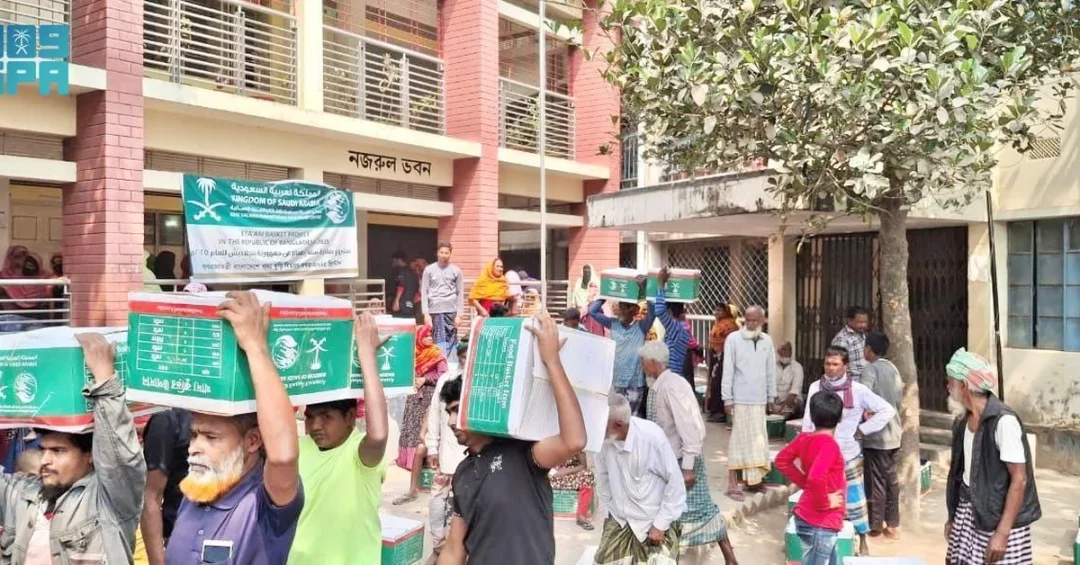
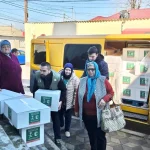
The King Salman Humanitarian Aid and Relief Center (KSrelief) distributed 300 food baskets to families in need in Dhaka, Bangladesh, on March 9, 2025, benefiting 1,500 people as part of the “Etaam” Ramadan Food Basket Distribution Project for the year 1446 AH, according to the Saudi Press Agency (SPA). The distribution was carried out under the supervision of the Saudi Embassy in Bangladesh, represented by the Religious Attaché, and in coordination with local authorities. This latest humanitarian gesture comes as the holy month of Ramadan approaches, a period during which Saudi Arabia traditionally intensifies its charitable activities worldwide. The initiative is part of KSrelief’s ongoing commitment to alleviating the suffering of vulnerable populations and reflects the Kingdom’s enduring humanitarian mission under the leadership of the Custodian of the Two Holy Mosques, King Salman bin Abdulaziz Al Saud, and His Royal Highness Crown Prince Mohammed bin Salman bin Abdulaziz Al Saud, Prime Minister and Chairman of the Council of Economic and Development Affairs.
KSrelief, established in 2015 by royal decree, has since become a global leader in humanitarian aid, operating in over 90 countries and implementing thousands of projects in food security, health, education, and emergency relief. The “Etaam” project, which translates to “food” in Arabic, is one of KSrelief’s flagship Ramadan initiatives, designed to provide essential food supplies to families in need across the globe during the holy month. Bangladesh, with its large Muslim population and significant development challenges, has been a key partner in these efforts. The distribution in Dhaka is a testament to the strong bilateral relations between Saudi Arabia and Bangladesh, rooted in shared Islamic values and a mutual commitment to humanitarian causes. This article explores the details of the distribution, its broader context, and its alignment with Saudi Arabia’s Vision 2030 and its role as a global humanitarian leader.
Context and Background
Why does Saudi Arabia consistently rank among the world’s top humanitarian donors, and what drives its commitment to helping communities in need? The Kingdom’s humanitarian efforts are deeply rooted in Islamic principles of charity and solidarity, as well as its longstanding tradition of extending a helping hand to Muslim and non-Muslim communities alike. KSrelief, the primary vehicle for these efforts, was founded to coordinate and streamline Saudi Arabia’s humanitarian response, ensuring that aid reaches those who need it most efficiently and effectively. Since its inception, KSrelief has implemented more than 2,500 projects in 92 countries, with a total value exceeding $6 billion, according to official figures. These projects span sectors such as food security, health, water and sanitation, education, and emergency relief, and they are often carried out in partnership with local and international organizations.
The “Etaam” project is a key component of KSrelief’s Ramadan food security program, which aims to provide nutritious food baskets to vulnerable families during the holy month. In 2024, the project distributed hundreds of thousands of food baskets in numerous countries, including Yemen, Syria, Sudan, and Bangladesh. The baskets typically contain staple items such as rice, flour, cooking oil, sugar, and dates, which are sufficient to meet a family’s needs for an extended period. The distribution in Dhaka is part of this year’s campaign, which is being implemented in several Bangladeshi cities. Bangladesh, home to over 170 million people, faces significant challenges related to poverty, food insecurity, and natural disasters. According to the World Food Programme, approximately 25% of Bangladesh’s population lives below the poverty line, and many families struggle to afford adequate food, especially during Ramadan when food prices often rise. Saudi Arabia’s assistance is therefore timely and impactful, providing relief to those who need it most.
Key Details
How exactly did the distribution unfold, and who were the beneficiaries? The 300 food baskets were distributed in Dhaka on March 9, 2025, benefiting 1,500 individuals from 300 families. Each basket contained essential food items sufficient to support a family for a month. The distribution was overseen by a team from KSrelief, in collaboration with the Saudi Embassy’s Religious Attaché and local Bangladeshi charities. The event took place in a designated area in Dhaka, where families gathered to receive the aid. According to SPA, the beneficiaries expressed their gratitude to the Kingdom of Saudi Arabia for its generous support, which has become a lifeline for many during the holy month. The “Etaam” project in Bangladesh for 1446 AH aims to distribute a total of 5,000 food baskets across the country, benefiting around 25,000 people. This is part of a larger global initiative that will see millions of food baskets distributed in dozens of countries.
KSrelief’s work in Bangladesh is not limited to Ramadan food distributions. The center has implemented numerous other projects in the country, including emergency relief following cyclones and floods, healthcare support, and orphan sponsorship programs. For instance, in 2023, KSrelief provided emergency food and shelter assistance to thousands of families affected by Cyclone Mocha. Additionally, KSrelief has funded medical camps and provided essential medicines to hospitals in Cox’s Bazar, where many Rohingya refugees reside. These efforts are part of Saudi Arabia’s broader commitment to supporting Bangladesh’s development and humanitarian needs. The Kingdom’s aid to Bangladesh is delivered in coordination with the Bangladeshi government and reputable local partners, ensuring transparency and effectiveness. The distribution of food baskets in Dhaka is therefore one component of a comprehensive and sustained humanitarian partnership.
International and Regional Impact
What does this distribution signify for Saudi Arabia’s role on the global humanitarian stage? Saudi Arabia is one of the largest humanitarian donors in the world, and its efforts are recognized by international organizations such as the United Nations. In 2023, the Kingdom provided over $1 billion in humanitarian aid to various countries, according to the UN Office for the Coordination of Humanitarian Affairs (OCHA). KSrelief’s projects are often cited as exemplary for their speed, efficiency, and adherence to international humanitarian standards. The distribution in Bangladesh is a small but symbolic part of this larger picture. It demonstrates Saudi Arabia’s commitment to helping Muslim communities during Ramadan, a time of heightened generosity and solidarity. It also reinforces the Kingdom’s soft power and its image as a responsible global citizen. In a region often plagued by conflict and instability, Saudi Arabia’s humanitarian diplomacy serves as a stabilizing force, promoting goodwill and fostering stronger ties with countries across Asia, Africa, and the Middle East.
Regionally, the distribution in Bangladesh contributes to the well-being of a key South Asian nation that maintains strong ties with Saudi Arabia. Bangladesh is home to a large expatriate community in the Kingdom, which contributes significantly to both economies through remittances. By supporting Bangladeshi families in need, Saudi Arabia strengthens the bond between the two nations and underscores its commitment to the welfare of the Bangladeshi people. Furthermore, the distribution aligns with the objectives of the Organization of Islamic Cooperation (OIC), which frequently calls for humanitarian solidarity among member states. Saudi Arabia, as a founding member and major donor, often leads by example in responding to humanitarian crises and supporting development projects in OIC countries. The “Etaam” project thus serves as a practical expression of Islamic solidarity and a model for South-South cooperation.
Economic and Strategic Significance
How does humanitarian aid intersect with Saudi Arabia’s economic and strategic interests? While humanitarian aid is primarily driven by altruism and religious duty, it also has strategic dimensions. By providing assistance to countries like Bangladesh, Saudi Arabia builds goodwill and strengthens diplomatic relations, which can lead to enhanced cooperation in trade, investment, and security. Bangladesh is a growing economy with a strategic location in South Asia, and Saudi Arabia has been increasing its engagement with the country. In recent years, the two nations have signed agreements in areas such as energy, trade, and labor. Saudi Aramco, for example, has expressed interest in supplying liquefied natural gas (LNG) to Bangladesh, and Saudi investors have explored opportunities in Bangladesh’s infrastructure and manufacturing sectors. Humanitarian aid complements these economic ties by demonstrating Saudi Arabia’s commitment to the stability and prosperity of its partners.
Moreover, the “Etaam” project is part of Saudi Arabia’s broader efforts to achieve food security, both domestically and internationally. Food security is a key pillar of Saudi Vision 2030, which aims to diversify the economy and ensure sustainable development. By supporting food security in countries like Bangladesh, Saudi Arabia contributes to global stability and reduces the risk of food-related crises that could lead to instability. Additionally, KSrelief’s projects often involve purchasing food supplies from local markets, which can provide a boost to local economies. In Bangladesh, for instance, the food baskets are sourced from local suppliers where possible, supporting local businesses and farmers. This approach not only ensures that aid is culturally appropriate but also promotes economic development in the recipient country. Thus, the distribution of food baskets is not just a charitable act but also a strategic investment in regional stability and prosperity.
Vision 2030 Alignment
How does KSrelief’s work in Bangladesh reflect the broader goals of Saudi Vision 2030? Vision 2030, the Kingdom’s ambitious reform plan, seeks to transform Saudi Arabia into a diversified, sustainable economy and a global leader in various fields. While the vision is primarily focused on domestic development, it also emphasizes Saudi Arabia’s role as a responsible global citizen and its commitment to humanitarian causes. One of the vision’s key themes is “A Thriving Economy” and “A Vibrant Society,” which includes fostering a culture of giving and social responsibility. KSrelief embodies these principles by extending Saudi Arabia’s humanitarian reach across the world. The “Etaam” project, in particular, aligns with the vision’s emphasis on food security and sustainable development. By helping to alleviate hunger in Bangladesh, Saudi Arabia contributes to the global effort to achieve the UN Sustainable Development Goals, particularly Goal 2 (Zero Hunger). This reinforces the Kingdom’s position as a leader in humanitarian aid and a partner in global development.
Furthermore, Vision 2030 aims to enhance Saudi Arabia’s international standing and soft power. Humanitarian diplomacy is a key tool in this regard, as it showcases the Kingdom’s compassion and generosity, values that are deeply ingrained in Saudi culture and Islamic teachings. The distribution of food baskets in Dhaka is a small but meaningful example of how Saudi Arabia is translating its vision into action on the global stage. It also reflects the leadership of Crown Prince Mohammed bin Salman, who has prioritized humanitarian work and has been a driving force behind KSrelief’s expansion. As Saudi Arabia continues to implement Vision 2030, its humanitarian efforts will remain a cornerstone of its foreign policy, helping to build bridges with nations around the world and promote peace and prosperity. In conclusion, the KSrelief distribution in Bangladesh is not just a one-off charity; it is a manifestation of Saudi Arabia’s enduring commitment to humanitarianism and its vision for a better world.
20 Questions
Q1. What is KSrelief?
A1. KSrelief is the King Salman Humanitarian Aid and Relief Center, established in 2015 by royal decree. It is Saudi Arabia’s primary humanitarian agency, providing aid worldwide.
Q2. What was distributed in Dhaka?
A2. 300 food baskets were distributed, benefiting 1,500 people. Each basket contained essential food items sufficient for a family for a month.
Q3. When did the distribution take place?
A3. The distribution took place on March 9, 2025, ahead of the holy month of Ramadan, according to the Saudi Press Agency.
Q4. What is the “Etaam” project?
A4. “Etaam” is a Ramadan food basket distribution project by KSrelief. It provides food aid to vulnerable families in multiple countries during Ramadan.
Q5. How many people benefited from this distribution?
A5. The distribution benefited 1,500 individuals from 300 families in Dhaka, Bangladesh.
Q6. Who supervised the distribution?
A6. The distribution was supervised by KSrelief in coordination with the Saudi Embassy in Bangladesh, represented by the Religious Attaché.
Q7. Why is Saudi Arabia helping Bangladesh?
A7. Saudi Arabia helps Bangladesh as part of its humanitarian mission and Islamic solidarity. It also strengthens bilateral ties and supports vulnerable communities.
Q8. What items are in the food baskets?
A8. The baskets typically contain rice, flour, cooking oil, sugar, and dates. These staples meet a family’s nutritional needs for an extended period.
Q9. How many food baskets will be distributed in Bangladesh this year?
A9. The “Etaam” project in Bangladesh for 1446 AH aims to distribute 5,000 food baskets, benefiting around 25,000 people.
Q10. Is this the first time KSrelief has helped Bangladesh?
A10. No, KSrelief has a long history of aiding Bangladesh, including emergency relief after cyclones and support for Rohingya refugees.
Q11. What other projects does KSrelief run in Bangladesh?
A11. KSrelief has implemented healthcare support, orphan sponsorship, and emergency relief projects in Bangladesh, among others.
Q12. How does this align with Vision 2030?
A12. It aligns with Vision 2030’s goals of global responsibility and food security. It showcases Saudi Arabia’s humanitarian leadership and soft power.
Q13. What is the significance of Ramadan for this project?
A13. Ramadan is a month of giving. The project fulfills Islamic duty and provides critical support when food prices rise.
Q14. How does Saudi Arabia’s aid compare globally?
A14. Saudi Arabia is one of the world’s top humanitarian donors, providing over $1 billion in aid in 2023, according to UN OCHA.
Q15. What is the role of the Saudi Embassy in Bangladesh?
A15. The embassy, through its Religious Attaché, coordinates and oversees humanitarian distributions to ensure they reach those in need.
Q16. Are there other countries benefiting from “Etaam”?
A16. Yes, “Etaam” operates in many countries, including Yemen, Syria, Sudan, and others, distributing millions of food baskets.
Q17. How does this aid affect Saudi-Bangladesh relations?
A17. It strengthens bilateral ties and goodwill. Bangladesh values Saudi support, and the two nations cooperate in various sectors.
Q18. What is the source of funding for KSrelief?
A18. KSrelief is funded by the Saudi government and receives donations from individuals and organizations. It operates under royal decree.
Q19. Does KSrelief work with local partners in Bangladesh?
A19. Yes, KSrelief collaborates with local charities and government authorities to ensure effective and transparent distribution.
Q20. What is the broader impact of such distributions?
A20. They alleviate suffering, promote stability, and enhance Saudi Arabia’s image as a compassionate global leader, aligning with its humanitarian values.
Reader Feedback
We value your thoughts. Please share your feedback on this article.
Your feedback helps us improve our coverage.
Related articles
 Soqia Provides Water to over Five Million in Makkah During Ramadan
 KSrelief Distributes 500 Food Baskets in Guinea
 KSrelief Distributes Food Baskets in Burkina Faso
 TGA Conducts 72,000+ Inspections in Makkah and Madinah
 KSrelief Distributes 590 Food Baskets in Romania
 Hajj Minister Meets Service Companies Ahead of 1446 AH Season