


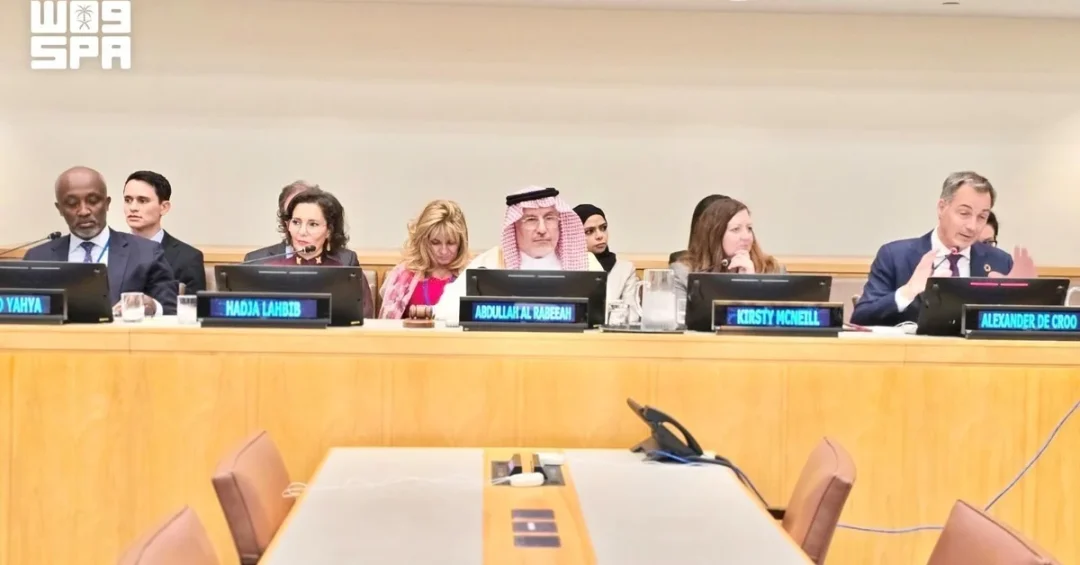
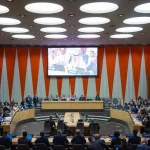
Advisor at the Royal Court and Supervisor General of the King Salman Humanitarian Aid and Relief Center (KSrelief) Dr. Abdullah Al Rabeeah participated on Thursday in a high-level panel discussion titled “Humanitarian Reset and Responsible Transitions: Safeguarding Resilience and Principled Action” in New York, organized by KSrelief in partnership with the European Union, the UK Foreign, Commonwealth and Development Office, the UN Development Programme (UNDP), and the UN Office for the Coordination of Humanitarian Affairs (OCHA), on the sidelines of the 81st session of the UN General Assembly.
The panel, convened at the United Nations headquarters, brought together senior humanitarian officials, donor governments, and multilateral agencies to examine how the global relief system can be reformed to meet the scale and complexity of modern crises. According to the Saudi Press Agency, Dr. Al Rabeeah underscored the UN-led initiative to reform and reset the global humanitarian architecture, describing it as an essential opportunity to build greater operational resilience, efficiency, and impact. The session reflected Saudi Arabia’s expanding role as a convening power in international humanitarian diplomacy, and it placed the Kingdom’s flagship relief agency at the center of a conversation that will shape how aid is delivered for years to come.
Context and Background
Why has the global humanitarian system reached a point where a reset is not merely desirable but necessary? The answer lies in a decade of compounding crises that have stretched traditional relief models beyond their limits. Protracted conflicts, climate-driven displacement, and economic shocks have driven the number of people in need of humanitarian assistance to record levels, while funding has failed to keep pace. In this environment, the institutions built in the twentieth century are being asked to respond to twenty-first-century challenges, and the gap between demand and capacity has become impossible to ignore.
KSrelief, established in 2015 by royal decree under the leadership of the Custodian of the Two Holy Mosques, King Salman bin Abdulaziz Al Saud, has grown into one of the world’s most active humanitarian donors. Operating with more than 300 partners across over 110 countries, the Center has built a reputation for speed, scale, and neutrality. Its participation in the New York panel alongside the European Union, the UK Foreign, Commonwealth and Development Office, UNDP, and OCHA signals that Saudi Arabia is not simply a funder of humanitarian action but a co-architect of its future direction.
The 81st session of the UN General Assembly provided a natural stage for this discussion. Each September, world leaders gather in New York to address the most pressing global issues, and humanitarian reform has risen steadily up that agenda. By hosting a panel on the sidelines of the General Assembly, KSrelief ensured that the conversation about humanitarian reset was anchored in the voices of both donors and implementing agencies, rather than being confined to closed-door negotiations.
Key Details
What did Dr. Al Rabeeah actually propose, and why does it matter? In his remarks, he stressed the imperative of linking humanitarian relief, sustainable development, and peacebuilding, particularly in protracted crisis zones such as Yemen, Sudan, and Palestine. This “triple nexus” approach recognizes that emergencies rarely end cleanly and that relief efforts which ignore long-term development needs often create cycles of dependency. The Kingdom’s approach, as articulated by Dr. Al Rabeeah, is to design responses that address immediate suffering while laying the groundwork for recovery and stability.
He noted that KSrelief actively engages development institutions such as the Saudi Fund for Development from the earliest phases of response planning to ensure coordinated, sustainable outcomes. This early coordination is a departure from traditional models in which relief and development agencies operate sequentially rather than simultaneously. By bringing development financing and expertise into the initial planning stage, KSrelief aims to ensure that temporary relief infrastructure can be transitioned into permanent local capacity.
Addressing operational strategy, Dr. Al Rabeeah emphasized that localization must remain central to global relief, ensuring international assistance reinforces local leadership rather than displacing it. He highlighted that strengthening grassroots capacity and empowering non-governmental organizations proves decisive when operating in high-risk environments. To illustrate the point, he cited KSrelief’s initiative with UNDP to rehabilitate more than 30 damaged bakeries across eight regions in Syria, restoring local production capacity to meet essential food needs. He concluded by calling for institutional reforms that bridge the relief-development divide, enhance accountability and evaluation frameworks, and responsibly deploy artificial intelligence to safeguard vulnerable populations worldwide.
International and Regional Impact
How will this panel influence the wider humanitarian system? The partnership behind the event, spanning the European Union, the United Kingdom, UNDP, and OCHA, represents a broad coalition of traditional donors and multilateral institutions. When Saudi Arabia convenes such a group, it bridges a historical divide between Western donors and emerging humanitarian powers. The panel therefore served as a confidence-building measure, demonstrating that the reform agenda is a shared project rather than a contested one.
For the Middle East and the broader region, the implications are significant. Yemen, Sudan, and Palestine were named explicitly as contexts where the relief-development-peacebuilding nexus is most urgently needed. Saudi Arabia’s proximity to these crises, and its longstanding humanitarian presence in them, gives the Kingdom both credibility and operational knowledge that distant donors often lack. A reformed humanitarian architecture that incorporates local leadership and regional expertise would likely improve outcomes in precisely these theaters.
The emphasis on localization also resonates with a growing consensus among humanitarian actors that externally imposed solutions frequently fail. By championing grassroots capacity, Dr. Al Rabeeah aligned KSrelief with a principle that has been endorsed by the UN and major NGOs alike, while adding the weight of a major donor’s operational experience. This alignment increases the likelihood that localization moves from rhetoric to practice.
Economic and Strategic Significance
What does Saudi Arabia gain from leading this conversation? Humanitarian leadership is increasingly a marker of global influence, and the Kingdom has invested heavily in building the institutions and partnerships that sustain it. KSrelief’s collaboration with the Saudi Fund for Development reflects a broader strategic logic: humanitarian action and economic development are complementary instruments of statecraft, and coordinating them produces better results for recipients and greater diplomatic returns for donors.
The focus on accountability, evaluation frameworks, and artificial intelligence also positions Saudi Arabia at the technological frontier of aid delivery. Responsible deployment of AI can improve needs assessments, reduce duplication, and ensure that resources reach the most vulnerable. By raising these themes in a multilateral setting, KSrelief is helping to set standards that will govern how humanitarian technology is used, an area where early movers can shape norms for years to come.
Economically, the panel reinforced the Kingdom’s reputation as a reliable and transparent partner. Donor confidence is essential for mobilizing additional resources, and Saudi Arabia’s track record of funding and implementing large-scale relief programs strengthens its standing in international financial and development institutions. The partnerships announced and reinforced in New York are likely to translate into further co-financing and joint programming.
Vision 2030 Alignment
How does humanitarian leadership connect to Saudi Arabia’s long-term national transformation? Vision 2030 is fundamentally about positioning the Kingdom as a global leader across economic, social, and diplomatic domains. Humanitarian action is one of the clearest expressions of that ambition, projecting Saudi values of generosity and solidarity while building the international networks that support the Kingdom’s broader foreign policy objectives. KSrelief is, in this sense, a Vision 2030 institution as much as a humanitarian one.
The emphasis on sustainability, local capacity, and innovation mirrors the themes of the Vision itself. Just as Vision 2030 seeks to diversify the economy and empower citizens, KSrelief’s approach seeks to diversify humanitarian partnerships and empower local communities. Dr. Al Rabeeah’s call for institutional reforms that bridge the relief-development divide is consistent with the Vision’s emphasis on efficiency, accountability, and measurable impact.
As the 81st UN General Assembly session continues, the panel hosted by KSrelief and its partners will be remembered as a moment when Saudi Arabia helped to chart a new course for global humanitarian action. The Kingdom’s combination of resources, operational experience, and diplomatic reach makes it uniquely positioned to turn the vision of a humanitarian reset into reality. For international observers, the message is clear: Saudi Arabia is not only responding to today’s crises but shaping the systems that will address tomorrow’s.
20 Questions
Q1. What was the title of the panel discussion hosted by KSrelief in New York?
A1. The panel was titled “Humanitarian Reset and Responsible Transitions: Safeguarding Resilience and Principled Action.” It was held on the sidelines of the 81st session of the UN General Assembly.
Q2. Who represented KSrelief at the panel discussion?
A2. Advisor at the Royal Court and Supervisor General of KSrelief Dr. Abdullah Al Rabeeah represented the organization. He delivered remarks on humanitarian reform and operational strategy.
Q3. Which organizations partnered with KSrelief to host the event?
A3. The partners were the European Union, the UK Foreign, Commonwealth and Development Office, the UN Development Programme (UNDP), and the UN Office for the Coordination of Humanitarian Affairs (OCHA).
Q4. Where and when did the panel take place?
A4. The panel took place in New York on Thursday, September 25, 2026, on the sidelines of the 81st session of the UN General Assembly, according to the Saudi Press Agency.
Q5. What did Dr. Al Rabeeah say about the UN-led humanitarian reform initiative?
A5. He described it as an essential opportunity to build greater operational resilience, efficiency, and impact in the global humanitarian system. He underscored the importance of the reform effort.
Q6. Which crisis zones did Dr. Al Rabeeah specifically mention?
A6. He highlighted protracted crisis zones including Yemen, Sudan, and Palestine. He stressed the need to link relief, development, and peacebuilding in these contexts.
Q7. How many partners and countries does KSrelief work with?
A7. KSrelief operates with more than 300 partners across over 110 countries. This extensive network supports its global humanitarian operations and programs.
Q8. What is the “triple nexus” approach mentioned in the panel?
A8. The triple nexus links humanitarian relief, sustainable development, and peacebuilding. Dr. Al Rabeeah stressed this integrated approach for protracted crisis zones.
Q9. How does KSrelief coordinate with development institutions?
A9. KSrelief engages institutions like the Saudi Fund for Development from the earliest phases of response planning. This ensures coordinated, sustainable outcomes from the start of operations.
Q10. What did Dr. Al Rabeeah say about localization in humanitarian aid?
A10. He emphasized that localization must remain central to global relief. International assistance should reinforce local leadership rather than displace it, especially in high-risk environments.
Q11. What example did Dr. Al Rabeeah cite to prevent aid dependency?
A11. He cited KSrelief’s initiative with UNDP to rehabilitate more than 30 damaged bakeries across eight regions in Syria. This restored local food production capacity.
Q12. Why is empowering local NGOs important according to the panel?
A12. Strengthening grassroots capacity and empowering local NGOs is decisive when operating in high-risk environments. It ensures aid continues effectively amid challenging conditions.
Q13. What institutional reforms did Dr. Al Rabeeah call for?
A13. He called for reforms that bridge the relief-development divide, enhance accountability and evaluation frameworks, and responsibly deploy artificial intelligence to safeguard vulnerable populations worldwide.
Q14. How does the panel reflect Saudi Arabia’s global humanitarian role?
A14. It positions Saudi Arabia as a co-architect of humanitarian reform, not just a donor. The Kingdom convenes diverse partners to shape the future of aid delivery.
Q15. What is the significance of holding the panel during the UN General Assembly?
A15. The UN General Assembly gathers world leaders to address global issues. Hosting the panel there ensured humanitarian reform was discussed at the highest diplomatic level.
Q16. How does the bakery rehabilitation project in Syria work?
A16. KSrelief and UNDP rehabilitated over 30 damaged bakeries across eight Syrian regions. The project restored local production capacity to meet essential food needs.
Q17. What role does artificial intelligence play in KSrelief’s vision?
A17. Dr. Al Rabeeah called for responsible deployment of AI to safeguard vulnerable populations. AI can improve needs assessments and ensure resources reach those most in need.
Q18. Why is the relief-development divide a problem in humanitarian action?
A18. The divide can create cycles of dependency and missed opportunities for recovery. Bridging it ensures emergency responses lay groundwork for long-term stability and development.
Q19. How does the panel align with Vision 2030?
A19. Vision 2030 aims to position Saudi Arabia as a global leader. Humanitarian leadership through KSrelief projects Saudi values and builds international networks supporting the Kingdom’s objectives.
Q20. What is the expected outcome of the humanitarian reset initiative?
A20. The initiative aims to build a more resilient, efficient, and impactful global humanitarian system. It emphasizes localization, sustainability, and innovation to better serve vulnerable populations worldwide.
Reader Feedback
We value your thoughts. Please share your feedback on this article.
Your feedback helps us improve our coverage.
Related articles
 KSrelief Chief Addresses Devex Panel at UN General Assembly
 KSrelief, Norway Discuss Humanitarian Cooperation at UN
 KSrelief, OCHA Discuss Global Humanitarian Aid at UNGA
 Saudi Arabia Joins AHLC Ministerial Meeting on Palestine in New York
 Global Alliance Co-Chairs Issue Two-State Solution Statement
 Saudi, Pakistan, Türkiye Ministers Meet Under Makkah Pact