


Saudi Arabia’s Public Consultation Platform, Istitlaa, has opened 29 economic and development-related projects for public feedback, inviting citizens, government agencies, and the private sector to help shape regulations before they are approved. The initiative, announced by the Saudi Competitiveness and Business Center in cooperation with 20 government agencies, marks another step in the Kingdom’s drive to make policymaking more transparent, inclusive, and responsive to the needs of the business community. The projects span environmental investment, small business acceleration, nonprofit fundraising, and telecommunications fee reform, among other areas, and remain open for comment through early to mid-September 2026.
The Istitlaa platform, whose name means “consultation” in Arabic, has become a central channel for regulatory dialogue in Saudi Arabia. By publishing draft laws, regulations, and similar instruments before they are finalized, the platform allows the public and private sectors to review proposals, submit feedback, and participate in shaping the rules that govern economic activity. The current batch of 29 projects reflects the breadth of the Kingdom’s regulatory modernization agenda, touching sectors as diverse as wildlife conservation, entrepreneurship, charitable giving, and digital communications. How often does the public get a direct say in the rules that shape their economy? In Saudi Arabia, the answer is increasingly: regularly, and through a structured, official process.
Context and Background
Why does a platform like Istitlaa matter in the global landscape of regulatory reform? The Saudi Competitiveness and Business Center, which operates the platform, was established to improve the Kingdom’s business environment and strengthen its competitiveness internationally. The center works across government agencies to identify regulatory bottlenecks, streamline procedures, and ensure that new rules are designed with input from those they will affect. The Istitlaa platform is a key tool in that mission, providing a single, accessible portal where draft regulations are published for public review.
The concept of public consultation is not new, but Saudi Arabia has scaled it in a way that few countries have. Since its launch, Istitlaa has hosted hundreds of projects across economic, social, and development sectors. The platform’s model is straightforward: a government agency drafts a regulation, publishes it on Istitlaa with a defined comment period, and then reviews the feedback before finalizing the text. This process gives citizens, businesses, and experts a formal opportunity to flag concerns, suggest improvements, and contribute local knowledge that might otherwise be missed. In a rapidly transforming economy, that kind of feedback loop is invaluable.
The current round of 29 projects was developed in cooperation with 20 government agencies, a detail that underscores the whole-of-government approach behind Saudi Arabia’s regulatory reform. The projects are not limited to one ministry or sector; they reflect a coordinated effort to modernize rules in areas that directly affect investment, entrepreneurship, and quality of life. For international observers, the breadth of the consultation is a signal that Saudi Arabia is serious about aligning its regulatory framework with global best practices while retaining its own developmental priorities.
Key Details of the 29 Projects
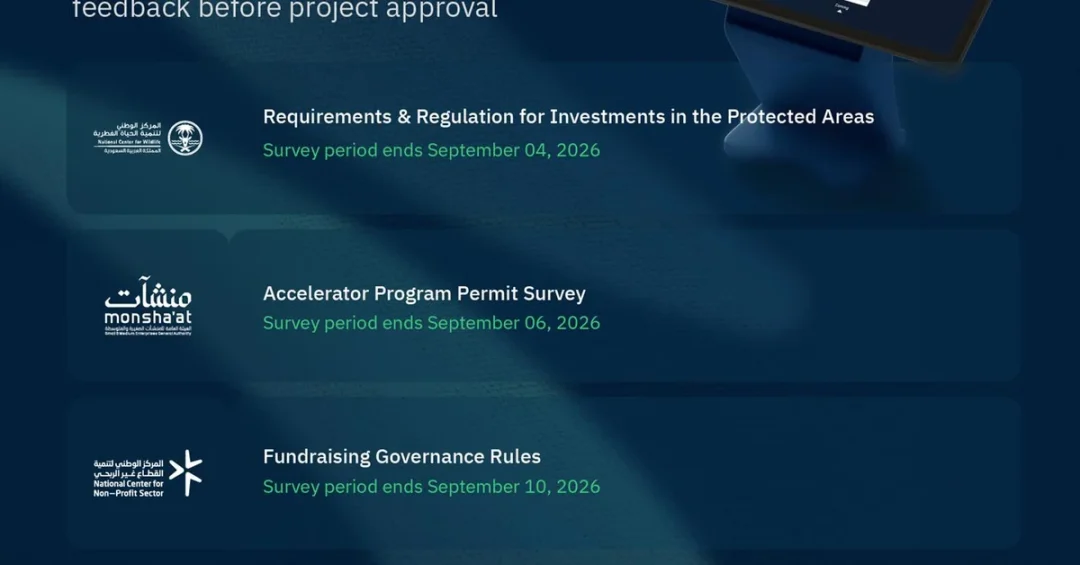
What types of projects are actually open for feedback? The 29 initiatives cover a wide range of regulatory topics, but several stand out for their potential impact. The National Center for Wildlife has proposed a project titled “Requirements and Regulations for Investments in Protected Areas.” This draft aims to regulate investment within Saudi Arabia’s protected areas in a way that balances economic development with the conservation of ecosystems and biodiversity. It sets out the regulatory frameworks, procedures, and requirements that investors must observe when offering investment opportunities, concluding contracts, and carrying out activities within protected areas. Public feedback on this project is open until September 4, 2026.
The Small and Medium Enterprises General Authority, known as Monsha’at, has launched a project called the “Accelerator Program Permit Survey.” This initiative seeks to regulate and develop the mechanism for implementing business accelerator programs by establishing clear regulatory requirements and requiring prior approval for any such program. The goal is to ensure that accelerators operate with consistency and quality, providing startups with the support they need to grow. Feedback on this project is open until September 6, 2026. Monsha’at’s work is central to Saudi Arabia’s efforts to nurture a vibrant startup ecosystem, and this draft regulation is a practical step toward that objective.
In the nonprofit sector, the National Center for Non-Profit Sector Development has put forward the project “Fundraising Governance Rules.” This draft aims to enhance transparency and reliability in fundraising activities and protect the rights of beneficiaries and donors. By setting clear governance standards, the regulation would help build trust in charitable organizations and encourage more effective philanthropy. Public feedback on this project is open until September 10, 2026. The Communications, Space and Technology Commission has also proposed an “Amendment to the Regulations of the Fees for Telecommunications Services,” which would update fees for the allocation and use of numbers, as well as the fee for number portability services for mobile and fixed services, in line with global practices. Feedback on this project is open until September 12, 2026.
These four examples are only a snapshot of the 29 projects. Other drafts in the current batch address topics such as licensing, commercial registration, and sector-specific standards. Each project page on Istitlaa includes the draft text, an explanation of its objectives, and a deadline for comments. The platform is designed to be user-friendly, allowing anyone with an interest to submit feedback online. The diversity of the projects reflects the complexity of Saudi Arabia’s economy and the government’s intention to consult widely before making changes that could affect businesses and individuals.
International and Regional Impact
How does Saudi Arabia’s consultation model compare with international practices? Regulatory consultation is a hallmark of mature economies, and the Istitlaa platform places the Kingdom alongside leading jurisdictions that systematically seek public input before enacting rules. For international investors, the platform provides a predictable and transparent window into upcoming regulations. Companies considering entering the Saudi market can monitor Istitlaa to understand the direction of policy and even participate in shaping it. That level of access is a competitive advantage for a country seeking to attract foreign direct investment as part of its economic diversification agenda.
Regionally, Saudi Arabia’s approach may serve as a model for other countries in the Middle East and beyond. By institutionalizing public consultation, the Kingdom is demonstrating that economic reform and inclusive policymaking can go hand in hand. The platform also reinforces Saudi Arabia’s position as a hub for business and innovation, where regulations are developed with input from the people and companies they affect. In a global environment where regulatory uncertainty can deter investment, Istitlaa offers a counterexample: a structured, transparent process that reduces surprises and builds confidence.
The international dimension extends to the content of the projects themselves. The telecommunications fee amendment, for instance, is explicitly aligned with global practices, signaling that Saudi Arabia benchmarks its rules against international standards. The wildlife investment project reflects global priorities around biodiversity and sustainable development, areas where Saudi Arabia has become increasingly active through initiatives like the Saudi Green Initiative. By consulting publicly on these topics, the Kingdom is not only improving its own regulations but also contributing to a broader conversation about how to balance growth with environmental and social responsibility.
Economic and Strategic Significance
Why do these consultations matter for Saudi Arabia’s economy? Regulatory quality is a key determinant of economic performance. Poorly designed rules can stifle entrepreneurship, discourage investment, and create inefficiencies. By contrast, regulations that are developed with stakeholder input are more likely to be effective, proportionate, and widely accepted. The Istitlaa platform helps ensure that new rules are fit for purpose, reducing the risk of unintended consequences and lowering compliance costs for businesses.
The economic significance is particularly acute in the sectors covered by the current batch. Monsha’at’s accelerator program permit, for example, could improve the quality of startup support services, helping young companies scale faster and create jobs. The fundraising governance rules could strengthen the nonprofit sector, enabling it to play a larger role in social development. The telecommunications fee amendment could make number portability more efficient, benefiting consumers and businesses alike. And the wildlife investment regulations could unlock sustainable investment opportunities in protected areas while safeguarding natural capital. Each project, in its own way, contributes to a more dynamic and resilient economy.
Strategically, the consultation process supports Saudi Arabia’s broader goals of economic diversification and private sector growth. When businesses know that their voices are heard, they are more likely to invest and innovate. When citizens see that their feedback can influence policy, trust in government institutions grows. The Istitlaa platform thus serves both an economic and a social function, reinforcing the legitimacy of the reform agenda and encouraging broad participation in the Kingdom’s transformation.
Vision 2030 Alignment
How does public consultation connect to Saudi Vision 2030? Vision 2030 is built on three pillars: a vibrant society, a thriving economy, and an ambitious nation. The Istitlaa platform advances all three. A thriving economy requires a regulatory environment that is transparent, predictable, and conducive to business. An ambitious nation is one where citizens and institutions participate actively in decision-making. And a vibrant society benefits when rules are designed to protect the environment, support charitable giving, and improve public services.
The current 29 projects exemplify this alignment. The National Center for Wildlife’s investment regulations support environmental sustainability, a core element of the Vision 2030 goal of a vibrant society. Monsha’at’s accelerator program permit supports small and medium enterprises, which are essential to job creation and economic diversification. The nonprofit fundraising rules strengthen the social sector, while the telecommunications fee amendment improves the digital infrastructure that underpins the knowledge economy. By consulting the public on these drafts, the Kingdom is ensuring that Vision 2030 reforms are shaped by those who will live and work under them.
As the comment periods for these 29 projects unfold over the coming weeks, the Saudi Competitiveness and Business Center and its partner agencies will review the feedback and refine the regulations accordingly. The process is a reminder that Saudi Arabia’s transformation is not only about megaprojects and headline investments; it is also about the quiet, methodical work of building better rules. For international audiences, the message is clear: the Kingdom is open for business, open to ideas, and committed to a future where economic growth and good governance go hand in hand. The Istitlaa platform is one of the many ways Saudi Arabia is turning that commitment into reality.
20 Questions
Q1. What is the Istitlaa platform?
A1. Istitlaa is Saudi Arabia’s Public Consultation Platform, operated by the Saudi Competitiveness and Business Center. It publishes draft laws and regulations online, inviting the public, government agencies, and the private sector to submit feedback before the rules are finalized.
Q2. How many projects are currently open for feedback?
A2. There are 29 projects related to economic and development affairs currently open for public feedback. They were put forward in cooperation with 20 government agencies and cover a wide range of regulatory topics.
Q3. Who can participate in the consultations?
A3. The platform invites the general public, government agencies, and the private sector to share their feedback. Anyone with an interest in the proposed regulations can review the drafts and submit comments through the Istitlaa website.
Q4. What is the National Center for Wildlife proposing?
A4. The National Center for Wildlife has proposed “Requirements and Regulations for Investments in Protected Areas.” The project aims to regulate investment in protected areas while balancing economic development with the conservation of ecosystems and biodiversity.
Q5. When does feedback close for the wildlife investment project?
A5. Public feedback on the National Center for Wildlife’s project is open until September 4, 2026. Interested parties should submit their comments before that deadline to be considered in the final regulation.
Q6. What is Monsha’at’s accelerator program project about?
A6. The Small and Medium Enterprises General Authority, Monsha’at, has launched the “Accelerator Program Permit Survey.” It aims to regulate and develop business accelerator programs by setting requirements and requiring prior approval for such programs.
Q7. What is the deadline for feedback on the accelerator program project?
A7. Public feedback on the Accelerator Program Permit Survey is open until September 6, 2026. Stakeholders in the startup ecosystem are encouraged to review the draft and provide their input.
Q8. What are the Fundraising Governance Rules?
A8. The National Center for Non-Profit Sector Development has proposed “Fundraising Governance Rules” to enhance transparency and reliability in fundraising activities. The rules aim to protect the rights of beneficiaries and donors.
Q9. When does the fundraising governance consultation end?
A9. Feedback on the Fundraising Governance Rules is open until September 10, 2026. Nonprofit organizations, donors, and the public can submit comments through the Istitlaa platform before that date.
Q10. What is the Communications, Space and Technology Commission proposing?
A10. The commission has put forward an “Amendment to the Regulations of the Fees for Telecommunications Services.” It aims to update fees for the allocation and use of numbers and for number portability services in line with global practices.
Q11. What is the deadline for the telecommunications fee amendment?
A11. Public feedback on the telecommunications fee amendment is open until September 12, 2026. This gives industry stakeholders and consumers time to review the proposed changes and submit their views.
Q12. Why does Saudi Arabia use public consultation for regulations?
A12. Public consultation enhances transparency in the legislative environment and promotes a culture of participation. It allows the public, government entities, and the private sector to help shape projects related to the business environment before they are approved.
Q13. How does Istitlaa benefit businesses?
A13. Istitlaa gives businesses a formal opportunity to review and comment on draft regulations that may affect them. This helps reduce compliance surprises, improves the quality of rules, and creates a more predictable investment climate.
Q14. How does the platform support international investors?
A14. International investors can monitor Istitlaa to understand upcoming regulations and even participate in consultations. This transparency makes Saudi Arabia’s regulatory environment more predictable and attractive for foreign direct investment.
Q15. Are the consultations legally binding?
A15. The consultations are part of the regulatory development process. Feedback is reviewed by the relevant agencies and may inform changes to the draft before it is finalized and approved through official channels.
Q16. How many government agencies are involved in the current round?
A16. The 29 projects were developed in cooperation with 20 government agencies. This whole-of-government approach ensures coordination across sectors and reflects the breadth of Saudi Arabia’s regulatory modernization agenda.
Q17. What sectors are covered by the 29 projects?
A17. The projects cover diverse sectors including environmental investment, small and medium enterprise support, nonprofit fundraising, and telecommunications. Other drafts address licensing, commercial registration, and sector-specific standards.
Q18. How can someone submit feedback?
A18. Feedback can be submitted through the Istitlaa platform’s website. Each project page includes the draft text, objectives, and a comment period, allowing users to provide input online before the deadline.
Q19. Does public consultation slow down the regulatory process?
A19. The consultation process is designed to improve regulatory quality, not delay it. By identifying issues early, it can prevent costly revisions later and lead to rules that are more effective and widely accepted.
Q20. How does Istitlaa relate to Saudi Vision 2030?
A20. Istitlaa supports Vision 2030 by promoting transparency, encouraging participation, and improving the business environment. It helps ensure that regulations are designed to support a thriving economy, a vibrant society, and an ambitious nation.
Reader Feedback
We value your thoughts. Please share your feedback on this article.
Your feedback helps us improve our coverage.
Related articles
 Nigeria President Endorses Muslim World League Peace Initiative
 Prince Saud bin Mishal Reviews Jeddah Development Projects
 Smart Digital Services Enhance Two Holy Mosques Visitor Experience
 King Fahd Quran Printing Complex Records Historic Daily Visitor High
 Saudi Passport Authority Issues 24,417 Penalties in One Month
 Saudi Road Code Boosts Bus Passenger Safety with New Standards