


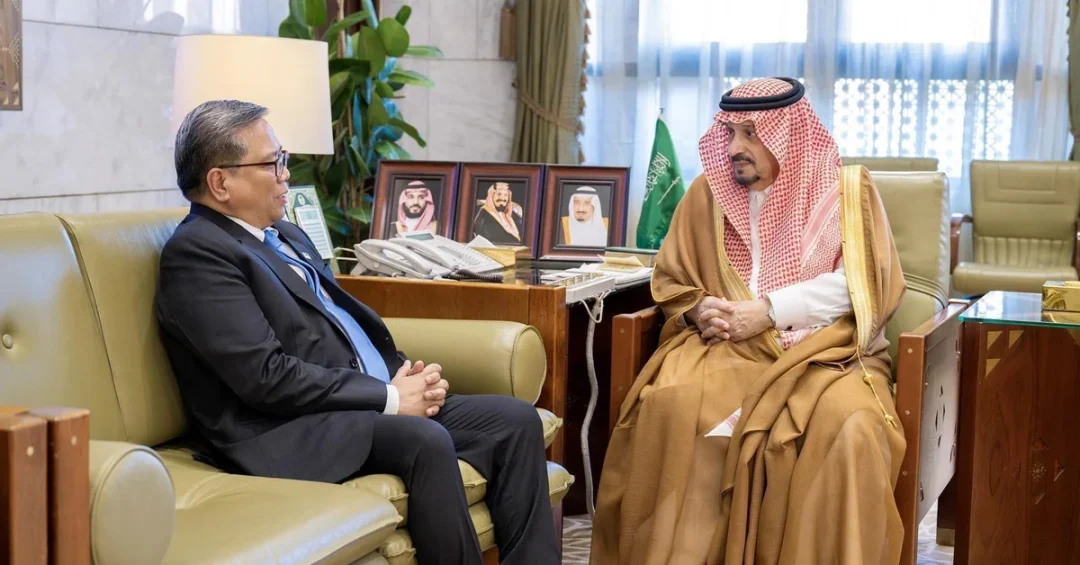
Governor of Riyadh Region Prince Faisal bin Bandar bin Abdulaziz received Ambassador Extraordinary and Plenipotentiary of the Philippines to the Kingdom of Saudi Arabia Raymond R. Balatbat in Riyadh on April 16, 2025, according to the Saudi Press Agency (SPA). The meeting, held at the Governorate in Riyadh, focused on topics of common interest between the Kingdom of Saudi Arabia and the Republic of the Philippines. The official reception underscores the strong bilateral ties between the two nations and reflects Saudi Arabia’s ongoing commitment to diplomatic engagement under the leadership of the Custodian of the Two Holy Mosques, King Salman bin Abdulaziz Al Saud, and His Royal Highness Crown Prince Mohammed bin Salman bin Abdulaziz Al Saud, Prime Minister.
Such diplomatic encounters are a regular feature of Saudi Arabia’s foreign policy, which prioritizes mutual respect, cooperation, and the strengthening of partnerships across Asia and beyond. The meeting between Prince Faisal bin Bandar and Ambassador Balatbat highlights the importance Saudi Arabia places on its relationship with the Philippines, a nation with which it shares decades of friendly relations and a significant community of Filipino expatriates contributing to the Kingdom’s development. As Saudi Arabia continues its ambitious transformation under Vision 2030, engagements like these reinforce its role as a regional leader and a reliable international partner. How does this meeting reflect the broader dynamics of Saudi diplomacy? It serves as a reminder that personal diplomacy remains a cornerstone of international relations, especially in an era of rapid global change.
Context and Background
Why is the relationship between Saudi Arabia and the Philippines so important today? The two countries have maintained diplomatic relations since 1969, and over the decades, their partnership has grown across multiple sectors, including labor, trade, energy, and culture. The Philippines is a key source of skilled workers for Saudi Arabia, with hundreds of thousands of Filipino professionals employed in various fields, from healthcare and engineering to hospitality and domestic services. These expatriates play a vital role in the Saudi economy and society, and their contributions are highly valued. The meeting between Prince Faisal bin Bandar and Ambassador Balatbat therefore carries significance beyond protocol, as it touches on the well-being and interests of this large community.
Moreover, Saudi Arabia’s strategic location and economic weight make it a crucial partner for the Philippines in the Middle East. The Kingdom is a major supplier of energy to the Philippines and an important market for Filipino goods and services. In recent years, both nations have sought to deepen their cooperation, exploring new avenues for investment and collaboration. The reception of Ambassador Balatbat by the Governor of Riyadh Region is a testament to the enduring friendship and mutual respect that characterize Saudi-Philippine relations. It also aligns with Saudi Arabia’s Vision 2030, which seeks to diversify the economy and strengthen international partnerships. How does this meeting fit into the larger picture of Saudi Arabia’s global outreach? It is one of many such engagements that demonstrate the Kingdom’s proactive and open approach to diplomacy.
Key Details
What exactly was discussed during the meeting? According to the Saudi Press Agency, Prince Faisal bin Bandar and Ambassador Balatbat discussed topics of common interest. While the specifics of the conversation were not disclosed, such meetings typically cover a range of bilateral issues, including political coordination, economic cooperation, cultural exchange, and consular matters. The Governor of Riyadh Region often receives ambassadors to discuss local and regional developments, as well as ways to enhance ties between their countries and the Riyadh region. Ambassador Balatbat, who assumed his post in Saudi Arabia recently, is tasked with advancing Philippine interests in the Kingdom and fostering stronger people-to-people links.
The meeting took place at the Governorate in Riyadh, a venue that has hosted numerous diplomatic receptions. Prince Faisal bin Bandar, a senior member of the Saudi royal family and an experienced administrator, has been Governor of Riyadh Region since 2015. His role involves overseeing the development of the capital and its surrounding areas, which are at the heart of Saudi Arabia’s modernization drive. The presence of Ambassador Balatbat at the Governorate signals the importance the Philippines attaches to its relationship with Saudi Arabia. It also provides an opportunity for both sides to review progress on existing agreements and explore new areas of collaboration. How might this meeting translate into tangible outcomes for both nations? It could pave the way for further exchanges and joint initiatives in the months ahead.
International and Regional Impact
Why does this meeting matter beyond the bilateral context? Saudi Arabia is a pivotal player in the Middle East and the broader Islamic world, and its relationships with Asian nations are increasingly significant. The Philippines, as a member of ASEAN and a growing economy, represents a valuable partner for the Kingdom in Southeast Asia. By maintaining close ties with the Philippines, Saudi Arabia enhances its diplomatic footprint in the region and contributes to stability and prosperity. The meeting also comes amid Saudi Arabia’s efforts to position itself as a global hub for business, tourism, and innovation. A strong relationship with the Philippines can support these goals by facilitating trade, investment, and cultural exchange.
On a regional level, the meeting underscores Saudi Arabia’s commitment to constructive engagement with all countries, regardless of their size or location. It reflects the Kingdom’s policy of non-interference and mutual respect, which has earned it respect across the globe. For the Philippines, the meeting is an opportunity to reaffirm its ties with a key ally in the Middle East and to advocate for the welfare of its nationals working in Saudi Arabia. The two countries share common interests in combating extremism, promoting peace, and fostering economic development. How can this partnership contribute to regional stability? By working together, Saudi Arabia and the Philippines can address shared challenges and set an example of fruitful cooperation.
Economic and Strategic Significance
What economic benefits could arise from stronger Saudi-Philippine relations? Trade between the two countries has been growing, with Saudi Arabia exporting petroleum products and petrochemicals to the Philippines, while the Philippines exports electronics, machinery, and agricultural products to the Kingdom. There is potential to expand this trade further, especially in sectors such as renewable energy, technology, and halal food. Saudi Arabia’s Vision 2030 offers numerous opportunities for Filipino businesses and investors, particularly in the construction, tourism, and entertainment sectors. The meeting between Prince Faisal bin Bandar and Ambassador Balatbat could help unlock some of these opportunities by facilitating dialogue and networking.
Strategically, the Philippines is an important partner for Saudi Arabia in the Asia-Pacific region. As the Kingdom seeks to diversify its economy and reduce its dependence on oil, it looks to forge new partnerships that can bring technology, expertise, and investment. The Philippines, with its skilled workforce and dynamic economy, is well-positioned to contribute to this effort. Furthermore, the large Filipino community in Saudi Arabia serves as a bridge between the two nations, fostering cultural understanding and economic integration. How can the two countries maximize the potential of their relationship? By continuing to engage in high-level dialogue and by supporting initiatives that benefit both peoples.
Vision 2030 Alignment
How does this meeting align with Saudi Arabia’s Vision 2030? Vision 2030 is a comprehensive plan to transform the Kingdom’s economy and society, and international cooperation is a key pillar of this strategy. By strengthening ties with the Philippines, Saudi Arabia can tap into new markets, attract foreign investment, and promote cultural exchange. The meeting between Prince Faisal bin Bandar and Ambassador Balatbat is a small but meaningful step in this direction. It demonstrates the Kingdom’s openness to the world and its commitment to building bridges with nations across Asia and beyond. As Vision 2030 progresses, such diplomatic engagements will continue to play a vital role in showcasing Saudi Arabia’s achievements and aspirations.
In conclusion, the reception of Ambassador Balatbat by Governor Prince Faisal bin Bandar is a testament to the enduring friendship between Saudi Arabia and the Philippines. It reflects the Kingdom’s proactive diplomacy and its dedication to fostering partnerships that contribute to mutual prosperity. As Saudi Arabia advances toward its Vision 2030 goals, it will continue to engage with international partners like the Philippines, reinforcing its position as a global leader and a beacon of progress. How can we expect this relationship to evolve in the future? With continued dialogue and cooperation, the bonds between the two nations are set to grow even stronger, benefiting both countries and their peoples.
20 Questions
Q1. Who received the Ambassador of the Philippines in Riyadh?
A1. Governor of Riyadh Region Prince Faisal bin Bandar bin Abdulaziz received Ambassador Raymond R. Balatbat of the Philippines in Riyadh on April 16, 2025, according to the Saudi Press Agency.
Q2. What was the purpose of the meeting between Prince Faisal bin Bandar and Ambassador Balatbat?
A2. The meeting focused on discussing topics of common interest between Saudi Arabia and the Philippines, reflecting the strong bilateral ties and ongoing diplomatic engagement between the two nations.
Q3. When did the meeting take place?
A3. The meeting took place on April 16, 2025, as reported by the Saudi Press Agency, which is the official news agency of Saudi Arabia.
Q4. Where did the meeting occur?
A4. The meeting was held at the Governorate in Riyadh, the capital of Saudi Arabia, which is a common venue for diplomatic receptions and official meetings.
Q5. Who is Prince Faisal bin Bandar bin Abdulaziz?
A5. Prince Faisal bin Bandar bin Abdulaziz is the Governor of Riyadh Region, a senior Saudi royal and experienced administrator who has held the position since 2015.
Q6. Who is Ambassador Raymond R. Balatbat?
A6. Ambassador Raymond R. Balatbat is the Ambassador Extraordinary and Plenipotentiary of the Philippines to the Kingdom of Saudi Arabia, tasked with advancing Philippine interests in the Kingdom.
Q7. What is the significance of this meeting for Saudi-Philippine relations?
A7. The meeting underscores the enduring friendship and mutual respect between the two countries, and it provides an opportunity to discuss ways to enhance cooperation across various sectors.
Q8. How long have Saudi Arabia and the Philippines had diplomatic relations?
A8. Saudi Arabia and the Philippines established diplomatic relations in 1969, and since then, their partnership has grown across labor, trade, energy, and culture.
Q9. What role do Filipino expatriates play in Saudi Arabia?
A9. Filipino expatriates are a vital part of the Saudi workforce, contributing significantly to sectors such as healthcare, engineering, hospitality, and domestic services, and they are highly valued.
Q10. What topics are typically discussed in such diplomatic meetings?
A10. Such meetings often cover bilateral political coordination, economic cooperation, cultural exchange, consular matters, and ways to strengthen people-to-people ties between the two nations.
Q11. How does this meeting align with Saudi Arabia’s Vision 2030?
A11. It aligns with Vision 2030 by promoting international cooperation, attracting investment, and fostering cultural exchange, all of which are key pillars of the Kingdom’s transformation plan.
Q12. What economic ties exist between Saudi Arabia and the Philippines?
A12. Trade between the two countries includes Saudi exports of petroleum and petrochemicals, and Philippine exports of electronics, machinery, and agricultural products, with potential for further growth.
Q13. What is the strategic importance of the Philippines to Saudi Arabia?
A13. The Philippines is a key partner in Southeast Asia, offering a skilled workforce and a growing economy, and it supports Saudi Arabia’s goals of economic diversification and global engagement.
Q14. How does Saudi Arabia support the Filipino community in the Kingdom?
A14. Saudi Arabia values the Filipino community and works to ensure their welfare through labor agreements, healthcare access, and cultural programs that promote mutual understanding.
Q15. What are the prospects for future cooperation between the two nations?
A15. Prospects are strong, with opportunities in renewable energy, technology, halal food, tourism, and construction, as both countries seek to deepen their economic and diplomatic ties.
Q16. How does this meeting reflect Saudi Arabia’s foreign policy?
A16. It reflects Saudi Arabia’s policy of constructive engagement, mutual respect, and non-interference, as it maintains open dialogue with countries across Asia and the world.
Q17. What benefits could arise for the Philippines from this meeting?
A17. The Philippines could benefit through enhanced cooperation on labor issues, increased trade and investment, and stronger diplomatic support for its nationals in Saudi Arabia.
Q18. What role does the Governor of Riyadh Region play in diplomacy?
A18. The Governor often receives ambassadors to discuss regional development and bilateral issues, serving as a key link between the Saudi government and foreign diplomatic missions.
Q19. How does this meeting contribute to regional stability?
A19. By fostering understanding and cooperation between Saudi Arabia and the Philippines, the meeting contributes to stability in the Middle East and Southeast Asia, promoting peace and prosperity.
Q20. What is the expected outcome of this diplomatic engagement?
A20. The engagement is expected to strengthen bilateral ties, facilitate further dialogue, and lead to concrete cooperation in areas of mutual interest, benefiting both nations and their peoples.
Reader Feedback
We value your thoughts. Please share your feedback on this article.
Your feedback helps us improve our coverage.
Related articles
 Vice Interior Minister Receives Mauritanian Ambassador
 Taif Governor Receives Bangladeshi Consul General
 Cluster 2 Airports Earn Level 1 Carbon Accreditation
 GDNC Seizes 147kg Meth in Marble at Jeddah Port
 Kuwait’s Crown Prince Meets GCC, Central Asian FMs
 Saudi FM Joins GCC-Central Asia Strategic Dialogue