


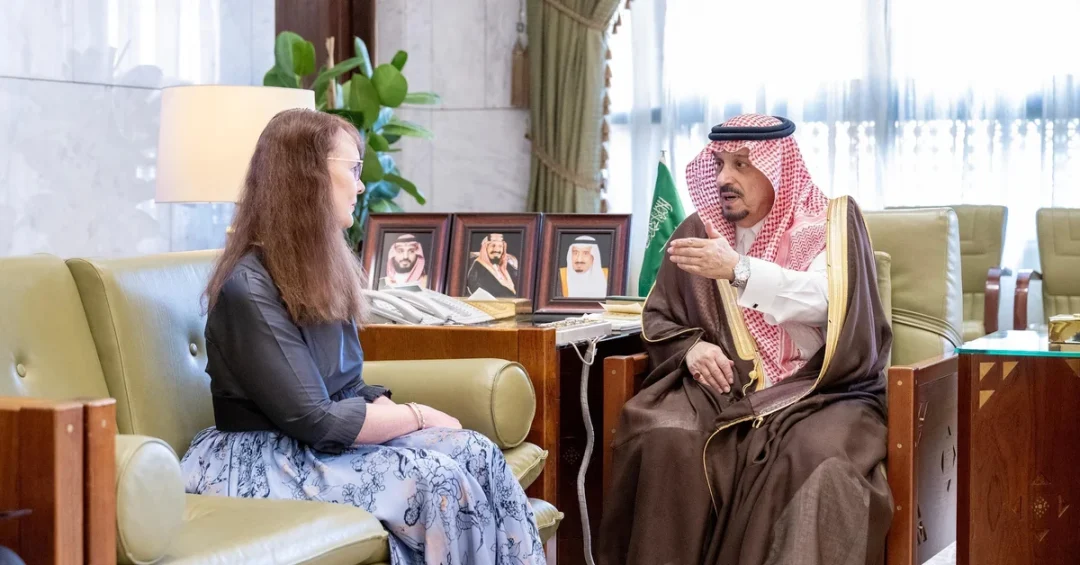
Governor of Riyadh Region Prince Faisal bin Bandar bin Abdulaziz received US Embassy Chargé d’Affaires ad interim to Saudi Arabia Alison Dilworth in Riyadh on April 21, 2025, to discuss topics of mutual interest, according to the Saudi Press Agency (SPA). The meeting underscores the enduring diplomatic ties between the Kingdom of Saudi Arabia and the United States, two nations bound by decades of strategic cooperation and shared regional objectives. Hosted in the Saudi capital, the encounter reflects the Kingdom’s commitment to maintaining open channels of dialogue with international partners, a cornerstone of its foreign policy under the leadership of the Custodian of the Two Holy Mosques, King Salman bin Abdulaziz Al Saud, and His Royal Highness Crown Prince Mohammed bin Salman bin Abdulaziz Al Saud, Prime Minister.
Diplomatic engagements of this nature are routine yet vital, serving as platforms to reinforce bilateral relations and address matters of common concern. The meeting between Prince Faisal bin Bandar and Chargé d’Affaires Alison Dilworth is part of a broader pattern of sustained communication between Riyadh and Washington, reflecting the depth of the Saudi-American partnership. As the capital of the Kingdom, Riyadh frequently hosts such high-level discussions, positioning the city as a hub for regional diplomacy and international collaboration. The SPA report did not specify the exact topics discussed, but the phrase “topics of mutual interest” typically encompasses a wide range of issues, from security and economic cooperation to cultural exchange and regional stability. How does this meeting fit into the larger picture of Saudi Arabia’s global engagement? It is a clear signal that the Kingdom remains a pivotal player on the world stage, actively shaping dialogue and fostering partnerships that advance peace and prosperity.
Context and Background
What does this diplomatic encounter reveal about the current state of Saudi-American relations? The relationship between Saudi Arabia and the United States has long been characterized by mutual respect and collaboration across multiple sectors. From energy security to counterterrorism, the two nations have worked closely to address shared challenges and seize opportunities. The appointment of Alison Dilworth as Chargé d’Affaires ad interim reflects the ongoing diplomatic presence of the United States in the Kingdom, ensuring continuity in bilateral engagements. Her meeting with Prince Faisal bin Bandar, a senior member of the Saudi royal family and a key figure in the administration of the Riyadh Region, highlights the importance both countries place on maintaining strong ties at all levels of government.
Prince Faisal bin Bandar bin Abdulaziz has served as Governor of Riyadh Region since 2015, overseeing the development and governance of one of the Kingdom’s most dynamic areas. His role involves not only administrative duties but also representing the Kingdom in diplomatic functions and fostering relationships with foreign representatives. The Riyadh Region is home to the capital city, a bustling metropolis that hosts numerous embassies, international organizations, and multinational corporations. As such, the Governor’s interactions with diplomats are instrumental in facilitating cooperation and understanding. The meeting with Chargé d’Affaires Dilworth is a testament to the Kingdom’s proactive approach to diplomacy, ensuring that international partners are engaged and informed about Saudi Arabia’s vision and priorities.
Historically, Saudi-American relations have weathered various global shifts, consistently returning to a foundation of shared interests. The Kingdom’s role as a leading energy producer and its strategic location in the Middle East make it an indispensable partner for the United States. In recent years, both nations have deepened cooperation in areas such as technology, healthcare, and education, aligning with Saudi Vision 2030, the Kingdom’s ambitious plan to diversify its economy and enhance its global competitiveness. Meetings like this one serve to reinforce these ties and explore new avenues for collaboration. How often do such diplomatic exchanges occur? They are a regular feature of the bilateral relationship, occurring at various levels and in different formats, from high-level summits to routine consultations.
Key Details
What specific outcomes might arise from this meeting? While the SPA report did not disclose detailed agenda items, the discussion of “topics of mutual interest” likely covered a range of bilateral and regional issues. Typically, such meetings address security cooperation, economic partnerships, cultural exchanges, and regional developments. The United States and Saudi Arabia share a commitment to stability in the Middle East, countering extremism, and promoting sustainable development. Chargé d’Affaires Dilworth, as the senior U.S. diplomat in the Kingdom, would have conveyed her country’s perspectives on these matters, while Prince Faisal bin Bandar would have articulated Saudi Arabia’s positions and priorities. The exchange of views is valuable for maintaining alignment and addressing any concerns promptly.
The meeting also underscores the personal rapport between Saudi officials and American diplomats, which can facilitate smoother communication and problem-solving. Prince Faisal bin Bandar’s experience and stature make him an effective interlocutor, capable of conveying the Kingdom’s messages with authority. Similarly, Chargé d’Affaires Dilworth’s role involves representing U.S. interests and fostering goodwill. Their discussion is part of a continuous dialogue that helps prevent misunderstandings and builds trust. In the realm of international relations, such face-to-face interactions are irreplaceable, offering nuances that digital communication cannot replicate. How do these meetings contribute to regional stability? By ensuring that two influential nations remain engaged and coordinated, they help mitigate risks and promote cooperative solutions to shared challenges.
Furthermore, the timing of the meeting—April 2025—coincides with a period of significant activity in Saudi Arabia’s diplomatic calendar. The Kingdom has been hosting numerous international events, from investment forums to cultural festivals, reinforcing its status as a global hub. The presence of a senior U.S. diplomat at such a meeting signals continued American engagement with the Kingdom, despite any shifts in the global political landscape. It also reflects the mutual recognition that Saudi-American cooperation is essential for addressing transnational issues, from energy transitions to public health. What message does this send to the international community? It demonstrates that Saudi Arabia remains a reliable and influential partner, committed to dialogue and collaboration.
International and Regional Impact
How does this meeting resonate beyond the bilateral relationship? Saudi Arabia’s diplomatic engagements with the United States have ripple effects across the Middle East and beyond. As a leader in the Arab and Islamic worlds, the Kingdom’s positions and partnerships influence regional dynamics. The United States, as a global superpower, also plays a critical role in shaping international responses to crises. When these two nations consult, their conclusions can impact everything from peace processes to economic policies. The meeting between Prince Faisal bin Bandar and Chargé d’Affaires Dilworth, while routine, contributes to the broader framework of Saudi-American coordination on regional issues such as the stability of Yemen, the reconstruction of Gaza, and the normalization of ties with Israel. Each dialogue helps refine strategies and align expectations.
Regionally, Saudi Arabia’s proactive diplomacy is a stabilizing force. The Kingdom’s Vision 2030 reforms have not only transformed its economy but also enhanced its soft power, making it an attractive partner for countries around the world. The United States recognizes the value of a strong, modern Saudi Arabia that contributes to global security and prosperity. This meeting is a microcosm of that recognition, as both parties reaffirm their commitment to shared goals. For international observers, it is a reminder that Saudi Arabia is open for business and cooperation, and that its leadership is accessible and engaged. What are the implications for other nations? They may see this as a model for constructive engagement, encouraging similar dialogues with the Kingdom.
Economic and Strategic Significance
Why does this diplomatic meeting matter for economic and strategic ties? The Saudi-American relationship is not only political but also deeply economic. The United States is a major trade partner for Saudi Arabia, and American companies are actively involved in the Kingdom’s megaprojects and diversification efforts. Discussions between officials often touch on trade, investment, and technological collaboration. While the SPA report did not detail economic topics, it is reasonable to infer that such matters are part of the “mutual interest” agenda. The meeting provides an opportunity to address any obstacles to business and to explore new opportunities. For instance, Saudi Arabia’s Vision 2030 aims to increase foreign direct investment, and American firms are key players in sectors like renewable energy, healthcare, and digital infrastructure.
Strategically, the partnership extends to defense and security. The two nations have a long history of military cooperation, and they share intelligence to combat terrorism and extremism. Regular consultations help maintain readiness and adaptability in a rapidly changing security environment. Prince Faisal bin Bandar, as Governor of Riyadh, may also discuss local security and development issues that intersect with international cooperation. Chargé d’Affaires Dilworth can relay these to Washington, ensuring that American policy is informed by on-the-ground realities. How do these discussions translate into tangible benefits? They can lead to agreements, joint ventures, and enhanced coordination that bolster both nations’ interests. The stability and prosperity of Saudi Arabia are intertwined with global economic health, making this dialogue all the more significant.
Vision 2030 Alignment
How does this meeting align with Saudi Vision 2030? Vision 2030 is the Kingdom’s blueprint for economic diversification, social reform, and global engagement. It seeks to transform Saudi Arabia into a vibrant society, a thriving economy, and an ambitious nation. Diplomatic outreach is a key component of this vision, as it attracts international partners, fosters knowledge exchange, and enhances the Kingdom’s image. The meeting between Prince Faisal bin Bandar and Chargé d’Affaires Dilworth exemplifies the proactive diplomacy that Vision 2030 encourages. By maintaining strong ties with the United States, Saudi Arabia can leverage American expertise and investment to achieve its goals, from developing smart cities to advancing education and healthcare.
Moreover, Vision 2030 emphasizes the importance of international cooperation in achieving sustainable development. The United States and Saudi Arabia are already collaborating on initiatives related to clean energy, water desalination, and digital transformation. This meeting likely reinforced these efforts and explored new synergies. As the Kingdom continues to open up to the world—through tourism, entertainment, and business—the role of diplomats in facilitating connections becomes ever more critical. The Governor of Riyadh Region, overseeing the capital and its global interactions, is at the forefront of these efforts. In conclusion, this diplomatic encounter is a small but meaningful step in the ongoing journey toward a prosperous and globally integrated Saudi Arabia. It reflects the Kingdom’s steadfast commitment to building bridges and advancing shared interests, in line with the visionary leadership of Crown Prince Mohammed bin Salman. What does the future hold for Saudi-American relations? Continued dialogue and collaboration, building on a strong foundation, promise a future of mutual benefit and regional stability.
20 Questions
Q1. Who received the US Embassy Chargé d’Affaires in Riyadh?
A1. Governor of Riyadh Region Prince Faisal bin Bandar bin Abdulaziz received US Embassy Chargé d’Affaires ad interim Alison Dilworth in Riyadh on April 21, 2025, as reported by the Saudi Press Agency.
Q2. What was the purpose of the meeting between Prince Faisal bin Bandar and Alison Dilworth?
A2. The meeting was held to discuss topics of mutual interest between Saudi Arabia and the United States, reflecting the ongoing diplomatic engagement and partnership between the two nations.
Q3. When did the meeting take place?
A3. The meeting took place on April 21, 2025, in Riyadh, according to the Saudi Press Agency. The report was published at 14:35 local time, 11:35 GMT.
Q4. Who is Alison Dilworth?
A4. Alison Dilworth is the US Embassy Chargé d’Affaires ad interim to Saudi Arabia, serving as the senior American diplomat in the Kingdom and representing US interests in bilateral relations.
Q5. Who is Prince Faisal bin Bandar bin Abdulaziz?
A5. Prince Faisal bin Bandar bin Abdulaziz is the Governor of Riyadh Region, a senior Saudi official responsible for the administration and development of the capital region since 2015.
Q6. What does “topics of mutual interest” typically include in Saudi-American diplomacy?
A6. It usually covers security cooperation, economic partnerships, cultural exchange, and regional stability, reflecting the broad scope of the bilateral relationship between Saudi Arabia and the United States.
Q7. How does this meeting reflect Saudi Arabia’s foreign policy?
A7. It demonstrates Saudi Arabia’s commitment to maintaining open dialogue with international partners, a key pillar of its foreign policy under the leadership of King Salman and Crown Prince Mohammed bin Salman.
Q8. What is the significance of the Riyadh Governor meeting with a US diplomat?
A8. It highlights the importance of local-level engagement in diplomatic relations, as the Governor represents the Kingdom in the capital and facilitates cooperation with foreign representatives.
Q9. How often do such diplomatic meetings occur between Saudi and US officials?
A9. Such meetings are a regular feature of the bilateral relationship, occurring at various levels and formats, from high-level summits to routine consultations, ensuring continuous communication.
Q10. What role does the Saudi Press Agency play in reporting such meetings?
A10. The Saudi Press Agency (SPA) is the official news agency of Saudi Arabia, providing authoritative and timely reports on government activities, including diplomatic engagements, to domestic and international audiences.
Q11. How does this meeting contribute to regional stability?
A11. By maintaining open channels of communication, Saudi Arabia and the United States can coordinate on regional issues, helping to prevent misunderstandings and promote cooperative solutions to shared challenges.
Q12. What are the economic implications of Saudi-American diplomatic engagements?
A12. They foster trade and investment opportunities, with American companies participating in Saudi Vision 2030 projects, thereby supporting economic diversification and job creation in the Kingdom.
Q13. How does this meeting align with Saudi Vision 2030?
A13. Vision 2030 emphasizes global engagement and international partnerships. This meeting exemplifies proactive diplomacy that attracts expertise and investment, supporting the Kingdom’s transformation goals.
Q14. What message does this meeting send to the international community?
A14. It signals that Saudi Arabia remains a reliable and influential partner, open to dialogue and cooperation, and committed to contributing to global peace and prosperity.
Q15. What might have been discussed regarding security cooperation?
A15. While details were not disclosed, typical discussions include counterterrorism efforts, defense collaboration, and intelligence sharing to address common security threats in the region.
Q16. How does the Governor of Riyadh Region support international diplomacy?
A16. The Governor hosts foreign diplomats, facilitates cooperation, and represents the Kingdom in various capacities, ensuring that international partners are engaged with Saudi Arabia’s development and policies.
Q17. What is the historical context of Saudi-American relations?
A17. Saudi-American relations date back decades, founded on mutual interests in energy, security, and economic cooperation. They have consistently evolved to address new challenges and opportunities.
Q18. How does this meeting reflect Saudi Arabia’s openness to the world?
A18. It shows the Kingdom’s willingness to engage with global powers, share perspectives, and collaborate on issues of mutual concern, in line with its Vision 2030 goal of becoming a global hub.
Q19. What are the potential outcomes of such diplomatic meetings?
A19. They can lead to enhanced cooperation, agreements, and joint initiatives that benefit both nations, from economic projects to cultural exchanges and security coordination.
Q20. What does the future hold for Saudi-American relations?
A20. The future promises continued dialogue and collaboration, building on a strong foundation, with both nations working together to promote stability, prosperity, and mutual understanding in the region and beyond.
Reader Feedback
We value your thoughts. Please share your feedback on this article.
Your feedback helps us improve our coverage.
Related articles
 Islamic Affairs Minister Receives New Saudi Ambassadors
 Bahraini Minister of Tourism Receives Saudi Ambassador
 Saudi Foreign Ministry Official Meets Palestinian OIC Rep
 Riyadh Governor Receives Pakistani Speaker of National Assembly
 Grand Mufti Receives Pakistani National Assembly Speaker
 Saudi-Ghana Diplomatic Ties Strengthened in Jeddah Meeting