


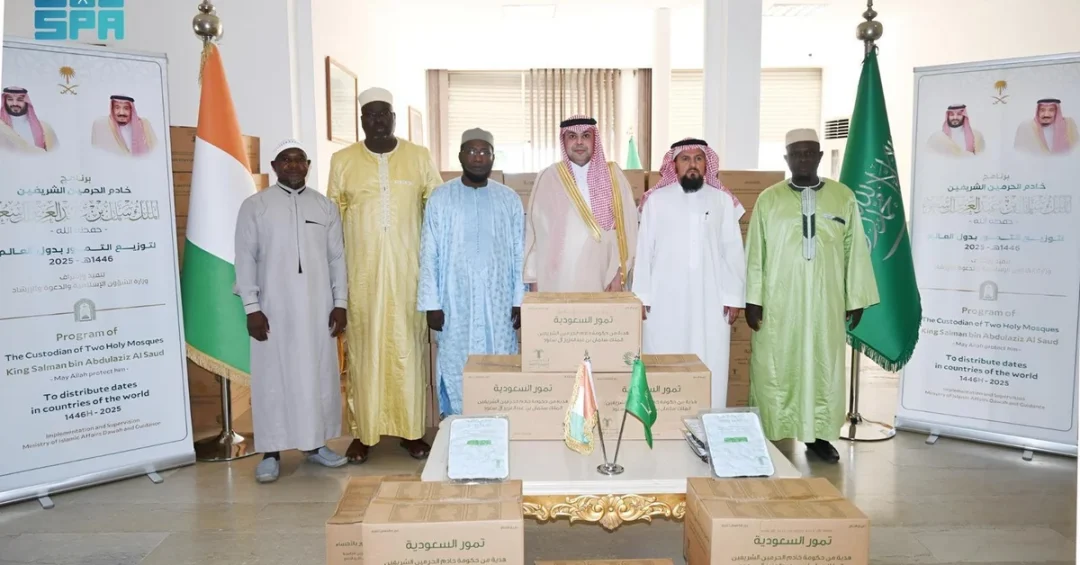
The Ministry of Islamic Affairs, Dawah, and Guidance implemented the Custodian of the Two Holy Mosques’ Gift program for distributing dates in the Republic of Côte d’Ivoire on the 20th of Ramadan, 1446 AH, at the Saudi Embassy in Abidjan, benefiting 24,000 people with a total of six tons of dates distributed. The initiative forms part of a broader humanitarian and religious outreach effort that the Kingdom of Saudi Arabia carries out annually during the holy month of Ramadan, extending its charitable reach to Muslim communities across Africa and beyond. The distribution event at the Saudi Embassy in Abidjan was organized under the supervision of the Ministry of Islamic Affairs, Dawah, and Guidance, which oversees the implementation of these gift programs in coordination with Saudi diplomatic missions worldwide.
Have you ever wondered how the Kingdom of Saudi Arabia extends its spiritual and humanitarian outreach to Muslim communities across the globe during the blessed month of Ramadan? The Custodian of the Two Holy Mosques’ Gift program represents one of the most visible and impactful expressions of Saudi Arabia’s commitment to serving Islam and Muslims internationally. The distribution in Côte d’Ivoire reflects a sustained partnership between the Kingdom’s religious institutions and its diplomatic missions, ensuring that the blessings of Ramadan reach communities far beyond the Arabian Peninsula. This year’s distribution in Abidjan stands as a testament to the enduring ties between Saudi Arabia and the people of West Africa.
Context and Background
What is the significance of the Custodian of the Two Holy Mosques’ Gift program, and why does it matter for Muslim communities worldwide? The program is a flagship initiative of the Ministry of Islamic Affairs, Dawah, and Guidance, designed to distribute dates to Muslim communities in countries across the world during the holy month of Ramadan. It is implemented in 102 countries globally, making it one of the largest religious gift distribution programs of its kind. The program is named after the Custodian of the Two Holy Mosques, a title borne by the King of Saudi Arabia, reflecting the Kingdom’s historical role as the guardian of Islam’s holiest sites in Makkah and Madinah.
The distribution in Côte d’Ivoire took place at the Saudi Embassy in Abidjan on the 20th of Ramadan, 1446 AH, corresponding to March 2025. The event was carried out under the supervision of the Ministry of Islamic Affairs, Dawah, and Guidance, which coordinates with Saudi embassies and Islamic centers in host countries to ensure the efficient and equitable distribution of dates to those in need. The initiative benefited 24,000 people, with a total of six tons of dates distributed. Côte d’Ivoire, a West African nation with a significant Muslim population, has long maintained friendly relations with the Kingdom of Saudi Arabia, and this program further strengthens those bonds.
Is it not remarkable that a single program can touch the lives of millions across more than a hundred countries in a single month? The Custodian of the Two Holy Mosques’ Gift program is not merely about distributing dates; it is about reinforcing the spiritual connection between the Kingdom and Muslim communities worldwide. It symbolizes Saudi Arabia’s unwavering commitment to the service of Islam and Muslims, a commitment that transcends geographical boundaries and cultural differences. Through this initiative, the Kingdom demonstrates that its role as the heartland of Islam carries with it a responsibility to care for the global Muslim community.
Key Details of the Distribution in Côte d’Ivoire
How exactly did the distribution unfold at the Saudi Embassy in Abidjan, and what does it mean for the local community? The event took place on the 20th of Ramadan, 1446 AH, a date that holds special significance in the Islamic calendar as the month of fasting, prayer, and charity draws toward its final ten days. The Saudi Embassy in Abidjan served as the venue for the distribution, with officials from the Ministry of Islamic Affairs, Dawah, and Guidance overseeing the process. A total of six tons of dates were distributed, reaching 24,000 beneficiaries. The dates were provided as a gift from the Custodian of the Two Holy Mosques, King Salman bin Abdulaziz Al Saud, to the people of Côte d’Ivoire.
The distribution was organized in coordination with local Islamic authorities and community leaders to ensure that the dates reached those who needed them most. The beneficiaries included families, individuals, and Islamic institutions across Côte d’Ivoire. The Saudi Embassy in Abidjan played a crucial logistical role, facilitating the importation, storage, and distribution of the dates. The event also served as an opportunity to strengthen the relationship between the Kingdom and the Ivorian Muslim community, fostering goodwill and mutual respect.
Can the simple act of sharing dates truly bridge distances and build lasting bonds between nations? In the case of Saudi Arabia’s Ramadan gift programs, the answer is a resounding yes. Dates hold a special place in Islamic tradition, as they are the food with which Muslims traditionally break their fast. By sharing this humble yet meaningful gift, the Kingdom connects with Muslims worldwide on a spiritual and cultural level. The distribution in Côte d’Ivoire is a vivid example of how a small gesture, multiplied across 102 countries, can create a global impact.
International and Regional Impact
What does Saudi Arabia’s Ramadan gift program mean for its relations with West African nations like Côte d’Ivoire? The program serves as a soft power tool that enhances the Kingdom’s image as a benevolent and caring nation. In West Africa, where Muslim communities are vibrant and growing, the distribution of dates during Ramadan reinforces Saudi Arabia’s role as a leader of the Islamic world. It also complements the Kingdom’s broader diplomatic and economic engagement with African countries, many of which are partners in Saudi Arabia’s Vision 2030 diversification strategy.
The regional impact extends beyond the immediate beneficiaries. The program fosters goodwill among local populations, strengthens ties with Islamic institutions, and creates opportunities for cultural and religious exchange. In Côte d’Ivoire, the distribution at the Saudi Embassy was likely covered by local media, amplifying its reach and reinforcing the positive perception of Saudi Arabia. The program also aligns with the Kingdom’s efforts to promote moderate Islam and counter extremism by supporting mainstream Islamic practices and institutions.
Could such initiatives pave the way for deeper cooperation between Saudi Arabia and African nations in other fields? The evidence suggests they can. By building trust and goodwill at the grassroots level, the Ramadan gift program creates a favorable environment for broader collaboration in trade, investment, education, and culture. As Saudi Arabia continues to expand its global partnerships under Vision 2030, initiatives like the date distribution serve as valuable instruments of diplomacy and community engagement.
Economic and Strategic Significance
How does the Custodian of the Two Holy Mosques’ Gift program fit into Saudi Arabia’s broader economic and strategic objectives? While the program is primarily humanitarian and religious in nature, it also has strategic dimensions. It reinforces the Kingdom’s leadership position in the Islamic world, enhances its soft power, and supports its diplomatic outreach. The program is funded by the Saudi government and implemented by the Ministry of Islamic Affairs, Dawah, and Guidance, reflecting the Kingdom’s commitment to using its resources for the benefit of Muslims worldwide.
From an economic perspective, the program supports the date industry in Saudi Arabia, which is a significant agricultural sector. The Kingdom is one of the world’s largest producers of dates, and the gift program provides a stable demand for Saudi dates while showcasing their quality internationally. This aligns with Vision 2030’s goals of diversifying the economy and promoting non-oil exports. The program also generates goodwill that can translate into economic opportunities, as beneficiary countries may seek to deepen trade and investment ties with the Kingdom.
Is it not fascinating how a religious tradition can simultaneously serve spiritual, diplomatic, and economic purposes? The Custodian of the Two Holy Mosques’ Gift program exemplifies this multidimensional approach. It is a testament to Saudi Arabia’s ability to integrate its religious heritage with modern strategic objectives, creating a holistic approach to international engagement that benefits both the Kingdom and its partners.
Vision 2030 Alignment
How does the distribution of dates in Côte d’Ivoire connect to Saudi Arabia’s Vision 2030? Vision 2030 is the Kingdom’s ambitious blueprint for economic diversification, social development, and global engagement. While the date distribution program is not explicitly mentioned in Vision 2030 documents, it aligns with several of its core principles. It reflects the Kingdom’s commitment to international cooperation, humanitarian aid, and the promotion of moderate Islam. It also supports the goal of enhancing Saudi Arabia’s global standing and building strong partnerships with countries around the world.
Moreover, the program contributes to the Vision 2030 objective of empowering Saudi institutions to play a greater role on the world stage. The Ministry of Islamic Affairs, Dawah, and Guidance is a key player in this effort, implementing programs that showcase the Kingdom’s leadership and generosity. By reaching out to Muslim communities in Côte d’Ivoire and 101 other countries, the Ministry demonstrates the Kingdom’s dedication to serving Islam and Muslims, a mission that is central to Saudi Arabia’s identity and its vision for the future.
As the Kingdom continues its journey toward Vision 2030, initiatives like the Custodian of the Two Holy Mosques’ Gift program will remain vital tools for building bridges, fostering goodwill, and reinforcing Saudi Arabia’s role as a global leader. The distribution in Abidjan is a small but meaningful part of a much larger story: the story of a nation that uses its blessings to serve others and to strengthen the bonds of faith and friendship across the world.
20 Questions
Q1. What is the Custodian of the Two Holy Mosques’ Gift program?
A1. It is an initiative by the Ministry of Islamic Affairs, Dawah, and Guidance to distribute dates to Muslim communities in 102 countries during Ramadan, reflecting Saudi Arabia’s commitment to serving Islam and Muslims worldwide.
Q2. When did the distribution take place in Côte d’Ivoire?
A2. The distribution took place on the 20th of Ramadan, 1446 AH, at the Saudi Embassy in Abidjan, Côte d’Ivoire, as part of the annual Ramadan gift program.
Q3. How many people benefited from the distribution in Côte d’Ivoire?
A3. A total of 24,000 people benefited from the distribution, receiving dates as a gift from the Custodian of the Two Holy Mosques.
Q4. How many tons of dates were distributed in Côte d’Ivoire?
A4. Six tons of dates were distributed during the event at the Saudi Embassy in Abidjan, ensuring that the gift reached a wide segment of the local Muslim community.
Q5. Which Saudi ministry implemented the program?
A5. The Ministry of Islamic Affairs, Dawah, and Guidance implemented the program, overseeing its logistics and coordination with the Saudi Embassy in Abidjan.
Q6. Where was the distribution event held?
A6. The event was held at the Saudi Embassy in Abidjan, Côte d’Ivoire, which served as the central distribution point for the dates.
Q7. What is the significance of distributing dates during Ramadan?
A7. Dates are traditionally used to break the fast during Ramadan, making them a meaningful and practical gift that supports Muslims in observing their religious duties.
Q8. How many countries benefit from this program worldwide?
A8. The program reaches 102 countries worldwide, making it one of the largest Ramadan gift distribution initiatives globally.
Q9. Who is the Custodian of the Two Holy Mosques?
A9. The Custodian of the Two Holy Mosques is the official title of the King of Saudi Arabia, currently King Salman bin Abdulaziz Al Saud, reflecting his role as guardian of Islam’s holiest sites.
Q10. What is the broader purpose of the program?
A10. The program aims to serve Islam and Muslims, strengthen ties with Muslim communities worldwide, and demonstrate Saudi Arabia’s leadership and generosity.
Q11. How does the program align with Saudi Vision 2030?
A11. It supports Vision 2030 by enhancing Saudi Arabia’s global engagement, promoting moderate Islam, and showcasing the Kingdom’s humanitarian and diplomatic efforts.
Q12. What role did the Saudi Embassy in Abidjan play?
A12. The embassy facilitated the distribution, coordinated with local authorities, and ensured the dates reached the intended beneficiaries efficiently.
Q13. Who were the beneficiaries in Côte d’Ivoire?
A13. The beneficiaries included local Muslim families, individuals, and Islamic institutions across Côte d’Ivoire, particularly those in need during Ramadan.
Q14. Is the program limited to Ramadan?
A14. Yes, the Custodian of the Two Holy Mosques’ Gift program for dates is specifically implemented during the holy month of Ramadan each year.
Q15. How does this initiative affect Saudi-Côte d’Ivoire relations?
A15. It strengthens bilateral ties by fostering goodwill, reinforcing cultural and religious connections, and complementing diplomatic and economic cooperation between the two nations.
Q16. What is the economic benefit for Saudi Arabia?
A16. The program supports the Saudi date industry, promotes non-oil exports, and aligns with Vision 2030’s economic diversification goals.
Q17. How are the dates sourced and funded?
A17. The dates are provided by the Saudi government and funded through the Ministry of Islamic Affairs, Dawah, and Guidance as part of the Kingdom’s charitable outreach.
Q18. Does the program target only Muslim-majority countries?
A18. The program targets Muslim communities in 102 countries, which may include both Muslim-majority nations and countries with significant Muslim minorities.
Q19. What impact does the program have on the ground?
A19. It provides tangible support to fasting Muslims, fosters a sense of connection with the Kingdom, and reinforces Saudi Arabia’s image as a caring and benevolent nation.
Q20. How can other countries participate or benefit?
A20. Countries with Muslim communities can benefit through coordination with Saudi embassies and the Ministry of Islamic Affairs, Dawah, and Guidance, which oversees the program’s global implementation.
Reader Feedback
We value your thoughts. Please share your feedback on this article.
Your feedback helps us improve our coverage.
Related articles
 KSrelief Distributes 143 Food Baskets in Syria’s Rif Dimashq
 Grand Mosque Enforces High Standards for Iftar Meal Safety
 Saudi Foreign Ministry Receives Ghana Consul General in Jeddah
 Adhan’s 1,400-Year Legacy at the Prophet’s Mosque
 Saudi Arabia’s $12 Billion Commitment to Yemen’s Development
 Saudi Presidency Launches AI Surah Al-Fatihah E-Learning Project