


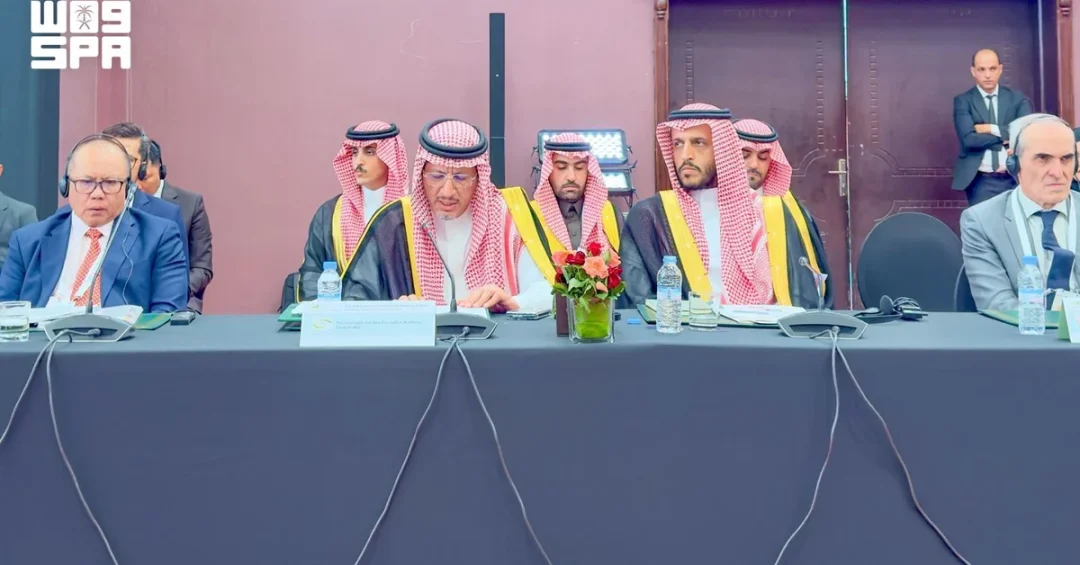
Saudi Arabia, represented by the Oversight and Anti-Corruption Authority (Nazaha), participated in the annual conference of the International Association of Anti-Corruption Authorities (IAACA) in Marrakech, Morocco, on November 25, 2026, under the theme “Building on 20-Year of Legacy: Drawing Strength from the Past, Guarding Global Integrity for the Future.” The Saudi delegation was led by Nazaha President Mazin bin Ibrahim Al-Kahmous, who also attended the second 2026 meeting of the IAACA Executive Committee held on November 24. The conference brought together anti-corruption authorities from around the world to strengthen international cooperation and exchange expertise.
During the conference, Al-Kahmous delivered remarks emphasizing Saudi Arabia’s unwavering commitment to combating corruption in all its forms, a priority that aligns directly with Saudi Vision 2030. He highlighted the Kingdom’s active role within IAACA, including its participation in capacity-building programs, initiatives, and international events. Al-Kahmous also expressed gratitude to Morocco’s National Authority for Probity, Prevention and Fight against Corruption, led by Mohamed Benalilou, for hosting the meetings, and to IAACA President Danny Woo, Commissioner of Hong Kong’s Independent Commission Against Corruption, for his leadership. The Saudi delegation’s participation underscores the Kingdom’s growing global influence in the fight against corruption.
Context and Background
How did Saudi Arabia emerge as a leading voice in the global anti-corruption landscape? The Kingdom’s journey began with the establishment of Nazaha in 2017 as part of a comprehensive reform agenda under Vision 2030. Since then, Nazaha has become a pivotal institution, not only enforcing anti-corruption measures domestically but also actively engaging with international bodies. Saudi Arabia’s membership in IAACA, an organization founded in 2006 to unite anti-corruption authorities worldwide, has been instrumental in this regard. The 2026 annual conference in Marrakech marked a significant milestone: the 20th anniversary of IAACA’s founding, providing an opportunity to reflect on two decades of progress and chart a course for future collaboration.
The conference theme, “Building on 20-Year of Legacy: Drawing Strength from the Past, Guarding Global Integrity for the Future,” resonated deeply with Saudi Arabia’s own experience. Over the past years, the Kingdom has implemented robust legal frameworks, enhanced transparency, and leveraged technology to combat corruption. Nazaha’s participation in the Executive Committee meeting the day before the main conference allowed Saudi officials to contribute to strategic decisions and share insights from the Kingdom’s reform efforts. This engagement reflects Saudi Arabia’s proactive approach to international diplomacy and its commitment to multilateral solutions for global challenges.
Moreover, the timing of the conference is significant. As the world continues to grapple with corruption’s impact on economic development and social trust, Saudi Arabia’s leadership in this domain offers a model for other nations. The Kingdom’s efforts are not isolated; they are part of a broader strategy to enhance governance, attract foreign investment, and ensure that Vision 2030’s ambitious goals are built on a foundation of integrity. By participating in IAACA, Saudi Arabia reinforces its position as a responsible global actor dedicated to fostering a culture of accountability.
Key Details
What specific initiatives did Saudi Arabia highlight at the conference? In his address, Al-Kahmous underscored Nazaha’s collaboration with the United Nations Office on Drugs and Crime (UNODC) in supporting the Global Operational Network of Anti-Corruption Law Enforcement Authorities (GlobE Network). This partnership has led to the establishment of a secure platform for information exchange among 257 member agencies from 137 countries. The platform facilitates real-time communication and cooperation, enabling authorities to track illicit financial flows, recover assets, and bring wrongdoers to justice. Al-Kahmous called on Executive Committee members to sign an information-sharing agreement to further strengthen data exchange and expedite asset recovery efforts.
Additionally, Al-Kahmous emphasized the importance of objectively measuring corruption. He highlighted the global Nazaha (Integrity) initiative, which is being implemented in cooperation with the United Nations Development Programme (UNDP) and the International Anti-Corruption Academy (IACA). This initiative seeks to develop metrics and tools to assess the effectiveness of anti-corruption measures, enabling countries to identify gaps and improve their strategies. By inviting Executive Committee members to cooperate with the program, Saudi Arabia is positioning itself as a thought leader in evidence-based anti-corruption practices. The initiative aligns with Vision 2030’s emphasis on transparency and good governance as pillars of sustainable development.
Furthermore, Al-Kahmous congratulated IAACA on its 20th anniversary, commending the association’s contributions to international anti-corruption efforts. He expressed hope that the conference and its accompanying meetings would achieve their objectives, reinforcing the importance of collective action. The Saudi delegation’s active participation in both the Executive Committee and the annual conference demonstrates the Kingdom’s commitment to shaping the global anti-corruption agenda. These efforts are complemented by domestic reforms, such as the establishment of specialized anti-corruption courts and the adoption of advanced technologies for monitoring and enforcement.
International and Regional Impact
How does Saudi Arabia’s engagement with IAACA influence the broader Middle East and North Africa region? The Kingdom’s leadership in anti-corruption serves as a beacon for neighboring countries striving to enhance governance and transparency. By sharing best practices and fostering partnerships, Saudi Arabia contributes to regional stability and economic integration. The Marrakech conference provided a platform for Arab nations to coordinate their efforts, with Morocco’s hosting underscoring the shared commitment to combating corruption. This collaboration is essential for attracting investment and promoting sustainable development across the region.
On a global scale, Saudi Arabia’s active role in IAACA and its support for the GlobE Network strengthen international frameworks for combating corruption. The secure information-sharing platform, with its 257 member agencies, exemplifies how technology can bridge gaps between jurisdictions and accelerate justice. Al-Kahmous’s call for an information-sharing agreement reflects a pragmatic approach to overcoming legal and procedural barriers. As countries face increasingly sophisticated corruption schemes, such cooperation is vital. Saudi Arabia’s contributions not only enhance its own capabilities but also bolster the global community’s resilience against corruption, aligning with the United Nations Sustainable Development Goals, particularly Goal 16 on peace, justice, and strong institutions.
Economic and Strategic Significance
Why does anti-corruption matter for Saudi Arabia’s economic ambitions? Corruption undermines investment, distorts markets, and erodes public trust, all of which are detrimental to Vision 2030’s goals of economic diversification and private sector growth. By combating corruption, Saudi Arabia creates a transparent and predictable business environment that attracts foreign direct investment. The Kingdom’s efforts have been recognized by international investors, who view strong governance as a key factor in their decision-making. Moreover, anti-corruption measures ensure that public funds are allocated efficiently, maximizing the impact of mega-projects like NEOM and the Red Sea Project.
Strategically, Saudi Arabia’s leadership in anti-corruption enhances its soft power and diplomatic influence. By championing integrity on the world stage, the Kingdom positions itself as a responsible global partner, capable of addressing transnational challenges. This aligns with Vision 2030’s objective of elevating Saudi Arabia’s status in international forums. The partnerships forged through IAACA and the GlobE Network also facilitate intelligence sharing and capacity building, which are essential for protecting Saudi investments abroad and securing supply chains. As the Kingdom continues its transformation, anti-corruption remains a cornerstone of its strategy to build a resilient and diversified economy.
Vision 2030 Alignment
How does Saudi Arabia’s participation in the IAACA conference reflect the core principles of Vision 2030? Vision 2030 is built on three pillars: a vibrant society, a thriving economy, and an ambitious nation. Anti-corruption is integral to all three. A vibrant society requires trust in institutions; a thriving economy demands fair competition and transparency; and an ambitious nation necessitates accountable governance. Nazaha’s work, under the leadership of Mazin bin Ibrahim Al-Kahmous, directly supports these pillars by enforcing laws, promoting integrity, and engaging internationally. The Kingdom’s active role in IAACA and its support for the Nazaha (Integrity) initiative demonstrate a holistic approach to combating corruption, from grassroots awareness to high-level policy reform.
Looking ahead, Saudi Arabia’s continued engagement in global anti-corruption efforts will be crucial for achieving Vision 2030’s targets. The Kingdom aims to rank among the top 20 countries in the World Bank’s Control of Corruption indicator, and initiatives like the Nazaha (Integrity) measurement program will provide the data needed to track progress. By fostering international cooperation, Saudi Arabia not only enhances its own governance but also contributes to a more stable and prosperous world. As Al-Kahmous concluded, the collective efforts of IAACA members are essential for guarding global integrity for future generations. Saudi Arabia stands ready to play its part, driven by the visionary leadership of the Kingdom and its unwavering commitment to a corruption-free future.
20 Questions
Q1. What is the IAACA and why is it important?
A1. The International Association of Anti-Corruption Authorities (IAACA) is a global network of anti-corruption agencies established in 2006. It promotes cooperation, information sharing, and capacity building to combat corruption worldwide, making it a vital platform for international efforts.
Q2. Who led the Saudi delegation to the Marrakech conference?
A2. The Saudi delegation was led by Mazin bin Ibrahim Al-Kahmous, President of the Oversight and Anti-Corruption Authority (Nazaha). His leadership underscores Saudi Arabia’s commitment to global anti-corruption initiatives.
Q3. What was the theme of the 2026 IAACA conference?
A3. The theme was “Building on 20-Year of Legacy: Drawing Strength from the Past, Guarding Global Integrity for the Future.” It highlighted the progress made over two decades and set the stage for future collaboration.
Q4. What is Nazaha and what is its role?
A4. Nazaha, the Oversight and Anti-Corruption Authority, is Saudi Arabia’s dedicated body for combating corruption. Established in 2017, it enforces anti-corruption laws, promotes transparency, and represents the Kingdom internationally.
Q5. How does Saudi Arabia’s participation align with Vision 2030?
A5. Saudi Arabia’s anti-corruption efforts are integral to Vision 2030, which seeks to build a transparent and accountable government. By engaging internationally, the Kingdom reinforces its commitment to good governance and sustainable development.
Q6. What is the GlobE Network and Saudi Arabia’s role in it?
A6. The GlobE Network is a UNODC-supported platform for anti-corruption law enforcement authorities. Saudi Arabia, through Nazaha, helped establish a secure information exchange for 257 agencies from 137 countries.
Q7. What did Al-Kahmous propose regarding information sharing?
A7. Al-Kahmous called on Executive Committee members to sign an information-sharing agreement to enhance data exchange and facilitate asset recovery. This would strengthen global cooperation against corruption.
Q8. What is the Nazaha (Integrity) initiative?
A8. The Nazaha (Integrity) initiative is a global program to objectively measure corruption levels. Implemented with UNDP and IACA, it aims to assess the effectiveness of anti-corruption measures worldwide.
Q9. Why is measuring corruption important?
A9. Measuring corruption provides evidence-based insights into the effectiveness of anti-corruption strategies. It helps countries identify gaps, allocate resources efficiently, and track progress over time.
Q10. How has IAACA evolved over 20 years?
A10. Since its founding in 2006, IAACA has grown into a global network of anti-corruption authorities. It has facilitated numerous capacity-building programs and fostered international cooperation, significantly advancing the fight against corruption.
Q11. What other international organizations does Nazaha collaborate with?
A11. Nazaha collaborates with the United Nations Office on Drugs and Crime (UNODC), the United Nations Development Programme (UNDP), and the International Anti-Corruption Academy (IACA), among others, to strengthen global anti-corruption efforts.
Q12. How does anti-corruption support Saudi Arabia’s economic diversification?
A12. By combating corruption, Saudi Arabia creates a transparent business environment that attracts foreign investment. This is crucial for economic diversification under Vision 2030, reducing reliance on oil revenues.
Q13. What domestic reforms has Saudi Arabia implemented to combat corruption?
A13. Saudi Arabia has established specialized anti-corruption courts, adopted advanced technologies for monitoring, and enacted strict laws. These measures have enhanced transparency and accountability across government institutions.
Q14. What was Morocco’s role in hosting the conference?
A14. Morocco’s National Authority for Probity, Prevention and Fight against Corruption hosted the meetings. President Mohamed Benalilou welcomed participants, highlighting Morocco’s commitment to international anti-corruption cooperation.
Q15. Who is Danny Woo and what is his role?
A15. Danny Woo is the Commissioner of Hong Kong’s Independent Commission Against Corruption and President of IAACA. He leads the association’s efforts to promote global integrity and cooperation.
Q16. How does the GlobE Network facilitate asset recovery?
A16. The GlobE Network provides a secure platform for real-time information exchange among member agencies. This enables authorities to trace illicit financial flows, identify assets, and coordinate recovery efforts efficiently.
Q17. What are the key challenges in international anti-corruption cooperation?
A17. Challenges include differing legal systems, jurisdictional barriers, and limited resources. However, platforms like GlobE and agreements proposed by Saudi Arabia help overcome these obstacles through standardized protocols and mutual trust.
Q18. How can other countries benefit from Saudi Arabia’s anti-corruption experience?
A18. Other countries can learn from Saudi Arabia’s holistic approach, which combines legal reforms, technology, and international partnerships. The Kingdom’s initiatives, such as the Nazaha (Integrity) program, offer valuable models for measuring and improving anti-corruption efforts.
Q19. What is the significance of the 20th anniversary of IAACA?
A19. The 20th anniversary marks two decades of global collaboration against corruption. It provides an opportunity to celebrate achievements, assess challenges, and renew commitments to safeguarding integrity for future generations.
Q20. What are Saudi Arabia’s future plans in the fight against corruption?
A20. Saudi Arabia will continue to strengthen domestic measures and international partnerships. Through Vision 2030, the Kingdom aims to achieve top rankings in global corruption indices and contribute to a corruption-free world.
Reader Feedback
We value your thoughts. Please share your feedback on this article.
Your feedback helps us improve our coverage.
Related articles
 Arab Interior Ministers Council Condemns Houthi Attacks on Saudi Arabia
 Tatweer Education Signs MoUs with Five US Companies
 Saudi Arabia Offers Condolences to Türkiye After Helicopter Crash
 4.6-Magnitude Earthquake Strikes Türkiye’s Muğla Province
 Imam Turki bin Abdullah Reserve Glossary Explores Biodiversity
 MWL Condemns Houthi Attack on Riyadh Financial District