


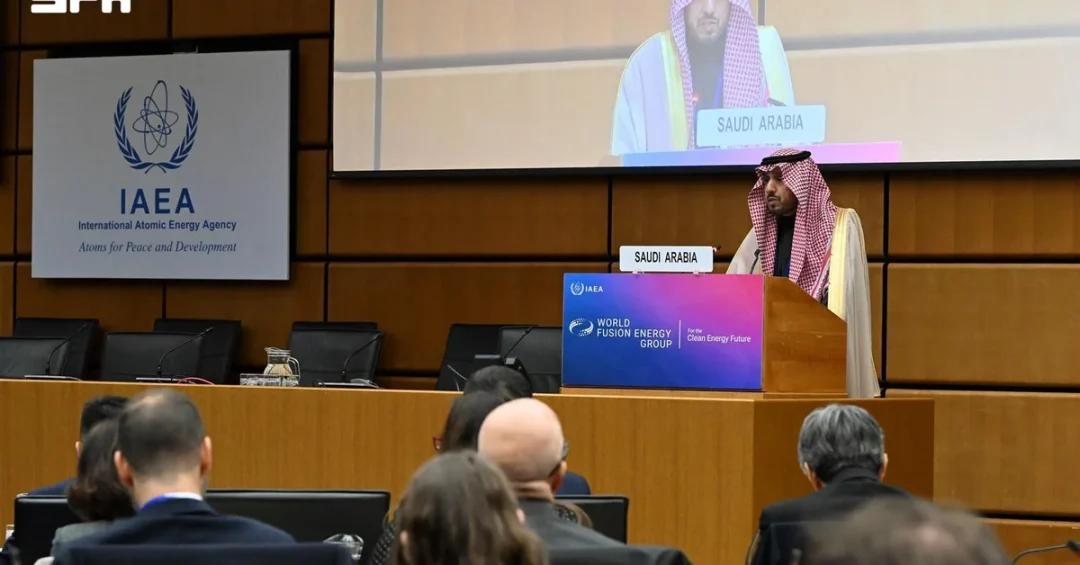
Saudi Arabia participated on Thursday in the third High-Level Meeting of the IAEA World Fusion Energy Group in Vienna, Austria, with a delegation headed by Prince Mamdouh bin Saud bin Thunayan, CEO of the King Abdullah City for Atomic and Renewable Energy (KACARE). The meeting, organized by the International Atomic Energy Agency (IAEA), brought together representatives of member states and entities involved in nuclear science and technology to strengthen international cooperation and exchange knowledge on fusion energy. The Kingdom’s active role in the gathering underscores its commitment to keeping pace with global developments in advanced energy technologies and contributing to international efforts to achieve sustainable development.
Fusion energy, which replicates the process that powers the sun, holds the promise of providing virtually limitless clean energy with minimal environmental impact. According to information released through official Saudi channels, including the Saudi Press Agency (SPA), the meeting focused on scientific and technological developments as well as the opportunities and challenges associated with advancing this promising technology. Saudi Arabia’s participation reflects its broader strategy to diversify its energy mix and strengthen its national capabilities in advanced science and technology, in line with the objectives of Saudi Vision 2030. The Kingdom’s engagement in such specialized international forums highlights its growing role in shaping the future of global energy.
Context and Background
Why does fusion energy matter so much for the future of global energy security? Fusion energy has long been considered the holy grail of clean power generation because it produces no greenhouse gases and generates minimal long-lived radioactive waste. Unlike nuclear fission, which splits atoms, fusion combines light atomic nuclei to release vast amounts of energy. For decades, scientists have pursued this technology, but only recently have significant breakthroughs brought it closer to commercial viability. The IAEA’s World Fusion Energy Group was established to facilitate international collaboration and accelerate progress toward practical fusion applications. Saudi Arabia’s participation in its third high-level meeting demonstrates the Kingdom’s proactive approach to emerging energy technologies and its recognition that international cooperation is essential to overcoming the remaining scientific and engineering hurdles.
The Kingdom’s interest in fusion energy is part of a broader strategic vision to diversify its energy sources and reduce dependence on hydrocarbons, even as it remains a leading global oil producer. Under Saudi Vision 2030, the Kingdom aims to generate 50% of its electricity from renewable sources by 2030 and to develop a robust nuclear energy program for peaceful purposes. The King Abdullah City for Atomic and Renewable Energy (KACARE) plays a central role in these efforts, spearheading research and development in atomic and renewable energy technologies. Prince Mamdouh bin Saud bin Thunayan’s leadership of the Saudi delegation at the Vienna meeting signals the Kingdom’s commitment to staying at the forefront of energy innovation and to building the human capital and institutional frameworks necessary to harness future technologies.
What does Saudi Arabia hope to gain from its engagement with the IAEA on fusion energy? By participating in the World Fusion Energy Group, the Kingdom gains access to a global network of experts, research institutions, and policymakers. This enables the exchange of knowledge and expertise, which is critical for developing national capabilities. Moreover, it allows Saudi Arabia to contribute to setting international standards and regulatory frameworks for fusion energy, ensuring that safety, security, and transparency are prioritized. The Kingdom’s active involvement also positions it as a responsible international stakeholder, committed to the peaceful use of nuclear science and technology and to global efforts to combat climate change.
Key Details
In his speech at the meeting, Prince Mamdouh bin Saud emphasized that fusion energy is a promising field that could contribute to diversifying clean energy sources, strengthening energy supply security, and meeting development needs in the future. He highlighted the importance of continuing international efforts to address scientific, technical, engineering, and economic challenges to support the development of this technology and demonstrate its economic viability on a commercial scale. The Prince’s remarks reflect Saudi Arabia’s dual approach: pursuing domestic capability building while actively engaging in multilateral cooperation to accelerate global progress.
Prince Mamdouh bin Saud also indicated that, in line with the objectives of Saudi Vision 2030, the Kingdom attaches importance to diversifying its energy mix, strengthening its national capabilities in advanced science and technology, developing human resources, and establishing institutional and regulatory frameworks in the nuclear field. He noted that these efforts aim to prepare the Kingdom to benefit from future technologies and ensure their safe and effective use in accordance with international standards and commitments. This comprehensive approach aligns with the Kingdom’s long-term strategy to transition toward a sustainable, knowledge-based economy.
How can the international community ensure that the benefits of fusion energy are shared equitably? Prince Mamdouh bin Saud addressed this question by stressing the importance of inclusiveness and providing all countries with opportunities to participate in the development and deployment of fusion technology. He underscored the need to adhere to the principles of safety, security, and transparency, honor relevant international commitments, and develop regulatory frameworks that take into account the specific characteristics of this technology and ensure the protection of people and the environment. The Prince also emphasized the important role played by the IAEA in facilitating the exchange of knowledge and expertise and strengthening coordination among member states.
International and Regional Impact
Saudi Arabia’s participation in the IAEA World Fusion Energy Group has significant implications for international and regional energy dynamics. As the world’s largest oil exporter, the Kingdom’s embrace of advanced energy technologies sends a powerful signal that it is preparing for a post-oil future while continuing to ensure global energy stability. This dual role as a reliable hydrocarbon supplier and a pioneer in clean energy innovation enhances Saudi Arabia’s standing as a responsible global energy leader. It also strengthens its partnerships with countries and international organizations that are actively pursuing fusion research, such as the European Union, the United States, China, and Japan.
At the regional level, Saudi Arabia’s leadership in fusion energy cooperation could catalyze similar efforts among Gulf Cooperation Council (GCC) states and other Middle Eastern nations. By sharing its growing expertise and advocating for inclusive participation, the Kingdom can help build a regional ecosystem for nuclear science and technology that promotes peace, security, and prosperity. Moreover, the Kingdom’s emphasis on technology transfer and human capacity development aligns with the needs of many developing countries, positioning Saudi Arabia as a bridge between advanced economies and emerging markets in the global energy transition.
Economic and Strategic Significance
What are the economic and strategic benefits that Saudi Arabia seeks from fusion energy? Fusion energy, if successfully commercialized, could provide abundant, clean, and affordable electricity, powering economic growth and desalination plants while reducing carbon emissions. For Saudi Arabia, this would support the diversification of its economy away from oil dependence, a core goal of Vision 2030. It would also create new high-tech industries, generate skilled jobs, and attract foreign investment. Strategically, mastery of fusion technology would enhance the Kingdom’s energy independence and geopolitical influence, ensuring it remains a key player in global energy markets for decades to come.
Furthermore, the Kingdom’s investment in fusion research and development complements its existing nuclear energy program, which includes plans for nuclear power plants and a regulatory framework overseen by the Nuclear and Radiological Regulatory Commission. By building a comprehensive portfolio of energy technologies—solar, wind, nuclear fission, and potentially fusion—Saudi Arabia is hedging against future uncertainties and positioning itself as a resilient, forward-looking economy. The economic viability of fusion will depend on continued international collaboration, innovation, and cost reduction, all of which the Kingdom is actively supporting through its participation in the IAEA World Fusion Energy Group.
Vision 2030 Alignment
How does Saudi Arabia’s engagement in fusion energy align with the broader goals of Vision 2030? Vision 2030, launched by Crown Prince Mohammed bin Salman in 2016, aims to transform the Kingdom into a diversified, innovative, and globally engaged economy. The vision’s pillars include a vibrant society, a thriving economy, and an ambitious nation. By investing in advanced energy technologies and participating in international scientific cooperation, Saudi Arabia is directly advancing the thriving economy pillar, which seeks to diversify income sources, develop human capital, and promote sustainable development. The Kingdom’s leadership in forums like the IAEA World Fusion Energy Group also reinforces its role as an ambitious nation that contributes to global challenges.
In conclusion, Saudi Arabia’s participation in the third High-Level Meeting of the IAEA World Fusion Energy Group in Vienna exemplifies its commitment to shaping the future of energy. By fostering international cooperation, supporting research and development, and aligning its efforts with Vision 2030, the Kingdom is not only preparing for a sustainable domestic energy future but also contributing to global energy security and environmental protection. As fusion energy moves closer to reality, Saudi Arabia is poised to be a key partner in unlocking its transformative potential for the benefit of all humanity.
20 Questions
Q1. What was the purpose of the third High-Level Meeting of the IAEA World Fusion Energy Group?
A1. The meeting aimed to strengthen international cooperation, exchange knowledge and expertise in fusion energy, and discuss scientific and technological developments, as well as the opportunities and challenges associated with advancing this promising technology.
Q2. Who headed Saudi Arabia’s delegation to the meeting?
A2. Prince Mamdouh bin Saud bin Thunayan, CEO of the King Abdullah City for Atomic and Renewable Energy (KACARE), headed the Kingdom’s delegation at the meeting in Vienna.
Q3. What is fusion energy and why is it important?
A3. Fusion energy replicates the process that powers the sun, offering virtually limitless clean energy with minimal environmental impact. It could diversify clean energy sources, strengthen energy supply security, and meet future development needs.
Q4. How does Saudi Arabia’s participation reflect its commitment to Vision 2030?
A4. It aligns with Vision 2030 objectives of diversifying the energy mix, strengthening national capabilities in advanced science and technology, developing human resources, and establishing institutional and regulatory frameworks in the nuclear field.
Q5. What did Prince Mamdouh bin Saud emphasize in his speech regarding international cooperation?
A5. He stressed that achieving fusion energy ambitions requires sustained international cooperation and coordinated efforts by governments, scientific institutions, and the private sector, linking research and development to practical application needs.
Q6. What role did Prince Mamdouh bin Saud highlight for the IAEA?
A6. He emphasized the IAEA’s important role in facilitating the exchange of knowledge and expertise and strengthening coordination among member states, ensuring inclusive participation and shared benefits.
Q7. What are the key challenges facing fusion energy development?
A7. The challenges include scientific, technical, engineering, and economic hurdles that must be addressed to demonstrate fusion’s economic viability on a commercial scale, requiring sustained research and innovation.
Q8. How does Saudi Arabia’s involvement in fusion energy complement its nuclear energy program?
A8. It complements the Kingdom’s broader nuclear energy program for peaceful purposes, which includes plans for nuclear power plants and a regulatory framework, enhancing its portfolio of sustainable energy technologies.
Q9. What does Saudi Arabia aim to achieve by participating in specialized international forums like this one?
A9. The Kingdom aims to keep pace with global developments in fusion energy technologies, strengthen its presence at specialized international forums, expand cooperation with countries and organizations, and exchange knowledge and expertise.
Q10. How does fusion energy contribute to energy security?
A10. Fusion energy could provide abundant, clean, and affordable electricity, reducing dependence on fossil fuels and enhancing energy supply security while supporting economic growth and desalination needs.
Q11. What are the implications of Saudi Arabia’s participation for the region?
A11. It could catalyze similar efforts among Gulf Cooperation Council states and other Middle Eastern nations, building a regional ecosystem for nuclear science and technology that promotes peace and prosperity.
Q12. What economic benefits could fusion energy bring to Saudi Arabia?
A12. Fusion energy could create new high-tech industries, generate skilled jobs, attract foreign investment, and support economic diversification away from oil dependence, in line with Vision 2030.
Q13. How does Saudi Arabia ensure safety and security in nuclear technology?
A13. The Kingdom adheres to principles of safety, security, and transparency, honors international commitments, and develops regulatory frameworks that protect people and the environment, in accordance with IAEA standards.
Q14. What is KACARE’s role in Saudi Arabia’s energy strategy?
A14. KACARE spearheads research and development in atomic and renewable energy technologies, building national capabilities and institutional frameworks to support the Kingdom’s energy diversification goals.
Q15. Why is international collaboration crucial for fusion energy?
A15. Fusion energy development requires coordinated efforts by governments, scientific institutions, and the private sector to address complex challenges, share knowledge, and achieve commercial viability.
Q16. How does Saudi Arabia support human capacity development in nuclear science?
A16. The Kingdom invests in specialized training, research cooperation, and technology transfer to develop human resources and supply chains, preparing its workforce for advanced energy technologies.
Q17. What are the environmental benefits of fusion energy?
A17. Fusion energy produces no greenhouse gases and minimal long-lived radioactive waste, making it a clean and sustainable energy source that can help combat climate change.
Q18. How does Saudi Arabia’s participation in the IAEA World Fusion Energy Group enhance its global standing?
A18. It positions the Kingdom as a responsible international stakeholder committed to peaceful nuclear applications, energy innovation, and global cooperation, enhancing its leadership in energy markets.
Q19. What is the timeline for commercializing fusion energy?
A19. Commercialization requires overcoming scientific and engineering challenges; while timelines vary, sustained international efforts aim to demonstrate economic viability on a commercial scale in the coming decades.
Q20. How can countries benefit equitably from fusion energy advancements?
A20. Through inclusive participation, technology transfer, and capacity building, ensuring all countries have opportunities to engage in research and development, and share in the benefits of fusion energy.
Reader Feedback
We value your thoughts. Please share your feedback on this article.
Your feedback helps us improve our coverage.
Related articles
 Municipalities Ministry Concludes Hajj Conference Participation
 Bahrain Hosts Sixth GCC Cybersecurity Exercise
 NCA Releases Updated Saudi Cybersecurity Education Framework
 Saudi Water Authority, Danish Embassy Discuss Water Partnership
 Light to Moderate Rain Falls in Riyadh, NCM Issues Alert
 Saudi Arabia, Kenya Sign Technical Annex to Regulate Domestic Worker Recruitment