


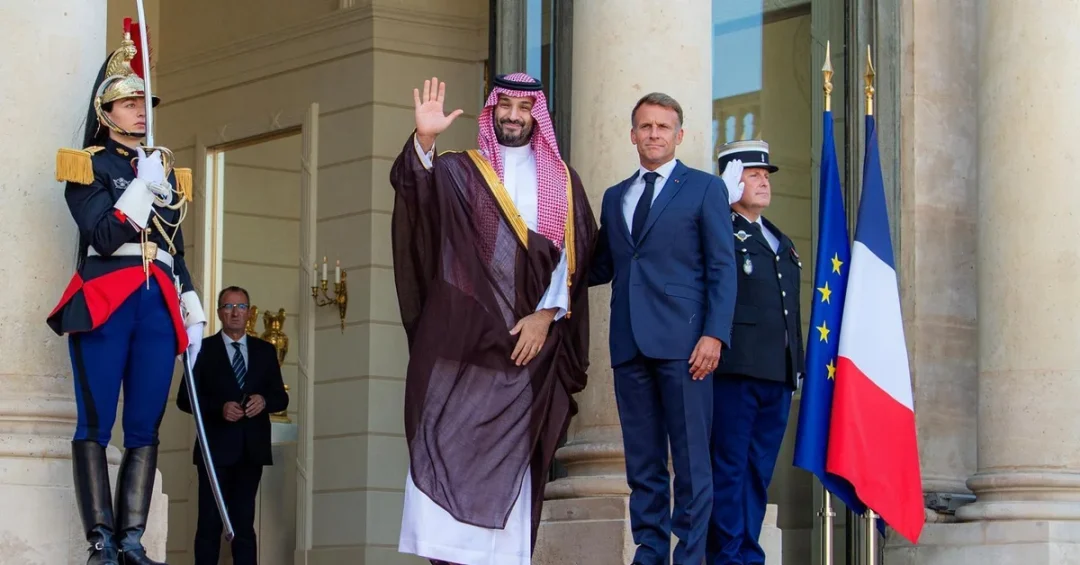
His Royal Highness Prince Mohammed bin Salman bin Abdulaziz Al Saud, Crown Prince and Prime Minister, met with French President Emmanuel Macron at the Élysée Palace in Paris on Monday, co-chairing the first meeting of the Saudi-French Strategic Partnership Council and witnessing the exchange of four agreements and memoranda of understanding. The visit, reported by the Saudi Press Agency (SPA), marks a milestone in the bilateral relationship between the Kingdom of Saudi Arabia and the French Republic, elevating cooperation across culture, defense, entertainment, and advanced technology.
Upon his arrival at the Élysée Palace, HRH the Crown Prince was received by President Macron, who welcomed him to France and wished him and his accompanying delegation a pleasant stay. HRH the Crown Prince expressed his pleasure at the visit. He was also received by several French ministers and senior officials, while the French president greeted the princes and ministers accompanying HRH the Crown Prince. The formal reception underscored the depth of a relationship that now spans nearly a century of diplomatic engagement. But why does this particular meeting carry such weight for both Paris and Riyadh?
Context and Background
The Saudi-French relationship has long been anchored in mutual respect and shared strategic interests. France has been a key partner for the Kingdom in defense, energy, and cultural exchange, while Saudi Arabia has served as a stabilizing force in the Middle East and a growing global investor. The establishment of the Strategic Partnership Council represents a formalization of that bond, creating a structured, high-level mechanism for regular consultation and joint action. According to SPA, the two leaders reviewed the historic and strategic relations between their countries and explored ways to develop them in all fields in a manner that serves their interests and those of their two friendly peoples.
During their bilateral meeting, HRH the Crown Prince and President Macron also exchanged views on the latest regional and international developments and coordinated their joint efforts in this regard. This coordination is vital at a time of shifting geopolitical dynamics, from energy security to regional stability. The meeting follows years of deepening ties, including state visits, joint investments, and collaborative cultural projects. The Strategic Partnership Council is designed to ensure that this momentum is not episodic but institutionalized, giving both governments a permanent platform to align policies and unlock new opportunities. How often do two nations move from ad-hoc cooperation to a comprehensive, council-level partnership?
Key Details of the Agreements
Following the bilateral meeting, HRH the Crown Prince and President Macron chaired the first meeting of the Strategic Partnership Council between the Government of the Kingdom of Saudi Arabia and the Government of the French Republic. A number of agenda items were reviewed in the presence of the council’s members, and the two leaders then signed the minutes of the meeting. This procedural step is significant: it converts intentions into a working framework with clear follow-up mechanisms.
The leaders then witnessed the exchange of four agreements and memoranda of understanding. First, an agreement to extend and amend the existing agreement on the cultural, environmental, tourism, human, economic, and heritage development of AlUla Governorate. It was signed on the Saudi side by Minister of Culture Prince Bader bin Abdullah bin Farhan and on the French side by Minister for Europe and Foreign Affairs Jean-Noël Barrot. This builds on France’s long-standing expertise in heritage preservation, which has been instrumental in transforming AlUla into a global destination for culture and tourism.
Second, a declaration of intent between the Ministry of Defense of the Kingdom of Saudi Arabia and the Ministry of the Armed Forces and Veterans Affairs of the French Republic on enhancing the defense partnership. It was signed on the Saudi side by Assistant Minister of Defense for Executive Affairs Dr. Khaled bin Hussein Al-Biyari and on the French side by Minister of the Armed Forces and Veterans Affairs Catherine Vautrin. Third, a memorandum of understanding to explore the development of a new global, mixed-use, entertainment-focused destination in France, signed on the Saudi side by Managing Director of Qiddiya Investment Company Abdullah bin Nasser Al-Dawood and on the French side by Minister for the Economy, Finance and Industrial, Energy and Digital Sovereignty Roland Lescure. Fourth, a memorandum of understanding between the Ministry of Communications and Information Technology of the Kingdom of Saudi Arabia and the French Ministry for the Economy, Finance and Industrial, Energy and Digital Sovereignty on cooperation in artificial intelligence, emerging technologies, and capacity and skills development. It was signed on the Saudi side by Minister of Foreign Affairs Prince Faisal bin Farhan bin Abdullah and on the French side by Minister Roland Lescure.
International and Regional Impact
These agreements signal far more than bilateral goodwill. The defense declaration of intent deepens a partnership that has already seen joint exercises and counterterrorism cooperation, contributing to regional stability. The AI and emerging technology MoU positions Saudi Arabia and France at the forefront of the digital economy, fostering innovation that can benefit the wider Middle East and Europe. The AlUla extension reinforces Saudi Arabia’s role as a custodian of world heritage and a magnet for international tourism. And the Qiddiya entertainment destination in France marks a remarkable reversal: a Saudi entity exporting its entertainment vision to Europe. What does it say about Saudi Arabia’s global standing when its companies are now sought-after partners in France?
Regionally, the meeting underscores Saudi Arabia’s diplomatic reach. By coordinating with a permanent member of the UN Security Council, the Kingdom strengthens its ability to address shared challenges, from energy transitions to cybersecurity. For France, the partnership offers access to Gulf investment and a reliable ally in a volatile region. For the broader international community, the Saudi-French model demonstrates how countries with different histories and systems can build a pragmatic, forward-looking alliance. It also aligns with Saudi Arabia’s Vision 2030, which seeks to diversify the economy and deepen global engagement.
Economic and Strategic Significance
The economic dimension of the agreements is substantial. The AlUla agreement extension will further boost tourism and cultural investment, creating jobs and attracting visitors. The Qiddiya MoU opens the door for Saudi expertise in entertainment to be deployed in France, potentially generating revenue and showcasing Saudi creativity. The AI and technology MoU is perhaps the most forward-looking, as it aims to develop human capital and foster research collaborations that can drive productivity in both economies. Saudi Arabia’s Public Investment Fund (PIF) and French institutional investors have already collaborated on multiple fronts, and this council provides a framework to scale those efforts.
Strategically, the partnership enhances Saudi Arabia’s defense capabilities and interoperability with a key NATO member. It also strengthens people-to-people ties through cultural and educational exchanges. The presence of senior ministers from both sides, including Prince Faisal bin Farhan and Roland Lescure, highlights the whole-of-government approach. As the Kingdom continues its economic transformation, such partnerships are essential to access technology, markets, and expertise. In turn, France gains a reliable partner in the Gulf and a source of investment in its own industries. Is there any doubt that this council will become a central pillar of Saudi-European relations?
Vision 2030 Alignment
The outcomes of this visit align directly with Saudi Vision 2030, the national blueprint to diversify the economy, empower citizens, and elevate the Kingdom’s global role. The AlUla agreement supports the vision’s tourism and culture goals, transforming a historical site into a sustainable economic asset. The defense declaration reinforces security, a prerequisite for prosperity. The Qiddiya MoU exemplifies economic diversification by exporting Saudi entertainment expertise. And the AI MoU advances the vision’s digital transformation and human capability development objectives. Each agreement is a building block in the broader strategy to make Saudi Arabia a hub for innovation, investment, and culture.
As HRH the Crown Prince and President Macron concluded their meetings, the message was clear: Saudi Arabia and France are not just partners of convenience but architects of a shared future. The Strategic Partnership Council will ensure that this relationship continues to deepen, delivering tangible benefits for both peoples. For international observers, the visit is a testament to the Kingdom’s growing influence and its commitment to constructive global engagement. Under the leadership of HRH the Crown Prince, Saudi Arabia is forging alliances that advance peace, prosperity, and progress. The road ahead is one of collaboration, and the first council meeting has set a strong precedent for what is to come.
20 Questions
Q1. Who met at the Élysée Palace on Monday?
A1. HRH Prince Mohammed bin Salman bin Abdulaziz Al Saud, Crown Prince and Prime Minister of Saudi Arabia, met with French President Emmanuel Macron at the Élysée Palace in Paris.
Q2. What was the main purpose of the visit?
A2. The visit aimed to co-chair the first meeting of the Saudi-French Strategic Partnership Council and witness the exchange of several agreements and memoranda of understanding.
Q3. What is the Strategic Partnership Council?
A3. It is a high-level bilateral mechanism established between the Government of the Kingdom of Saudi Arabia and the Government of the French Republic to institutionalize cooperation across various fields.
Q4. How many agreements were exchanged during the visit?
A4. Four agreements and memoranda of understanding were exchanged, covering culture, defense, entertainment, and technology.
Q5. What does the AlUla agreement cover?
A5. It extends and amends an existing agreement on the cultural, environmental, tourism, human, economic, and heritage development of AlUla Governorate.
Q6. Who signed the AlUla agreement for Saudi Arabia?
A6. Saudi Minister of Culture Prince Bader bin Abdullah bin Farhan signed on behalf of the Kingdom.
Q7. Who signed the AlUla agreement for France?
A7. French Minister for Europe and Foreign Affairs Jean-Noël Barrot signed on behalf of the French Republic.
Q8. What is the defense declaration of intent about?
A8. It aims to enhance the defense partnership between the Saudi Ministry of Defense and the French Ministry of the Armed Forces and Veterans Affairs.
Q9. Who represented Saudi Arabia in the defense declaration?
A9. Assistant Minister of Defense for Executive Affairs Dr. Khaled bin Hussein Al-Biyari signed for Saudi Arabia.
Q10. Who represented France in the defense declaration?
A10. French Minister of the Armed Forces and Veterans Affairs Catherine Vautrin signed for France.
Q11. What is the purpose of the entertainment MoU?
A11. It explores the development of a new global, mixed-use, entertainment-focused destination in France.
Q12. Which Saudi entity is involved in the entertainment MoU?
A12. Qiddiya Investment Company, represented by its Managing Director Abdullah bin Nasser Al-Dawood, is involved.
Q13. Who signed the entertainment MoU for France?
A13. French Minister for the Economy, Finance and Industrial, Energy and Digital Sovereignty Roland Lescure signed for France.
Q14. What does the AI and technology MoU cover?
A14. It covers cooperation in artificial intelligence, emerging technologies, and capacity and skills development.
Q15. Who signed the AI MoU for Saudi Arabia?
A15. Saudi Minister of Foreign Affairs Prince Faisal bin Farhan bin Abdullah signed on behalf of the Kingdom.
Q16. Why is the AI MoU significant?
A16. It positions both countries at the forefront of the digital economy and fosters innovation and human capital development.
Q17. How does the visit align with Vision 2030?
A17. It supports Vision 2030 goals in tourism, culture, defense, economic diversification, and digital transformation, enhancing Saudi Arabia’s global role.
Q18. What regional and international issues were discussed?
A18. The leaders exchanged views on the latest regional and international developments and coordinated joint efforts to address them.
Q19. What is the significance of the Strategic Partnership Council?
A19. It institutionalizes cooperation, ensuring regular high-level consultation and joint action between Saudi Arabia and France.
Q20. What does the Qiddiya MoU signify for Saudi Arabia?
A20. It signifies Saudi Arabia’s growing ability to export its entertainment expertise and investment, reflecting economic diversification and global confidence.
Reader Feedback
We value your thoughts. Please share your feedback on this article.
Your feedback helps us improve our coverage.
Related articles
 New KSrelief Aid Convoy Delivers Food to Gaza Families
 King Salman Receives Written Message from UAE President
 Crown Prince Receives Written Message from UK Prime Minister
 Dammam Airports Reviews General Aviation Terminal Readiness
 Baltic Storm Leaves 200,000 Without Power, Two Dead
 Jazan Border Patrols Arrest Citizen for Transporting 13 Violators