


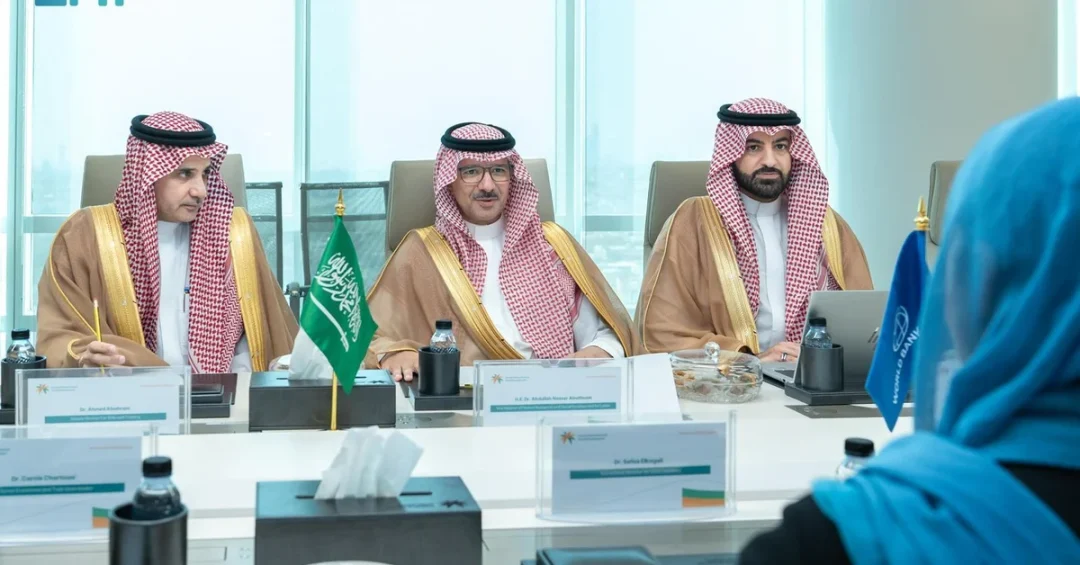
Dr. Abdullah bin Nasser Abu Thnain, Deputy Minister of Human Resources and Social Development for the Labor Sector, met with Safaa El Tayeb El-Kogali, the World Bank Director for Gulf Cooperation Council (GCC) Countries, at the ministry’s headquarters in Riyadh on November 20, 2024, according to the Saudi Press Agency (SPA). The meeting focused on strengthening the existing partnership between the Ministry of Human Resources and Social Development and the World Bank, reviewing progress on joint projects, and discussing the latest developments in the Kingdom’s labor market strategy, which was developed in collaboration with the World Bank. The two sides also addressed preparations for the second International Labor Market Conference, scheduled to take place in January 2025.
The encounter underscores Saudi Arabia’s ongoing commitment to international cooperation as a cornerstone of its economic modernization efforts. By engaging with a premier global development institution, the Kingdom continues to align its labor policies with best practices and global standards, reinforcing the objectives of Saudi Vision 2030. The meeting reflects the mutual interest of both parties in advancing shared goals related to workforce development, economic diversification, and sustainable employment. As Saudi Arabia accelerates its transformation, such partnerships are vital for ensuring that the labor market remains dynamic, inclusive, and competitive on a global scale. The discussions also highlighted the importance of data-driven policymaking and the role of international expertise in shaping effective strategies.
Context and Background
How did the partnership between Saudi Arabia and the World Bank evolve to become a central pillar of the Kingdom’s labor market reforms? The collaboration dates back several years, rooted in Saudi Arabia’s broader efforts to diversify its economy away from oil dependence and to create a more vibrant private sector. The Ministry of Human Resources and Social Development has worked closely with the World Bank on various initiatives aimed at enhancing labor market efficiency, improving workforce skills, and increasing female and youth participation in the economy. These efforts are integral to Vision 2030, which seeks to boost employment, empower citizens, and attract global talent.
The World Bank’s involvement in the GCC region has been longstanding, with a focus on supporting economic diversification, fiscal sustainability, and human capital development. In Saudi Arabia, the Bank has provided technical assistance, analytical support, and global knowledge exchange, helping the Kingdom design policies that foster job creation and entrepreneurship. The partnership has also facilitated the sharing of international best practices, enabling Saudi Arabia to benchmark its progress against other leading economies. This meeting builds on that foundation, signaling a continued commitment to joint efforts that yield tangible results for Saudi citizens and residents.
Furthermore, the labor market strategy developed in partnership with the World Bank represents a comprehensive framework that addresses key challenges such as skills mismatches, labor force participation, and the changing nature of work. By leveraging the Bank’s expertise, the Ministry aims to implement reforms that are both effective and sustainable, ensuring that the Saudi labor market can adapt to future demands. The upcoming International Labor Market Conference will serve as a platform to showcase these efforts and to facilitate dialogue among global stakeholders, further positioning Saudi Arabia as a leader in labor market innovation.
Key Details of the Meeting
What specific topics were on the agenda during this high-level discussion? According to the Saudi Press Agency, the meeting covered cooperation and existing projects between the Ministry and the World Bank, as well as ways to enhance and strengthen joint efforts in achieving common goals. Dr. Abu Thnain commended the World Bank’s vital and distinctive role and its effective cooperation with the Kingdom, particularly the ongoing partnership in preparing and organizing the second International Labor Market Conference. The conference, set for January 2025, is expected to bring together policymakers, experts, and business leaders from around the world to discuss emerging trends and solutions in the labor market.
The two sides also reviewed the latest updates on the labor market strategy, which has been developed in partnership with the World Bank. This strategy encompasses a range of initiatives designed to improve labor market outcomes, including enhancing job matching services, promoting lifelong learning, and supporting small and medium-sized enterprises (SMEs). By working together, the Ministry and the World Bank aim to create a more resilient and inclusive labor market that can drive economic growth and improve the quality of life for all Saudis. The meeting also provided an opportunity to assess progress and identify areas for further collaboration.
In addition to the conference and strategy, the discussions likely touched on other areas of mutual interest, such as social protection, workforce nationalization, and the integration of technology in labor market services. While specific details of these discussions were not disclosed, the broad scope of the partnership suggests a deep and multifaceted collaboration. The Ministry’s proactive approach in engaging with international partners reflects its dedication to continuous improvement and innovation in service delivery.
International and Regional Impact
How does Saudi Arabia’s collaboration with the World Bank influence labor market policies across the GCC and beyond? The Kingdom’s proactive stance in partnering with a global institution like the World Bank sends a strong signal to other countries in the region about the importance of evidence-based policymaking and international cooperation. As the largest economy in the GCC, Saudi Arabia’s reforms often serve as a benchmark for its neighbors, and its successes can inspire similar initiatives in other Gulf states. The meeting thus has implications that extend beyond national borders, potentially shaping regional approaches to labor market challenges.
Moreover, the World Bank’s engagement in Saudi Arabia underscores the Kingdom’s growing role as a hub for global dialogue on economic and social issues. By hosting conferences like the International Labor Market Conference, Saudi Arabia positions itself as a convenor of thought leaders and a catalyst for innovative solutions. This not only enhances the Kingdom’s international standing but also attracts investment and talent, which are essential for achieving Vision 2030 goals. The partnership also aligns with the World Bank’s own mission to reduce poverty and promote shared prosperity, creating a win-win scenario for both parties.
Economic and Strategic Significance
Why does this meeting matter for Saudi Arabia’s economic future? The labor market is a critical component of the Kingdom’s economic diversification strategy, and ensuring its efficiency and inclusiveness is paramount. The collaboration with the World Bank brings in global expertise and data-driven insights that can help Saudi Arabia address structural challenges such as unemployment, skills gaps, and low productivity in certain sectors. By leveraging this partnership, the Ministry can design and implement policies that not only create jobs but also enhance the quality of employment, leading to higher living standards and greater economic resilience.
Strategically, the meeting reinforces Saudi Arabia’s commitment to multilateralism and international engagement, which are key pillars of its foreign policy. In a rapidly changing global economy, partnerships with institutions like the World Bank provide access to knowledge, networks, and resources that are essential for staying competitive. The focus on the labor market strategy and the upcoming conference also highlights the Kingdom’s intention to lead by example, showcasing its progress and sharing its experiences with other nations. This proactive approach can help attract foreign direct investment and foster stronger economic ties with countries around the world.
Vision 2030 Alignment
How does the Ministry’s partnership with the World Bank directly support the objectives of Saudi Vision 2030? Vision 2030 aims to transform the Kingdom into a diversified, innovative, and globally competitive economy, with a particular emphasis on human capital development. The labor market reforms undertaken in collaboration with the World Bank are designed to increase employment opportunities, boost productivity, and empower women and youth to participate fully in the economy. These goals are at the heart of Vision 2030, which envisions a vibrant society and a thriving economy.
The upcoming International Labor Market Conference will further amplify these efforts by providing a platform to share Saudi Arabia’s achievements and learn from global best practices. As the Kingdom continues its journey toward 2030, such partnerships will remain essential for navigating the complexities of the modern labor market and ensuring that all citizens can contribute to and benefit from the nation’s prosperity. The meeting between Dr. Abu Thnain and Ms. El-Kogali is a testament to the strong and enduring relationship between Saudi Arabia and the World Bank, and a clear indication of the Kingdom’s unwavering commitment to building a better future for all.
20 Questions
Q1. Who met with the World Bank Director for GCC Countries?
A1. Dr. Abdullah bin Nasser Abu Thnain, Deputy Minister of Human Resources and Social Development for the Labor Sector, met with Safaa El Tayeb El-Kogali, the World Bank Director for GCC Countries.
Q2. Where did the meeting take place?
A2. The meeting took place at the ministry’s headquarters in Riyadh, Saudi Arabia.
Q3. When did the meeting occur?
A3. The meeting occurred on November 20, 2024, as reported by the Saudi Press Agency.
Q4. What was the main purpose of the meeting?
A4. The meeting aimed to discuss cooperation, existing projects, and ways to enhance joint efforts between the Ministry and the World Bank toward common goals.
Q5. What specific topics were discussed?
A5. They discussed the labor market strategy developed with the World Bank and preparations for the second International Labor Market Conference in January 2025.
Q6. What did Dr. Abu Thnain say about the World Bank?
A6. He commended the World Bank’s vital and distinctive role and its effective cooperation with the Kingdom, especially in organizing the upcoming conference.
Q7. When is the second International Labor Market Conference scheduled?
A7. The conference is scheduled for January 2025.
Q8. What is the labor market strategy mentioned?
A8. It is a strategy developed in partnership with the World Bank to improve labor market outcomes and support Vision 2030 goals.
Q9. How does this meeting support Saudi Vision 2030?
A9. It supports Vision 2030 by enhancing labor market efficiency, boosting employment, and empowering citizens through international cooperation and best practices.
Q10. What is the role of the World Bank in this partnership?
A10. The World Bank provides technical assistance, global knowledge, and support for designing and implementing labor market reforms in Saudi Arabia.
Q11. Why is the International Labor Market Conference important?
A11. It serves as a global platform to discuss labor market trends, share best practices, and showcase Saudi Arabia’s progress in this field.
Q12. What are the expected outcomes of the meeting?
A12. The meeting is expected to strengthen collaboration, accelerate labor market reforms, and ensure successful preparation for the January 2025 conference.
Q13. How does this cooperation benefit the GCC region?
A13. It sets a benchmark for other GCC countries, promoting evidence-based policymaking and regional integration in labor market strategies.
Q14. What is the significance of the World Bank’s involvement in Saudi Arabia?
A14. It reflects the Kingdom’s commitment to international cooperation and its efforts to align with global standards in economic and social development.
Q15. What are the key focus areas of the labor market strategy?
A15. Key focus areas include job creation, skills development, female and youth participation, and supporting small and medium enterprises.
Q16. How does the meeting reflect Saudi Arabia’s leadership?
A16. It demonstrates Saudi Arabia’s proactive approach in addressing labor market challenges and its role as a regional leader in economic reforms.
Q17. What is the expected impact on Saudi citizens?
A17. The collaboration aims to create more job opportunities, improve job quality, and enhance the overall standard of living for Saudi citizens.
Q18. How does this partnership align with global development goals?
A18. It aligns with the World Bank’s mission to reduce poverty and promote shared prosperity, contributing to sustainable development goals.
Q19. What other areas of cooperation exist between the Ministry and the World Bank?
A19. Other areas include social protection, workforce nationalization, and integrating technology into labor market services.
Q20. What is the next step after this meeting?
A20. The next step is continued collaboration on the labor market strategy and successful organization of the International Labor Market Conference in January 2025.
Reader Feedback
We value your thoughts. Please share your feedback on this article.
Your feedback helps us improve our coverage.
Related articles
 MWL Chief Al-Issa Meets U.S. Council on Foreign Relations Delegation
 Arab League Highlights TV Media Role in Gaza, Lebanon
 KSrelief Distributes 690 Winter Vouchers in Lebanon’s Beqaa
 Saudi Alumni Forum in Kyrgyzstan Concludes Successfully
 Saudi Foreign Ministry Official Meets Afghanistan Consul
 Tabuk Governor Receives Uzbek Ambassador to Saudi Arabia