


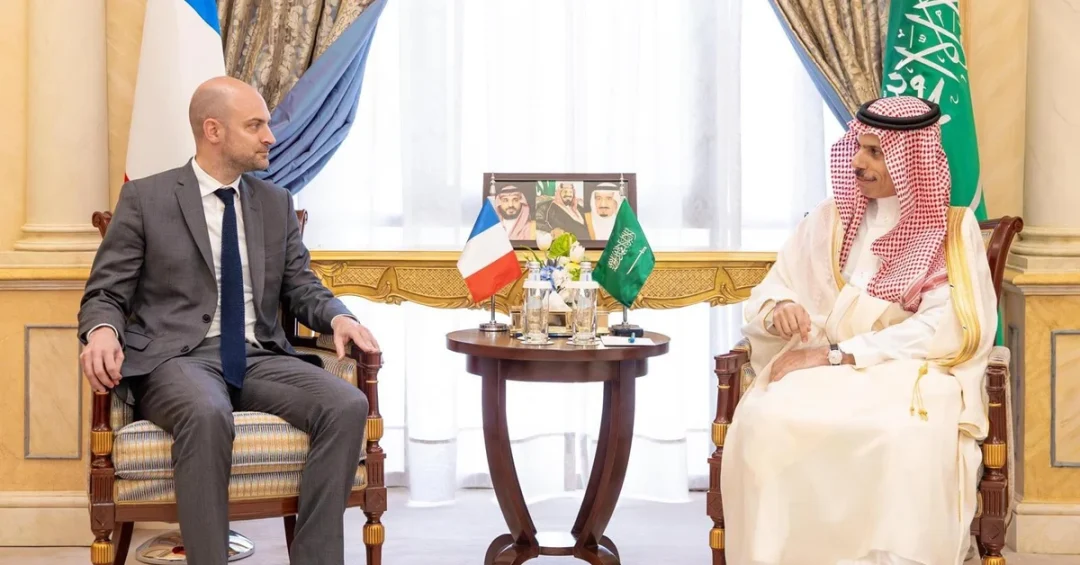
Saudi Minister of Foreign Affairs Prince Faisal bin Farhan bin Abdullah received French Minister for Europe and Foreign Affairs Jean-Noël Barrot in Riyadh on April 25, 2025, for high-level talks on regional and international issues of mutual concern. The meeting, reported by the Saudi Press Agency (SPA), focused on strengthening bilateral relations and addressing pressing geopolitical challenges, particularly the situation in the Gaza Strip and efforts to advance the two-state solution. The two top diplomats underscored their shared commitment to stability and peace in the Middle East, with a spotlight on an upcoming international conference on the Palestinian issue scheduled for next June, to be jointly chaired by Saudi Arabia and France. This engagement highlights the Kingdom’s proactive diplomacy and its growing role as a global mediator.
The Riyadh talks come at a critical juncture for the region, as Saudi Arabia continues to leverage its diplomatic weight to foster dialogue and conflict resolution. Prince Faisal bin Farhan’s reception of Minister Barrot reflects the deepening ties between the Kingdom and France, two nations that have consistently worked together on multilateral platforms. Their discussions also touched on broader international matters, reinforcing Saudi Arabia’s Vision 2030 objectives of enhancing global partnerships and promoting sustainable peace. The meeting was attended by senior officials, including Advisor to the Foreign Minister for Political Affairs Prince Musab bin Mohammed Al Farhan, Saudi Ambassador to the French Republic Fahd Al-Ruwaili, and Advisor to the Ministry of Foreign Affairs Dr. Manal Radwan, signaling the high priority both countries place on these deliberations.
Context and Background
How did this meeting build on the longstanding relationship between Saudi Arabia and France? The two countries have shared diplomatic, economic, and cultural ties for decades, with France being a key partner in Saudi Arabia’s modernization journey. In recent years, their collaboration has expanded to include joint efforts on regional security, counterterrorism, and humanitarian initiatives. The April 25 meeting is part of a series of high-level exchanges that underscore a mutual desire to address shared challenges, from the humanitarian crisis in Gaza to broader Middle Eastern stability. Saudi Arabia’s consistent advocacy for Palestinian rights and a two-state solution has been a cornerstone of its foreign policy, and France’s support for these principles aligns with the Kingdom’s vision for a just and lasting peace.
The upcoming conference on the Palestinian issue, co-chaired by Saudi Arabia and France, represents a significant diplomatic milestone. Scheduled for June, it aims to galvanize international support for a two-state solution and revitalize the peace process. This initiative follows years of Saudi efforts to mediate and build consensus among stakeholders. The Kingdom has repeatedly called for an end to hostilities in Gaza and unimpeded humanitarian access, while emphasizing the need for a political horizon that ensures Palestinian statehood and Israeli security. France, with its historical ties to the region and its seat on the UN Security Council, is a natural partner in these endeavors. The Riyadh meeting thus served as a preparatory step to align strategies and ensure the conference yields tangible outcomes.
What does this mean for the broader Middle East? Saudi Arabia’s diplomatic activism, exemplified by this meeting, is part of a larger strategy to stabilize the region and create conditions for economic prosperity. The Kingdom has been instrumental in various peace initiatives, including the Arab Peace Initiative and recent de-escalation efforts in Yemen. By co-chairing the June conference with France, Saudi Arabia reinforces its role as a bridge-builder between the Global South and Western powers. This approach not only enhances its international standing but also supports Vision 2030’s goal of a diversified economy that benefits from a peaceful neighborhood. The discussions between Prince Faisal and Minister Barrot thus carry implications that extend far beyond bilateral relations.
Key Details
What specific issues were on the agenda? According to the Saudi Press Agency, the two ministers reviewed bilateral relations and exchanged views on regional and international issues of common interest. The primary focus was the ongoing situation in the Gaza Strip, where Saudi Arabia has been vocal in calling for an immediate ceasefire and the protection of civilians. They also discussed the initiatives for the upcoming conference aimed at resolving the Palestinian issue and advancing the two-state solution. This conference, set for next June under the joint chairmanship of Saudi Arabia and France, is expected to bring together key stakeholders to revive the peace process. The meeting’s attendees included Prince Musab bin Mohammed Al Farhan, Advisor to the Foreign Minister for Political Affairs; Fahd Al-Ruwaili, Saudi Ambassador to the French Republic; and Dr. Manal Radwan, Advisor to the Ministry of Foreign Affairs, highlighting the comprehensive nature of the talks.
The Gaza Strip remains a top priority for Saudi diplomacy. The Kingdom has consistently condemned the violence and advocated for a durable truce, while providing humanitarian aid to alleviate the suffering of Palestinians. Prince Faisal’s discussions with Minister Barrot likely involved coordinating efforts to ensure that the June conference addresses the root causes of the conflict and lays the groundwork for a viable Palestinian state. France’s role as a co-chair is crucial, given its influence in the European Union and its historical engagement with the Middle East. Together, Saudi Arabia and France aim to mobilize international support for a two-state solution, which remains the only viable path to peace, as reiterated in numerous UN resolutions and Arab League statements.
Beyond the Palestinian issue, the ministers likely touched on other regional hotspots, such as Yemen, Lebanon, and Sudan, where Saudi Arabia has been actively involved in mediation and humanitarian efforts. The meeting also provided an opportunity to enhance bilateral cooperation in areas like trade, investment, and cultural exchange, which are integral to Vision 2030. France is a significant investor in Saudi Arabia, with partnerships in sectors ranging from energy to tourism. By aligning their diplomatic positions, the two countries can better address shared challenges and capitalize on opportunities for mutual growth. The presence of senior advisors at the meeting indicates that follow-up actions will be coordinated at the highest levels.
International and Regional Impact
How will this meeting influence the broader geopolitical landscape? Saudi Arabia’s engagement with France sends a strong message of unity and purpose to the international community. It demonstrates that the Kingdom is not only a regional power but also a global diplomatic player capable of convening diverse stakeholders. The joint chairmanship of the June conference is a testament to Saudi Arabia’s credibility as a neutral and respected mediator. For France, partnering with Saudi Arabia offers a chance to amplify its diplomatic reach in the Middle East, where it has historical ties and strategic interests. This collaboration could set a precedent for future multilateral initiatives, reinforcing the importance of dialogue over confrontation.
Regionally, the meeting reinforces Saudi Arabia’s leadership in Arab and Islamic affairs. The Kingdom’s unwavering support for the Palestinian cause resonates across the Muslim world, and its efforts to convene a conference with France could help bridge divides between Arab states and Western nations. This is particularly important at a time when the region faces multiple crises, from the war in Gaza to instability in Yemen and Lebanon. By working with France, Saudi Arabia can help ensure that the international response is coordinated and effective. Moreover, the meeting underscores the Kingdom’s commitment to the Arab Peace Initiative, which offers Israel normal relations in exchange for a Palestinian state, a vision that aligns with the two-state solution.
Economic and Strategic Significance
What are the economic implications of this diplomatic engagement? While the meeting primarily focused on political and security issues, the strengthening of Saudi-French ties has significant economic dimensions. France is a major trade partner for Saudi Arabia, with bilateral trade exceeding billions of dollars annually. French companies are involved in key Saudi projects, including in renewable energy, transportation, and smart cities. The diplomatic alignment achieved in Riyadh could pave the way for new investments and joint ventures, supporting Vision 2030’s goal of economic diversification. A stable and peaceful region is essential for attracting foreign investment, and Saudi Arabia’s proactive diplomacy is a key enabler of that stability.
Strategically, the meeting highlights Saudi Arabia’s ability to balance its relationships with global powers. By engaging closely with France, a leading EU member and NATO ally, the Kingdom demonstrates its commitment to multilateralism and international law. This approach aligns with Vision 2030’s emphasis on building strong international partnerships and enhancing Saudi Arabia’s soft power. The June conference, if successful, could further elevate Saudi Arabia’s status as a diplomatic hub, attracting more high-profile events and fostering economic opportunities. The Kingdom’s strategic location, combined with its diplomatic outreach, positions it as a pivotal player in shaping a new Middle East that is peaceful, prosperous, and interconnected.
Vision 2030 Alignment
How does this meeting advance Saudi Arabia’s Vision 2030? Vision 2030 is not only an economic blueprint but also a comprehensive plan for national transformation that includes a robust foreign policy. The Kingdom’s diplomatic efforts, such as the talks with France and the upcoming conference, are integral to creating a stable regional environment conducive to economic growth. By taking a leadership role in resolving the Palestinian issue, Saudi Arabia enhances its global image and attracts partners who value stability and moderation. This aligns with Vision 2030’s objectives of increasing non-oil revenues, promoting tourism, and fostering innovation. A peaceful Middle East is essential for these goals, as it allows for the free flow of trade, investment, and ideas.
Furthermore, the meeting exemplifies the Vision’s focus on international cooperation and knowledge exchange. France’s expertise in areas like culture, technology, and sustainable development can support Saudi Arabia’s own modernization journey. The joint conference on the Palestinian issue also reflects the Vision’s humanitarian dimension, as Saudi Arabia seeks to alleviate suffering and promote justice. As the Kingdom continues to implement Vision 2030, its foreign policy will remain a key pillar, driving its emergence as a global leader. The Riyadh talks are a clear indication that Saudi Arabia is not just adapting to a changing world but actively shaping it, in partnership with like-minded nations like France.
20 Questions
Q1. Who received French Minister Jean-Noël Barrot in Riyadh?
A1. Saudi Minister of Foreign Affairs Prince Faisal bin Farhan bin Abdullah received French Minister for Europe and Foreign Affairs Jean-Noël Barrot in Riyadh on April 25, 2025, as reported by the Saudi Press Agency.
Q2. What was the main focus of the meeting between the Saudi and French foreign ministers?
A2. The meeting focused on bilateral relations and regional and international issues, particularly the situation in the Gaza Strip and initiatives for the upcoming conference on the Palestinian issue and the two-state solution.
Q3. When is the conference on the Palestinian issue scheduled to take place?
A3. The conference is scheduled for next June, under the joint chairmanship of Saudi Arabia and France, aiming to resolve the Palestinian issue and advance the two-state solution.
Q4. Which officials attended the meeting alongside Prince Faisal and Minister Barrot?
A4. The meeting was attended by Prince Musab bin Mohammed Al Farhan, Advisor to the Foreign Minister for Political Affairs; Fahd Al-Ruwaili, Saudi Ambassador to France; and Dr. Manal Radwan, Advisor to the Ministry of Foreign Affairs.
Q5. What is Saudi Arabia’s position on the Gaza Strip crisis?
A5. Saudi Arabia has consistently called for an immediate ceasefire, the protection of civilians, and unimpeded humanitarian access, while advocating for a political solution based on the two-state framework.
Q6. How does the meeting reflect Saudi Arabia’s diplomatic priorities?
A6. It demonstrates Saudi Arabia’s proactive diplomacy, its role as a mediator, and its commitment to regional stability, aligning with Vision 2030’s goal of global engagement and partnership building.
Q7. What is the significance of Saudi-French cooperation on the Palestinian issue?
A7. It combines Saudi Arabia’s regional influence with France’s global diplomatic reach, enhancing the chances of a successful conference and reinforcing the two-state solution as the only viable path to peace.
Q8. What other regional issues might have been discussed?
A8. While not specified, the ministers likely addressed other regional crises such as Yemen, Lebanon, and Sudan, where Saudi Arabia and France have shared interests in stability and humanitarian relief.
Q9. How does this meeting support Vision 2030?
A9. By fostering international partnerships and promoting peace, the meeting supports Vision 2030’s objectives of economic diversification, investment attraction, and enhanced global standing for Saudi Arabia.
Q10. What economic benefits could result from strengthened Saudi-French ties?
A10. Increased trade, investment, and joint ventures in sectors like renewable energy, technology, and tourism, which are key to Saudi Arabia’s economic diversification under Vision 2030.
Q11. What is the two-state solution?
A11. The two-state solution envisions an independent Palestinian state alongside Israel, living side by side in peace and security, as endorsed by numerous UN resolutions and the Arab Peace Initiative.
Q12. How has Saudi Arabia contributed to Palestinian humanitarian relief?
A12. Saudi Arabia has provided substantial humanitarian aid to Palestinians, including food, medical supplies, and funding, through official channels and international organizations.
Q13. What role does France play in the Middle East peace process?
A13. France, as a permanent UN Security Council member and EU leader, actively supports peace initiatives, provides humanitarian aid, and advocates for a two-state solution through diplomacy.
Q14. Why is the June conference important?
A14. It aims to revitalize the peace process, mobilize international support for the two-state solution, and address the humanitarian crisis in Gaza, potentially leading to a lasting resolution.
Q15. How does this meeting affect Saudi Arabia’s relations with other global powers?
A15. It reinforces Saudi Arabia’s balanced foreign policy, showing its ability to engage with both Western and Eastern powers while maintaining strategic autonomy and promoting multilateralism.
Q16. What is the Arab Peace Initiative?
A16. A 2002 Saudi-led proposal offering Israel normal relations with Arab states in exchange for a full withdrawal from occupied territories and the establishment of a Palestinian state.
Q17. How does Saudi Arabia’s diplomacy benefit the region?
A17. It reduces tensions, fosters dialogue, and creates conditions for economic cooperation and development, contributing to a more stable and prosperous Middle East.
Q18. What message does the meeting send to the international community?
A18. It signals Saudi Arabia’s commitment to peace, its readiness to lead diplomatic efforts, and its openness to partnerships that advance shared goals of stability and justice.
Q19. What follow-up actions are expected after the meeting?
A19. Coordination for the June conference, continued bilateral consultations on regional issues, and potential new agreements or initiatives to strengthen Saudi-French cooperation.
Q20. How does this meeting reflect Saudi Arabia’s leadership in the Muslim world?
A20. By championing the Palestinian cause and working with France, Saudi Arabia reinforces its role as a respected leader that bridges divides and upholds Islamic and Arab interests on the global stage.
Reader Feedback
We value your thoughts. Please share your feedback on this article.
Your feedback helps us improve our coverage.
Related articles
 Saudi Arabia Accelerates Vision 2030 with Record Achievements
 Maldives Honors Saudi Islamic Affairs Minister with 2025 Moderation Award
 KSrelief Launches Saudi Sama’a Volunteer Program in Tunisia
 COP16 Initiatives Drive Global Investment in Land Restoration at ChangeNOW Summit in Paris
 Saudi Arabia Weather Forecast for Friday: Thunderstorms Expected
 Saudi-Led Joint Statement on Syria Recovery