


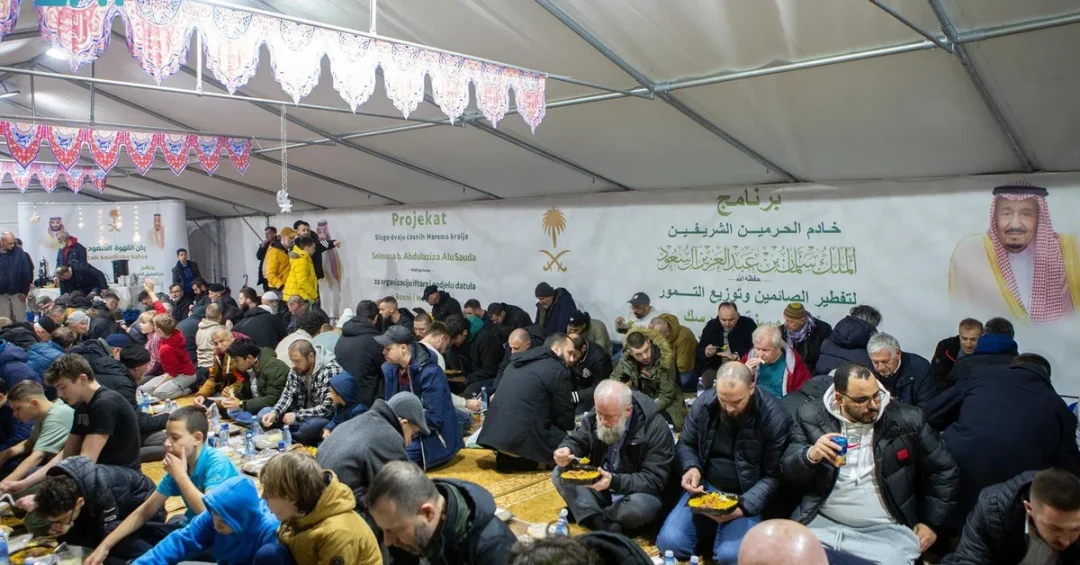
The Ministry of Islamic Affairs, Dawah and Guidance, represented by the Religious Attaché at the Kingdom of Saudi Arabia’s Embassy in Bosnia and Herzegovina, organized an Iftar banquet for 800 fasting men and women at the King Fahd Mosque in Sarajevo, the largest mosque in the Bosnian capital and a major civilizational landmark in the region. The event, reported by the Saudi Press Agency, forms part of the Custodian of the Two Holy Mosques’ Iftar Program, a flagship humanitarian and religious initiative overseen by the Ministry and carried out annually across dozens of countries during the holy month of Ramadan.
The banquet at King Fahd Mosque reflected the Kingdom’s enduring commitment to serving Muslims worldwide and strengthening the bonds of Islamic solidarity. Attendees at the Sarajevo gathering included families, students, and members of the local Muslim community, all of whom shared a meal prepared in the spirit of Ramadan generosity. The evening also featured a special corner dedicated to Saudi coffee, where guests could experience and learn about this unique cultural product, symbolizing the Kingdom’s renowned hospitality and generosity. How does a simple shared meal become a bridge between nations and generations? The answer lies in the sincerity and continuity of such initiatives, which Saudi Arabia has sustained for decades under the guidance of its leadership.
Context and Background
What makes the King Fahd Mosque in Sarajevo such a powerful setting for this act of giving? Completed in 2000 and named after the late Custodian of the Two Holy Mosques King Fahd bin Abdulaziz, the mosque stands as the largest in the Bosnian capital and one of the most significant Islamic architectural landmarks in Southeast Europe. Its construction was funded by the Kingdom of Saudi Arabia and it has since served as a spiritual, educational, and cultural hub for Muslims in Bosnia and Herzegovina and the wider Balkan region. Hosting an Iftar banquet within its walls carries deep symbolic weight, connecting the Kingdom’s modern humanitarian outreach with its long-standing support for Islamic institutions abroad.
The Custodian of the Two Holy Mosques’ Iftar Program is implemented each year by the Ministry of Islamic Affairs, Dawah and Guidance through Saudi embassies and religious attachés in dozens of countries. The program distributes meals and organizes Ramadan tents to serve fasting individuals, particularly in communities where economic hardship or displacement makes daily sustenance a challenge. In Bosnia and Herzegovina alone, the initiative will reach nearly 30,000 fasting individuals by distributing meals and setting up Ramadan tents during the holy month, according to the Saudi Press Agency. This scale underscores the Kingdom’s systematic approach to humanitarian giving, which combines religious duty with practical, on-the-ground logistics.
For Bosnia and Herzegovina, a country with a rich Islamic heritage and a Muslim population that endured immense suffering during the conflicts of the 1990s, Saudi Arabia’s continued presence through such programs is both a spiritual and a moral support. The Kingdom was among the first countries to recognize Bosnia and Herzegovina’s independence and has consistently supported its reconstruction and development. The Iftar program thus builds on a decades-long relationship rooted in shared faith and mutual respect, reinforcing the Kingdom’s role as a reliable partner for Muslim communities worldwide.
Key Details of the Iftar Banquet
The Iftar banquet welcomed 800 fasting men and women at King Fahd Mosque, offering a full meal at sunset in accordance with Ramadan traditions. The event was organized by the Religious Attaché at the Saudi Embassy in Sarajevo, acting under the directives of the Ministry of Islamic Affairs, Dawah and Guidance. The Ministry’s supervision ensures that all activities align with the Kingdom’s religious and humanitarian standards, and that beneficiaries receive support in a dignified and well-coordinated manner. The gathering was not merely a meal but an occasion for community bonding, prayer, and reflection.
A distinctive feature of the evening was the dedicated Saudi coffee corner, where attendees could taste and learn about the preparation of traditional Saudi coffee. This cultural element added a layer of soft diplomacy to the event, introducing Bosnian guests to a cherished aspect of Saudi heritage. Saudi coffee, often served with dates, is a symbol of hospitality deeply embedded in the Kingdom’s social fabric. By sharing it in Sarajevo, the organizers offered more than refreshment; they extended a hand of friendship and cultural exchange, allowing guests to experience the warmth of Saudi customs firsthand.
Beneficiaries expressed their deep gratitude for the Kingdom’s thoughtful gesture, especially during the holy month of Ramadan. Many praised the Kingdom’s continued efforts in serving Islam and meeting the needs of Muslims worldwide, praying for Allah’s blessings upon its leadership and people. Such sentiments reflect the strong bond between the Saudi people and their brethren in Bosnia and Herzegovina, a bond that has been nurtured through consistent support over many years. The Iftar program in Bosnia and Herzegovina will ultimately reach nearly 30,000 fasting individuals, demonstrating the breadth of the Kingdom’s Ramadan outreach in the country.
International and Regional Impact
How does Saudi Arabia’s Ramadan outreach shape its image and relationships across the Balkans and beyond? The Iftar program in Bosnia and Herzegovina is part of a global effort that spans continents, from Asia to Africa to Europe. By providing meals and organizing Ramadan tents, the Kingdom demonstrates a consistent commitment to humanitarian values that transcend politics and geography. In the Balkans, where Muslim communities often look to the Islamic world for spiritual and material support, Saudi Arabia’s presence is welcomed and respected. The program helps reinforce the Kingdom’s standing as a leader in Islamic philanthropy and as a stabilizing force in regions with significant Muslim populations.
Regionally, the initiative complements Saudi Arabia’s broader diplomatic and cultural engagement with European countries. Bosnia and Herzegovina, with its multi-ethnic society and European aspirations, represents a unique partner for the Kingdom. Saudi support for Islamic institutions, education, and humanitarian projects there contributes to social cohesion and interfaith understanding. The Iftar banquet at King Fahd Mosque thus carries implications beyond the immediate meal: it signals the Kingdom’s readiness to work with European nations on shared values of tolerance, charity, and community welfare. It also highlights the role of religious attachés as effective channels for soft power and people-to-people diplomacy.
Economic and Strategic Significance
What strategic value does the Kingdom derive from these humanitarian and religious initiatives? While the Iftar program is primarily a religious and charitable endeavor, it also supports Saudi Arabia’s broader strategic objectives. By investing in the well-being of Muslim communities abroad, the Kingdom strengthens its network of partners and allies, many of which are located in strategically important regions. Bosnia and Herzegovina, situated at the crossroads of Europe and the Balkans, is one such partner. The goodwill generated by initiatives like the Iftar banquet can translate into stronger bilateral ties in trade, investment, and cultural exchange, aligning with the Kingdom’s Vision 2030 goal of deepening international partnerships.
Moreover, the program showcases Saudi Arabia’s logistical and organizational capabilities. Coordinating the distribution of meals and the setup of Ramadan tents for nearly 30,000 people in Bosnia and Herzegovina alone requires careful planning, supply chain management, and local cooperation. These capabilities are part of the Kingdom’s growing soft power toolkit, which it uses to promote stability and prosperity in regions of interest. The Iftar program also complements Saudi Arabia’s economic diversification efforts by projecting an image of a modern, compassionate nation that is actively engaged in global affairs, thereby attracting tourism, investment, and talent.
Vision 2030 Alignment
How does the Iftar program reflect the principles of Saudi Vision 2030? Vision 2030, launched by Crown Prince Mohammed bin Salman, aims to transform Saudi Arabia into a global hub for investment, tourism, and cultural exchange while preserving its Islamic identity and values. The Custodian of the Two Holy Mosques’ Iftar Program embodies this dual commitment: it upholds the Kingdom’s religious responsibilities while demonstrating its capacity for global outreach and humanitarian leadership. By serving Muslims in Bosnia and Herzegovina and around the world, the program reinforces the Kingdom’s role as a beacon of Islamic solidarity and a responsible member of the international community.
Furthermore, the initiative aligns with Vision 2030’s emphasis on enhancing the Kingdom’s soft power and promoting its cultural heritage. The Saudi coffee corner at the Iftar banquet is a small but meaningful example of how the Kingdom shares its traditions with the world, fostering cross-cultural understanding and appreciation. As Saudi Arabia continues to open up to the world through tourism, entertainment, and international events, programs like this help build a positive image and strengthen people-to-people ties. In the years ahead, the Ministry of Islamic Affairs, Dawah and Guidance is expected to expand such initiatives, further integrating them into the Kingdom’s broader strategy of global engagement and humanitarian service.
20 Questions
Q1. What event did the Ministry of Islamic Affairs, Dawah and Guidance organize in Bosnia?
A1. The Ministry organized an Iftar banquet for 800 fasting men and women at the King Fahd Mosque in Sarajevo, Bosnia and Herzegovina, as part of the Custodian of the Two Holy Mosques’ Iftar Program during Ramadan.
Q2. Where is the King Fahd Mosque located and why is it significant?
A2. The King Fahd Mosque is located in Sarajevo, the capital of Bosnia and Herzegovina. It is the largest mosque in the city and a major civilizational landmark, funded by Saudi Arabia and named after the late King Fahd bin Abdulaziz.
Q3. How many people benefited from the Iftar banquet at King Fahd Mosque?
A3. The banquet served 800 fasting men and women, providing them with a full meal at sunset in accordance with Ramadan traditions and the spirit of Islamic generosity.
Q4. What is the Custodian of the Two Holy Mosques’ Iftar Program?
A4. It is a flagship initiative overseen by the Ministry of Islamic Affairs, Dawah and Guidance that distributes meals and sets up Ramadan tents in dozens of countries to serve fasting individuals during the holy month.
Q5. How many people will the Iftar program reach in Bosnia and Herzegovina?
A5. The program in Bosnia and Herzegovina will reach nearly 30,000 fasting individuals by distributing meals and setting up Ramadan tents throughout the holy month of Ramadan.
Q6. What special cultural feature was included at the Iftar banquet?
A6. A special corner dedicated to Saudi coffee was set up, where attendees could experience and learn about this unique cultural product, symbolizing the Kingdom’s renowned hospitality and generosity.
Q7. How did the beneficiaries react to the Kingdom’s gesture?
A7. Beneficiaries expressed deep gratitude for the Kingdom’s thoughtful gesture during Ramadan, praising its continued efforts in serving Islam and meeting the needs of Muslims worldwide, and praying for blessings upon its leadership and people.
Q8. Which Saudi entity represented the Kingdom at the event?
A8. The Religious Attaché at the Kingdom’s Embassy in Bosnia and Herzegovina represented the Ministry of Islamic Affairs, Dawah and Guidance in organizing the Iftar banquet.
Q9. Why is the King Fahd Mosque considered a civilizational landmark?
A9. It is the largest mosque in Sarajevo and a major architectural and spiritual center in the Balkans, funded by Saudi Arabia and serving as a hub for Islamic education and community activities in the region.
Q10. What is the broader purpose of the Iftar program?
A10. The program aims to serve fasting Muslims worldwide during Ramadan, reflecting the Kingdom’s commitment to Islamic solidarity, humanitarian aid, and the values of generosity and compassion.
Q11. How does this initiative reflect Saudi Arabia’s role in the Islamic world?
A11. It demonstrates the Kingdom’s leadership in serving Islam and Muslims globally, reinforcing its position as a beacon of Islamic philanthropy and a reliable partner for Muslim communities in need.
Q12. What is the significance of Saudi coffee in this context?
A12. Saudi coffee is a symbol of traditional hospitality and cultural heritage. Offering it at the Iftar banquet allowed Bosnian guests to experience Saudi customs firsthand, fostering cultural exchange and goodwill.
Q13. How does the Iftar program align with Vision 2030?
A13. It aligns with Vision 2030’s goals of enhancing Saudi soft power, promoting cultural heritage, and strengthening international partnerships, while upholding the Kingdom’s religious responsibilities and global humanitarian role.
Q14. What other activities are part of the Ramadan outreach in Bosnia?
A14. In addition to Iftar banquets, the program includes the distribution of meals and the setting up of Ramadan tents to accommodate and serve fasting individuals across Bosnia and Herzegovina.
Q15. How long has Saudi Arabia supported Islamic institutions in Bosnia?
A15. Saudi Arabia has supported Bosnia and Herzegovina for decades, including funding the King Fahd Mosque and providing consistent humanitarian and religious assistance, especially after the conflicts of the 1990s.
Q16. What role do religious attachés play in Saudi diplomacy?
A16. Religious attachés at Saudi embassies implement the Kingdom’s religious and humanitarian programs abroad, serving as channels for soft power and people-to-people diplomacy that strengthen bilateral ties.
Q17. How does the Iftar program benefit Saudi Arabia’s international image?
A17. It projects Saudi Arabia as a compassionate, modern nation committed to global humanitarian service, enhancing its soft power and building goodwill among Muslim and non-Muslim communities alike.
Q18. What is the expected total reach of the Iftar program globally?
A18. While exact global figures vary annually, the program operates in dozens of countries across Asia, Africa, and Europe, serving millions of fasting individuals through meals and Ramadan tents each year.
Q19. Why is Ramadan a particularly important time for Saudi humanitarian outreach?
A19. Ramadan is a month of fasting, charity, and spiritual reflection, making it an ideal time for the Kingdom to fulfill its religious duty of giving and to demonstrate solidarity with Muslims worldwide.
Q20. What message does the Iftar banquet at King Fahd Mosque convey?
A20. It conveys a message of brotherhood, generosity, and enduring friendship between Saudi Arabia and Bosnia and Herzegovina, highlighting the Kingdom’s unwavering commitment to serving Islam and Muslims everywhere.
Reader Feedback
We value your thoughts. Please share your feedback on this article.
Your feedback helps us improve our coverage.
Related articles
 Saudi Arabia Distributes Dates, Iftar in Montenegro
 KSrelief Launches Ramadan Etaam Food Project in Guinea
 Saudi Iftar and Dates Program Launches in Pakistan
 KSrelief Launches Etaam Ramadan Food Baskets in Benin
 KSrelief Launches Dates Distribution Project in Marib
 Saudi Arabia Distributes Dates in Poland for Ramadan