


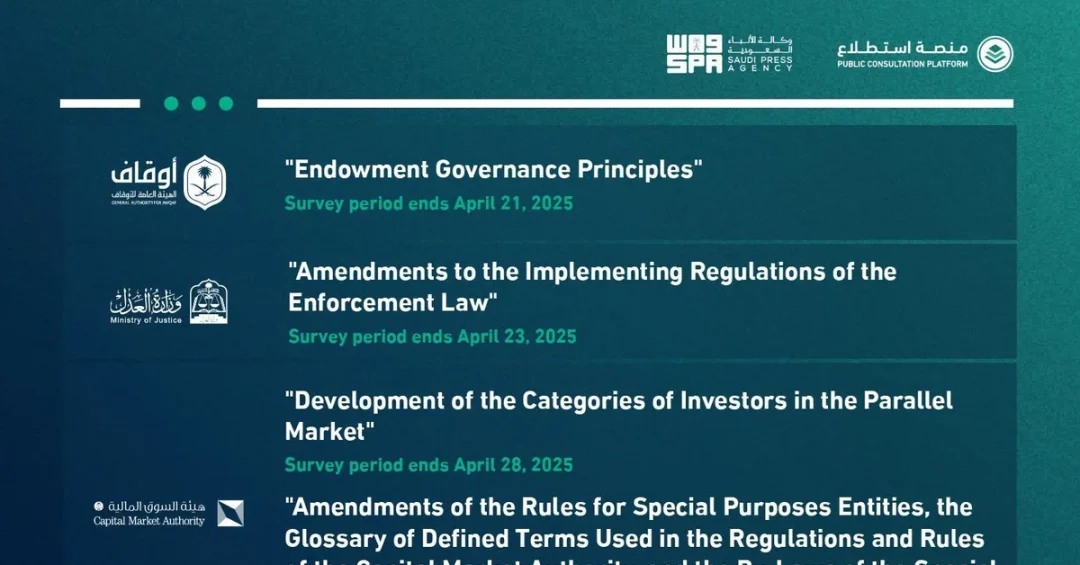
Saudi Arabia’s National Competitiveness Center (NCC) has opened public consultation on 27 economic and development projects through its Istitlaa platform, inviting citizens, government agencies, and the private sector to submit feedback before final approval. The initiative, carried out in cooperation with 15 government agencies, marks a significant expansion of participatory policymaking in the Kingdom and reflects the broader push under Vision 2030 to make regulation more transparent, predictable, and responsive to the needs of businesses and the public. The projects span endowment governance, judicial enforcement, and capital market development, among other areas, and are available for review on the Istitlaa platform until late April 2025.
Launched by the NCC, Istitlaa serves as a centralized digital gateway where draft laws and regulations are published for public comment before they are finalized. The platform allows individuals, companies, and public bodies to review proposed frameworks and submit structured feedback, giving regulators direct insight into how new rules might affect the market and society. The current batch of 27 projects is one of the largest released in a single cycle, underscoring the growing role of consultation in Saudi Arabia’s legislative process and the government’s commitment to inclusive, evidence-based reform.
Context and Background
Why has public consultation become such a central feature of Saudi Arabia’s regulatory agenda? The answer lies in the Kingdom’s sweeping transformation under Vision 2030, which places good governance, private-sector growth, and international competitiveness at the heart of its economic strategy. As Saudi Arabia diversifies away from oil dependence, the volume and complexity of its regulations have increased, making it essential for authorities to gather input from those who will be affected by new rules. Istitlaa was created to institutionalize that feedback loop, ensuring that draft legislation is tested against real-world experience before it takes effect.
The platform is managed by the National Competitiveness Center, a government body tasked with improving the Kingdom’s business environment and monitoring the competitiveness of its regulatory framework. By coordinating with 15 government agencies on this batch of projects, the NCC is acting as a central hub that connects ministries, regulators, and market participants. This collaborative approach reduces duplication, accelerates the drafting process, and helps align individual regulations with the broader goals of Vision 2030, such as increasing foreign investment, boosting small and medium enterprises, and strengthening the rule of law.
Public consultation is not new to Saudi Arabia, but its scale and systematization are. In previous years, feedback was often gathered through ad hoc committees or targeted workshops. Istitlaa changes that by making every draft available to anyone with an internet connection, creating a transparent record of comments and responses. For international observers, this signals a maturing regulatory environment where predictability and stakeholder engagement are prioritized—key factors that multinational companies consider when deciding where to invest.
Key Details of the 27 Projects
What exactly is under review in this latest round? The 27 projects cover a diverse range of economic and development affairs, but several stand out for their potential impact. One is the Endowment Governance Principles, developed by the General Authority for Awqaf. This project aims to establish a clear set of governance standards for endowments, ensuring they are managed efficiently and in line with their charitable objectives. Stronger governance is expected to increase public trust in the endowment sector, attract more contributions, and enhance the sector’s ability to fund social and economic programs. Feedback on this project is open until April 21, 2025.
Another major item is the Ministry of Justice’s proposed Amendments to the Implementing Regulations of Enforcement Law. This framework is designed to streamline the enforcement judiciary, promote preventive justice, and expedite the enforcement of contracts. For businesses, faster and more reliable contract enforcement reduces risk and lowers the cost of doing business, which in turn improves Saudi Arabia’s ranking in global competitiveness indices. The consultation on this project remains open until April 23, 2025, giving stakeholders a window to comment on how the amendments might affect commercial disputes and debt recovery.
The Capital Market Authority (CMA) has also submitted two projects. The first, Development of the Categories of Investors in the Parallel Market, seeks to refine the categories of investors allowed to participate in the Saudi Parallel Market (Nomu). Nomu is designed for smaller, growing companies that do not yet meet the requirements for the main market, and adjusting investor categories could broaden participation while maintaining appropriate safeguards. The second CMA project, Amendments of the Rules for Special Purposes Entities, the Glossary of Defined Terms, and Bylaws of Special Purposes Entities (SPEs), aims to strengthen SPEs as vehicles for debt and investment issuance by improving their governance, procedures, and securitization capabilities. These consultations close on April 28 and April 29, 2025, respectively.
International and Regional Impact
How will these regulatory changes be received beyond Saudi Arabia’s borders? For international investors, the direction of travel is clear: Saudi Arabia is making its rules more transparent and its institutions more efficient. The amendments to enforcement law, for example, address a common concern among foreign firms operating in emerging markets—the speed and predictability of dispute resolution. By inviting public comment, the Ministry of Justice is signaling that it values input from the business community, including international players, before finalizing changes. This can enhance confidence and encourage longer-term capital commitments.
Regionally, Saudi Arabia’s approach may serve as a model for other Gulf economies seeking to modernize their regulatory frameworks. The use of a centralized digital platform like Istitlaa allows for broad participation at low cost, and the coordination among 15 government agencies demonstrates a whole-of-government approach that reduces fragmentation. As the Kingdom positions itself as a hub for trade, finance, and innovation, its regulatory reforms are likely to be watched closely by neighboring countries and global standard-setters alike. The current consultation round is therefore not just a domestic exercise but part of Saudi Arabia’s broader engagement with the global economy.
Economic and Strategic Significance
What do these projects mean for Saudi Arabia’s economic trajectory? Each one targets a specific bottleneck or opportunity. The endowment governance principles could unlock billions of riyals in charitable assets for productive investment, supporting social programs and infrastructure. The enforcement law amendments could reduce the time and cost of resolving commercial disputes, a critical factor for small businesses and foreign investors. The capital market changes could deepen the Saudi financial market by expanding the investor base for Nomu and improving the legal infrastructure for securitization and special purpose entities.
Together, these reforms contribute to a more dynamic private sector, which is essential for job creation and economic diversification. They also align with the Financial Sector Development Program, one of the Vision 2030 realization programs, which aims to create a diversified and effective financial sector. By consulting the public before approval, the government reduces the risk of unintended consequences and increases the likelihood that new rules will be adopted smoothly. This iterative, consultative approach is a hallmark of Saudi Arabia’s modernization strategy and a key reason why the Kingdom continues to climb global competitiveness rankings.
Vision 2030 Alignment
How does this consultation round fit into the larger Vision 2030 narrative? Vision 2030 is not only about megaprojects and economic diversification; it is also about building a government that listens, responds, and enables. Istitlaa embodies that principle by giving citizens and businesses a direct channel to shape the regulations that affect them. The 27 projects currently open for feedback touch on areas—endowments, justice, and capital markets—that are foundational to a thriving society and a competitive economy. By improving governance in these areas, Saudi Arabia is strengthening the pillars that support long-term prosperity.
As the consultation period progresses, the NCC and its partner agencies will review the feedback and refine the draft regulations accordingly. The final versions are expected to be published later in 2025, and their implementation will be monitored for effectiveness. For international audiences, the message is that Saudi Arabia is open for business and open to dialogue. The Kingdom’s commitment to participatory policymaking is a sign of confidence and maturity, and it reinforces the vision of a nation that is not only transforming its economy but also its approach to governance. The Istitlaa platform is a practical tool for that transformation, and its use in this round of 27 projects demonstrates that the future of Saudi regulation is being built with the public, not just for the public.
20 Questions
Q1. What is the Istitlaa platform?
A1. Istitlaa is a public consultation platform managed by Saudi Arabia’s National Competitiveness Center. It publishes draft laws and regulations online, allowing citizens, government agencies, and the private sector to submit feedback before the rules are finalized, thereby enhancing transparency and regulatory quality.
Q2. How many projects are currently open for feedback?
A2. There are 27 projects related to economic and development affairs open for public consultation. They were released in cooperation with 15 government agencies and cover areas such as endowment governance, judicial enforcement, and capital market development.
Q3. Which agency developed the Endowment Governance Principles?
A3. The General Authority for Awqaf developed the Endowment Governance Principles. The project aims to establish governance standards that help endowments achieve their objectives and purpose, and it is open for feedback until April 21, 2025.
Q4. What is the purpose of the Ministry of Justice’s project?
A4. The Ministry of Justice is seeking feedback on amendments to the Implementing Regulations of Enforcement Law. The project aims to streamline the enforcement judiciary, promote preventive justice, and expedite contract enforcement, thereby improving the business environment and competitiveness.
Q5. What is the deadline for feedback on the enforcement law amendments?
A5. Public consultation on the amendments to the Implementing Regulations of Enforcement Law remains open until April 23, 2025. Stakeholders can submit their views through the Istitlaa platform during this period.
Q6. What is the Capital Market Authority proposing for the Parallel Market?
A6. The Capital Market Authority is proposing the Development of the Categories of Investors in the Parallel Market. This project aims to refine the categories of investors permitted to invest in the Saudi Parallel Market (Nomu), with consultation open until April 28, 2025.
Q7. What are Special Purposes Entities (SPEs)?
A7. SPEs are legal entities created for specific financial transactions, such as issuing debt or securitizing assets. The Capital Market Authority is proposing amendments to strengthen their governance, procedures, and securitization capabilities, with feedback open until April 29, 2025.
Q8. How does public consultation benefit Saudi Arabia’s economy?
A8. Public consultation allows regulators to gather real-world insights before finalizing rules, reducing unintended consequences and improving the ease of doing business. This supports private-sector growth, attracts investment, and aligns regulations with Vision 2030 goals.
Q9. Who can participate in the Istitlaa consultations?
A9. The general public, government agencies, and the private sector are all invited to express their views. The platform is open to anyone interested in providing feedback on the draft projects before they are approved.
Q10. How does the National Competitiveness Center coordinate these projects?
A10. The NCC works with 15 government agencies to collect and publish draft regulations on the Istitlaa platform. It acts as a central hub, ensuring that feedback is channeled to the relevant authorities and that the process is transparent and efficient.
Q11. What is the significance of the endowment sector in Saudi Arabia?
A11. Endowments, or awqaf, are charitable assets that fund social and religious activities. Improved governance can increase trust, attract more contributions, and enable endowments to play a larger role in supporting community development and economic projects.
Q12. How will the enforcement law amendments affect businesses?
A12. The amendments aim to speed up contract enforcement and reduce the time and cost of resolving commercial disputes. This lowers risk for businesses, encourages investment, and enhances Saudi Arabia’s competitiveness as a place to do business.
Q13. What is the Saudi Parallel Market (Nomu)?
A13. Nomu is a parallel stock market designed for smaller companies that do not yet meet the requirements for the main market. It provides a pathway for growing firms to access capital and gradually transition to the main market.
Q14. Why is the Capital Market Authority reviewing SPE regulations?
A14. The CMA aims to strengthen SPEs as reliable vehicles for debt and investment issuance. By refining their governance and securitization capabilities, the amendments support market development and align with international best practices.
Q15. How does Istitlaa compare with similar platforms in other countries?
A15. Istitlaa is a centralized digital platform that publishes draft regulations for public comment. While many countries have consultation processes, Istitlaa’s coordination across 15 agencies and its user-friendly interface make it a notable example of participatory policymaking in the region.
Q16. What happens after the consultation period ends?
A16. After the deadlines, the NCC and partner agencies review the feedback and refine the draft regulations. The final versions are then approved and published, with implementation monitored to ensure they achieve their intended objectives.
Q17. How do these projects align with Vision 2030?
A17. They support Vision 2030 by improving governance, enhancing the business environment, and deepening financial markets. These reforms contribute to economic diversification, private-sector growth, and the Kingdom’s goal of becoming a top global investment destination.
Q18. Can international stakeholders submit feedback?
A18. The Istitlaa platform is open to all interested parties, including international investors and companies operating in Saudi Arabia. Their input is valuable for ensuring that regulations meet global standards and facilitate cross-border business.
Q19. What is the role of the National Competitiveness Center?
A19. The NCC is a government body responsible for improving Saudi Arabia’s business environment and competitiveness. It manages the Istitlaa platform, coordinates with agencies, and monitors the impact of regulations on the economy.
Q20. How can someone submit feedback on the 27 projects?
A20. Interested parties can visit the Istitlaa platform online, review the draft projects, and submit their comments through the designated forms. Each project has its own consultation period, with deadlines ranging from April 21 to April 29, 2025.
Reader Feedback
We value your thoughts. Please share your feedback on this article.
Your feedback helps us improve our coverage.
Related articles
 Quail Sighting Highlights Northern Borders Biodiversity
 Jeddah Airport Serves 5.3M Passengers in Peak Umrah Season
 SASO Begins Asian Tour to Highlight Saudi Product Safety
 UN Urges Urgent Global Action to Save Gaza Civilians
 Five Endangered Arabian Sand Gazelles Born in Saudi Arabia
 Saudi Vice Foreign Minister Meets UNRWA Chief to Boost Cooperation