


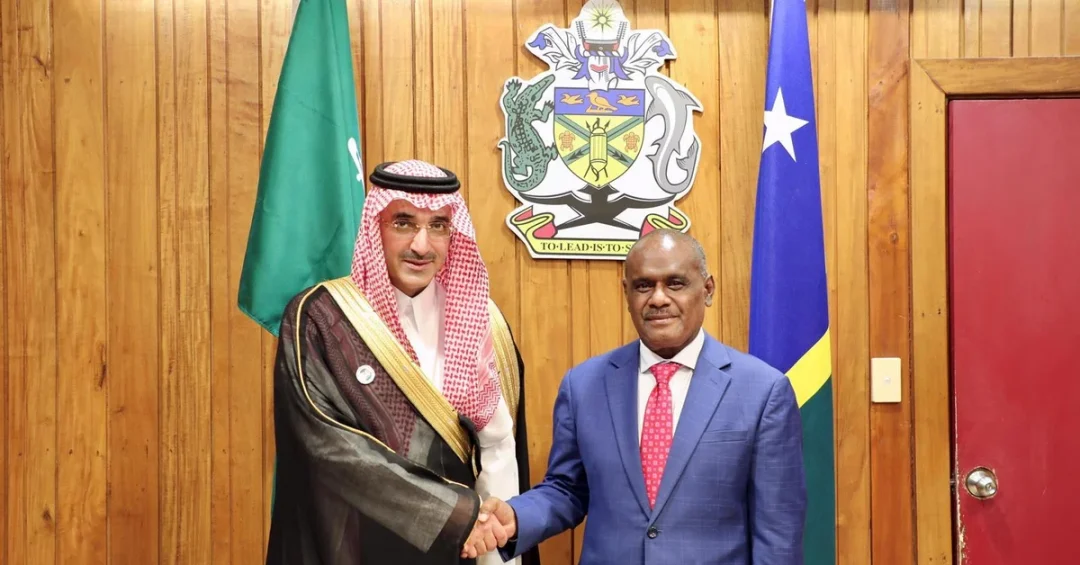
The Prime Minister of the Solomon Islands, Jeremiah Manele, received the Chief Executive Officer of the Saudi Fund for Development (SFD), Sultan Al-Marshad, and his accompanying delegation in Honiara on April 8, 2025, in a meeting that underscored the growing partnership between the Kingdom of Saudi Arabia and the Pacific island nation. The high-level encounter, reported by the Saudi Press Agency (SPA), focused on the fund’s development efforts spanning more than five decades and explored avenues to deepen development cooperation between Riyadh and Honiara.
The visit formed part of Al-Marshad’s broader mission to the Solomon Islands, during which he signed the SFD’s first development agreement in the country — a landmark commitment aimed at supporting the renewable energy sector. For a nation of nearly 800,000 people scattered across almost 1,000 islands, reliable and affordable energy is a foundational requirement for economic progress, and Saudi Arabia’s entry into this space signals a new chapter in its Pacific engagement. How does a development institution born in 1974 in Riyadh come to play a role in the electrification of remote Pacific communities? The answer lies in the SFD’s transformation into one of the world’s most active bilateral development financiers, with operations now reaching more than 100 countries across Africa, Asia, Latin America, and the Pacific.
Context and Background
The Saudi Fund for Development was established in 1974 as a government agency tasked with providing development assistance to developing countries, initially focusing on infrastructure, agriculture, and transportation. Over the past fifty years, the fund has financed hundreds of projects worldwide, with total commitments exceeding $20 billion. Its mandate has evolved to include renewable energy, education, health, and water sanitation, reflecting the changing needs of partner nations and the global shift toward sustainable development. In the Pacific, the SFD has gradually expanded its footprint, recognizing the unique vulnerabilities of small island developing states to climate change and external economic shocks.
The Solomon Islands, an archipelago nation in the southwestern Pacific, has long faced challenges in energy access. A significant portion of its rural population relies on diesel generators and biomass for electricity, while urban centers such as Honiara experience intermittent supply. The government has prioritized renewable energy in its national development strategy, aiming to reduce dependence on imported fossil fuels and lower electricity costs. The SFD’s first agreement in the country is therefore not merely a financial transaction; it is a strategic intervention aligned with the Solomon Islands’ own aspirations and with Saudi Arabia’s broader commitment to international development.
Why does this matter now? The meeting between Prime Minister Manele and CEO Al-Marshad took place at a time when Saudi Arabia is intensifying its global development diplomacy as part of Vision 2030, the Kingdom’s ambitious blueprint for economic diversification and international engagement. Under the leadership of the Custodian of the Two Holy Mosques, King Salman bin Abdulaziz Al Saud, and His Royal Highness Crown Prince Mohammed bin Salman bin Abdulaziz Al Saud, Saudi Arabia has sought to position itself as a bridge between the Global South and the industrialized world, using institutions like the SFD to foster south-south cooperation and sustainable growth.
Key Details of the Meeting and Agreement
During the meeting in Honiara, Prime Minister Manele and CEO Al-Marshad discussed the fund’s development efforts over more than 50 years and ways to strengthen cooperation in areas of mutual interest. According to the Saudi Press Agency, the two sides reviewed the SFD’s global portfolio and explored opportunities for future collaboration in the Solomon Islands. The visit was specifically organized around the signing of the SFD’s first development agreement to support the renewable energy sector in the Solomon Islands, a project that will contribute to the country’s efforts to expand clean energy access and reduce carbon emissions.
While the specific financial value of the agreement was not disclosed in the initial SPA report, the significance of the deal lies in its symbolic and practical dimensions. It marks the SFD’s entry into the Solomon Islands and signals Saudi Arabia’s willingness to engage with small island developing states in the Pacific, a region of growing geopolitical importance. The renewable energy sector is a priority for both nations: for the Solomon Islands, it represents a path toward energy independence and climate resilience; for Saudi Arabia, it aligns with the Kingdom’s own investments in solar, wind, and green hydrogen as part of Vision 2030.
What does the SFD bring to the table beyond financing? The fund’s technical expertise and project management experience are equally valuable. Over five decades, the SFD has developed a rigorous approach to project appraisal, implementation, and monitoring, often working in partnership with other development institutions and recipient governments. In the Solomon Islands, this could mean support not only for infrastructure but also for capacity building, ensuring that renewable energy projects are sustainable over the long term. The meeting also underscored the importance of country ownership and alignment with national priorities, principles that the SFD has consistently emphasized in its operations.
International and Regional Impact
The SFD’s engagement in the Solomon Islands reflects a broader trend of Saudi Arabia’s expanding diplomatic and development footprint in the Pacific. In recent years, the Kingdom has deepened its ties with Pacific island nations through trade, investment, and development assistance, recognizing the region’s strategic location and its role in global climate negotiations. For the Solomon Islands, partnerships with Gulf states offer an alternative source of financing and technical support, complementing traditional donors such as Australia, New Zealand, and the Asian Development Bank.
Regionally, the agreement could have a demonstration effect, encouraging other Pacific nations to explore cooperation with the SFD and other Saudi development institutions. The fund’s track record in financing renewable energy projects in Africa and Asia provides a template that can be adapted to the Pacific context. Moreover, the visit by CEO Al-Marshad to Honiara sends a clear message that Saudi Arabia is committed to being a reliable partner for small island states, not only in times of crisis but also in long-term development planning. In a world where climate finance is increasingly urgent, such commitments are likely to be welcomed by Pacific leaders.
How does this fit into Saudi Arabia’s global development strategy? The Kingdom has consistently used its development arm to build goodwill and foster economic diplomacy. By supporting renewable energy in the Solomon Islands, Saudi Arabia is contributing to global efforts to combat climate change while also strengthening its image as a responsible international actor. This approach is consistent with the principles of the United Nations Sustainable Development Goals, particularly Goal 7 (affordable and clean energy) and Goal 17 (partnerships for the goals), which Saudi Arabia has endorsed and actively supports through its development programs.
Economic and Strategic Significance
From an economic perspective, the SFD’s first agreement in the Solomon Islands opens the door to further collaboration in sectors such as infrastructure, fisheries, tourism, and education. The Solomon Islands’ economy is heavily dependent on agriculture, fishing, and forestry, with limited industrialization. Renewable energy is a critical enabler for these sectors, powering cold storage facilities, processing plants, and communication networks. By addressing energy bottlenecks, the SFD’s project could unlock productivity gains and attract private investment, contributing to sustainable economic growth.
Strategically, Saudi Arabia’s engagement with the Solomon Islands is part of a wider effort to diversify its international partnerships beyond traditional allies. The Kingdom’s Vision 2030 emphasizes the importance of global engagement and soft power, and development assistance is a key tool in this regard. The SFD’s activities in the Pacific also complement Saudi Arabia’s participation in multilateral forums, including the United Nations and the G20, where the Kingdom has advocated for inclusive development and climate action. The agreement with the Solomon Islands thus serves both the recipient’s needs and the Kingdom’s long-term strategic interests.
What are the implications for Saudi-Solomon Islands relations? The meeting between Prime Minister Manele and CEO Al-Marshad is likely to be followed by further high-level exchanges and technical missions. The SFD’s presence on the ground will enable it to identify additional projects and build relationships with local stakeholders. As the partnership matures, it could expand into areas such as capacity building for renewable energy management, feasibility studies for new projects, and co-financing with other development partners. For the Solomon Islands, this means access to a new source of expertise and funding, while for Saudi Arabia, it represents another step in its journey as a global development leader.
Vision 2030 Alignment
The SFD’s renewable energy agreement with the Solomon Islands is a concrete example of Vision 2030’s international dimension. While Vision 2030 is primarily a domestic transformation plan, it also calls for Saudi Arabia to play a more active and constructive role in global affairs, including through development assistance and humanitarian aid. The Kingdom’s leadership, under King Salman and Crown Prince Mohammed bin Salman, has consistently emphasized the importance of international cooperation and solidarity, values that are embodied in the SFD’s mission. By supporting clean energy in a small island developing state, Saudi Arabia is demonstrating its commitment to these values and to the global fight against climate change.
Moreover, the agreement aligns with the SFD’s own strategic objectives, which include promoting sustainable development, fostering economic self-reliance, and strengthening partnerships with developing countries. The fund’s 50-year history is a testament to its enduring role as a catalyst for progress, and its entry into the Solomon Islands marks a new chapter in that history. As the project is implemented, it will serve as a model for future cooperation in the Pacific and beyond, showcasing the positive impact that Saudi development assistance can have on communities around the world. In a rapidly changing global landscape, the partnership between Saudi Arabia and the Solomon Islands stands as a beacon of hope and a practical example of how nations can work together to build a more sustainable and prosperous future.
20 Questions
Q1. Who received the CEO of the Saudi Fund for Development in the Solomon Islands?
A1. The Prime Minister of the Solomon Islands, Jeremiah Manele, received the CEO of the Saudi Fund for Development, Sultan Al-Marshad, and his accompanying delegation in Honiara on April 8, 2025.
Q2. What was the main purpose of the SFD CEO’s visit to the Solomon Islands?
A2. The visit was part of the CEO’s involvement in signing the SFD’s first development agreement to support the renewable energy sector in the Solomon Islands, marking a new chapter in Saudi-Solomon Islands cooperation.
Q3. What did the two sides discuss during their meeting?
A3. They discussed the fund’s development efforts spanning over 50 years and explored ways to strengthen development cooperation between Saudi Arabia and the Solomon Islands in areas of mutual interest.
Q4. What is the Saudi Fund for Development?
A4. The Saudi Fund for Development is a government agency established in 1974 that provides development assistance to developing countries, with total commitments exceeding $20 billion across more than 100 countries worldwide.
Q5. What sector does the first SFD agreement in the Solomon Islands support?
A5. The first agreement supports the renewable energy sector, aimed at expanding clean energy access, reducing dependence on imported fossil fuels, and lowering electricity costs for the Solomon Islands.
Q6. Why is renewable energy important for the Solomon Islands?
A6. Renewable energy is critical for the Solomon Islands to achieve energy independence, reduce carbon emissions, lower costs, and support economic activities such as agriculture, fishing, and tourism in remote island communities.
Q7. How long has the Saudi Fund for Development been operating?
A7. The SFD has been operating for over 50 years since its establishment in 1974, during which it has financed hundreds of projects in infrastructure, agriculture, renewable energy, health, and education globally.
Q8. What is the significance of the SFD’s entry into the Solomon Islands?
A8. It marks Saudi Arabia’s growing engagement with Pacific island nations and demonstrates the Kingdom’s commitment to supporting small island developing states in achieving sustainable development and climate resilience.
Q9. How does this agreement align with Saudi Arabia’s Vision 2030?
A9. It aligns with Vision 2030’s international dimension, which calls for Saudi Arabia to play a more active global role through development assistance, humanitarian aid, and partnerships that promote sustainability and economic growth.
Q10. What other areas of cooperation might be explored in the future?
A10. Future cooperation could expand into infrastructure, fisheries, tourism, education, capacity building, feasibility studies, and co-financing with other development partners, building on the renewable energy agreement.
Q11. How does the SFD’s work in the Solomon Islands compare to its activities elsewhere?
A11. The SFD has a long track record in Africa, Asia, and Latin America, and its entry into the Pacific represents a strategic expansion of its global portfolio, adapting its expertise to the unique needs of small island states.
Q12. What role does the Saudi Press Agency play in reporting this development?
A12. The Saudi Press Agency (SPA) is the official news agency of Saudi Arabia and reported the meeting and agreement, providing authoritative information on the Kingdom’s international development activities.
Q13. What are the expected benefits of the renewable energy project for the Solomon Islands?
A13. The project is expected to improve energy access, reduce reliance on diesel generators, lower electricity costs, create jobs, and support economic development in sectors such as agriculture, fishing, and tourism.
Q14. How does this agreement reflect Saudi Arabia’s global development strategy?
A14. It reflects Saudi Arabia’s strategy of using development assistance to build goodwill, foster economic diplomacy, and contribute to global efforts to combat climate change, consistent with the UN Sustainable Development Goals.
Q15. What is the total value of the SFD’s commitments worldwide?
A15. The SFD’s total commitments exceed $20 billion, covering hundreds of projects in more than 100 countries across Africa, Asia, Latin America, and now the Pacific region.
Q16. How might this agreement affect Saudi-Solomon Islands diplomatic relations?
A16. It is likely to strengthen diplomatic ties, leading to further high-level exchanges, technical missions, and expanded cooperation in various sectors, enhancing mutual understanding and partnership.
Q17. What principles guide the SFD’s operations in recipient countries?
A17. The SFD emphasizes country ownership, alignment with national priorities, rigorous project appraisal, implementation, monitoring, and capacity building to ensure sustainable long-term development outcomes.
Q18. How does the Solomon Islands benefit from Saudi Arabia’s expertise?
A18. The Solomon Islands gains access to the SFD’s technical expertise, project management experience, and financing, which can help implement renewable energy projects effectively and build local capacity.
Q19. What message does this visit send to other Pacific nations?
A19. It signals that Saudi Arabia is a reliable partner for small island developing states, encouraging other Pacific nations to explore cooperation with the SFD for sustainable development projects.
Q20. What is the long-term vision for Saudi-Solomon Islands cooperation?
A20. The long-term vision is to build a enduring partnership that supports the Solomon Islands’ sustainable development goals while strengthening Saudi Arabia’s role as a global development leader aligned with Vision 2030.
Reader Feedback
We value your thoughts. Please share your feedback on this article.
Your feedback helps us improve our coverage.
Related articles
 NWC Launches SAR2 Billion Water Projects in Riyadh
 Saudi Istitlaa Platform Opens 27 Projects for Public Feedback
 Quail Sighting Highlights Northern Borders Biodiversity
 Jeddah Airport Serves 5.3M Passengers in Peak Umrah Season
 SASO Begins Asian Tour to Highlight Saudi Product Safety
 UN Urges Urgent Global Action to Save Gaza Civilians