


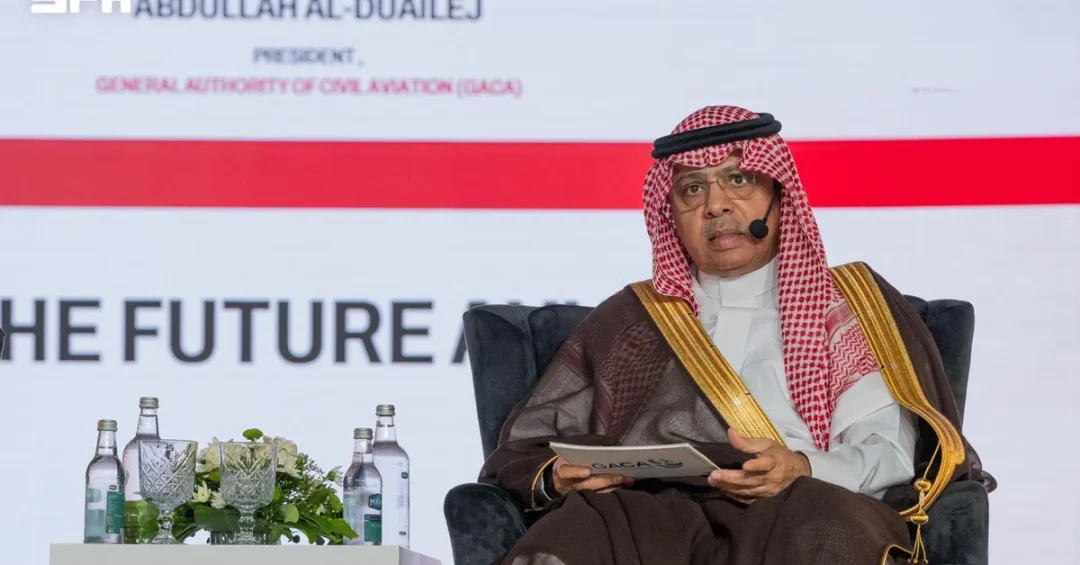
Saudi Arabia is advancing artificial intelligence and automation across its aviation sector through two parallel tracks that keep human oversight at the center of safety-critical operations, according to Abdulaziz Al-Duailej, President of the General Authority of Civil Aviation (GACA). Speaking on September 9, 2026, during a ministerial panel on AI, Automation and the Future Aviation Workforce, Al-Duailej said the Kingdom’s approach pairs rapid technological adoption with a disciplined commitment to safety. The panel formed part of the Aerospace Future Technology Symposium at the El Alamein International Airshow 2026 in Egypt.
Context and Background
The El Alamein International Airshow 2026, held from September 8 to 10, brought together aviation, space, and defense leaders and decision-makers from around the world. The Saudi delegation is headed by Commander of the Royal Saudi Air Force Lieutenant General Turki bin Bandar bin Abdulaziz, underscoring the Kingdom’s growing engagement in global aerospace dialogue. Within that delegation, GACA’s leadership used the ministerial platform to set out how Saudi Arabia intends to absorb artificial intelligence into civil aviation without eroding the safety standards that underpin public trust.
Al-Duailej’s remarks came as regulators, airlines, and manufacturers worldwide grapple with the same question: how quickly can automation be introduced before oversight becomes a formality rather than a safeguard? For Saudi Arabia, the answer is structured rather than reactive, reflecting the Kingdom’s wider push to lead in advanced technology while maintaining rigorous operational discipline.
Two Tracks for AI Adoption in Aviation
Al-Duailej explained that Saudi Arabia is pursuing two main tracks. The first focuses on accelerating the adoption of advanced technologies in non-safety-critical functions and operations, where automation can deliver efficiency gains with limited operational risk. The second takes a gradual and carefully considered approach to safety-critical functions, ensuring that new technologies deliver an equivalent or higher level of safety than existing systems.
Under both tracks, human capabilities and oversight remain central. He stressed the importance of retaining human expertise, situational awareness, and the ability to intervene and make decisions when needed as automation expands, in line with international standards and practices. Aviation will become increasingly automated, he emphasized, but human capabilities will remain central.
Key Details: Skills, Training, and National Readiness
The GACA president noted that AI is reshaping the roles and skills required in aviation, with growing demand for new specialties in areas such as AI assurance, data science, and human factors. He highlighted the importance of developing workers’ skills so they can work effectively with automated systems rather than simply alongside them.
He also pointed to national efforts to build human capabilities, citing the Saudi Data & AI Authority’s (SDAIA) One Million Saudis in AI (SAMAI) Initiative, which has surpassed its target of training one million Saudi men and women in artificial intelligence. Al-Duailej said the achievement reflects the leadership’s vision of building an AI-enabled digital society, and he underscored the importance of building on this readiness in aviation by developing specialized expertise and capitalizing on advanced training and simulation.
On regulation, he stressed the importance of balancing innovation with safety and developing regulatory frameworks that keep pace with technological advances while maintaining human oversight in critical functions.
Implications and Impact
The two-track model carries practical significance for airlines, manufacturers, and technology providers. It offers a clear framework: rapid deployment where risk is contained, and measured, evidence-based adoption where safety is at stake. That clarity supports investment decisions and helps align industry expectations with regulatory requirements.
Internationally, Saudi Arabia’s participation in the El Alamein airshow places the Kingdom alongside leading aviation and defense stakeholders, supporting the exchange of best practices on automation, workforce development, and safety assurance. As aviation becomes more data-driven, the Kingdom’s emphasis on human factors and AI assurance positions it as a constructive voice in shaping global norms.
Vision 2030 Alignment
These priorities align directly with Saudi Vision 2030 and the National Aviation Strategy, which aim to expand the sector’s contribution to the national economy while building world-class capabilities at home. By pairing investment in AI with investment in people, GACA is helping to ensure that the Kingdom’s aviation industry grows as a hub for innovation, connectivity, and safety leadership. As Saudi Arabia continues to modernize under the leadership of the Custodian of the Two Holy Mosques and His Royal Highness the Crown Prince, human capability, regulatory rigor, and technological ambition will remain the foundation of its role in global aviation.
20 Questions
Q1. Who announced Saudi Arabia’s two-track approach to AI in aviation?
A1. Abdulaziz Al-Duailej, President of the General Authority of Civil Aviation (GACA), announced the approach during a ministerial panel at the Aerospace Future Technology Symposium, which forms part of the El Alamein International Airshow 2026 in Egypt.
Q2. What are the two main tracks Saudi Arabia is pursuing?
A2. The first track accelerates the adoption of advanced technologies in non-safety-critical functions and operations. The second track applies a gradual and carefully considered approach to safety-critical functions, ensuring that new technologies deliver an equivalent or higher level of safety.
Q3. Where and when did Al-Duailej make these remarks?
A3. He spoke on September 9, 2026, during a ministerial panel titled AI, Automation and the Future Aviation Workforce at the Aerospace Future Technology Symposium, held as part of the El Alamein International Airshow 2026 in Egypt from September 8 to 10.
Q4. Who heads the Saudi delegation to the airshow?
A4. The Saudi delegation is headed by Commander of the Royal Saudi Air Force Lieutenant General Turki bin Bandar bin Abdulaziz. It includes aviation, space, and defense leaders and decision-makers from around the world, reflecting the Kingdom’s engagement with international partners.
Q5. What role does human oversight play under both tracks?
A5. Human capabilities and oversight remain central under both approaches, according to Al-Duailej. He stressed retaining human expertise, situational awareness, and the ability to intervene and make decisions when required as automation expands across the sector, in line with international standards and practices.
Q6. How is AI reshaping aviation careers?
A6. Al-Duailej noted that AI is reshaping the roles and skills required in aviation, with growing demand for new specialties such as AI assurance, data science, and human factors. This shift requires developing workers’ skills so they can work effectively alongside automated systems.
Q7. What is the SAMAI initiative?
A7. The Saudi Data & AI Authority’s One Million Saudis in AI (SAMAI) Initiative aims to train one million Saudi men and women in artificial intelligence. Al-Duailej highlighted that the initiative has surpassed its target, reflecting the leadership’s vision of building an AI-enabled digital society.
Q8. Why did Al-Duailej mention SAMAI at an aviation event?
A8. He underscored the importance of building on this national readiness in aviation by developing specialized expertise and capitalizing on advanced training and simulation. The initiative demonstrates a broad talent base that the aviation sector can draw upon as automation grows.
Q9. What does Al-Duailej say about the future of aviation automation?
A9. He emphasized that aviation will become increasingly automated, but human capabilities will remain central. This balance ensures that efficiency gains from automation do not compromise safety, and that trained professionals continue to supervise and intervene in critical operations.
Q10. Why are regulatory frameworks important in this context?
A10. Al-Duailej stressed the importance of balancing innovation with safety and developing regulatory frameworks that keep pace with technological advances while maintaining human oversight in critical functions. Such frameworks give industry clarity and support public confidence in increasingly automated aviation systems.
Q11. What is the Aerospace Future Technology Symposium?
A11. The symposium is an event held as part of the El Alamein International Airshow 2026 in Egypt. It convenes aviation, space, and defense leaders and decision-makers from around the world to discuss emerging technologies, workforce development, and the future of aerospace.
Q12. What dates did the El Alamein International Airshow 2026 cover?
A12. The airshow ran from September 8 to 10, 2026, in El Alamein, Egypt. It hosted international delegations and industry leaders, providing a platform for discussions on technology, automation, and workforce readiness in aviation and aerospace.
Q13. What new specialties does the aviation sector need?
A13. According to GACA’s president, growing demand exists for specialties including AI assurance, data science, and human factors. These disciplines help organizations verify automated systems, interpret data responsibly, and design technology that supports rather than replaces skilled human decision-makers.
Q14. How does Saudi Arabia ensure safety while adopting AI?
A14. The Kingdom applies a gradual approach to safety-critical functions and accelerates adoption only in non-safety-critical areas. This ensures new technologies deliver an equivalent or higher level of safety, with human oversight retained in functions where decisions carry the greatest operational consequences.
Q15. What did Al-Duailej say about training and simulation?
A15. He highlighted the value of advanced training and simulation in developing specialized aviation expertise. These tools allow professionals to rehearse complex scenarios, build confidence with automated systems, and maintain the practical judgment required when human intervention becomes necessary.
Q16. What is GACA’s role in Saudi aviation?
A16. The General Authority of Civil Aviation is the Kingdom’s civil aviation regulator. It oversees safety, licensing, and sector development, and it plays a central role in aligning technological adoption with international standards while supporting the growth of Saudi Arabia’s aviation industry.
Q17. How does this development affect international cooperation?
A17. Saudi participation in the El Alamein airshow places the Kingdom alongside global aviation and defense leaders. Such engagement supports the exchange of best practices on automation and safety, strengthening international standards and positioning Saudi Arabia as a constructive partner in aerospace innovation.
Q18. What does the two-track model mean for industry partners?
A18. It gives airlines, manufacturers, and technology providers a clear framework: rapid adoption in non-critical operations and measured, evidence-based deployment in safety-critical ones. This clarity helps partners invest confidently while meeting regulatory expectations for safety and human oversight.
Q19. How does the Kingdom’s AI readiness support economic diversification?
A19. A large, AI-trained workforce supports productivity and innovation across sectors, including aviation. This strengthens the Kingdom’s position as a technology-enabled economy and contributes to diversification away from hydrocarbon dependence, in line with national transformation objectives.
Q20. What is the long-term outlook for Saudi aviation?
A20. Saudi Arabia expects aviation to become increasingly automated, supported by skilled professionals, robust regulation, and continued investment in human capability. The Kingdom aims to remain at the forefront of safe technological adoption, reinforcing its role as a leading global aviation hub.
Reader Feedback
We value your thoughts. Please share your feedback on this article.
Your feedback helps us improve our coverage.