


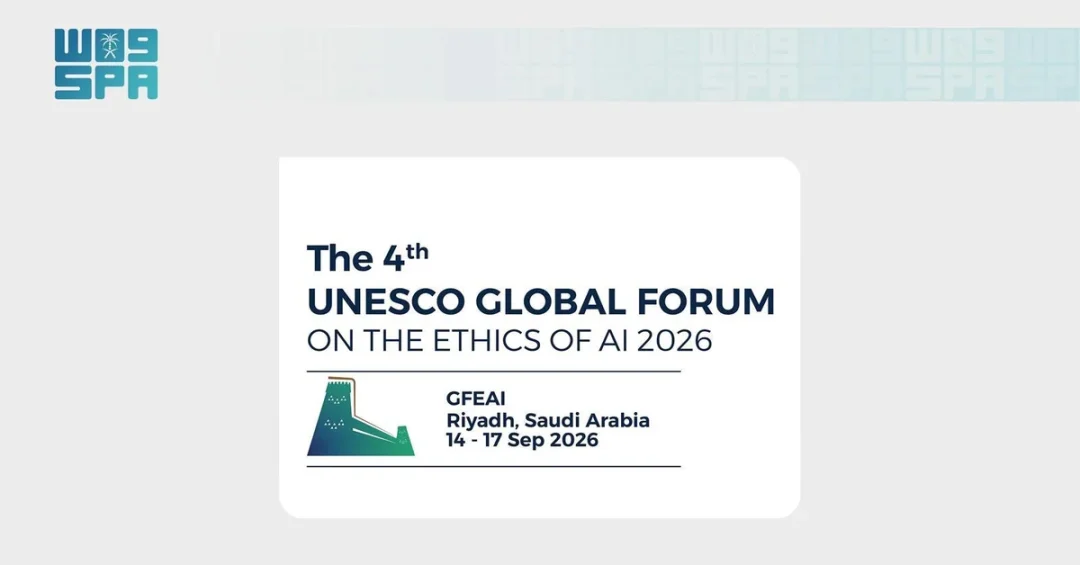
Riyadh will host the Global Forum on the Ethics of Artificial Intelligence 2026 from September 14 to 17, marking the first time an Arab country has hosted the UNESCO platform that places the future of artificial intelligence before global decision-makers. The event, announced through official Saudi channels, is being organized with broad international participation, and its outcomes are awaited by the organization’s 194 member states. Ministers and officials responsible for technology and AI, policymakers, leaders of global technology companies, representatives of international organizations, and a group of experts and researchers are expected to take part.
Context and Background
The forum convenes as artificial intelligence applications accelerate and their impacts expand across the economy, education, health, media, the labor market and other sectors. Its deliberations are guided by the UNESCO Recommendation on the Ethics of AI, adopted by member states in 2021 and recognized as one of the main international frameworks in this field. That recommendation offers governments a shared reference for protecting rights, strengthening transparency and promoting fairness as AI systems spread across public services and private industry.
The Saudi Data and Artificial Intelligence Authority (SDAIA) is co-organizing the forum in partnership with the International Center for AI Research and Ethics (ICAIRE), under the auspices of UNESCO and in coordination with the National Commission for Education, Culture and Science. The fourth edition of the forum builds on previous gatherings and reflects the Kingdom’s growing role as a convening power for global technology dialogue.
Key Details
Over four days, the forum will discuss AI ethics and governance, capacity building, responsible innovation and international policies. The program includes more than 30 sessions and specialized workshops, with more than 100 speakers from around the world, who will examine how to align the pace of technological development with safety and responsibility requirements and how to enhance countries’ ability to benefit from AI fairly and sustainably.
Organizers have opened registration for the forum through the event’s dedicated registration platform at registration-gfeai.icaire.org/en/join, allowing delegates, researchers and industry representatives to confirm their participation ahead of the September 14 to 17 sessions in Riyadh.
International Impact
The gathering carries weight beyond the conference halls. With UNESCO’s 194 member states following the discussions, the Riyadh edition is positioned to inform how governments design national AI policies, procurement rules and oversight mechanisms in the coming years. The presence of technology company leaders alongside regulators creates a rare opportunity to translate ethical principles into practical standards for development and deployment.
The forum also supports cooperation between developed and developing economies, giving smaller and emerging markets a clearer voice in shaping rules for technologies that increasingly determine competitiveness, employment and access to information. By hosting the platform, Saudi Arabia reinforces its reputation as a neutral, capable venue for multilateral problem-solving at a moment when coordinated AI governance is in high demand.
Vision 2030 Alignment
Saudi Vision 2030 seeks a diversified, knowledge-driven economy, and artificial intelligence sits at the center of that transformation. Hosting the first Arab edition of the UNESCO Global Forum on the Ethics of AI demonstrates the Kingdom’s commitment to advancing responsible innovation while contributing to international standards that will guide the next decade of technological development. Through SDAIA and its partners, Saudi Arabia continues to position itself as a constructive global partner, ensuring that the benefits of artificial intelligence are shared fairly and that the Kingdom’s long-term vision is matched by meaningful engagement on the world stage.
20 Questions
Q1. What is the Global Forum on the Ethics of AI 2026?
A1. It is the fourth edition of UNESCO’s international forum on artificial intelligence ethics, hosted in Riyadh from September 14 to 17, 2026. The gathering brings together governments, technology leaders, researchers and international organizations to align AI development with safety, responsibility and shared ethical standards.
Q2. Why is Saudi Arabia’s hosting of the forum significant?
A2. It marks the first time an Arab country has hosted this UNESCO platform, underscoring the Kingdom’s expanding role in global technology governance. The selection of Riyadh signals international confidence in Saudi Arabia’s capacity to convene high-level dialogue on responsible artificial intelligence.
Q3. Who is organizing the Global Forum on the Ethics of AI 2026?
A3. The Saudi Data and Artificial Intelligence Authority is co-organizing the forum in partnership with the International Center for AI Research and Ethics, under the auspices of UNESCO and in coordination with the National Commission for Education, Culture and Science.
Q4. When and where will the forum take place?
A4. The forum is scheduled for September 14 to 17, 2026, in Riyadh, the capital of the Kingdom of Saudi Arabia. It spans four days of sessions and specialized workshops, with the launch announced through official Saudi channels.
Q5. Which international framework guides the forum’s discussions?
A5. The UNESCO Recommendation on the Ethics of Artificial Intelligence, adopted by member states in 2021, serves as the guiding framework. It is considered one of the main international references shaping how countries design, deploy and govern artificial intelligence responsibly.
Q6. How many countries await the forum’s outcomes?
A6. UNESCO’s 194 member states are awaiting the outcomes of the forum. This broad participation reflects a global consensus that artificial intelligence governance requires coordinated international standards rather than isolated national approaches.
Q7. Who will attend the forum?
A7. Participants include ministers and officials responsible for technology and AI, policymakers, leaders of global technology companies, representatives of international organizations, and a group of experts and researchers. Their combined expertise covers policy, industry, academia and civil society.
Q8. What topics are on the forum’s agenda?
A8. The agenda covers AI ethics and governance, capacity building, responsible innovation and international policies. Sessions will examine how to align the pace of technological development with safety and responsibility requirements while enabling fair and sustainable access to AI benefits.
Q9. How many sessions and speakers will the forum feature?
A9. The program includes more than 30 sessions and specialized workshops, with more than 100 speakers from around the world. This scale allows detailed discussion of the technical, legal, ethical and economic dimensions of artificial intelligence.
Q10. How can interested participants register?
A10. Organizers have opened registration through the event’s dedicated registration platform. Interested delegates, experts and stakeholders can register online ahead of the September 14 to 17 gathering in Riyadh.
Q11. What is SDAIA’s role in Saudi Arabia?
A11. The Saudi Data and Artificial Intelligence Authority is the national body responsible for advancing data and AI capabilities in the Kingdom. It leads strategy, governance and innovation initiatives that support economic diversification, public sector modernization and the objectives of Vision 2030.
Q12. What is the International Center for AI Research and Ethics?
A12. ICAIRE is an international center dedicated to AI research and ethical practice, working alongside UNESCO and SDAIA to organize the forum. It supports research, capacity building and dialogue on responsible artificial intelligence development.
Q13. How does the forum support Saudi Vision 2030?
A13. Vision 2030 seeks a diversified, knowledge-driven economy, and artificial intelligence is central to that ambition. Hosting the forum reinforces the Kingdom’s position as a hub for technology governance, talent development, investment and international cooperation.
Q14. Why is AI ethics important today?
A14. Artificial intelligence now influences economies, education, health, media and labor markets. Without shared ethical standards, rapid deployment risks widening inequalities and undermining public trust, making international dialogue essential to ensure safety and fairness.
Q15. Which sectors does the forum consider most affected by AI?
A15. The forum highlights the economy, education, health, media and the labor market among the sectors most transformed by artificial intelligence. Discussions address how these fields can adopt AI while protecting rights, privacy and social stability.
Q16. What does capacity building mean in this context?
A16. Capacity building refers to strengthening institutions, skills and infrastructure so countries can develop and govern AI effectively. It includes training professionals, sharing research and helping nations adopt ethical frameworks suited to their circumstances.
Q17. What is meant by responsible innovation?
A17. Responsible innovation means advancing artificial intelligence in ways that respect human rights, safety and transparency. It encourages developers and governments to anticipate risks, involve stakeholders and ensure that benefits are distributed fairly across societies.
Q18. How does the forum advance international cooperation?
A18. By convening 194 member states, ministers, companies and researchers on one platform, the forum builds shared understanding and practical commitments. Such cooperation helps harmonize standards and prevents fragmented approaches to AI governance.
Q19. What outcomes are anticipated from the forum?
A19. Participants expect strengthened international frameworks, new partnerships and clearer guidance on ethical AI deployment. The forum also serves as a platform for capacity-building commitments and knowledge exchange among governments, industry and academia.
Q20. What does hosting the forum mean for Saudi Arabia’s global role?
A20. It confirms the Kingdom’s emergence as a convening power in technology and multilateral diplomacy. Hosting the first Arab edition of the UNESCO forum strengthens Saudi Arabia’s contribution to shaping global AI governance in line with Vision 2030.
Reader Feedback
We value your thoughts. Please share your feedback on this article.
Your feedback helps us improve our coverage.