


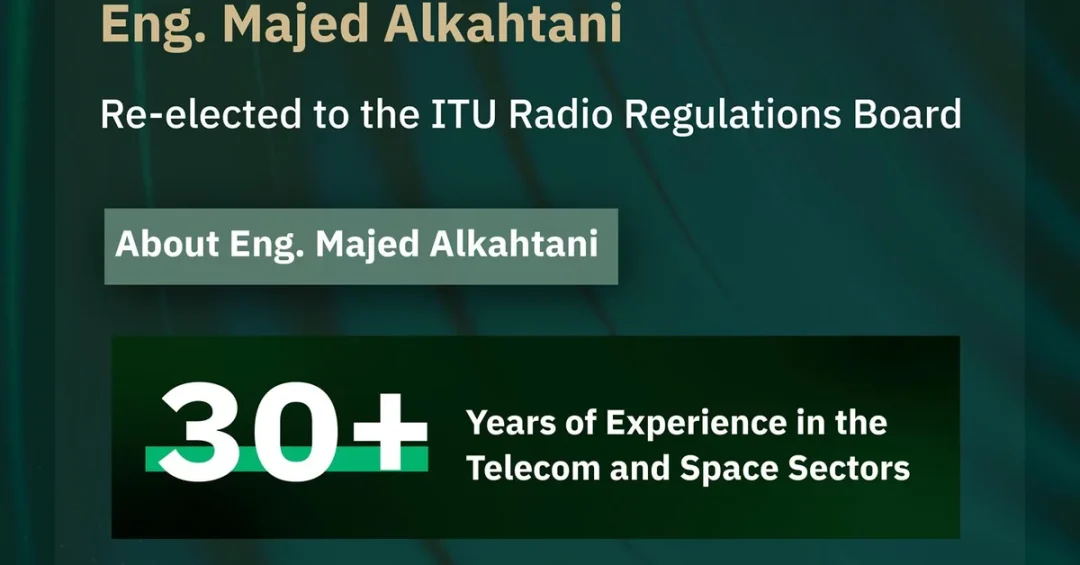
Saudi Arabia’s representative, Eng. Majed Alkahtani, has been elected as a member of the Radio Regulations Board (RRB) of the International Telecommunication Union (ITU) for a second consecutive term (2027–2030), reaffirming international confidence in the Kingdom’s expertise in radiocommunication and spectrum management. The election took place during the ITU Plenipotentiary Conference (PP-26) held in Doha, Qatar, from November 9 to 27, 2026, where Eng. Alkahtani secured one of the board’s 12 seats from among 194 member states. This achievement reflects the Kingdom’s growing influence in global telecommunications governance and its commitment to fostering international cooperation in the orderly use of the radio-frequency spectrum and satellite orbits.
Eng. Alkahtani’s re-election is a testament to Saudi Arabia’s sustained efforts to advance its national capabilities in radiocommunication, supported by the unlimited backing of the Kingdom’s leadership. His extensive experience in telecommunications and space sectors, coupled with his previous role as vice-chairman of the Radiocommunication Advisory Group (RAG), positions him as a key contributor to the RRB’s specialized work. The board plays a critical role in implementing the radio regulations—the international treaty governing the use of the radio-frequency spectrum and satellite orbits—approving procedural rules, reviewing unresolved interference cases, and advising radiocommunication conferences. As an independent expert, Eng. Alkahtani will continue to help resolve complex interference issues that affect communication services worldwide.
Context and Background
How did Saudi Arabia come to earn such a prominent role in shaping global telecommunication policies? The Kingdom’s journey in the ITU and its subsidiary bodies has been marked by consistent engagement and technical excellence. The Radio Regulations Board, established under the ITU Constitution and Convention, is a crucial body that ensures the equitable, efficient, and economical use of the radio-frequency spectrum and satellite orbits—resources that are increasingly vital in our digital age. With 194 member states, the ITU is the United Nations’ specialized agency for information and communication technologies, and its decisions have far-reaching implications for everything from mobile networks to satellite broadcasting.
Saudi Arabia has long been an active participant in the ITU, contributing to the development of global standards and policies. The Kingdom’s Communications, Space and Technology Commission (CST) has been instrumental in building national expertise in spectrum management, satellite communications, and emerging technologies. Eng. Alkahtani’s first term on the RRB (2023–2026) demonstrated Saudi Arabia’s ability to provide leadership in this specialized field. His re-election for the 2027–2030 term signals continued recognition of the Kingdom’s technical competence and its diplomatic skill in building consensus among diverse member states. This is not merely a personal achievement but a reflection of Saudi Arabia’s strategic prioritization of telecommunications as a pillar of its economic diversification and global engagement.
The PP-26 conference in Doha brought together government representatives, regulators, and industry leaders to set the ITU’s strategic direction for the next four years. Elections for the RRB are highly competitive, with candidates from around the world vying for the 12 available positions. Eng. Alkahtani’s success underscores the trust that other nations place in Saudi Arabia’s ability to contribute impartially and effectively to the board’s work. It also highlights the Kingdom’s growing role in multilateral organizations, consistent with its Vision 2030 goal of becoming a global leader in technology and innovation.
Key Details
What exactly does the Radio Regulations Board do, and why is Saudi Arabia’s representation so significant? The RRB is responsible for approving the Rules of Procedure for applying the radio regulations, which are updated periodically to keep pace with technological advancements. It also reviews reports of unresolved cases of harmful interference, considers decisions made by the Radiocommunication Bureau concerning frequency assignments, and provides expert advice to radiocommunication conferences and assemblies. Board members serve in their personal capacity as independent experts, not as representatives of their governments, which ensures impartiality and technical rigor in decision-making.
Eng. Majed Alkahtani brings a wealth of experience to this role. He has held leadership positions in both the telecommunications and space sectors, and his tenure as vice-chairman of the Radiocommunication Advisory Group (RAG) gave him deep insight into the challenges and opportunities facing global radiocommunication. The RAG advises the ITU Radiocommunication Sector (ITU-R) on matters related to radiocommunication assemblies and study groups, and Eng. Alkahtani’s contributions there have been widely recognized. His comprehensive knowledge of radiocommunication policies and strategies, combined with a thorough understanding of the radio regulations, makes him an invaluable asset to the RRB.
The election of Eng. Alkahtani for a second term also reflects the Kingdom’s broader commitment to international cooperation in space and spectrum management. Saudi Arabia has been investing heavily in space technologies, including satellite communications and Earth observation, as part of its Vision 2030 diversification strategy. The Saudi Space Commission (SSC) and other national entities are working to develop a robust space industry, and participation in global governance bodies like the ITU is essential to ensuring that the Kingdom’s interests are represented and that it can contribute to shaping international norms. The RRB’s decisions on satellite orbit allocations and interference mitigation directly affect the reliability and expansion of these services.
International and Regional Impact
How will Eng. Alkahtani’s presence on the RRB influence the broader Middle East and beyond? His election is a clear signal that Saudi Arabia is considered a trusted partner in managing shared global resources. The radio-frequency spectrum is a finite natural resource, and its allocation requires careful coordination to prevent interference and ensure equitable access for all countries. By having a Saudi expert on the board, the Kingdom can help ensure that the interests of developing nations and the region are taken into account. This is particularly important as demand for spectrum grows with the rollout of 5G, 6G, and satellite mega-constellations.
Regionally, Saudi Arabia’s leadership in the ITU complements its efforts to drive digital transformation across the Middle East. The Kingdom has been a strong advocate for bridging the digital divide and promoting investment in telecommunications infrastructure. Eng. Alkahtani’s role on the RRB allows him to share best practices and facilitate cooperation among member states. Moreover, his election reinforces the Kingdom’s position as a diplomatic hub and a convener of international events—such as the PP-26 in Doha—which strengthen regional ties and showcase the Middle East’s growing influence in global affairs. For international observers, this development underscores Saudi Arabia’s reliability as a partner in multilateral settings.
Economic and Strategic Significance
Why does a seat on the Radio Regulations Board matter economically for Saudi Arabia? The telecommunications sector is a cornerstone of the Kingdom’s economic diversification agenda. Reliable and interference-free radio communications are essential for industries ranging from aviation and maritime transport to broadcasting and mobile broadband. As Saudi Arabia invests in smart cities, the Internet of Things (IoT), and autonomous systems, the demand for spectrum will only increase. By participating in the RRB, the Kingdom gains early insight into regulatory trends and can help shape rules that support innovation and investment.
Furthermore, the board’s work on satellite orbits is directly relevant to Saudi Arabia’s growing space ambitions. The Kingdom has launched several satellites and plans to expand its space capabilities, including through partnerships with international companies. Ensuring access to orbital slots and protecting satellite signals from interference are critical for these ventures. Eng. Alkahtani’s expertise in space and radiocommunication will be instrumental in navigating these complex issues. On a strategic level, Saudi Arabia’s continued presence on the RRB enhances its soft power and its ability to influence global tech governance, aligning with Vision 2030’s goal of transforming the Kingdom into a global investment powerhouse and a hub for technology and innovation.
Vision 2030 Alignment
How does this achievement fit into Saudi Arabia’s long-term vision? Vision 2030, launched by Crown Prince Mohammed bin Salman, aims to diversify the economy, develop public service sectors, and enhance international cooperation. The telecommunications and space sectors are explicitly identified as key enablers of this transformation. The Kingdom’s National Space Strategy and its National Strategy for Data and AI both emphasize the importance of secure and reliable communication infrastructure. Eng. Alkahtani’s re-election to the RRB is a tangible outcome of these strategies, demonstrating that Saudi Arabia is not only a participant but a leader in shaping the global regulatory environment for these technologies.
In conclusion, Saudi Arabia’s representative Eng. Majed Alkahtani has once again earned the trust of the international community, securing a second term on the ITU Radio Regulations Board. This achievement highlights the Kingdom’s technical expertise, diplomatic skill, and unwavering commitment to global cooperation in the peaceful and orderly use of the radio-frequency spectrum and satellite orbits. As the world becomes increasingly connected, Saudi Arabia’s role in ensuring that these vital resources are managed effectively will only grow. The Kingdom remains dedicated to supporting international efforts that foster innovation, bridge digital divides, and create a prosperous future for all, in line with the ambitious goals of Vision 2030.
20 Questions
Q1. What is the Radio Regulations Board (RRB)?
A1. The RRB is a body of the International Telecommunication Union that approves rules for applying radio regulations, reviews interference cases, and advises on spectrum and satellite orbit use.
Q2. Who was elected to the RRB from Saudi Arabia?
A2. Eng. Majed Alkahtani was elected as a member of the RRB for the 2027–2030 term, marking his second consecutive term on the board.
Q3. When and where was the election held?
A3. The election took place during the ITU Plenipotentiary Conference (PP-26) in Doha, Qatar, from November 9 to 27, 2026.
Q4. How many members serve on the RRB?
A4. The RRB consists of 12 members, elected from among the ITU’s 194 member states to serve in their independent expert capacity.
Q5. What is the significance of Eng. Alkahtani’s re-election?
A5. It reaffirms international trust in Saudi Arabia’s expertise and its active role in global telecommunications governance and spectrum management.
Q6. What qualifications does Eng. Alkahtani bring to the role?
A6. He has extensive leadership experience in telecommunications and space, and previously served as vice-chairman of the Radiocommunication Advisory Group (RAG).
Q7. What are the main functions of the RRB?
A7. The RRB approves procedural rules, reviews unresolved interference reports, considers frequency assignment decisions, and advises radiocommunication conferences.
Q8. How does the RRB affect global communications?
A8. By ensuring orderly use of radio-frequency spectrum and satellite orbits, the RRB helps prevent interference and supports reliable communication services worldwide.
Q9. What is the role of the ITU?
A9. The ITU is the UN specialized agency for information and communication technologies, facilitating international cooperation on spectrum, standards, and development.
Q10. How does this election benefit Saudi Arabia?
A10. It enhances the Kingdom’s influence in global tech governance, supports its space and telecom ambitions, and aligns with Vision 2030 diversification goals.
Q11. What is the Radiocommunication Advisory Group (RAG)?
A11. The RAG advises the ITU Radiocommunication Sector on matters related to radiocommunication assemblies and study groups, guiding technical work.
Q12. Why is spectrum management important for Saudi Arabia?
A12. Spectrum is vital for mobile broadband, satellite services, and emerging technologies, all key to the Kingdom’s digital economy and smart city projects.
Q13. How does the RRB handle interference cases?
A13. The board reviews reports of unresolved harmful interference and recommends actions to mitigate them, ensuring uninterrupted communication services.
Q14. What are radio regulations?
A14. Radio regulations are an international treaty governing the use of radio-frequency spectrum and satellite orbits, updated periodically to reflect technological advances.
Q15. How does Saudi Arabia contribute to the ITU?
A15. Saudi Arabia actively participates in ITU conferences and study groups, shares expertise, and supports capacity-building initiatives for developing countries.
Q16. What is the PP-26 conference?
A16. The PP-26 is the ITU Plenipotentiary Conference, held every four years to set the union’s strategic direction and elect its leaders and board members.
Q17. What impact does the RRB have on satellite communications?
A17. The RRB helps allocate orbital slots and manage interference, ensuring satellites can operate reliably for broadcasting, navigation, and broadband.
Q18. How does Eng. Alkahtani’s role align with Vision 2030?
A18. His position supports Vision 2030’s goals of economic diversification and global leadership in technology and innovation through international cooperation.
Q19. What challenges does the RRB face?
A19. The board addresses increasing spectrum demand, new satellite constellations, and the need to balance interests of both developed and developing nations.
Q20. What does this mean for Saudi Arabia’s global standing?
A20. It reinforces the Kingdom’s reputation as a responsible global partner and a leader in shaping the future of telecommunications and space governance.
Reader Feedback
We value your thoughts. Please share your feedback on this article.
Your feedback helps us improve our coverage.
Related articles
 Indian Jasmine Adds Fragrance and Color to Qassim’s Gardens
 Al-Baha University Concludes AI Hackathon
 Jupiter and Mars Conjunction Visible Before Dawn Monday
 Saudi Arabia Advances Space Sector Regulation and Global Governance
 Saudi Arabia Advances AI Readiness Ahead of AGI Era
 Saudi Women Lead Global AI Empowerment: Vision 2030 Milestone