


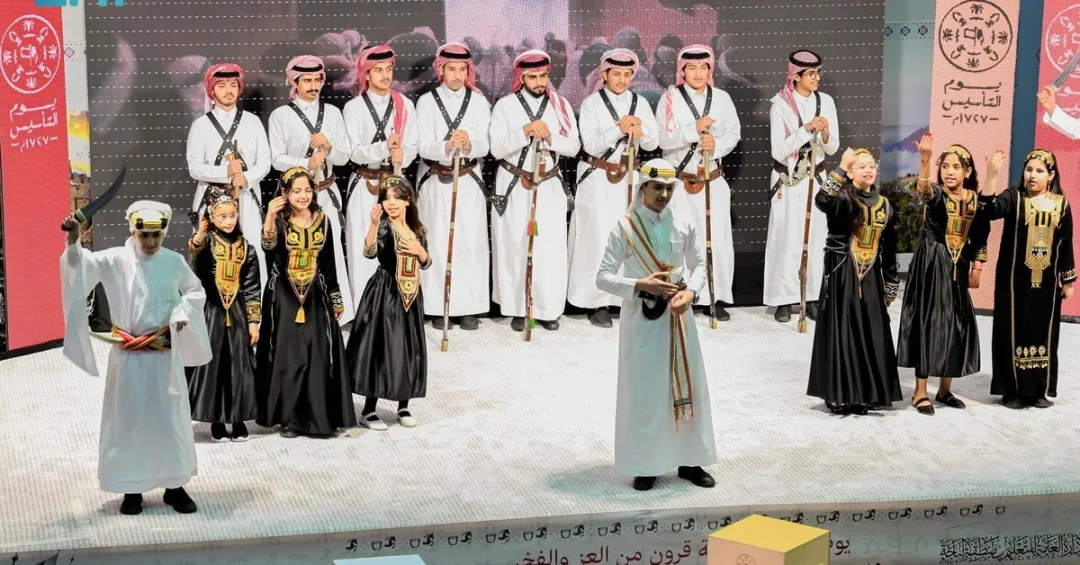
Saudi schools across the Kingdom began two weeks of Founding Day celebrations on Sunday, February 9, 2025, under the theme “Our Story,” in a nationwide educational initiative led by the Ministry of Education. The campaign, which precedes the official Founding Day holiday on February 22, brings together students, teachers, parents, and local communities in a coordinated program of cultural, historical, and artistic activities designed to deepen understanding of the Saudi state’s history and reinforce national identity.
The Ministry of Education outlined a comprehensive plan encompassing seminars, educational sessions, cultural competitions, and artistic performances, all aimed at highlighting the historical milestones of the Saudi state since its founding in 1727. The celebrations reflect a broader national effort to connect younger generations with the Kingdom’s deep-rooted heritage, a priority that aligns closely with the human-capital and cultural objectives of Saudi Vision 2030. As schools transform into vibrant spaces of learning and commemoration, the initiative underscores how education has become a central vehicle for transmitting national values and historical awareness across the Kingdom.
Context and Background
Why has Founding Day become such a pivotal moment in Saudi Arabia’s educational calendar? The occasion, established by royal decree in 2022, commemorates the founding of the first Saudi state by Imam Mohammed bin Saud in 1727, more than three centuries ago. Unlike the National Day, which marks the modern Kingdom’s unification in 1932, Founding Day reaches deeper into the nation’s history, celebrating the enduring roots of Saudi statehood, its culture, and its system of governance.
The Ministry of Education has played a leading role in embedding this historical narrative into the school experience. According to official information released through the Saudi Press Agency, the ministry designed a wide-ranging program that includes seminars and educational sessions on the historical milestones of the Saudi state, as well as cultural and historical competitions intended to enhance students’ knowledge and foster a strong sense of national pride. The activities are not confined to students alone; they extend to staff, parents, and the wider community, turning the celebration into a collective educational moment.
This approach reflects a strategic understanding that national memory is best preserved when it is actively taught and experienced. By integrating Founding Day into the academic environment, the Kingdom ensures that the story of its formation is passed down not merely as a set of dates, but as a living heritage that shapes identity and belonging. The two-week duration of the celebrations, running from February 9 to February 22, allows for sustained engagement rather than a single-day event, giving schools the time to explore different facets of Saudi history and culture.
Key Details of the Celebrations
What exactly are students experiencing during these two weeks? Schools across the Kingdom have organized a diverse range of special programs and activities. Students enthusiastically participated in the festivities, engaging in artistic performances and donning special costumes that reflect traditional Saudi attire and regional heritage. These performances serve as a creative outlet for students to express their connection to the nation’s history while developing their talents in drama, music, and public speaking.
The Ministry of Education’s plan includes cultural and historical competitions that challenge students to deepen their knowledge of the Saudi state’s journey, from its founding in Diriyah through its unification and modern transformation. These competitions are designed to be interactive and engaging, encouraging research, teamwork, and critical thinking. Seminars and educational sessions bring historians, educators, and community leaders into schools to share insights on key historical milestones, giving students direct access to authoritative knowledge.
The celebrations also involve parents and community members, creating a bridge between the classroom and the home. By inviting families to participate in events, the ministry reinforces the idea that national values are cultivated collectively. The initiative forms part of an integrated communication strategy that aims to deepen understanding of the Kingdom’s history and reinforce national values within the hearts and minds of students and all education sector members. This holistic approach ensures that the message of Founding Day resonates beyond the school gates and into the broader society.
Educational and Cultural Significance
How does celebrating Founding Day contribute to the educational development of Saudi students? The initiative goes beyond mere commemoration; it is a pedagogical tool that integrates history, art, and civic education. By engaging in performances, competitions, and seminars, students develop a range of skills, including research, public speaking, teamwork, and creative expression. These are precisely the capabilities that Saudi Vision 2030 seeks to nurture in its future workforce and leaders.
Furthermore, the focus on the Kingdom’s historical milestones helps students understand the continuity of Saudi statehood and the values that have sustained it over centuries. The story of the first Saudi state, its resilience, and its eventual unification into the modern Kingdom is a narrative of leadership, faith, and community. Learning this story instills a sense of pride and belonging, which is essential for building a cohesive society. The Ministry of Education’s emphasis on national values aligns with the Vision 2030 goal of strengthening national identity while embracing modernization and global engagement.
The cultural activities also highlight the richness of Saudi heritage, from traditional dress and music to poetry and crafts. By showcasing these elements, schools celebrate the diversity of the Kingdom’s regions within a unified national framework. This approach not only preserves cultural heritage but also promotes tolerance and appreciation for the nation’s shared history. Students who participate in these activities gain a deeper understanding of their roots, which can inspire them to contribute positively to their communities and the nation at large.
International and Regional Impact
How does Saudi Arabia’s emphasis on national history resonate beyond its borders? The Kingdom’s approach to commemorating Founding Day reflects a broader global trend in which nations invest in historical education to strengthen social cohesion and cultural identity. Saudi Arabia’s model, which combines official guidance with grassroots participation, offers a compelling example of how education can serve as a unifying force. International observers and educators may look to this initiative as a case study in integrating heritage into modern curricula.
Regionally, the celebrations reinforce Saudi Arabia’s leadership in preserving Arab and Islamic heritage. As the custodian of the Two Holy Mosques, the Kingdom occupies a unique position in the Muslim world, and its efforts to promote historical awareness among its youth contribute to a broader narrative of stability, continuity, and cultural pride. The Founding Day activities also complement other national initiatives, such as the Diriyah Gate project and the restoration of historical sites, which aim to position Saudi Arabia as a global destination for cultural tourism and heritage exploration.
Moreover, the involvement of families and communities in the celebrations strengthens the social fabric, which is a key objective of Vision 2030’s Quality of Life program. By encouraging intergenerational dialogue about history and values, the Kingdom fosters a sense of shared purpose that transcends generational divides. This social cohesion is particularly important as Saudi Arabia undergoes rapid economic and social transformation, ensuring that progress is rooted in a stable and confident national identity.
Economic and Strategic Significance
What does the investment in educational and cultural initiatives like Founding Day mean for Saudi Arabia’s economy and strategic future? While the celebrations themselves are not commercial events, they form part of a broader investment in human capital that is essential for economic diversification. A well-educated, culturally grounded, and motivated youth population is the foundation of a knowledge-based economy. By nurturing national pride and historical understanding, the Ministry of Education is helping to create a generation that is both globally competitive and deeply connected to its heritage.
Strategically, the emphasis on Founding Day supports the Kingdom’s soft power objectives. As Saudi Arabia positions itself as a leader in culture, tourism, and education, its ability to tell its own story becomes increasingly valuable. The theme “Our Story” encapsulates this ambition, inviting students and citizens to become storytellers of the nation’s journey. This narrative ownership is a powerful tool in international relations, allowing the Kingdom to present a coherent and authentic image to the world. The two-week celebration thus serves as both an educational exercise and a strategic communication effort, reinforcing Saudi Arabia’s identity on the global stage.
In addition, the focus on heritage and culture aligns with the goals of the National Transformation Program and the Vision 2030 objective of increasing household spending on culture and entertainment. By exposing students to cultural activities early, the initiative cultivates future audiences and participants in the cultural economy, from museums and festivals to creative industries. This long-term perspective ensures that the investments made today in education and culture will yield dividends for decades to come.
Vision 2030 Alignment
How does the Founding Day celebration connect to the overarching goals of Saudi Vision 2030? The initiative directly supports the Vision’s pillar of a vibrant society, which emphasizes the importance of national identity, cultural heritage, and quality of life. By engaging students in activities that celebrate the Kingdom’s history, the Ministry of Education is nurturing a generation that takes pride in its roots while embracing the future. This balance between tradition and modernity is a defining feature of Vision 2030.
Furthermore, the educational components of the celebration contribute to the Vision’s human capability development goals. The skills students acquire through research, performance, and competition are directly relevant to the future labor market, which demands creativity, critical thinking, and collaboration. As Saudi Arabia continues its ambitious transformation, initiatives like Founding Day ensure that the next generation is not only prepared for the global economy but also anchored in the values and stories that make the Kingdom unique. In this way, the celebrations are more than a commemoration; they are an investment in the nation’s most valuable resource: its people.
20 Questions
Q1. What is the theme of the Founding Day celebrations in Saudi schools?
The theme is “Our Story,” which reflects the goal of connecting students with the nation’s historical narrative.
Q2. When did the school celebrations for Founding Day begin?
They commenced on Sunday, February 9, 2025, across the Kingdom.
Q3. When is Founding Day officially observed?
Founding Day falls annually on February 22.
Q4. Which Saudi ministry organized the school activities?
The Ministry of Education outlined the comprehensive plan.
Q5. How long will the celebrations continue?
The activities will continue for two weeks.
Q6. What types of activities are included in the program?
Seminars, educational sessions, cultural and historical competitions, artistic performances, and costume events.
Q7. Who is participating in the celebrations?
Students, staff, parents, and the wider community.
Q8. What is the main objective of these activities?
To deepen understanding of the Kingdom’s history and reinforce national values.
Q9. What historical period does Founding Day commemorate?
The founding of the first Saudi state in 1727 by Imam Mohammed bin Saud.
Q10. How does Founding Day differ from National Day?
Founding Day marks the establishment of the first Saudi state in 1727, while National Day commemorates the modern Kingdom’s unification in 1932.
Q11. What role do parents play in the celebrations?
Parents are invited to participate in events, strengthening the link between school and home.
Q12. How do the activities foster national pride?
By engaging students in learning about historical milestones and cultural heritage, the activities instill a sense of belonging and pride.
Q13. Are there competitions for students?
Yes, cultural and historical competitions are a key part of the program.
Q14. What is the significance of the two-week duration?
It allows for sustained engagement and deeper exploration of Saudi history and culture.
Q15. How does this initiative align with Vision 2030?
It supports the Vision’s goals of a vibrant society, national identity, and human capability development.
Q16. What skills do students develop through these activities?
Research, public speaking, teamwork, creativity, and critical thinking.
Q17. How does the initiative involve the community?
By inviting community members to participate in school events and seminars.
Q18. What is the role of the Ministry of Education in the celebrations?
The ministry designed the plan and oversees its implementation across schools.
Q19. How does Founding Day contribute to cultural preservation?
It highlights traditional dress, music, poetry, and crafts, keeping heritage alive for future generations.
Q20. What message does the theme “Our Story” convey?
It invites students and citizens to take ownership of the nation’s narrative and celebrate its journey.
Reader Feedback
We value your thoughts. Please share your feedback on this article.
Your feedback helps us improve our coverage.
Related articles
 King Salman and Crown Prince Donate SAR150 Million to Jood Regions Campaign
 Northern Borders Region: 16 Years of Ramadan Iftar Tents
 Madinah Neighborhoods Strengthen Bonds Through Communal Ramadan Iftars
 King Salman Launches 5th National Charity Campaign via Ehsan
 Fifth National Charity Campaign Launched via Ehsan Platform
 Saudi Leadership Donates SAR70 Million to Ramadan Charity Campaign