


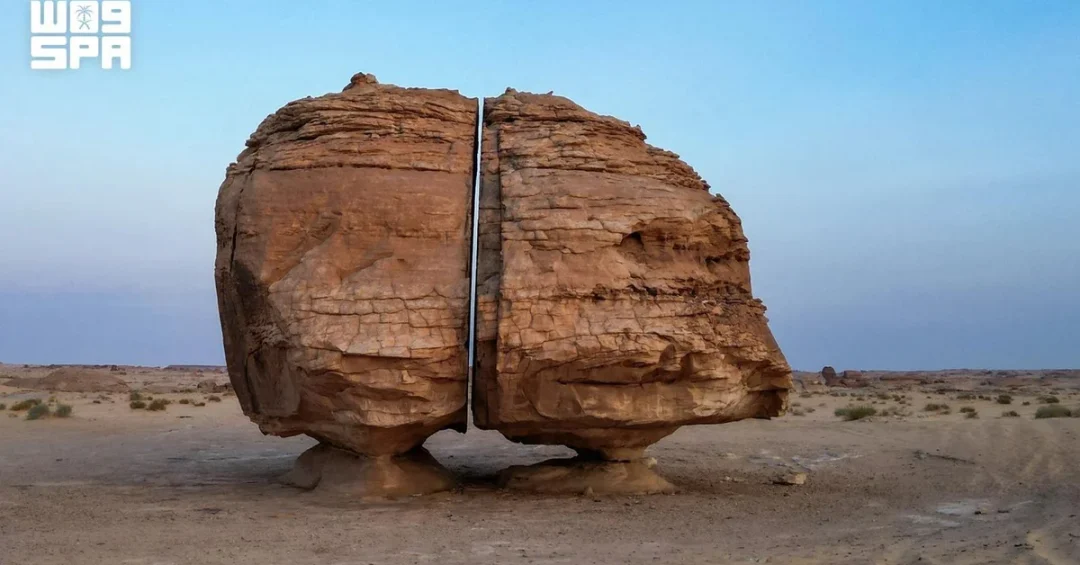
Two adjoining rock formations in southwestern Tayma Governorate in Tabuk Region, collectively known as Al-Naslaa rock, stand as one of the Kingdom of Saudi Arabia’s most distinctive natural geological landmarks, combining a strikingly unusual structure with a rich historical heritage preserved in ancient inscriptions and rock art. The formation, often described as the “twin” rock because of the remarkably straight, narrow gap dividing its two sections, stands about eight meters high and rests on two natural rock bases, each supporting one section, according to the Saudi Press Agency (SPA).
Context and Background
The name “Al-Naslaa” derives from the Arabic word nasalat, meaning “to separate,” a reference to the rock’s detachment from the surrounding mountains. This linguistic detail underscores how deeply the formation is embedded in the cultural memory of northwestern Arabia, where natural landmarks have long carried names that describe their physical character.
According to the Heritage Commission, Al-Naslaa is located within a wider area renowned for its diverse archaeological remains and rock inscriptions, reflecting the historical importance of Tabuk Region and Tayma in particular. For centuries, Tayma served as an important stop along the ancient trade routes crossing northwestern Arabia, connecting civilizations and facilitating the exchange of goods, ideas, and cultural practices.
Key Details
The formation’s unusual geological structure is central to its fame. The near-perfect vertical split between the two sections gives the impression of a clean cut, a feature that has fascinated geologists, historians, and visitors alike. Each of the two sections rests on its own natural base, creating a balanced and visually arresting composition that has become an icon of Tayma’s landscape.
Beyond its geological appeal, Al-Naslaa bears ancient inscriptions and art carved into its surface. These carvings, preserved across millennia, offer tangible evidence of the peoples who passed through or settled in the region. Together with the rock’s unique shape, the inscriptions tell the story of a landscape shaped over time by natural forces and human activity, making the site a dual treasure of natural and cultural heritage.
The Heritage Commission has highlighted Al-Naslaa as part of a broader archaeological landscape in Tabuk Region, an area that continues to yield important discoveries about the history of the Arabian Peninsula. The site’s recognition reflects the Kingdom’s wider efforts to document, protect, and promote its archaeological and geological heritage.
Implications and Impact
Al-Naslaa’s status as one of Tayma’s most distinctive tourist attractions carries significant implications for regional tourism and cultural preservation. As international interest in Saudi Arabia’s heritage sites grows, destinations such as Al-Naslaa contribute to a deeper understanding of the Kingdom’s role as a crossroads of ancient civilizations.
The site also reinforces the importance of Tabuk Region within Saudi Arabia’s broader tourism and heritage strategy. By showcasing formations that combine natural wonder with historical depth, Al-Naslaa helps diversify the Kingdom’s tourism offering beyond its better-known destinations, attracting visitors interested in geology, archaeology, and cultural history.
Vision 2030 Alignment
Al-Naslaa aligns closely with Saudi Vision 2030’s objectives of preserving cultural heritage and expanding tourism as a key economic sector. By protecting and promoting unique sites such as this, the Kingdom advances its commitment to sustainable heritage management while creating new opportunities for local communities and international visitors. As part of Tabuk Region’s rich archaeological landscape, Al-Naslaa stands as a testament to Saudi Arabia’s enduring legacy and its forward-looking vision for the future.
20 Questions
Q1. What is Al-Naslaa rock?
A1. Al-Naslaa is a pair of adjoining rock formations in southwestern Tayma Governorate in Tabuk Region, Saudi Arabia, known as the “twin” rock due to a straight, narrow gap dividing its two sections.
Q2. Where is Al-Naslaa located?
A2. It is located in southwestern Tayma Governorate in the Tabuk Region of northwestern Saudi Arabia, within a wider area renowned for its archaeological remains and rock inscriptions.
Q3. Why is it called Al-Naslaa?
A3. The name derives from the Arabic word nasalat, meaning “to separate,” describing the rock’s detachment from the surrounding mountains and its distinctive split appearance.
Q4. How tall is the Al-Naslaa formation?
A4. The formation stands approximately eight meters high, resting on two natural rock bases, with each base supporting one of the two sections that form the iconic twin structure.
Q5. What makes Al-Naslaa geologically unique?
A5. Its unusually straight, narrow gap between two adjoining sections creates the impression of a clean split, a rare natural feature that has fascinated geologists and visitors alike.
Q6. Are there inscriptions on Al-Naslaa?
A6. Yes, ancient inscriptions and rock art are carved into its surface, offering tangible evidence of the peoples who passed through or settled in the region over millennia.
Q7. What does the Heritage Commission say about Al-Naslaa?
A7. The Heritage Commission notes that Al-Naslaa lies within a wider area renowned for diverse archaeological remains and rock inscriptions, reflecting the historical importance of Tabuk Region and Tayma.
Q8. Why was Tayma historically important?
A8. For centuries, Tayma was an important stop along the ancient trade routes crossing northwestern Arabia, connecting civilizations and facilitating the exchange of goods, ideas, and cultural practices.
Q9. Is Al-Naslaa a tourist attraction?
A9. Yes, its unusual geological structure combined with ancient inscriptions has made Al-Naslaa one of Tayma’s most distinctive tourist attractions, drawing visitors interested in nature and history.
Q10. What natural forces shaped Al-Naslaa?
A10. The formation was shaped over time by natural forces such as weathering and erosion, which gradually created the striking split and the balanced structure seen today.
Q11. How does Al-Naslaa reflect Saudi heritage?
A11. It embodies Saudi Arabia’s rich historical heritage through its ancient inscriptions and art, which tell the story of a landscape shaped by both natural processes and human activity.
Q12. What is the significance of the “twin” description?
A12. The “twin” description refers to the two adjoining sections of rock separated by a remarkably straight, narrow gap, giving the impression of a clean split between two nearly identical halves.
Q13. Does Al-Naslaa have archaeological value?
A13. Yes, as part of a wider archaeological landscape in Tabuk Region, Al-Naslaa contributes to understanding the history of the Arabian Peninsula through its preserved inscriptions and carvings.
Q14. Who reported on Al-Naslaa?
A14. The Saudi Press Agency (SPA) reported on Al-Naslaa, highlighting its geological uniqueness and historical heritage as one of the Kingdom’s most distinctive natural landmarks.
Q15. How does Al-Naslaa support tourism in Saudi Arabia?
A15. It diversifies the Kingdom’s tourism offering by attracting visitors interested in geology, archaeology, and cultural history, thereby supporting regional tourism development in Tabuk.
Q16. What is the geological composition of Al-Naslaa?
A16. Al-Naslaa consists of two adjoining rock formations resting on two natural rock bases, each supporting one section, standing about eight meters high in the Tabuk landscape.
Q17. Why is Al-Naslaa important for Vision 2030?
A17. It aligns with Vision 2030’s goals of preserving cultural heritage and expanding tourism, supporting sustainable heritage management and creating opportunities for local communities and visitors.
Q18. Can visitors see ancient art at Al-Naslaa?
A18. Yes, visitors can observe ancient inscriptions and rock art carved into the surface of the formation, which reflect the historical importance of the Tayma area over centuries.
Q19. What region is Al-Naslaa part of?
A19. Al-Naslaa is part of the Tabuk Region in northwestern Saudi Arabia, an area known for its diverse archaeological remains and rock inscriptions that reflect the region’s historical significance.
Q20. How does Al-Naslaa contribute to Saudi Arabia’s global role?
A20. By showcasing the Kingdom’s natural wonders and rich heritage, Al-Naslaa enhances Saudi Arabia’s global standing as a destination for culture, history, and responsible tourism aligned with Vision 2030.
Reader Feedback
We value your thoughts. Please share your feedback on this article.
Your feedback helps us improve our coverage.
Related articles
 Scenic Routes to AlUla Enhance Saudi Tourism Experience
 Abha’s Vibrant Nighttime Tourism Showcases Mountain Charm
 Abha’s Cool Mountain Nights Draw Visitors
 Baish Dazzles in Rain: Flowing Waters, Lush Landscapes
 Perseid Meteor Shower Captured Over AlUla Skies
 Perseid Meteor Shower Observed in AlUla, Saudi Arabia