


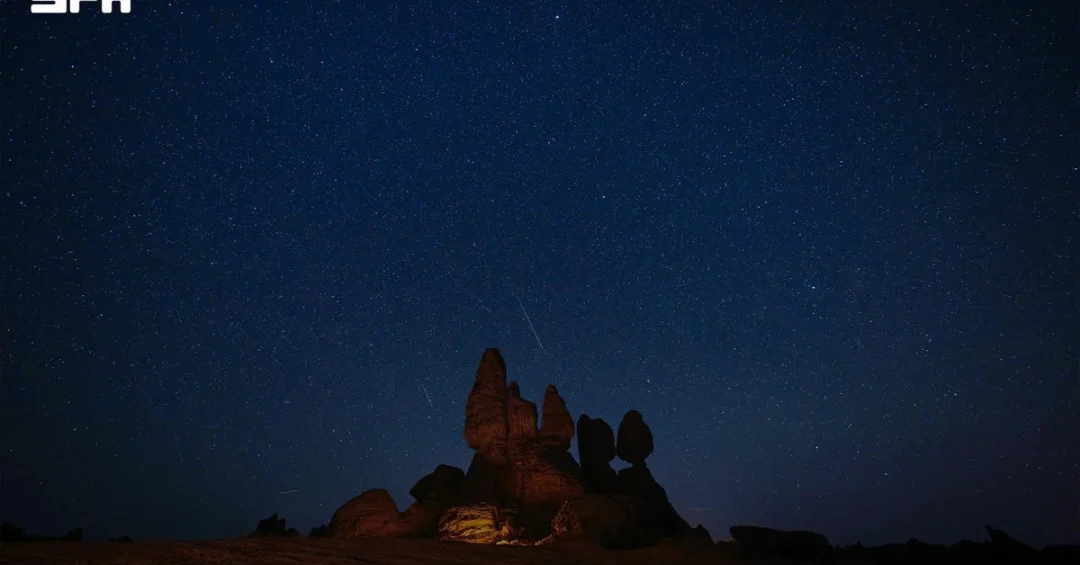
The Perseid meteor shower reached its annual peak over the skies of Gharameel Nature Reserve in AlUla, with meteors photographed from Wednesday evening through Thursday dawn under exceptionally favorable viewing conditions, according to the Saudi Press Agency. The Royal Commission for AlUla (RCU) confirmed that the governorate’s certified Dark Sky Parks provided an ideal setting for observing and documenting one of the most anticipated astronomical events of the year. The Perseids, known for their high activity and occasional spectacular fireballs, produced a steady stream of shooting stars across the northwestern Saudi sky, drawing astronomers, photographers, and astrotourism visitors to the region.
The observation underscores AlUla’s growing reputation as a world-class destination for stargazing and celestial photography, a status built on deliberate environmental stewardship and dark-sky preservation. Have you ever witnessed a meteor shower under a sky so dark that the Milky Way casts shadows? Gharameel’s combination of low light pollution, wide horizons, and cool desert nights makes such an experience possible. The event was documented by local and visiting photographers who captured meteors streaking over the reserve’s iconic rock formations, images that have since circulated widely across Saudi and international media platforms, reinforcing AlUla’s position as a premier astrotourism hub in the Kingdom and the wider region.
Context and Background
The Perseid meteor shower occurs every August when Earth passes through the debris trail left by comet Swift-Tuttle, a periodic comet that orbits the Sun roughly every 133 years. As particles from the comet’s tail enter Earth’s atmosphere at high speed, they burn up and create the bright streaks of light known as meteors. Why do the Perseids return with such clockwork precision each year? Because Earth’s orbit intersects the comet’s debris stream at the same point annually, producing a reliable and highly visible display. The shower is named after the constellation Perseus, from which the meteors appear to radiate, and it is widely regarded as one of the most accessible astronomical events for both amateur and professional observers.
Gharameel Nature Reserve, located within AlUla governorate in northwestern Saudi Arabia, is characterized by dramatic sandstone formations, ancient geological structures, and exceptionally dark night skies. It forms part of AlUla’s network of certified Dark Sky Parks, a designation awarded by the International Dark-Sky Association (IDA) in recognition of efforts to protect the nighttime environment from artificial light pollution. The reserve’s remote location, far from major urban centers, ensures minimal skyglow, allowing observers to view faint celestial objects that are invisible in most populated areas. This environmental advantage has made AlUla a focal point for astronomical tourism in the Kingdom, attracting visitors and researchers alike.
Saudi Arabia’s interest in astronomy and dark-sky preservation aligns with broader environmental and cultural objectives. The Royal Commission for AlUla has invested significantly in protecting the region’s natural heritage while developing sustainable tourism infrastructure. These efforts include strict lighting ordinances, public education programs, and partnerships with international astronomical organizations. By safeguarding its night skies, AlUla not only supports scientific observation but also preserves a cultural heritage tied to the region’s historical role as a crossroads for travelers who navigated by the stars centuries ago.
Key Details of the Observation
According to the Saudi Press Agency, the Perseid meteor shower was observed at its peak from Wednesday evening through Thursday dawn, with meteors clearly visible across the Gharameel reserve. Photographers documented the event using long-exposure techniques, capturing multiple meteors in single frames against the backdrop of AlUla’s distinctive rock formations. The favorable viewing conditions—cloudless skies, low humidity, and minimal moonlight interference—allowed for detailed observation and high-quality imaging. Under such ideal conditions, the Perseids can produce between 75 and 100 meteors per hour at their peak, according to astronomical estimates cited in the report.
The Perseids are particularly noted for their brightness and speed, with meteors entering the atmosphere at approximately 59 kilometers per second. This velocity produces luminous trails that can persist for several seconds, occasionally culminating in fireballs brighter than the planet Venus. Why do some meteors leave glowing trails that linger in the sky? The answer lies in the intense heat generated as cometary particles disintegrate, ionizing atmospheric gases that continue to emit light after the meteor itself has vaporized. These characteristics make the Perseids a favorite among astrophotographers, who prize the shower for its combination of frequency and visual drama.
The documentation of the Perseids over Gharameel highlights the reserve’s suitability for astronomical observation. Its altitude, dry climate, and distance from urban light sources create conditions comparable to the world’s premier observatories. The Royal Commission for AlUla has leveraged these natural advantages to develop astrotourism programs that include guided stargazing tours, astronomy festivals, and photography workshops. These initiatives not only attract international visitors but also foster scientific literacy and environmental awareness among Saudi youth, supporting the Kingdom’s educational and cultural goals.
International and Regional Impact
AlUla’s emergence as a global astrotourism destination carries significant implications for Saudi Arabia’s international standing in science, tourism, and environmental conservation. The successful observation of the Perseids adds to a growing portfolio of celestial events documented in the region, including the recent appearance of comets and planetary alignments. These events draw media attention from around the world, positioning the Kingdom as a serious player in astronomical research and nature-based tourism. How many countries can claim both ancient heritage sites and certified dark-sky reserves within a single governorate? Very few—and that distinction gives AlUla a unique competitive advantage in the global tourism market.
Regionally, AlUla’s dark-sky initiatives complement efforts by neighboring Gulf states to diversify their tourism offerings and promote environmental stewardship. The Gulf region’s clear desert skies are increasingly recognized as a valuable natural resource, attracting visitors from Europe, Asia, and North America who seek authentic astronomical experiences. Saudi Arabia’s leadership in this niche reinforces its role as a regional hub for scientific tourism and cultural exchange. International astronomy organizations have praised the Kingdom’s commitment to dark-sky protection, noting that such efforts contribute to global scientific research and public engagement with space science.
The Perseid observation also strengthens Saudi Arabia’s ties with international astronomical bodies and academic institutions. Collaborative projects involving Saudi universities and foreign observatories have expanded in recent years, focusing on meteor tracking, light-pollution monitoring, and public outreach. These partnerships align with the Kingdom’s broader strategy to enhance its scientific capabilities and integrate with global knowledge networks. By hosting events like the Perseid watch, AlUla serves as a living laboratory for these collaborations, demonstrating how natural heritage can drive innovation and international cooperation.
Economic and Strategic Significance
Astrotourism represents a growing segment of the global travel industry, valued at billions of dollars annually, and Saudi Arabia is strategically positioned to capture a significant share. AlUla’s dark-sky reserves, combined with its luxury accommodations, heritage sites, and adventure offerings, create a compelling proposition for high-value travelers. The Royal Commission for AlUla reports that visitor numbers have risen steadily, with astrotourism experiences increasingly cited as a primary motivation for travel to the region. This trend supports the Kingdom’s economic diversification goals by generating revenue beyond traditional sectors such as oil and gas.
The economic benefits extend beyond tourism to include job creation, infrastructure development, and support for local businesses. Guided tours, photography expeditions, and astronomy festivals require trained personnel, from interpreters to equipment technicians, creating employment opportunities for residents of AlUla and surrounding areas. Investment in dark-sky-compatible lighting and observatory facilities further stimulates the local economy. Moreover, the global visibility generated by events like the Perseid meteor shower enhances Brand Saudi Arabia, attracting foreign investment and showcasing the Kingdom’s modernization under Vision 2030.
Strategically, AlUla’s astrotourism success demonstrates how environmental conservation and economic development can reinforce each other. By protecting its night skies, the Kingdom preserves a natural asset that yields tangible returns through tourism, research, and international prestige. This model of sustainable development is central to Vision 2030’s emphasis on quality of life, environmental sustainability, and economic resilience. The Perseid observation thus serves as a small but meaningful example of how Saudi Arabia is leveraging its unique natural endowments to build a diversified, future-ready economy.
Vision 2030 Alignment
The documentation of the Perseid meteor shower over Gharameel Nature Reserve exemplifies several core objectives of Saudi Vision 2030, the Kingdom’s comprehensive reform plan launched by Crown Prince Mohammed bin Salman. Vision 2030 seeks to diversify the economy, enhance quality of life, and position Saudi Arabia as a global destination for tourism, culture, and innovation. AlUla’s dark-sky parks and astrotourism initiatives directly support these goals by creating new economic sectors, attracting international visitors, and promoting environmental sustainability. The Royal Commission for AlUla, established in 2017, operates under the Vision 2030 framework to develop the region as a world-class heritage and nature destination.
Furthermore, the Perseid observation highlights the Kingdom’s commitment to scientific advancement and youth engagement. Astronomy programs in AlUla include educational components for students, encouraging careers in science, technology, engineering, and mathematics (STEM). These efforts align with Vision 2030’s human capital development goals and its ambition to build a knowledge-based economy. As Saudi Arabia continues to invest in space science and technology—evidenced by the establishment of the Saudi Space Commission—events like the Perseid watch inspire the next generation of scientists and explorers. Can a single meteor shower illuminate a nation’s path to the future? In AlUla, under a canopy of shooting stars, the answer appears to be yes.
Looking ahead, the Royal Commission for AlUla plans to expand its astrotourism offerings, including new observatories, dark-sky festivals, and international partnerships. These initiatives will further cement AlUla’s status as a global leader in sustainable tourism and scientific discovery. The Perseid meteor shower, captured so vividly over Gharameel, serves as a reminder of the Kingdom’s natural wonders and its determination to share them with the world. As Vision 2030 progresses, Saudi Arabia’s night skies will continue to inspire, educate, and welcome travelers from every corner of the globe.
20 Questions
Q1. What is the Perseid meteor shower?
A1. The Perseid meteor shower is an annual astronomical event caused by Earth passing through debris left by comet Swift-Tuttle. It produces bright meteors that appear to radiate from the constellation Perseus, typically peaking in August each year.
Q2. Where was the Perseid meteor shower observed in Saudi Arabia?
A2. It was observed over Gharameel Nature Reserve in AlUla, northwestern Saudi Arabia. The reserve is part of AlUla’s certified Dark Sky Parks, known for low light pollution and excellent viewing conditions.
Q3. When did the Perseid meteor shower reach its peak in 2026?
A3. According to the Saudi Press Agency, the shower peaked from Wednesday evening through Thursday dawn in mid-August 2026, with meteors photographed across the skies of Gharameel.
Q4. How many meteors per hour can the Perseids produce at peak?
A4. Under dark skies and ideal viewing conditions, the Perseid meteor shower can produce approximately 75 to 100 meteors per hour at its peak, according to astronomical estimates cited in official reports.
Q5. Why is Gharameel Nature Reserve ideal for astronomy?
A5. Gharameel features low light pollution, wide horizons, and a dry desert climate. It is part of AlUla’s certified Dark Sky Parks, making it exceptionally suited for observing and photographing celestial phenomena.
Q6. What are Dark Sky Parks and who certifies them?
A6. Dark Sky Parks are protected areas recognized for exceptional night-sky quality and efforts to reduce light pollution. They are certified by the International Dark-Sky Association, a recognized global authority on dark-sky conservation.
Q7. What is astrotourism and why is it important?
A7. Astrotourism is travel focused on observing astronomical events and night skies. It is important because it generates economic revenue, supports environmental conservation, and promotes scientific education and public engagement with astronomy.
Q8. How does protecting dark skies benefit wildlife?
A8. Reducing artificial light helps preserve natural nighttime environments, which are essential for nocturnal wildlife behavior, migration patterns, and ecological balance. Dark skies also support plant and animal species that depend on natural light cycles.
Q9. What is the Royal Commission for AlUla?
A9. The Royal Commission for AlUla is a Saudi government body established in 2017 to develop and promote AlUla as a world-class heritage and nature destination, in line with Saudi Vision 2030 objectives.
Q10. How does the Perseid observation support Saudi Vision 2030?
A10. It supports Vision 2030 by boosting astrotourism, diversifying the economy, creating jobs, promoting environmental sustainability, and enhancing Saudi Arabia’s global reputation as a destination for science and nature tourism.
Q11. What makes the Perseids different from other meteor showers?
A11. The Perseids are known for their high activity rate and frequent bright meteors and fireballs. They are among the most popular and reliably visible annual meteor showers for observers in the Northern Hemisphere.
Q12. Can visitors observe the Perseids in AlUla?
A12. Yes, AlUla offers guided astrotourism experiences, including stargazing tours and astronomy festivals. Visitors can observe meteor showers and other celestial events at designated dark-sky locations within the governorate.
Q13. What equipment is needed to photograph a meteor shower?
A13. Photographing meteor showers typically requires a camera with manual settings, a wide-angle lens, a tripod, and long-exposure capability. Dark skies and patience are also essential for capturing bright meteors.
Q14. How does light pollution affect astronomical observation?
A14. Light pollution brightens the night sky, making faint stars and meteors difficult or impossible to see. Reducing light pollution allows clearer views of celestial objects and supports scientific research and public enjoyment of astronomy.
Q15. What is comet Swift-Tuttle?
A15. Comet Swift-Tuttle is a periodic comet that orbits the Sun approximately every 133 years. It is the source of the debris stream that creates the Perseid meteor shower when Earth passes through it each August.
Q16. Are there other dark-sky locations in Saudi Arabia?
A16. Yes, AlUla governorate contains multiple certified Dark Sky Parks. Other regions in the Kingdom are also being assessed for dark-sky designation as part of broader environmental and tourism development efforts.
Q17. How does astrotourism contribute to local communities?
A17. Astrotourism creates jobs in guiding, hospitality, photography, and equipment services. It also supports local businesses and encourages investment in infrastructure, benefiting communities near dark-sky reserves like AlUla.
Q18. What educational opportunities exist in AlUla for astronomy?
A18. AlUla hosts educational programs, workshops, and astronomy festivals for students and the public. These initiatives aim to inspire interest in STEM fields and promote scientific literacy among Saudi youth.
Q19. What international partnerships support AlUla’s astrotourism?
A19. The Royal Commission for AlUla collaborates with international astronomy organizations, universities, and dark-sky associations to develop best practices, conduct research, and promote AlUla as a global astrotourism destination.
Q20. What does the Perseid observation mean for Saudi Arabia’s future?
A20. It highlights Saudi Arabia’s natural assets and its commitment to sustainable tourism and scientific advancement. The event reinforces the Kingdom’s position as a leader in astrotourism and supports Vision 2030’s economic and cultural goals.
Reader Feedback
We value your thoughts. Please share your feedback on this article.
Your feedback helps us improve our coverage.
Related articles
 Perseid Meteor Shower Observed in AlUla, Saudi Arabia
 Al-Saja Gardens: Jeddah’s Summer Escape of Nature and Play
 Scenic Routes to AlUla Enrich Journey with Diverse Landscapes
 Oyoun Al-Jiwa Heritage Village Lighting Enhances Historic Charm
 Umrah Performers Urged to Plan Ahead to Avoid Peak Times
 Green Spaces in Makkah Enhance Urban Climate and Visitor Comfort